
Odoru Daisousasen; or, To Protect and Serve
In order to serve justice, you need to be superior.
I admit it, this was bound to happen. Even though I am more
into movies than TV shows, I occasionally feel the need to check out some
Japanese or Korean drama. Thus, I picked up Odoru Daisousasen, hoping it will
be something with Police Academy-feel to it. Well, nothing could be further
from the truth. The very first episode sucked me in so badly that I
binge-watched all 11 episodes. I could not believe what was happening. Why is
this show so awesome that I can’t stop watching it!? Well, let’s find out more
about the phenomenon of Bayside Shakedown franchise.
Release Info
Developed by: Ryoichi Kimizuka Starring: Yuji Oda, Eri Fukatsu, Toshiro Yanagiba, Yusuke Santamaria
Language: Japanese Original Title: 踊る大捜査線 No. of eps.: 12 (+4 SPs)

Synopsis
A young up-and-coming police officer Shunsaku Aoshima (Yuji
Oda) finally becomes a detective and is assigned to the fictional Wangan Police
Station of the Tokyo Metropolitan Police Department. Aoshima quickly realises
that his new job is not about spectacular shootouts, car chases, and explosions.
Instead, police work is more like “office politics with bureaucratic red tape,
lethargic civil servants, bosses more interested in playing golf and saving
face than solving crime” (source). Nevertheless, a new detective soon finds
motivation and excitement as he makes friends with fellow WPS officers and
cracks a series of big (and small) cases throughout the series.

Odoru Daisousasen is not just a typical soap opera
tearjerker, but rather, a well made mixture of police drama and comedy. There
are serious bits as well as lots of moments where utter hilarity ensues. The
show is filled with likeable characters, awesome soundtrack, provocative
stories, and intriguing subplots. It’s no wonder that it became such a massive hit
in Japan. Bayside Shakedown’s success spanned a series of TV specials,
theatrical movies, spin-offs, and even a stage-play...
Now a few words about the characters:

Sergeant Aoshima Shunsaku (Yuji Oda): The main hero of the
show (with the same name as the Governor of Tokyo). He is an outgoing extrovert
with a dynamic personality. In addition, he has an infallible moral compass, so
usually emotions get the better of him. He always wears a used up coat when
going to a crime scene.
Superintendent Muroi Shinji (Toshiro Yanagiba): Constantly-frowning top man of HQ’s investigative division. When he steps into action,
sh*t gets real. He often crosses paths with Aoshima and the young detective gradually
changes his perspective on how the police should work. Initially being a cold
and emotionless bureaucrat, he eventually shows his compassionate side.
Sergeant Onda Sumire (Eri Fukatsu): An independent woman
with a strong affinity for consuming food. She sympathises with victims of male
abuse as she herself had a similar experience in the past. Frequently deals
with burglary cases.
Kashiwagi Yukino (Miki Mizuno): A traumatised witness of her
father’s death. After being ruthlessly interrogated by Muroi, she regains
health thanks to Aoshima’s compassion. When HQ accuses her of being part of a drug-smuggling
ring, Aoshima clears her of suspicion. Grateful to Wangan detectives, she
decides to join the police force.
Senior Inspector Waku Heihachiro (Chosuke Ikariya): The
eldest detective in the section and a mentor figure to Aoshima. Waku can’t
close the case of his partner’s murder as he is unable to find the murderer.
Assistant Inspector Mashita Masayoshi (Yusuke Santamaria): A
bit cowardly but extremely likable youngster. He is in the so-called “career
group” as he constantly studies for exams to become an inspector. His father is a
high-rank official, thus WPS chiefs are always sympathetic to him. Hopelessly
in love with Yukino.
Division Chief Uozumi Jiro (Kenta Satoi): A well-mannered
detective who secretly dreads Mashita’s development up the career ladder. He
frequently mentions his wife, Angela, who is Finnish. She makes an unexpected
appearance in the Year-End Special Alert TV movie.
Chief Kanda (Soichiro Kitamura), Assistant Chief Akiyama
(Satoru Saito), Section Chief Hakamada (Takehiko Ono): The “Three Amigos” of
the Wangan Station. These stooges care more about sucking up to HQ officials
than doing the real job. Together, they seek solutions to the most ridiculous
problems (like proper naming of the investigative groups, choosing the best-looking
secretaries, or embezzling public funds without getting caught).

With regard to the show itself, below are short descriptions
and my thoughts on the individual episodes:
Ep. 1: Detective Salaryman's First Difficult Case- A great
introduction to the series. We start the work along with Aoshima and discover
all the peculiarities of the Wangan Station. Of course, there is also a murder
case (which Aoshima is not allowed to investigate). As a result, the conflict
between police headquarters and jurisdictional officers is drawn up. Superintendent
Muroi Shinji is the personification of bureaucracy and heartlessness as he questions
a traumatised witness, Kashiwagi Yukino. Aoshima, in contrast, shows compassion
for the witness and resolves not to become like Muroi.

Ep. 2: An Express Package of Love and Revenge- In my
opinion, the most hilarious episode of the series. Aoshima is targeted by an
insurance agent, Sumire for some reason does not want to be alone on Tuesday
nights, and Waku receives a relaxing chair with a grenade underneath it.
Basically, the toilet situation from Lethal Weapon 2 (1989) perfected.

Ep. 3: Erased Written Evidence and a Female Incident- A typical
story of a spoiled brat who got off easy because of his daddy has connections.
Yet, it’s never easy with Sumire and Aoshima as they teach a purse-snatcher a
lesson. Nice Sumire-centered story.

Ep. 4: A Woman's Tears and Detective's Pride- Aoshima’s
first chance to become HQ investigator as Muroi orders him to follow a
certain criminal. However, things get out of hand and Aoshima learns that big
and small cases should be equal for detectives. Aoshima nearly quits the job,
but WPS colleagues refuel his faith. A wonderful development of Aoshima/Muroi
relation.

Ep. 5: Her Scream Cannot Be Heard- This episode literally
scared the hell out of me. I’m not joking. Sumire’s fear of Tuesday nights is
finally revealed and it turns out to be a stalker! Sumire is attacked and
injured; as a result, WPS officers take matters into their hands to hunt down
the creep. Yet, Aoshima comes up with a dangerous plan to arrest the stalker.
Awesome Sumire-centered story with an epic finale.

Ep. 6: Stake-out... Her Love and the Truth- First episode of
a two-part story revolving around Yukino. Aoshima and Waku go on a stake-out
(very much like Richard Dreyfuss and Emilio Estevez) and observe the apartment
of a drug smuggler. Surprisingly, Yukino turns out to have just moved there.
Aoshima, convinced of her innocence, opposes HQ’s accusations against her. In
order to save Yukino, he arrests her at WPS; in consequence, buying himself 48
hours to prove her innocence.

Ep. 7: Time limit, 48 Hours- Continuation of the previous
story, more engaging this time. As Yukino remains safe at the station, Aoshima
and Waku go at lengths to find the drug dealer from Los Angeles. In order to do
this, Aoshima uses his tricks and charm of a salaryman, which is quite hilarious.
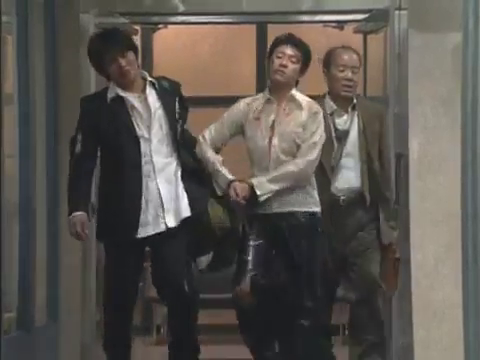
Ep. 8: Goodbye Beloved Detective- Dark times have come for
jurisdictional detectives as profiling team of university students takes over
murder investigation. Muroi is visibly displeased with the students' arrogance,
whereas Waku takes a leave of absence. The story ends with a bitter conclusion
that technology outweighs detective skill.

Ep. 9: Wangan Station's Great Panic and Detective Aoshima's
Critical Moment- Aoshima and Sumire are ordered by the Section Chief to guard
the lover of a man who murdered his wife. The situation is quite complicated and
outrageous, especially as the lover does not see her fault in the crime. In the
midst of the station’s chaos, a mysterious man comes face to face with the lover.
Nice story with an action-packed ending.

Ep. 10: Evil Bullet: The Detective's Tears That Disappeared
in the Rain- First part of the final story. Waku is soon retiring, but he did
not close the 6-year-old case of his partner’s murder. The suspect has fled the
country, but a casino owner provides Aoshima with a tip. Meanwhile, Mashita
ineptly courts Yukino who has just passed her police academy entrance exams.
All of a sudden, Mashita tries to calm down an angry bystander, but the man
stabs him in the middle of a street...

Ep. 11: Final Episode- As Mashita is fighting for his life
in hospital, WPS officers draw their guns and proceed to search for the
assaulter. It turns out to be the very same man who killed Waku’s partner six
years earlier. As HQ is unwilling to take immediate action, Aoshima and Muroi
join forces to apprehend the criminal. This episode is all about Aoshima and
Muroi and how much they have in common. At the end of the day, the criminal is
arrested, but Muroi is reprimanded and Aoshima demoted. Still, the two make a
promise to each other which provides the seed for the continuation.

In addition, it has to be mentioned that there was also episode No.
12 (The case of the brutal strangulation homicide of the company director), which was basically a short compilation of outtakes and bloopers from the
show, with the actors losing it each time they made a mistake.
To sum up, if you like police drama that does not treat itself too seriously, then Odoru Daisousasen is the perfect choice for you. In addition, if you are new to Japanese drama and don’t know where to start, then the show is also good for starters as it primarily focuses on cops, action, tears, and laughs all at once. It simply has everything one could wish for from a decent police procedural. In other words: extremely entertaining, gripping, and best of the best.
To sum up, if you like police drama that does not treat itself too seriously, then Odoru Daisousasen is the perfect choice for you. In addition, if you are new to Japanese drama and don’t know where to start, then the show is also good for starters as it primarily focuses on cops, action, tears, and laughs all at once. It simply has everything one could wish for from a decent police procedural. In other words: extremely entertaining, gripping, and best of the best.

Overall score: 10/10


