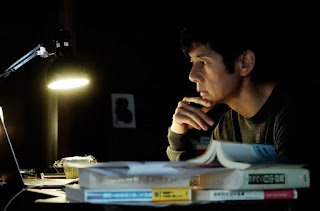
Showing posts with label adaptation. Show all posts

Drive My Car (2021) [Film Review]

Drive My Car; or, Depression: The Movie
     I like that car. I can tell it’s been treated with care. That’s why I also want to drive it with care. Let’s go.
I heard about Drive My Car movie for the first time when it started gaining awards at the Cannes Film Festival. It would have almost joined the line of “stuff I wanted to check out but forgot about it” had it not been for a summer movie festival in my country. I was lucky enough to check out the film, but it left me with mixed feelings. Consequently, I hesitated for a long time with this review, but well, here it is.
Release Info
Directed by: Ryusuke Hamaguchi Starring: Hidetoshi Nishijima, Toko Miura, Masaki Okada, Reika Kirishima
Language: Japanese Original Title: ドライブ・マイ・カー Runtime: 179 min
Synopsis
Yusuke Kafuku (Hidetoshi Nishijima) is a stage-actor who collaborates closely with his wife Oto (Reika Kirishima). One day, by complete accident, Yusaka discovers that Oto is cheating on him. He never confronts his wife about it, but the marital status quo is disrupted by her untimely passing. Two years later, Yusuke goes to Hiroshima in order to direct a multilingual adaptation of Chekhov’s play Uncle Vanya. However, the producers’ regulations prevent Yusuke from driving on his own. He gets assigned a special chauffeur called Misaki Watari (Toko Miura). While driving his car, Misaki learns about Yusuke’s ambiguous past.
A man without a woman
I have to be frank and say that my expectations for this film were enormous. Drive My Car gets praised time and time again across film festivals, it is an adaptation of Haruki Murakami’s short story, and on top of that the director of the film is Ryusuke Hamaguchi, the man who co-wrote Wife of a Spy (2020).
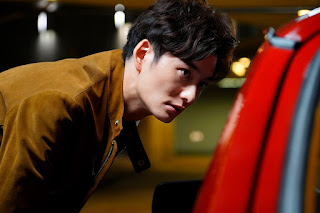
I have re-read the original short story before the screening, and the movie follows and greatly expands upon major plot points of Murakami’s work. I was all game during the prologue sequence, but when the opening credits hit at about the 40-minute mark, the storyline started going a bit downhill for me.
Please do not get me wrong, but I felt the prologue was meant to prepare the viewers for a massive catharsis, a grand journey in the course of which Yusuke will rediscover himself. Truth be told, I found the protagonist’s actions to be questionable. He goes to Hiroshima to do this super unconventional theatre play (which in itself adds tons of layers to the film’s storyline), but he hires an actor who slept with his wife (Masaki Okada). What was his motivation? To torment the guy? At least, that’s what Yusuke says in the short story, but it does not become transparent enough in the movie. Actually, Yusuke behaves like a depressed individual who enjoys being tormented by his wife’s lover.
Evidently, there is a big reconciliation scene between the two characters in the third act of the film, but this moment only made me realise how hard it is to adapt Murakami. The author frequently introduces exposition through conversation. In many of his short stories and even novels, we have two characters talking to each other, and in the course of this seemingly casual talk, the readers get to discover some major twist or a whole story. Hamaguchi’s Drive My Car lays out everything chronologically from beginning to the end, leaving little room for this Murakami-specific trope only towards the end of the film. Call me cruel, but I would have appreciated the movie more had the driving scenes looked more like this.
Well, this movie did not click with me, unfortunately. Nevertheless, I have to give justice to the cast and praise nuanced but powerful performances of Hidetoshi Nishijima, Toko Miura, and Masaki Okada. In addition, I have huge respect for production design and the titular car itself, which indeed felt like a separate character.
Recommendations
Out of all Murakami adaptations I have seen so far, I still like Burning (2018) best. Drive My Car deserves your attention in terms of how neatly it manages to handle performance art (a stage play, which makes the characters confront each other). All in all, it’s a film about lost love and an attempt to drive away from traumas of the past. I understand the growing popularity of this adaptation, but it is not a movie for everybody. It certainly was not for me.
Overall score: 6/10 
«Enjoyed this post? Never miss out on future posts by following us»

Mulan (2020) [Film Review]

Mulan; or, A Love Letter to the PRC
Your Chi is strong, Mulan. The Chi is for warriors, not daughters. Soon you will be a young woman and it is time for you to hide your gift away.
The second week of September, 2020 is the Mulan week! After months of postponing the release due to the outbreak, the live-action adaptation of a legend about everybody’s favorite princess finally saw the light of day on Disney+. In spite of mixed opinions and the drama war concerning fake reviews on Rotten Tomatoes, I was very much hopeful about Mulan, and I checked it out with an open heart… Well, the movie turned out to be painfully mediocre.
Release Info
Directed by: Niki Caro Starring: Liu Yifei, Yoson An, Donnie Yen, Gong Li
Language: English Runtime: 120 min
Synopsis
The Rouran tribes under the leadership of Böri Khan (Jason Scott Lee) are attacking the Northern parts of China. The Emperor (Jet Li) orders a nationwide draft into the army that will ward off the Rourans. Soon after, the recruitment instructions arrive to a village where the Hua family lives. Hua Zhou (Tzi Ma) is a proud father of two daughters but he is too sick to participate in the war, yet he obediently accepts the royal order. His daughter, Hua Mulan (Liu Yifei), steals his armour, sword, and horse under the cover of the night. Pretending to be a man, she joins the division led by Commander Tung (Donnie Yen). During her quest, Mulan will have to face not only the Rourans but also struggle with her feelings to Honghui (Yoson An) and battle a mysterious witch known as Xianniang (Gong Li).
#NotMyMulan
I saw Mulan a couple of days ago and wrote my original thoughts about the film on MDL feeds. Initially, I had no intention of writing a review (because even though the film has an all-Asian cast, it was not made by Asians at all), but the more I kept thinking about the film, the more I wanted to elaborate upon my first impressions.
So, I wrote at the beginning of this text that I find Mulan to be painfully mediocre. By saying this, I do not mean that the movie is technically bad, but the executions of many aspects left me pretty underwhelmed. For instance, the opening scenes already establish the fact that Mulan is already a perfect warrior while being a child; therefore, there is no progression of her character. In addition, the screenplay cuts corners at the most important plot-points of the narrative: Mulan has no sidekick (where’s my Mushu!), there is no dramatic reveal of her identity, and she does not single-handedly save the day in the film’s finale. In consequence, where the 1998 animation was pouring heart and passion into each scene, the live-action movie just tries get through the plot without any aim of providing entertainment.
The best example of the film’s blandness is the Matchmaker scene. The sequence in the animation is so much fun, but in the film, everything feels forced and awkward. But hey, at least I recognised Cheng Pei-Pei through heavy make-up (To be honest, she would have been the perfect choice for the grandma character who, similarly to Mushu, was also removed from this version).
That being said, I am not saying that there is not anything I liked about the film. Liu Yifei did not convince me as Mulan, but I was full on board with her performance when she was pretending to be guy. The actress did a good job as Mulan undercover, but as Mulan Mulan… so-so. I also welcomed the presence of Donnie Yen in golden armour. Though he does not do much fighting, his character just loves talking about honour.
Another thing I noticed is shoddy CGI. I do not consider myself to be a demanding viewer, so if I could spot that the background of many outdoors scenes is fake, then you can as well. For a big budget production from Disney, the special effects seem to have been made without an effort.
Recommendations
All things considered, Mulan is yet another Hollywood’s attempt (after the Star Wars sequels) to buy their way into the Chinese market. The best thing about making these movies in accordance with PRC’s rulebook is that China does not care at all about blockbusters from the West. In 2020, they commissioned not one, not two, but three of their own live-action Mulan movies, plus an animation, and two dramas. In addition, the controversy surrounding Disney's Mulan also has to be addressed, especially the disputable remarks of the main actress and more than questionable shooting locations. So… if you want to experience Mulan at her glory, then I suggest coming back to the 1998 animation or checking out the 2009 movie.
Overall score: 5/10
Note: All the images come from the official trailer.
«Enjoyed this post? Never miss out on future posts by following us»

Battle Royale (2000) [Film Review]

Battle Royale; or, The Ultimate Survival Programme
     Life is a game. So fight for survival...and find out if you're worth it.
Battle Royale is the movie that needs no introduction. Based on a novel by Koshun Takami and directed by veteran filmmaker Kinji Fukasaku, the film made its way to the silver screen on December 16, 2000 and it took the popular culture by the storm. Apart from a sequel, there was also a manga adaptation and tie-in books. In addition, lots of video games, visual novels, and anime used the phrase “battle royale” as an umbrella term to describe the new genre (the last man standing challenges). The harrowing story about 42 students forced to fight each other to the death is a modern morality tale that criticises authoritarian regimes and degradation of our society
Release Info
Directed by: Kinji Fukasaku Starring: Tatsuya Fujiwara, Aki Maeda, Taro Yamamoto
Language: Japanese Original Title: バトル・ロワイアル Runtime: 110 min

 
Synopsis
Due to economic recession, Japan has fallen into chaos. As a result, many of the youngsters rebelled against authorities. In order to discipline the unruly youth, the government has passed the Battle Royale Act. Each year, one grade 9 class is selected at random and sent on a remote island. They are given instructions, survival gear, and weapons. They are ordered to kill each other. Any sort of rebellion will be punished by death. Any escape attempt will also be punished by death. The only winner of the game is the one student left alive after the time period of three days. This is the story of Class 3-B and their teacher, Kitano (Takeshi Kitano).
 
The Last Class
Probably, every enthusiast of Japanese cinema has heard about Battle Royale. I was absolutely stunned when I saw this movie for the first time, roughly a decade ago. Of course, this is a top-class action survival horror, but I believe that its shock value was not emphasised merely to satisfy the vanity of some less-than-normal viewers. I believe that the violence of Battle Royale is not meaningless. In fact, it serves to make a point.
 
Kinji Fukasaku signed on to direct the picture because the story reminded him about his own experiences during World War II. Koshun Takami explained in the afterword of the 2009 edition of the novel, that the story is about fear and betrayal (He got an inspiration for the novel after having a hallucinatory dream). In my opinion, Battle Royale is an outcry about how broken our world is. Evidently, we do not kill students for sport, but maniacs do commit horrible crimes and ordinary people are constantly betrayed by authority figures (politicians, parents, teachers). Not all of the students participating in the game are bad by default: some were made crazy, some act out of fear, and some refuse to participate in this madness (but still, all of their actions are monitored by Kitano and the military). The students of Class 3-B reflect different kinds of people and different approaches to life (all within the grasp of mighty government).
 
Thought-provoking script and gruesome action set pieces are not the only advantages of Battle Royale. Powerful visuals are accompanied by a magnificent music score composed by Masamichi Amano. Apart from the usage of classical music, I particularly liked Amano’s “Winner of Sorrow” track.
 
From the making of featurette, one can clearly see that Kinji Fukasaku, while directing on the set, was like a warrior on a battlefield. Getting each shot right was extremely important to him. In addition, it is striking that in his time off, Fukasaku would drink beer and drive Skyline R32 like a totally laid back guy.
Teenagers playing high school kids approached the matter very seriously, even though some of their roles were small. Nevertheless, the chaos of the motion picture was not reflected on the set. Everyone was in good spirits and ready to work, but the boys and the girls tended to stay away from each other. Takeshi Kitano himself seemed very timid during the shooting, but the director managed to bring the badass out of him we all know and love. Interestingly, Kitano drew by himself the famous painting which is featured at the end of the movie and in the sequel.
In fact, there are two versions of Battle Royale available. The theatrical cut runs at 110 minutes and the Special Edition cut which is approximately 10 minutes longer. It features additional scenes that were shot after the original release of the movie, including basketball game flashbacks, Mitsuko Souma’s backstory, and an extended scene between Kitano and Noriko. I personally prefer the theatrical cut because it has better pacing.
 
Speaking about performances, literally everyone gave their best in the movie. Of course performances of the three main leads: Tatsuya Fujiwara, Aki Maeda, and Taro Yamamoto will remain unforgettable. I also enjoyed small parts done by (now legendary) Chiaki Kuriyama and Kou Shibasaki. Takeshi Kitano was great as the teacher. Additionally, we cannot forget about Yuko Miyamura (that crazy awesome voice actress) who played the host of the Battle Royale Video Guide!
 
Recommendations
All things considered, Battle Royale is a movie that does not need any remake in this day and age. There is constant talk about it in Hollywood, but I hope that nothing will come to fruition. (Besides, the Americans made a shameless rip-off already!) Kinji Fukasaku’s Battle Royale is a timeless cult film that will certainly continue to inspire new generations of fans of Japanese pop-culture. In the meantime, all of us run, no matter how far, run for all we're worth!
Overall score: 8/10

Ring: Saishushou [Ring: The Final Chapter] (1999) [Drama Review]

Ring Saishushou; or, Race Against Time
     Why must you hate mankind? Even till now, there’s someone who loves you with all his heart. You didn’t expect it?
Right after the premiere of Hideo Nakata’s Ringu in 1998, the Ring craze took Japan by the storm. In spite of a sequel (more about it soon) released by Toho simultaneously with the original, FujiTV commissioned a TV drama. Ring: Saishushou, also known as Ring: The Final Chapter, is a 12-episode-long adaptation of Koji Suzuki’s famous novel. If counting the preceding films, Ring: Kanzenban and Ringu, then Ring: Saishushou is actually the third re-telling of the novel since its publication in 1991.
Release Info
Directed by: Fukumoto Yoshito, Hidetomo Matsuda, Yoshihito Fukumoto Starring: Toshiro Yanagiba, Tomoya Nagase, Kotomi Kyono, Hitomi Kuroki
Language: Japanese Original Title: リング ~最終章~ No. of eps: 12
 
Synopsis
Kazuyuki Asakawa (Toshiro Yanagiba) is a newspaper reporter who investigates the case of teenagers who died simultaneously in various places due to myocardial infarction. He arrives at a cabin in the countryside and finds the VHS tape which was viewed by the teenagers. The tape turns out to be… a music video by a pop idol Nao Matsuzaki. With the help of a specialist in paranormal phenomena, Ryuji Takayama (Tomoya Nagase), Asakawa discovers that the video contains a hidden, subliminal curse which causes people to die 13 days after watching it. Together with a fellow reporter, Akiko Yoshino (Kotomi Kyono), and a scientist, Reiko Miyashita (Hitomi Kuroki), Asakawa sets out on a search to find a person behind the curse…
 
Sadako Ain’t Letting It Go
As some other blogger rightfully stated in his review of the drama, each entry in the Ring franchise is bound to be compared with Hideo Nakata’s acclaimed work. It is understandable, in my opinion; however, every Ring adaptation should also be set against its original source material, Koji Suzuki’s novel. The drama only seemingly resembles the literary work in its first few episodes. For example, Asakawa is, indeed, a male reporter, but he is also a widower in this version who single-handedly raises a son. The tape is at first turned into a joke, with its true contents only to be revealed later. In addition, the curse’s time span is stretched so as to accommodate new characters and their subplots.
 
I don now want to get into the spoiler territory, so just let me say that the liberties this drama takes to change the story are not outrageous or particularly bad. In fact, they actually seem to work. I love the new take on the VHS tape and the search for Sadako in this series. We do get to know a lot of details about her life this time, and even some relatives pop up for a moment. Sadako herself (played brilliantly by Tae Kimura) does not do her iconic “coming out of a TV” gig, but she has a whole set of other haunting tricks (for instance, telepathic communication or materialising through a sink).
 
Unfortunately, it is obvious that this drama was made on a tight budget, so do not expect any spellbinding special effects. The only disadvantage that really struck me was an underworked music score which was painfully overused in the key scenes.
 
What I appreciated the most in this adaptation is that it really focused on an aspect from the novel that was conveniently omitted by the movies. Namely, a scientific explanation is implied behind Sadako’s curse. The VHS is merely a stimulant which initiates a virus in bodies of poor people who watch it. By the way, I was surprised to find out that Nao Matsuzaki is a real J-singer. Way to go with promoting your brand via Ring!
 
With regard to performances, Toshiro Yanagiba at first seems to be ardently working on material that was not written for him, but with each consecutive episode he begins to own the part (best confrontation-in-the-well scene in the franchise!). Tomoya Nagase is a worthy addition; however, he gets sidelined halfway through the series. Kotomi Kyono and Akiko Yada are a-okay as an annoying reporter and a distressed sister, respectively. A wonderful icing on the cake is Hitomi Kuroki as a scientist who tries to find a cure for the Ring Virus.
 
Recommendations
If you are as equally obsessed as me about checking out Ring adaptations, then Ring: Saishushou is the stuff for you. You can easily check it out on Youtube. I would not label the drama as scary, but it undoubtedly has the right atmosphere and a few very creepy moments. I’m really keen on watching FujiTV’s follow up to this series, which is Rasen (1999), the adaptation of Suzuki’s second Ring novel.
Overall score: 8/10

The Next Generation Patlabor: Tokyo War (2015) [Film Review]

The Next Generation Patlabor: Tokyo War; or, Oshii Strikes Back
It's a tradition of SV2. Is it OK with you, as the second generation Captain?

     We've made it this far. I consider the tradition as a blessing.
Four months after the release of the drama, Mamoru Oshii concluded his live-action Patlabor project with the premiere of The Next Generation Patlabor: Tokyo War in Japanese cinemas on the 1st of May, 2015. It is the final chapter of the new SV2’s story arc while also explaining the aftermath of the events from Patlabor 2: The Movie (1993). Is it a worthy live-action adaptation? Let’s find out.
Release Info
Directed by: Mamoru Oshii Starring: Erina Mano, Toshio Kakei, Reiko Takashima, Yoshiko Sakakibara
Language: Japanese Original Title: THE NEXT GENERATION パトレイバー 首都決戦 Runtime: 94 min
 
Synopsis
13 years after Yukihito Tsuge’s attempted coup d’état, the followers of his ideals try to recreate the state of nationwide unrest with the bombing of the Rainbow Bridge in Tokyo. Captain of the SV2, Keiji Gotoda (Toshio Kakei) is recruited by Kei Takahata (Reiko Takashima) from Public Security to help her find and arrest the terrorists. In the meantime, Captain Nagumo Shinobu (Yoshiko Sakakibara) returns from the UN’s mission in the Middle East and informs Gotoda what really happened to her and Goto after the apprehension of Tsuge. In order to stop the chaos, Gotoda opposes his incompetent superiors and sends the SV2 team on the search for a highly advanced military helicopter known as the Grey Ghost.
 
Shoot for Tomorrow!
Upon its original release, the movie did less than well at the box office, becoming the least grossing live-action Japanese production of 2015. Nevertheless, apart from the standard home video release, the producers pushed hard for a Director’s Cut edition in order to reimburse the income loss. However, Mamoru Oshii claims that he was the one lobbying for the Director’s Cut because he was denied of this privilege for theatres. Regardless of who is right in this conflict, one thing which is certain is that the movie is not for everyone.
 
In comparison with the drama, much of the light-hearted tone and comedy was significantly toned down. Right from the opening scene, Oshii replicates the dead-serious atmosphere from Patlabor 2: The Movie. In fact, The Next Generation Patlabor: Tokyo War is not just a follow-up but also a remake of that classic anime feature. Did you like such sequences as Wyvern interception, assault on the Yokohama Bay Bridge, Shinobu’s demotion, Goto’s pondering about peace, the destruction of SV2 base, or exploding Tokyo MPD? Well, you’re in luck because Tokyo War re-enacts those scenes nearly frame by frame.
 
If you expect an original story with mecha action, then you may be disappointed. I, on the other hand, was quite satisfied. In spite of Oshii’s standard philosophical interjections, I enjoyed the film for what it was and what it tried to achieve. It serves as a poetic echoing of the second anime movie. While reiterating Oshii’s views from the anime on the current political state of Japan, it also gets across the message about doing the right thing. The “time bomb” in the story are Tsuge’s followers and it is up to Gotoda and his team to stop them, so that they could prove to themselves that they truly are SV2 police officers.
 
Apart from nostalgic referencing, I also liked the fact that the character of Captain Nagumo Shinobu was brought back. We can’t see her face but she speaks in her original voice from the anime, provided by the legendary Yoshiko Sakakibara. In addition, I also enjoyed the presence of Reiko Takashima who this time had more stuff to than in the drama. Her character felt as the substitute for Shinobu and she had a great chemistry with Toshio Kakei playing Gotoda. Other cast members from the drama (I’m looking at you Erina Mano, Seiji Fukushi, and Rina Ohta) also did extremely well.
 
Recommendations
If you like the drama and love the second anime film, then The Next Generation Patlabor: Tokyo War is the movie for you. I appreciate the amount of sweat which Oshii put into this, but I don't approve his constant espionage-thriller take on the series. Nevertheless, I honestly would love to see the sequel (though it’s unlikely). This film proves that Patlabor can exist outside of the anime realm and that there’s still lots of cinematic potential for this franchise. Maybe somebody else will take over and come up with new live action films in the future? I can only hope. In the meantime, I will be revisiting this flick every once in a while.
Overall score: 7/10