Showing posts with label imaginings. Show all posts

Rising Sun over Hollywood: American Imaginings of the Japanese Setting in Cinema- Part 2 [the 1970s-1980s]

Disclaimer: The article is filled with spoilers for such movies as The Yakuza, Shogun, The Challenge, Tokyo Pop, Black Rain.
 
You made the rain black, and shoved your values down our throat. We forgot who we were. You created Sato and thousands like him. I'm paying you back. ~ Oyabun from Black Rain
 
Hello and welcome to today’s update. As I am writing these words, I realise that a considerable amount of time has passed since my last blog update, and even more daylight will be burned by the time this article is ready for publication. As I explained months ago, my break from writing was caused by work obligations, but I was also struggling with personal stuff, which made me seriously consider whether or not I should continue running this blog. To cut the long story short, I decided to continue, but instead of forcing myself to watch a random Asian film I was not in the mood for, I decided to bring myself round and finish the old article project that was started over a year ago and abandoned by yours (lazy) truly.
     So here we are, this is the second part of my article series on American movies focusing on Japan. In the previous part, I covered the decades between the 1950s and the 1960s, whereas this text focuses on the period between the 1970s and the 1980s. The reason as to why I decided to finally write the second part was not only my desire to finish the project, but the still visible Hollywood’s preoccupation with Japanese pop culture in the world of today. For example, Netflix relentlessly churns out their own anime shows as well as live-action adaptations of popular franchises. In addition, Godzilla still rules within the realm of global box office on both sides of the Pacific. Last but not least. Hulu and FX gear up to deliver yet another adaptation of James Clavell’s classic novel Shogun, which was originally published in 1975.
     With regard to perception of The Land of the Rising Sun by Hollywood, it is the period of the 1970s that marks a noticeable shift for the better. Indeed, the movies from the 1950s and the 1960s strived to provide positive depictions of Japan and its people, but oftentimes Japanese characters were played by Western actors in heavy makeup. It appears as if the West was convinced it was permissible or even trendy to pretend to be Japanese (or turn Japanese, for lack of a better term).
     The 1970s definitely ushered in a different approach to Western enchantment of the Orient. Indeed, the change can already be noticed in the historical war drama Tora! Tora! Tora! (1970) directed by Richard Fleischer and Kinji Fukasaku. The production of the 20th Century Fox strives to accurately retell the attack on Pearl Harbor which pushed the United States into officially joining World War II.
 
    Undoubtedly, Tora! Tora! Tora! differentiates itself from other standard war flicks with this documentary style that puts emphasis on reality and facts rather than telling how it all happened from the perspective of one fictional character. That is why I prefer Tora! Tora! Tora! over Michael Bay’s Pearl Harbor (2001). Still again, Tora! Tora! Tora! does contain a fair share of not only action, but also pathos and respect towards depicting Japanese soldiers not as bloodthirsty monsters but man of pride. I will always remember a scene in which the Akagi Air Group departs and the Lieutenant Commander Mitsuo Fuchida receives a Bandana with the national symbol of Japan and ties it around his head. I can’t help but wonder how Akira Kurosawa would depict the Japanese side of the conflict had he stayed on as the director, but I am pleased with the final movie nonetheless.
     Apart from war themes, another movie worth mentioning is Sydney Pollack’s The Yakuza from 1975. In this neo-noir flick penned by Paul Schrader and Robert Towne, we follow Harry Kilmer (Robert Mitchum), a retired detective who travels from the US to Japan in order to rescue the daughter of his old friend. However, not everything seems what it appears to be and soon after Kilmer finds himself in direct conflict with the Yakuza and in need to face old ghosts of the past.
     The Yakuza is not by any means a painstakingly gut-wrenching depiction of the Japanese underworld done in the style of the aforementioned Kinji Fukasaku. Nevertheless, the movie does provide a hidden message about the American consequences of occupying Japan in the 1940s and 1950s and how these consequences affect the younger generation who never experienced the atrocities of war. Hollywood pays out the classic theme of children suffering for the sins of their parents, but it is up to the parent figures: Kilmer and Tanaka (Ken Takakura) to take matters into their own hands and restore order.
     Sidney Pollack presents in his picture the image of Japan as a country that stands tall on the concept of honour, justice, and sacrifice. To modern-day viewers, these ideas might not be so out-of-the-box, but they might have appeared like that in the 1970s. Therefore, The Yakuza shows us the Western protagonist who comes to understand the intricacies of the Oriental culture and eventually makes his own sacrifice in order to receive forgiveness from a Japanese person who was indebted to him. Robert Mitchum and Ken Takakura really nailed it to the cross with their performances.
 
    Unfortunately, the same positives cannot be said about the 1978 comedy called Bad News Bears Go to Japan, which is in fact the third instalment of the series centering around children playing football. I caught a fragment of this film a couple of years ago on TV and thought to myself, “Hmm, that's interesting.” One could think that a film about a little league baseball team would make great material for a family comedy, but nothing could be further from the truth. The Bad News Bears Go to Japan desperately tries to cater for anti-Japanese audiences by providing an abundance of racist and stereotypical jokes about Japan and its culture (mispronouncing Domo Arigato, usings ethnic slurs such as Japs and Nips, referencing Pearl Harbor...) Consequently, what is supposed to be a baseball flick for kids is actually a tasteless SNL sketch for redneck John Doe.
     Interestingly, the jokes get significantly toned down in the second half of the picture, which makes the theme of “Murica vs. Japan on the baseball field” completely incoherent towards the end. Basically, the storyline goes completely nowhere and achieves no resolution at all. What is more, the movie has one of the creepiest love subplots I have ever seen on screen. One of the The Bears players accidentally spots a beautiful girl in a kimono (played by Hatsune Ishihara) in the middle of the street and follows her around like Jason Vorhees, constantly talking to her in English. Of course, the screenplay is completely bonkers and the girl reciprocates the advances of a teenager who actually should have been jailed by the Kasumigaseki police for his outrageous behaviour.
     Tony Curtis as the team’s manager seems tired and depressed on the screen, as if appearing in this movie was some sort of a punishment for him. The legendary Tomisaburo Wakayama (Lone Wolf and Cub series) plays a coach of the Japanese team but his role is wasted as well. With regard to a few advantages, I have to praise the nicely done overview shots of Tokyo and Yokohama which are a pleasure to watch in HD. In addition, one scene attempts to recreate the spirit of variety shows from the Showa era, and it works really well.
 
    This brings us to the NBC miniseries from 1980, which of course is the original adaptation of James Clavell’s Shogun with Richard Chamberlain, Toshiro Mifune, and Yoko Shimada in the leading roles.
     I remember watching it on Television as a child, but not paying much attention to it. Years later, when I was recovering from an illness, I rewatched the show on TV and now I dare to think it is the best you can get in terms of the “gaijin in Japan” trope. There is an internal struggle for power, Portuguese colonialism, the Catholic Church, and Protestants! Perhaps the most important aspect of the series is the fact that our protagonist John Blackthorne (Richard Chamberlain) is not the white saviour, but a pawn in the hands of Lord Toranaga (epic Toshiro Mifune). Interracial romance also works (beautiful Yoko Shimada), but surprisingly it does not receive a happy ending as in the case of Sayonara! with Marlon Brando.
     A lot of footage was shot on location in Japan, so I am quite surprised to learn that the show did not hit it big there upon original broadcast. Originally, 5 episodes were made with varying runtimes, but in my country, the show was divided into 10 episodes, each 50 minutes long. All things considered, Shogun is definitely a criminally-underrated series. Even though it may not accurately communicate the subtlety of Japanese culture, the historical content is extremely important because Shogun basically presents a fictionalised tale of the rise of the Tokugawa Shogunate.
     Another movie that should not go unnoticed is The Challenge (1982). The film was directed by John Frankenheimer who made such classics as The Manchurian Candidate, The French Connection II, and Ronin. The music score was done by the legendary Jerry Goldsmith, and the main stars are Scott Glenn and Toshiro Mifune.
     Interestingly, the movie was shot entirely on location in Japan and the crew even had a Japanese cinematographer. The storyline itself is a bit too thin (our heroic protagonist from the West has to protect two katana swords from his sensei's evil brother), but marvelous Japanese setting and dynamic personalities of Glenn and Mifune keep this show going.
     The movie evidently tries to be too edgy at times, almost exploitation-like (lots of blood in fight scenes, but not anything extremely r-rated), but this aspect is forgivable. However, the theme of romance between the hero and the sensei's daughter is so forced and out of place. It functions only as an excuse for a love scene.
     Nevertheless, I have to praise the effort of the crewmembers. In a scene where Glenn confronts one of the henchmen you can tell that they shot the entire thing spontaneously in the middle of a street with real passersby. What is more, Kyoto International Conference Center was used as “the villain's lair.” Even 40 years since the movie's release, not much has changed in this bizarre building which tries to mix Japanese traditionality with high-tech modernity. It is a pleasure to see Toshiro Mifune taking down the baddies from behind V-shaped columns and audience seats.
     All in all, The Challenge is a surprisingly well-made flick. Mifune really gets to prove that he can carry a Hollywood movie, and it is also great to see Scott Glenn in "oriental action" as a Westerner who learns the Japanese values.
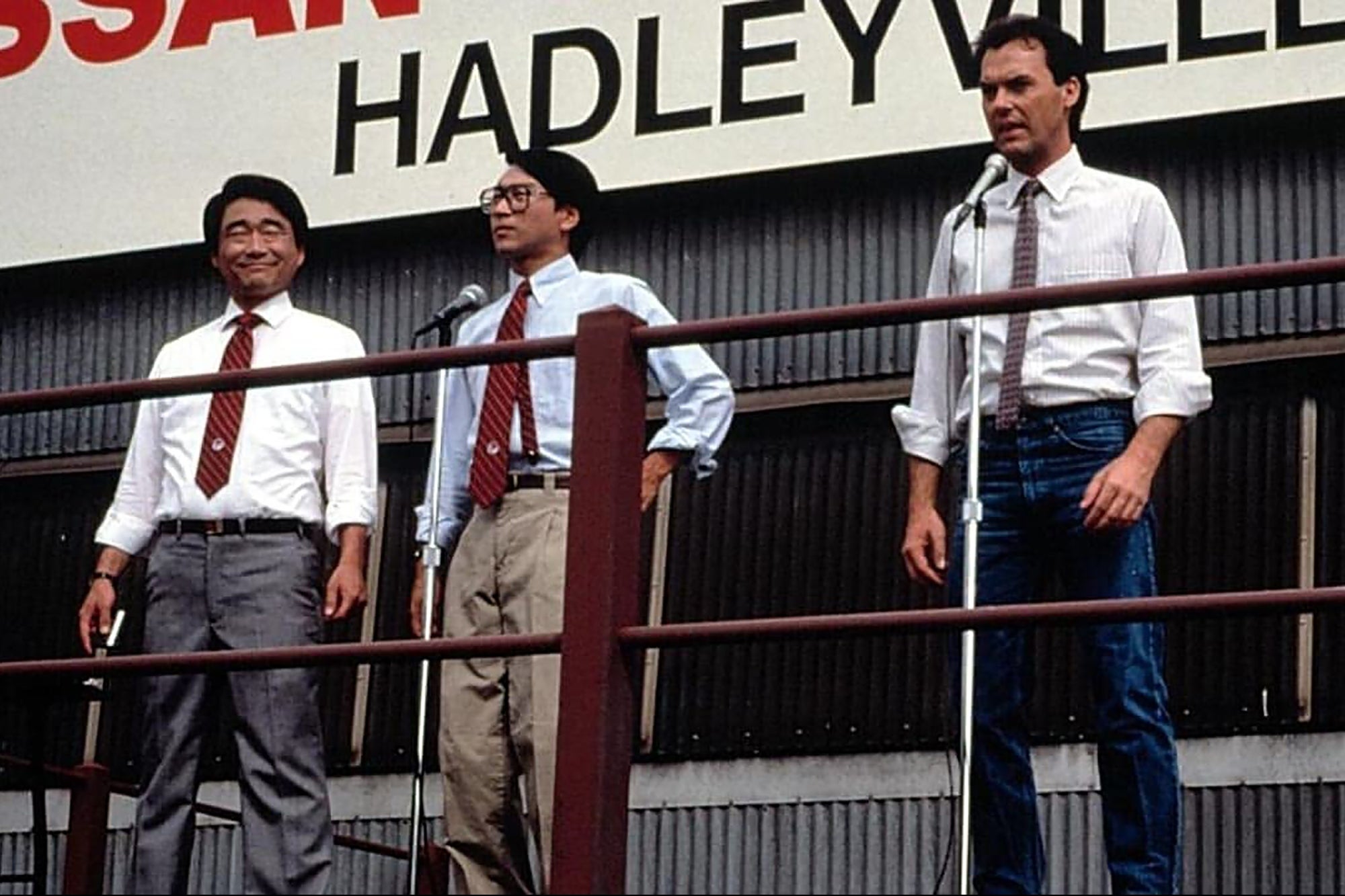
 
    Ron Howard’s wacky comedy from 1986 called Gung Ho provides an interesting play on the clash of cultures when the Japanese strive for perfection collides with American sloppiness. Arguably, the most interesting sequence in the film is the opening in which the main character Hunt Stevenson (Michael Keaton) is sent to Japan to negotiate the takeover of a car manufacturing plant. Needless to say, the Westerner’s brief sojourn in Japan is not entirely comfortable.
     The same can be said about Daniel LaRusso’s trip in The Karate Kid Part II (1986). The sequel to the popular film transports sensei and his student to a village on Okinawa, where Mr Miyagi has to confront his past. Unfortunately, The Karate Kid Part II does not hit the same sensibilities as The Yakuza, resorting only to raw fight sequences, which make you question the validity of Japan portrayed on screen. All in all, the movie’s approach towards the Oriental sphere is very simplistic if not entirely ignorant.
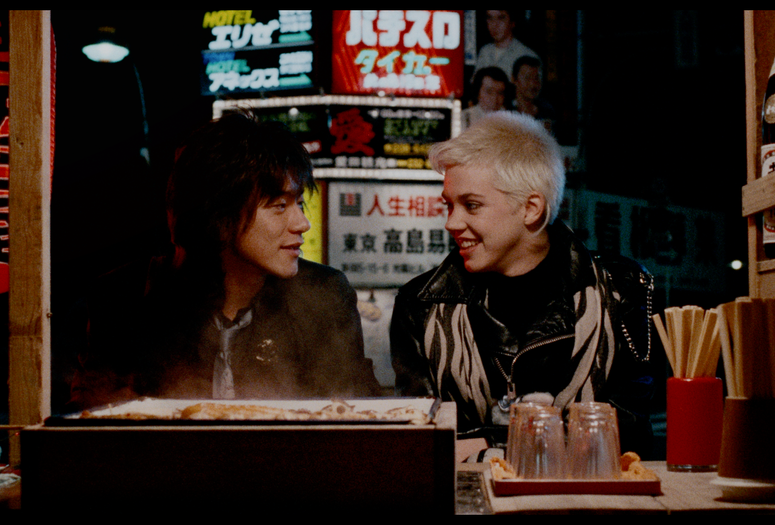
 
    Additionally, there is also Tokyo Pop (1988), a musical comedy film in which we follow the misadventures of an American girl Wendy Reed (played by Carrie Hamilton) who meets a Japanese boy called Hiro (Yutaka Tadokoro) and his band, the Red Warriors. They join forces and decide to make it big in the music industry.
     Interestingly, Tokyo Pop provides a very honest portrayal of a Westerner’s fate of making it big in Japan. It is a very hard place to live for a foreigner, and life is not a fairy tale. Wendy and Hiro might have fallen in love together, but it does not mean they can be together. Although she tries to integrate into the Japanese society, Wendy realises that she is unable to do so. At the end of the day, memories of her time with Hiro matter the most for Wendy.
 
    Last but not least, allow me to take a look at Black Rain (1989) produced by Paramount Pictures and directed by Ridley Scott. In my opinion, this often underrated picture is one of the quintessential movies that focus on the theme of a Westerner in Japan.
     Initially, you are bound to categorise this flick as a typical 1980s buddy-cop action flick, but while being superficially stereotypical, it breaks many conventions of the genre. For instance, our main protagonist, Nick Conklin (Michael Douglas), is a cop "on the take". He is tired, angry, and in debt. It is surprising that he is not playing russian roulette with his gun. However, upon meeting a Japanese officer Masahiro (Ken Takakura), he regains his integrity and decides to start his life anew. What is more,Conklin's partner (Andy Garcia) is not killed at the beginning or the end of the film, but right in the middle. This is so unexpected that we really feel Conkiln's shock when this happens. In addition, the main bad guy (Yusaku Matsuda) does not die in the final confrontation. Instead, Conklin and Masahiro do everything by the book and they arrest the culprit.
 
    The cinematography is outstanding (Osaka totally looks like futuristic LA from Blade Runner), Hans Zimmer is literally at his best with an epic music score, and performances of the leads are top-notch across the board. Arguably, the most eerie scene of the film is when Conklin has a discussion with oyabun (played by Tomisaburo Wakayama), in which the yakuza boss explains that the Americans are directly responsible for creating the generation of psychopaths like the villainous Sato: men without honour, only focused on power and greed.
     To conclude, Hollywood productions preoccupied with the image of Japan from the 1970s and the 1980s are generally more respectful and considerate than the movies from the previous decades. The Japanese persona is no longer ridiculed by being portrayed by a Western actor, and a character of a foreigner comes to appreciate the strange but ordered world of the Orient in which he or she experiences personal catharsis. Stay tuned for the third part of the article series in which I will discuss the period of the 1990s. Hopefully, this will take me a shorter amount of time than composing part 2. In the meantime, thank you for reading.
Sources and images used: Speaking in Images: Japan in Hollywood Films (2005) by Charles Fox * Pictures used are screenshots and photos taken from the movies.
«Enjoyed this post? Never miss out on future posts by following us»

Rising Sun over Hollywood: American Imaginings of the Japanese Setting in Cinema- Part 1 [the 1950s-1960s]

Disclaimer: The article is filled with spoilers for such movies as Sayonara, The Teahouse of the August Moon, My Geisha, You Only Live Twice, and The Crimson Kimono. Please refer to endnotes whenever these are indicated in the article by parenthesis.
 
Everybody wants to talk about themselves, and everybody wants to hear everybody else's story, so we take turns playing reporter and celebrity. ~ Ryū Murakami
 
In the world of today when globalization takes precedence over everything else, it is hard to find a movie enthusiast who has not heard about the giants of Japanese Cinema, such as Akira Kurosawa, Nagisa Oshima, Hirokazu Koreeda, Ryusuke Hamaguchi, and many others. Indeed, we live in the age of immediacy, which (thanks to physical media, festivals, and online services) allows Western consumers to gain access to a wide variety of Asian productions. However, this was not always the case. Before the advent of Television and the universal format of VHS, the phenomenon of importing foreign movies and presenting them to a wider audience was not a common practice. If it did happen, the movie was either significantly altered to accommodate the “supposed” needs of an audience unfamiliar with the piece[1] or remade altogether, which happens nowadays as well (for instance, the upcoming remake of Parasite).
     Evidently, production companies and distributors know best. Like an overprotective father, they look after spectators who are (according to them) consumed by idle, child-like stupidity which renders them unable to read subtitles or appropriately understand cultural intricacies of a given theatrical piece. Oftentimes, it is much easier to take viewers by a hand and transport them away to Oriental frontiers in a special safety harness which does away with the language barrier and enables to face cultural differences between the East and the West head on, turning this aspect into a main axis which drives the story. Of course, I refer to Hollywood-made pictures set in Japan. The purpose of this article is to examine how the Japanese setting and its central protagonists were (and continue to be) reflected in American productions.
     Apart from numerous bullet-point lists outlining the many foreign movies set in Japan, it is hard to find academic information on the subject. The only interesting article I was able to find was “Speaking in Images: Japan in Hollywood Films” (2005) penned by Charles Fox, a researcher from Ritsumeikan University. It is a bit challenging read indeed and the 30-page-long text does not exhaust the topic completely, but it makes a few valid arguments which may serve as points of departure for further discussion.
     “It should be noted that Japan made its first entry into the American film consciousness all the way back in the silent film era, and that entry was both as a subject and as a member of the company creating the illusion that is popular film,” Fox states on page 268 of his article and gives an example of Sessue Hayakawa who made in it big in Hollywood during the pre-war era and beyond[2]. With regard to the early days of Hollywood representations of Japan, Fox focuses in great detail on a detective movie called Mr. Moto’s Last Warning (1939); however, the researcher largely omits the period of the 1960s in his analysis, the time of America’s renewed interest in Japan after the occupation.
     In my opinion, this period is the most crucial one for understanding the nature of cross-cultural encounter where the West met the East and the baggage of onscreen stereotypes that came with it. The reason is that the late 1950s/early 1960s marked a shift in public American consciousness. Japan was no longer an enemy, but a much-needed ally during the challenging phase of the Cold War. How did that shift transpire in Hollywood?
     Allow me to focus on a film called Sayonara (1957) with Marlon Brando and Miiko Taka in the leading roles and based on a novel by James Michener. The movie presents us with an American Air Force fighter pilot Major Gruver (Brando) who is transferred from his outpost in Korea to Japan so he could reunite with his fiancée Eileen (Patricia Owens). Gruver is accompanied by his former subordinate Kelly (Red Buttons) who comes back to Japan to marry a local woman, Katsumi (Miyoshi Umeki). Gruver supports his friend in his marital endeavour but learns in the process that mixed relationships between American army men and Japanese women are frowned upon by generals in charge. The real problem for Gruver arises when he falls in love with the lead performer of a theatre company, Hana-ogi (Taka).
     Evidently, it has to be acknowledged that Sayonara touches upon the troubling issue of prejudice and racism against the people of Japan. The military personnel in the movie and their families (see Eileen and her mother) are present in as idyllic fashion as the inhabitants of the Tara household from Gone with the Wind (1939). They choose to stay amongst themselves and they have more than a questionable view of the Japanese citizens. Major Gruver initially shares this discriminatory mindset, but his outlook on things gradually changes with the help of Kelly and Captain Bailey, who is also romantically involved with a local dancer. After a confrontation with Eileen, Gruver realises that he is a prisoner of his own presuppositions, and his integration into a foreign land manifests itself when he meets the beautiful Hana-ogi.
     Sayonara is both a light-hearted rom-com and a tragic drama. In the first half of the picture, we see Gruver’s clumsy attempts to win Hana-ogi’s heart. The problem is that Hana-ogi hates Americans because she lost her family during the air raids. However, Hana-ogi very quickly (and conveniently for the plot’s sake) changes her viewpoint: “I realised the hate was of my own making. That is why I came to ask you to forgive me for what I have been feeling,” says Hana-ogi. This is perhaps the most controversial line of the entire movie which nearly turns the woman into yet another reincarnation of, what Charles Fox calls, the Madame Butterfly archetype[3]. However, the disastrous consequences of that line are quickly quelled by Gruver’s response who tactfully asks Hana-ogi to forgive him for his own foolishness and prejudice.
     In consequence, a passionate relationship develops between Gruver and Hana-ogi, but I would not compare it to the shallow enchantment between Pinkerton and Butterfly from Puccini’s opera. Gruver treats Hana-ogi with respect and states numerous times that he truly loves her. This is the moment when the tragic aspect of Sayonara sets in because Kelly is ordered to go back to the States without his wife. Of course, Gruver intervenes but to no avail. As a result, his dear friend and Katsumi resolve to commit suicide, so they could at least be together in heaven. The scene in which Gruver finds their bodies in an embrace constitutes the tragic core of the story. This is a cautionary sign for Gruver; how he is going to end up if he keeps pursuing a Japanese woman’s heart. Hana-ogi realises that as well, so she bids him farewell from the distance and leaves.
     This would have been a perfect way to end the film, but no… The Hollywood machine has to conclude a film with a happy ending. Therefore, we get another 15 minutes in the course of which it turns out that a magical new law is passed which will allow American army men return home with their Japanese spouses. Needless to say, Gruver tracks down Hana-ogi in Tokyo and, in an extremely rushed ending, proposes to her. The damsel obviously accepts the proposal and expresses to pesky journalists her hope that someday the people of America will accept their relationship.
     On the whole, Sayonara is unevenly paced. The movie tries to tackle Japan-oriented racism while reinforcing some of the outdated stereotypes. By no means I refer to the Gruver/Hana-ogi relation but an affair between Eileen and a Japanese kabuki actor Nakamura… who is played by Ricardo Montalban in a heavy make-up. Apart from the fact that this relationship goes absolutely nowhere in the story (because the audiences can’t see a Western woman marrying a Japanese man), it is unforgivable in my opinion that a Mexican actor was given the Japanese-specific part. Talk about the height of white-washing. This aspect and the over-idealised ending render Sayonara just an interesting take on Japan, which may serve as a land of cross-cultural encounter and mutual reconciliation, but the filmmakers themselves remain prisoners of cultural presuppositions. This forces them to create double standards in a story that is supposed to break such.
     Speaking of Marlon Brando, we cannot omit in this discussion yet another Japan-centered production with him in the leading role. To be specific, I refer to The Teahouse of the August Moon (1956). Evidently, the movie was released just a year before Sayonara, but it also serves as a pitiful example of yellowface casting.
     In the film, we follow Captain Fisby (Glenn Ford) who, as punishment for his past blunders in the army, is ordered to turn a small village of Tobiki on Okinawa into a glowing example of American democracy and capitalism. The Captain ardently proceeds to fulfil his superiors’ wishes, but cultural differences get in the way. These are especially aggravated by a local, happy-go-lucky translator Sakini (played by Brando himself).
     Nowadays, The Teahouse of the August Moon is frequently cited as the first American movie which openly discussed the issue of interracial marriage. To me, this particular motion picture feels like an extended episode of M*A*S*H sitcom because it has the same witty ambience and, just like that TV show, strives to educate the viewers. That is to say, the message is intercultural exchange should not be overtaken by the process of Americanization. Rather than that, both parties should acknowledge their respective differences. Captain Fisby realises that when the villagers build a teahouse for the purpose of making brandy for the army. Initially, his orders were to make them build a school in the shape of a pentagon…

     The Teahouse of the August Moon is a passable Hollywood production, but in my opinion, the casting of Marlon Brando as a Japanese native literally destroys the viewing experience. Allegedly, Marlon worked very hard on his role, trying to learn the dialect, and enduring two hours of make-up session each day before shooting. Still, the end result is off-putting and dated.
     My Geisha from 1962 is, in turn, a classic comedy of mistakes. In this story, the viewers are presented with a “film-within-a-film” structure as an experienced and successful director Paul Robaix (Yves Montand) desires to shoot a movie adaptation of Madame Butterfly. The director is married to a popular actress, Lucy Dell (Shirley MacLane) who was always the leading lady of her husband’s picture; however, this time Robaix (in pursuit of his artistic aspirations) wants to make an entire movie in Japan, and with a Japanese actress in the lead! Nevertheless, Lucy is determined to show that she is the perfect choice to play the legendary Madame Butterfly.
     As Charles Fox describes in his article, “Lucy does not intend in the beginning to crash Paul’s picture; rather, on a bet with the film’s producer she dresses as a geisha at a party in Tokyo for Paul and the film’s leading man, Bob (played by Robert Cummings), just to see if she can fool Paul. She succeeds only too well. Almost immediately afterward, Paul announces that he is tired of the endless string of would-be Americans he is seeing at his auditions, that the geisha he met at the party (Lucy, in other words) is the only person for the part of that essence of Japanese womanhood, Butterfly” (2005: 275).
     On the basis of this elaborate description, it may seem that My Geisha is yet another example of whitewashing in motion next to Sayonara and The Teahouse of the August Moon. However, there is much more to this story. Lucy pretends to be a Japanese girl, not just to win a role, but to save her husband’s production from budget cuts. If anything, her own ignorance of the oriental culture is reflected back at her on numerous occasions: When she offends a geisha master, or when she pretends to speak Japanese. In the moment when Paul discovers the whole affair and intends to break up with Lucy on the premiere night, Lucy realises the vanity of her actions when the real, proper geisha Kazumi (Yoko Tani) presents her with a special gift.
     In other words, My Geisha focuses on marital problems which are exposed and alleviated by a foreign setting. Had it not been for Japan itself, Paul and Lucy would have never reached an understanding in the film’s finale because the husband had to set aside his pride, whereas the wife had to renounce her fake Japanese identity. In my opinion, Fox is too harsh towards the movie when remarking that “Lucy’s version of the Madame Butterfly geisha construes the Japanese woman as offering sex freely as comfort to any man with whom she shares what she mysteriously calls ‘sympathy’” (2005: 276). In the context of My Geisha, Fox over-interprets a scene in which Lucy (disguised as a Japanese woman) rejects the marriage proposal of her co-star, and in doing so, she says simple mumbo-jumbo about geishas always willing to offer themselves to men but only physically. If anything, this scene once again underlines Lucy’s ignorance of Japan.
 
    Interestingly, James Bond himself is also a part of a large pantheon of gaijins who visited Japan. In You Only Live Twice we see him having (mis)adventures in Tokyo, Kobe, and in the region of Kagoshima.
     The movie itself is an intriguing entry from a historical point of view. Sean Connery was done and dusted with the role because he felt cheated by the producers and could not handle the popularity that was propelled by the media. What is more, he was frequently mobbed by the paparazzi during the shooting in Japan. As a result, what we get to see most of the time is Sean being constantly bitter on camera. Consequently, the editing, especially of conversation scenes, is quite shoddy when compared to earlier (and subsequent) Bond films.
     Nevertheless, the locations are amazing. I dare to think that this is the first Bond film that used outdoor shooting to the fullest. Hotel New Otani in Tokyo is appropriated as "Osato Chemicals and Engineering Company," which Bond investigates. In addition, we see Bond running from the bad guys at docks in Kobe, and there is even a training scene near the famous Himeji Castle (which also appears in Kurosawa's Kagemusha). Blofeld's base is located in a volcano, which can be found in Kirishima National Park.
     There is also a whole slew of Asian actors who appear in the film. We get the wonderful Tetsuro Tamba as Bond's ally and the Bond girls are played by Akiko Wakabayashi and Mie Hama. In brief roles, we can also spot Teru Shimada and Burt Kwok (the immortal Kato from the Pink Panther movies).
     From the technical side, You Only Live Twice is a solid motion picture, but the screenplay is its Achilles’ heel. For instance, halfway through the movie Bond has to "turn Japanese" in order to stay undercover. They just paint his eye line a bit which looks downright silly... Alas! The disguise does not work as Blofeld's henchmen try to kill the spy at least on two occasions.
     As for the Bond girls, Akiko Wakabayashi has a great onscreen chemistry with Sean, so it is all the more surprising to see her suddenly killed off at the end of the second act. Her death serves no purpose in the story apart from introducing Mie Hama. Had the producers curbed their enthusiasm to cram as many beauties as possible, the story itself would have been more compelling. The audience was already familiar with Akiko Wakabayashi’s character for two thirds of the film, so she could have provided a greater emotional anchor during the film’s finale.
     Bond movies always try to go with the latest trends, so when ninja movies were popular in the 1960s, we get a squad of ninjas storming Blofeld's base (because ninjas are cool!) Well, at least lavish production design by Ken Adam adds an entertaining factor to the finale.
     Summing up, You Only Live Twice marks the first time when the Bond franchise started going off the rails. Japan is yet another exotic land functioning as a background for explosive action, yet another chapter in Bond’s life filled with expendable women and more-than-reliable allies who save his skin at the right moment. On the whole, You Only Live Twice is an okay action movie, but I like to revisit other Bond’s adventures centering on Asian themes (The Man with the Golden Gun and Tomorrow Never Dies).
     Last but not least, the notable exception from Hollywood’s shortcomings in portraying Japanese people on the screen is a black-and-white noir film The Crimson Kimono (1959) directed by Samuel Fuller. In this movie, we follow two LAPD detectives: Joe Kojaku (James Shigeta) and Charlie Bancroft (Glenn Corbett) who are trying to solve a murder of a stripper. The problem arises when the two officers fall for a damsel in distress, Christine (Victoria Shaw).
     Indeed, The Crimson Kimono does not take place in Japan, but still, it manages to obliterate every single faux pas committed by the previously discussed movies. By analogy, one would think that Detective Bancroft is the romantic hero of the story whereas Detective Kojaku functions as his clumsy sidekick. Nothing could be further from the truth. It is Kojaku who is the main protagonist. He is an able and determined policeman who always jumps into action. He is no way inferior to his American friend. What is more, it is Kojaku who wins the girl in the chilling finale.
 
    The Crimson Kimono is not so much a whodunit but an examination of a bromance between Kojaku and Bancroft. The exposition halfway through the film tells us that the two men go way back together. They fought in the Korean War and now they are living together as roommates: “But what those two had together in the war, no one can touch. It was Joe's blood that kept Charlie alive in Korea, and now it's Charlie's friendship that's keeping Joe alive. It's like... Well, it's like mixing two dabs of paint together. You can never separate them.”
     The core of the conflict arises when Kojaku and Bancroft fall in love with a woman whom they are supposed to protect. Christine reciprocates the advances of Kojaku, which ultimately makes him question his own identity: “I was born here. I'm American. I feel it and live it and love it, but down deep, what am I? Japanese-American? American-Japanese? Nisei? What label do I live under, Chris? You tell me.” In addition Kojaku does not want to be unfair towards Bancroft and tells him about his feelings towards Christine but the confrontation ultimately leads to a misunderstanding in the course of which Kojaku accuses Bancroft of racism.
     In the end, when the culprit is caught, Kojaku learns that he made a mistake. He became a victim of his own presupposition. The Japanese character emerges triumphant with a lady by his side, but at a cost of losing his dear friend. In my opinion, it is absolutely criminal that in the modern age of questionable blockbusters where Japanese actors are featured as supporting characters (see numerous productions with Ken Watanabe and Hiroyuki Sanada) nobody talks about The Crimson Kimono. It is almost as if Hollywood wants you to forget about the film which was ahead of its time.
     All things considered, Hollywood movies made in the 1950s and the 1960s explore an array of interesting themes concerning American-Japanese relations, but many of these pictures are unable to go outside the constraints propelled by cultural ignorance. Oftentimes, the character of a Japanese local is played by a Westerner, whereas the heroine sometimes serves as a reflection of the Madame Butterfly archetype. The Land of the Rising Sun in these productions functions as a site of cross-cultural encounter, the outcomes of which are frequently positive, although a bit idealistic. How does the image of Japan in American movies progress further in subsequent decades? Please stay tuned for the second part of the article in which I will discuss the period of the 1970s and the 1980s. In the meantime, thank you for reading.
Endnotes
[1] For instance, please refer to the American cut of Godzilla (1954) released as Godzilla: King of the Monsters in 1956.
[2] See the actor’s brilliant performance in The Bridge on the River Kwai (1953).
[3] The Madame Butterfly archetype: In the context of Puccini’s opera, the Japanese woman is regarded by a Western lover as a romanticised boon from the Orient. The woman really loves her husband, but it is a one-sided dependency. In the end, Butterfly has to give up her life to fulfil the needs of her ungrateful lover (Yoshinara 2002 in Fox 2005: 269). Basically, this archetype symbolises an enchantment of a Westerner with the East.
«Enjoyed this post? Never miss out on future posts by following us»