This week, I would like to bring to your attention a Youtube channel called JDM Restoration. On the basis of the name, you’d think that it focuses on automobiles, but its main purpose is actually restoration and preservation of film media centering around JDM.
Interestingly, the person behind the channel has taken it upon themselves to restore the Shuto Kousoku Trial movie series, about which I wrote on my blog and on Kayo Kyoku Plus blog as well. You don’t need to look further, just scroll down this post, to see all the movies restored by this Youtuber. Needless to say, they did an amazing job, and it is even more surprising that they worked on the only available DVD sources out there. The subtitles are also hardcoded from scratch. If you wish to know all the technical details beyond the restoration of these gems, then head over to description boxes under the first video. All things considered, they are doing God's work. I wish there were more channels like that out there preserving forgotten movies.
«Enjoyed this post? Never miss out on future posts by following us»
Well, this is not really a traditional editorial, but more like an uncalled-for blog update. I’m just touching base with the readers in order to explain (as I shyly mentioned in some of the earlier posts) that I am not particularly active because of work responsibilities and personal life.
In addition, even though I do have a little free time each week, I try to devote it to conquering some new challenges. Writing reviews and articles is essentially non-fiction that communicates an opinion, but in 2024 I decided to get out of my comfort zone and, for the first time, try creative writing (so, short stories, poetry, and even an attempt at a novel). Even though this activity is very time-consuming, and I realise it is a big effort for little gain, it gives immense pleasure and strength, so I intend to focus on this.
That being said, I don’t want to throw my blog content down the drain, Indeed, it can be quite discouraging to see a comment notification that is just old, plain spam, but the visitors’ traffic is satisfactory to me, and the blog has actually been cited on wikipedia twotimes this past year. I never cared about wikipedia, and I found out about this by accident, but it’s quite heartwarming to see that someone actually decided to include my thoughts on specific movie profile pages.
In addition, East Asia Resource Center in Washington composed a bulky overview of Chinese Cinema in 2022, and they also included one of my reviews. Again, nobody contacted me about this, but as long as people appropriately cite my blog and give proper source, I am fine with the inclusions.
To conclude, I do wish to come back to writing reviews, and I hope I will be able to do so at the end of April. I have two movies sitting on the proverbial shelf that I want to discuss, and then I may focus on finally sitting down and reviewing some of the sequels to popular movies, which I forgot to talk about previously. Thanks for sticking around and I wish you all the best.
«Enjoyed this post? Never miss out on future posts by following us»
Even though it has been several months since the premiere of Godzilla Minus One, the fallout dust resulting from warm reception of the film across the globe has not settled yet. In January, the movie was re-released in Japan and the USA in a special version called Godzilla Minus One/Minus Color. What is more, the film received 12 nominations at the 47th Japan Academy Film Prize, and a nomination for Best Visual Effects at the 96th Academy Awards. In consequence Minus One is the first Godzilla production to be nominated for an Oscar(!) I have already praised the film in review last month, so I am not going to repeat my comments. The reason why I am writing today’s post is to praise the mastermind behind Minus One: Takashi Yamazaki, the ultimate die-hard fan of King of the Monsters. Yesterday, I accidentally spotted on Youtube an interview Yamazaki gave to Rotten Tomatoes and it absolutely made my day. Apart from having custom-made shoes, he had the audacity to bring with himself a Godzilla action figure. He is such a sweet fan boy who is not ashamed of his love for the franchise!
Evidently, Yamazaki poured his heart and soul into making Godzilla Minus One, not only as a writer and director, but also as a VFX supervisor, which (according to FX artists) really shortened the chain of command on a blockbuster production and smoothed the production process (source). In an interview, Yamazki says that he is open to the possibility of making “Godzilla Minus Two”, and I think Academy Awards offer the director a solid platform to convince Toho for one more shot at making a Godzilla flick. When I cooled down after reviewing Minus One, I would personally love to see Yamazaki’s take on a sequel in a time when Japan is rebuilding itself after World War II, but I would like the story to focus on entirely new characters. Please don’t bring the old gang because they deserved the happy ending!
This brings me to the Rotten Tomatoes question that was brought up in the interview. It is clear that Yamazaki has a lot of reverence for Christopher Nolan and Oppenheimer, and when the director was asked about the potential international casting choices for a new Godzilla film, he eloquently responded that the Oppenheimer cast was very talented (without giving any specific names). I know that Yamazaki was very gracious and careful with his answer, but this Oppenheimer touch really set my mind going for a potential Oppenheimer x Godzilla crossover. How crazy that could be? I know this is just fanboying, but nothing will deny the fact that Oppenheimer and Godzilla Minus One ruled the cinemas in 2023. Both movies focused on the themes of nuclear weapons, destruction, and morality of man in their own unique ways.
To end this text, allow me to say that during one of my high school lessons, I allowed students to ask me various questions in English. One student asked me on a whim “Have you seen Godzilla Minus One?” convinced that I haven’t seen the film, but I answered positively, his eyes lit up and shouted, “This is the greatest film of 2023!” and that remark comes from a 15-year-old. To sum up, I salute you Takashi Yamazaki, your movie has transcended countries, languages, and generations in its quest to creep into the hearts of Godzilla fans across the world. You are the greatest of all.
*Feature image source. The remaining pictures used are promotional photos of Godzilla Minus One.
«Enjoyed this post? Never miss out on future posts by following us»
Men always seem to think about their past before they die, as though they were frantically searching for proof that they truly lived. ~ Jet Black
As promised last week, I am back with my blog post about the popular anime series from the late 1990s: Cowboy Bebop. Well, better late than never. Cowboy Bebop was part of my introduction into the realm of anime over 10 years ago, and I have been meaning to write about this show for a long time. However, as in the case of GTO, I avoided doing it because this show is such an all-time classic. To be honest, I regard Cowboy Bebop together with Outlaw Star and Trigun as the Holy Trinity of the animated space western genre. However, all three series exhibit radically idiosyncratic styles. I mentioned in my special review of Outlaw Star that I have some issues with Cowboy Bebop, and today allow me to explain what I meant. Whereas Outlaw Star (and Trigun) seem very modernist and traditional with their approach towards the concept of a hero and his journey (the monomyth), Cowboy Bebop, in contrast, appears to be a deeply postmodernist show. It is, in fact, a disjointed, freewheeling story about a too-cool-for-school bounty hunter who is unable to escape his own past.
First things first, so let’s briefly summarise what the show is about. It was originally conceived by Shinichiro Watanabe and the creative staff led by him in Sunrise animation studio. Bebop presents us with a not-so-distant future, namely the year 2071 in which Earth is almost uninhabitable due to a hyperspace gateway incident. As a result, humanity has colonised the rest of the Solar System, which unfortunately led to skyrocketing crime rates. In consequence, the Inter Solar System Police authorised the profession of bounty hunters (aka Cowboys) who catch criminals alive and return them to law enforcement for financial reward. Spike Spiegel, Jet Black, Faye Valentine, Ed, and Ein accidentally form the bounty hunting crew of a ship called Bebop. It is difficult for me to explain why, but I felt the need recently to revisit Cowboy Bebop. I tried to do this a few years ago (during the pandemic), but I tuned out after a couple of episodes, bitterly labelling the show as dated (that’s how hardwired I am in my unconditional love for Outlaw Star). However, now, as a person who is over 30, I looked at the show in a different light. I really do not want to nitpick Cowboy Bebop, so let me say that after so many years, this anime is still great fun. I nearly forgot how good some of the episodes were, and the light-hearted storylines really brought a smile to my face, such as Stray Dog Strut, Gateway Shuffle, Toys in the Attic, Bohemian Rhapsody, and Wild Horses. This is exactly the type of cheerful, escapist entertainment I needed.
As a result, Cowboy Bebop really excels in the fun department and effortlessly hits the same strides as Outlaw Star and Trigun. However, what makes it truly different is the way in which the show handles the serious stuff. Evidently, we have stand alone episodes about the tragedies of side characters Spike encounters/has to fight, as in the case of Asteroid Blues, Sympathy for the Devil, Heavy Metal Queen, and Waltz for Venus. Spike confronts these characters in the fashion of 1980s action drama heroes (see Magnum PI) and these interactions, and their unfortunate fates, make him grow as a protagonist.
However, the whole seriousness concerning Spike’s personal past is just so stereotypical that it devours the enjoyment of Cowboy Bebop for me. Yes, I get it. Spike is a cool guy, so he was a criminal in the past, and he was in love, but the villain character of Vicious (to my mind) is way too exaggerated. Indeed, he has a cool introduction in the opera house, but it is all there is to his depth: showmanship. The show never made me care about Vicious. I can understand he was a caricature of John Woo’s bromance-charged villains, but things did get lost in translation, which ultimately renders Spike’s story arc flat for me. Nevertheless, Spike’s past is not the only concern of the show. Jet Black faces his own demons in Ganymede Elegy and Black Dog Serenade, and so does Faye Valentine in My Funny Valentine and Speak Like a Child. The way the supporting characters have to deal with their trauma is done perfectly. Time and time again, they try to avoid it, escape it, but the past eventually catches up with them and forces them to evaluate their identity. Jet and Faye really “carry that weight.” Still again, what about Spike? He confronts Vicious head on three times in the show, and this ultimately leads to his death. Perhaps the character truly needed this kind of bleak retribution (he wanted to know if he is alive), but I as an audience member did not. Spike choses death instead of carrying his weight (isn’t it cutting corners?), and this ultimately makes the show a downer, especially if you are a 30/40-something adult dealing with responsibilities of life.
So, here we are. Instead of a typical review, I blurted out my chain of incoherent thoughts about Cowboy Bebop. Thank you for reading, and if you have your own opinions about the series, feel free to share them. Hopefully, next week, I will try to discuss something else. In the meantime, Life is But a Dream and See You Space Cowboys.
«Enjoyed this post? Never miss out on future posts by following us»
We cannot go back to the past, no matter how hard we try. No matter how wonderful it was. The past is nothing but the past. ~ Eikichi Onizuka
Hello and welcome to my first blog post of 2024 after a long-ish, six week break. First of all, I feel that I need to explain my absence. Evidently, I wanted to continue writing right after Christmas but a set of personal circumstances forced me to adjust my schedule. In addition, I did not have time (and I was not in the mood) to watch absolutely anything. In fact, throughout January, I managed to see some random stuff on TV and only one(!) movie, which was Amadeus (1984). What is more, there is one more important factor responsible for my absence that is connected with the topic of today’s editorial. That is to say, I have made a New Year’s Resolution to become a better teacher for my students. Yes, some of the readers may already know this from the context of my previous reviews and articles. I have been working as a high school teacher for two years now (previously I worked at a university), and it is a very challenging profession at times. Of course, everybody has a different perception of it, depending on their place of birth, but where I live, it is not a line of employment held in high esteem by society (but more on that later).
The beginning of the current school year was particularly challenging for me. Apart from regular teaching, I got an increase in work hours, I became a homeroom teacher to a class of first graders, and I also had to oversee a team of new teachers in terms of bureaucratic paperwork. The period between September and November was very exhausting for me, and I didn’t feel like a teacher at all, but more like an administrative official who had to mediate his way between students, teachers, and principals. Thankfully, things did calm down towards the end of December and I had some time to recharge my batteries and think clearly. It was at that time when I made a firm decision to limit the overbearing paperwork to an absolute minimum and focus primarily on regaining that teaching spark. I even began to re-educate myself, looking for the latest information on classroom management techniques and learning/acquisition strategies other than traditional textbook cramming.
This is where GTO comes in. For those of you who do not know, Great Teacher Onizuka is a popular Japanese franchise created by manga artist Tooru Fujisawa in 1997. It initially started with a 25-volume manga series that received subsequent continuations and iterations in other media. In 1998, it was turned into a J-Drama. In 1999, there was a theatrical movie as well as a 43-episode anime series. In 2012, GTO was remade again as a J-Drama by Fuji TV. The series tells the story of an ex-bosozoku gang member Eikichi Onizuka who barely finishes studies allowing him to become a teacher. He finds a job at a private middle school in Tokyo, and he is assigned to the most troublesome class. Nevertheless, Onizuka’s unconventional techniques quickly lead to changes in the mentalities of unruly students. To be honest, I am a fan of the whole franchise, but the 1998 series with Takashi Sorimachi stole my heart, and to date remains my favourite interpretation of GTO. I have been meaning to write about this drama on the blog for years, but I never felt I had anything innovative to say about this all-time classic. However, in this article, I would like to put it in perspective with regard to my work.
Consequently, when I was scavenging the abyss of the internet in search of information that might help me on my teaching journey, I stumbled upon a reddit discussion about the validity of techniques used by Onizuka-sensei. This discussion really got me thinking. Evidently, Onizuka is this larger-than-life, too-cool-for-school character with a deep sense of morality overshadowed by typical manga wackiness. However, it is difficult to see him do any actual teaching in the series(!) Yes, sometimes in the drama we see him holding a coursebook for social sciences, so at least we know what subject he is supposed to teach, but that is it! Ultimately, Onizuka’s teaching purpose is about conveying life wisdom to his students. He is not teaching them hard theory, but how to live a life. In this manner, Onizuka is yet another fictional teacher in the pantheon of mentor characters like John Keating, Mark Thackeray, and William Hundert who always strived to inspire their students and often treated them like adults. Perhaps this is the most uplifting takeaway from GTO for any struggling teacher: Onizuka persistently broke the stale teacher/student power dynamic, going out of his way to show his students that he does not look down on them.
Still again, “educational” techniques used by Onizuka to achieve his goal leave a lot to be desired. If I were to repeat them, I would certainly end up in jail for jeopardising the health and safety of my students by jumping off a roof, getting into a fight with bikers, busting into a student’s home with a sledgehammer, or playing chicken with a speeding truck. However, I wouldn’t mind wrecking the vice-principal's Toyota Cresta every week. Point of the matter is that you will not learn anything about classroom management techniques from GTO (you are better off watching Dragon Zakura instead); however, GTO teaches you about employing a different approach towards your students. Onizuka, in contrast to fellow peers in the teacher’s lounge, understands that teaching is actually a relationship game. Hating your students will not get you anywhere. You should make an effort and familiarise yourself with them, even when they are troublemakers. Remember their names, ask them about their interests. greet them at the beginning of every lesson, and say goodbye when they leave.
Kindness doesn't cost much, but for many teachers in my country it is an impossible feat. I know from experience that many (not all) teachers here are just in it for the money. They often lack necessary knowledge to conduct a subject, let alone conduct a proper class with beginning, middle, and end. This situation only fuels students’ unwillingness to learn. I know I can’t change the world, but at least I can work on bettering myself. All things considered, the past six weeks of teaching were extremely rewarding for me. This is not the time and not the place to get into personal specifics, but my adjusted approach resulted in many unexpected, kind-hearted situations with my students, and I feel really proud because of that. My thanks go to my dear friend @penel from MDL who was willing to patiently hear my stories.
So, coming back to the question of this editorial: Was Great Teacher Onizuka right? Well, he was definitely right about changing your perspective and attitude to your students. And this made me like the character even more. Thank you for sticking by, I did not think this editorial would be so long. Next week, I will try to write something related to Cowboy Bebop (hopefully)!
«Enjoyed this post? Never miss out on future posts by following us»
Disclaimer: The article is filled with spoilers for such movies as The Yakuza, Shogun, The Challenge, Tokyo Pop, Black Rain.
You made the rain black, and shoved your values down our throat. We forgot who we were. You created Sato and thousands like him. I'm paying you back. ~ Oyabun from Black Rain
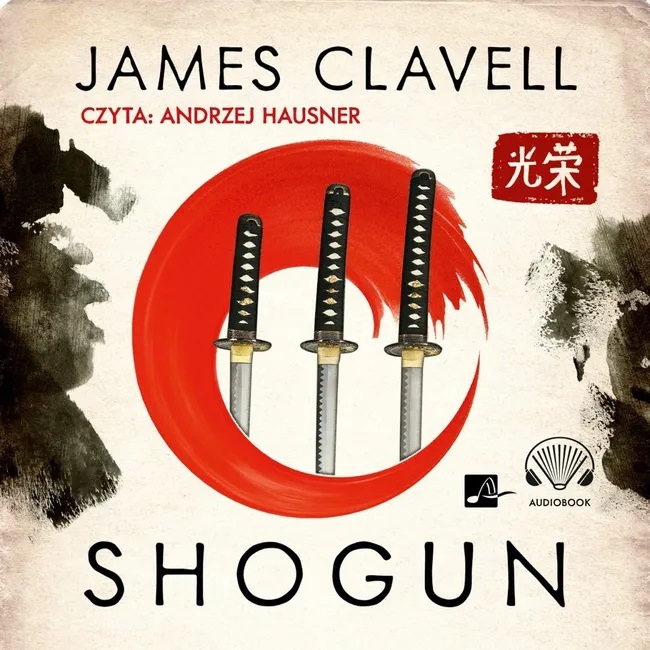
Hello and welcome to today’s update. As I am writing these words, I realise that a considerable amount of time has passed since my last blog update, and even more daylight will be burned by the time this article is ready for publication. As I explained months ago, my break from writing was caused by work obligations, but I was also struggling with personal stuff, which made me seriously consider whether or not I should continue running this blog. To cut the long story short, I decided to continue, but instead of forcing myself to watch a random Asian film I was not in the mood for, I decided to bring myself round and finish the old article project that was started over a year ago and abandoned by yours (lazy) truly. So here we are, this is the second part of my article series on American movies focusing on Japan. In the previous part, I covered the decades between the 1950s and the 1960s, whereas this text focuses on the period between the 1970s and the 1980s. The reason as to why I decided to finally write the second part was not only my desire to finish the project, but the still visible Hollywood’s preoccupation with Japanese pop culture in the world of today. For example, Netflix relentlessly churns out their own anime shows as well as live-action adaptations of popular franchises. In addition, Godzilla still rules within the realm of global box office on both sides of the Pacific. Last but not least. Hulu and FX gear up to deliver yet another adaptation of James Clavell’s classic novel Shogun, which was originally published in 1975.
With regard to perception of The Land of the Rising Sun by Hollywood, it is the period of the 1970s that marks a noticeable shift for the better. Indeed, the movies from the 1950s and the 1960s strived to provide positive depictions of Japan and its people, but oftentimes Japanese characters were played by Western actors in heavy makeup. It appears as if the West was convinced it was permissible or even trendy to pretend to be Japanese (or turn Japanese, for lack of a better term). The 1970s definitely ushered in a different approach to Western enchantment of the Orient. Indeed, the change can already be noticed in the historical war drama Tora! Tora! Tora! (1970) directed by Richard Fleischer and Kinji Fukasaku. The production of the 20th Century Fox strives to accurately retell the attack on Pearl Harbor which pushed the United States into officially joining World War II.
Undoubtedly, Tora! Tora! Tora! differentiates itself from other standard war flicks with this documentary style that puts emphasis on reality and facts rather than telling how it all happened from the perspective of one fictional character. That is why I prefer Tora! Tora! Tora! over Michael Bay’s Pearl Harbor (2001). Still again, Tora! Tora! Tora! does contain a fair share of not only action, but also pathos and respect towards depicting Japanese soldiers not as bloodthirsty monsters but man of pride. I will always remember a scene in which the Akagi Air Group departs and the Lieutenant Commander Mitsuo Fuchida receives a Bandana with the national symbol of Japan and ties it around his head. I can’t help but wonder how Akira Kurosawa would depict the Japanese side of the conflict had he stayed on as the director, but I am pleased with the final movie nonetheless. Apart from war themes, another movie worth mentioning is Sydney Pollack’s The Yakuza from 1975. In this neo-noir flick penned by Paul Schrader and Robert Towne, we follow Harry Kilmer (Robert Mitchum), a retired detective who travels from the US to Japan in order to rescue the daughter of his old friend. However, not everything seems what it appears to be and soon after Kilmer finds himself in direct conflict with the Yakuza and in need to face old ghosts of the past.
The Yakuza is not by any means a painstakingly gut-wrenching depiction of the Japanese underworld done in the style of the aforementioned Kinji Fukasaku. Nevertheless, the movie does provide a hidden message about the American consequences of occupying Japan in the 1940s and 1950s and how these consequences affect the younger generation who never experienced the atrocities of war. Hollywood pays out the classic theme of children suffering for the sins of their parents, but it is up to the parent figures: Kilmer and Tanaka (Ken Takakura) to take matters into their own hands and restore order. Sidney Pollack presents in his picture the image of Japan as a country that stands tall on the concept of honour, justice, and sacrifice. To modern-day viewers, these ideas might not be so out-of-the-box, but they might have appeared like that in the 1970s. Therefore, The Yakuza shows us the Western protagonist who comes to understand the intricacies of the Oriental culture and eventually makes his own sacrifice in order to receive forgiveness from a Japanese person who was indebted to him. Robert Mitchum and Ken Takakura really nailed it to the cross with their performances.
Unfortunately, the same positives cannot be said about the 1978 comedy called Bad News Bears Go to Japan, which is in fact the third instalment of the series centering around children playing football. I caught a fragment of this film a couple of years ago on TV and thought to myself, “Hmm, that's interesting.” One could think that a film about a little league baseball team would make great material for a family comedy, but nothing could be further from the truth. The Bad News Bears Go to Japan desperately tries to cater for anti-Japanese audiences by providing an abundance of racist and stereotypical jokes about Japan and its culture (mispronouncing Domo Arigato, usings ethnic slurs such as Japs and Nips, referencing Pearl Harbor...) Consequently, what is supposed to be a baseball flick for kids is actually a tasteless SNL sketch for redneck John Doe. Interestingly, the jokes get significantly toned down in the second half of the picture, which makes the theme of “Murica vs. Japan on the baseball field” completely incoherent towards the end. Basically, the storyline goes completely nowhere and achieves no resolution at all. What is more, the movie has one of the creepiest love subplots I have ever seen on screen. One of the The Bears players accidentally spots a beautiful girl in a kimono (played by Hatsune Ishihara) in the middle of the street and follows her around like Jason Vorhees, constantly talking to her in English. Of course, the screenplay is completely bonkers and the girl reciprocates the advances of a teenager who actually should have been jailed by the Kasumigaseki police for his outrageous behaviour. Tony Curtis as the team’s manager seems tired and depressed on the screen, as if appearing in this movie was some sort of a punishment for him. The legendary Tomisaburo Wakayama (Lone Wolf and Cub series) plays a coach of the Japanese team but his role is wasted as well. With regard to a few advantages, I have to praise the nicely done overview shots of Tokyo and Yokohama which are a pleasure to watch in HD. In addition, one scene attempts to recreate the spirit of variety shows from the Showa era, and it works really well.
This brings us to the NBC miniseries from 1980, which of course is the original adaptation of James Clavell’s Shogun with Richard Chamberlain, Toshiro Mifune, and Yoko Shimada in the leading roles. I remember watching it on Television as a child, but not paying much attention to it. Years later, when I was recovering from an illness, I rewatched the show on TV and now I dare to think it is the best you can get in terms of the “gaijin in Japan” trope. There is an internal struggle for power, Portuguese colonialism, the Catholic Church, and Protestants! Perhaps the most important aspect of the series is the fact that our protagonist John Blackthorne (Richard Chamberlain) is not the white saviour, but a pawn in the hands of Lord Toranaga (epic Toshiro Mifune). Interracial romance also works (beautiful Yoko Shimada), but surprisingly it does not receive a happy ending as in the case of Sayonara! with Marlon Brando. A lot of footage was shot on location in Japan, so I am quite surprised to learn that the show did not hit it big there upon original broadcast. Originally, 5 episodes were made with varying runtimes, but in my country, the show was divided into 10 episodes, each 50 minutes long. All things considered, Shogun is definitely a criminally-underrated series. Even though it may not accurately communicate the subtlety of Japanese culture, the historical content is extremely important because Shogun basically presents a fictionalised tale of the rise of the Tokugawa Shogunate.
Another movie that should not go unnoticed is The Challenge (1982). The film was directed by John Frankenheimer who made such classics as The Manchurian Candidate, The French Connection II, and Ronin. The music score was done by the legendary Jerry Goldsmith, and the main stars are Scott Glenn and Toshiro Mifune. Interestingly, the movie was shot entirely on location in Japan and the crew even had a Japanese cinematographer. The storyline itself is a bit too thin (our heroic protagonist from the West has to protect two katana swords from his sensei's evil brother), but marvelous Japanese setting and dynamic personalities of Glenn and Mifune keep this show going. The movie evidently tries to be too edgy at times, almost exploitation-like (lots of blood in fight scenes, but not anything extremely r-rated), but this aspect is forgivable. However, the theme of romance between the hero and the sensei's daughter is so forced and out of place. It functions only as an excuse for a love scene.
Nevertheless, I have to praise the effort of the crewmembers. In a scene where Glenn confronts one of the henchmen you can tell that they shot the entire thing spontaneously in the middle of a street with real passersby. What is more, Kyoto International Conference Center was used as “the villain's lair.” Even 40 years since the movie's release, not much has changed in this bizarre building which tries to mix Japanese traditionality with high-tech modernity. It is a pleasure to see Toshiro Mifune taking down the baddies from behind V-shaped columns and audience seats. All in all, The Challenge is a surprisingly well-made flick. Mifune really gets to prove that he can carry a Hollywood movie, and it is also great to see Scott Glenn in "oriental action" as a Westerner who learns the Japanese values.
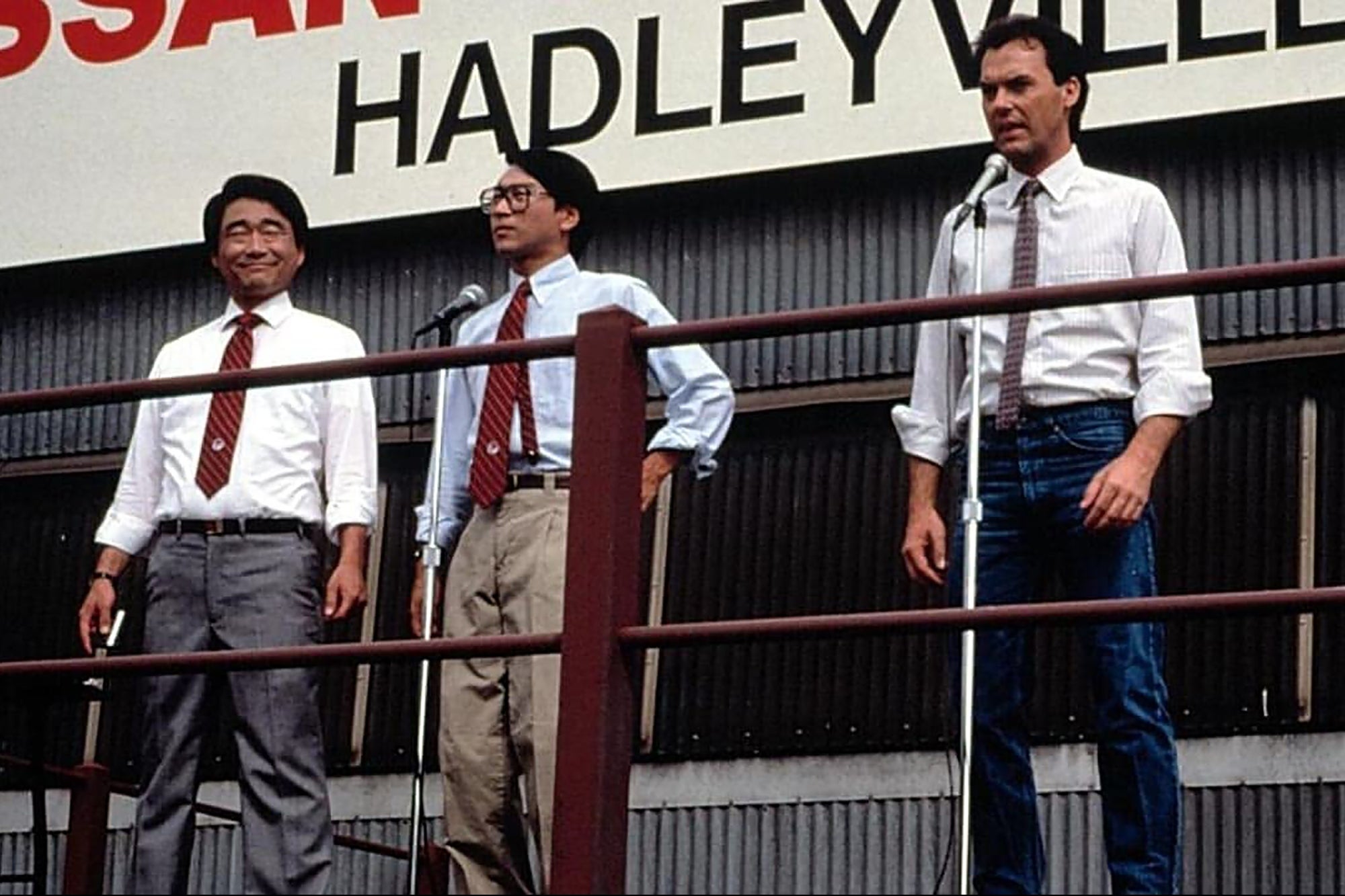
Ron Howard’s wacky comedy from 1986 called Gung Ho provides an interesting play on the clash of cultures when the Japanese strive for perfection collides with American sloppiness. Arguably, the most interesting sequence in the film is the opening in which the main character Hunt Stevenson (Michael Keaton) is sent to Japan to negotiate the takeover of a car manufacturing plant. Needless to say, the Westerner’s brief sojourn in Japan is not entirely comfortable. The same can be said about Daniel LaRusso’s trip in The Karate Kid Part II (1986). The sequel to the popular film transports sensei and his student to a village on Okinawa, where Mr Miyagi has to confront his past. Unfortunately, The Karate Kid Part II does not hit the same sensibilities as The Yakuza, resorting only to raw fight sequences, which make you question the validity of Japan portrayed on screen. All in all, the movie’s approach towards the Oriental sphere is very simplistic if not entirely ignorant.
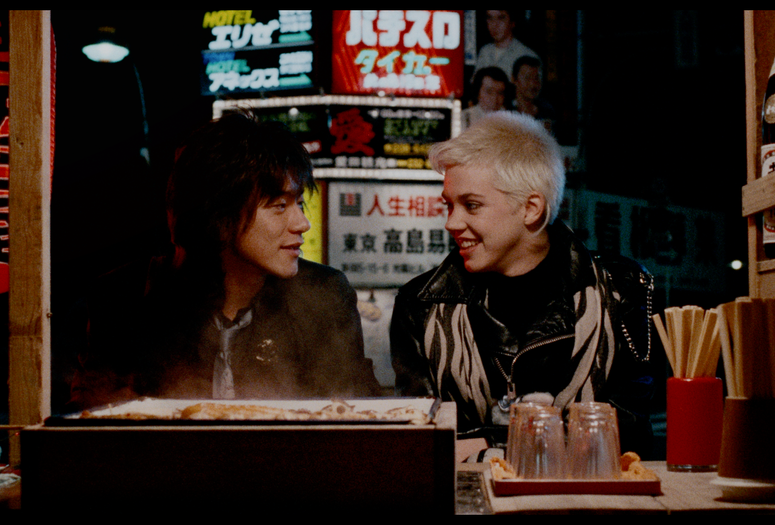
Additionally, there is also Tokyo Pop (1988), a musical comedy film in which we follow the misadventures of an American girl Wendy Reed (played by Carrie Hamilton) who meets a Japanese boy called Hiro (Yutaka Tadokoro) and his band, the Red Warriors. They join forces and decide to make it big in the music industry. Interestingly, Tokyo Pop provides a very honest portrayal of a Westerner’s fate of making it big in Japan. It is a very hard place to live for a foreigner, and life is not a fairy tale. Wendy and Hiro might have fallen in love together, but it does not mean they can be together. Although she tries to integrate into the Japanese society, Wendy realises that she is unable to do so. At the end of the day, memories of her time with Hiro matter the most for Wendy.
Last but not least, allow me to take a look at Black Rain (1989) produced by Paramount Pictures and directed by Ridley Scott. In my opinion, this often underrated picture is one of the quintessential movies that focus on the theme of a Westerner in Japan. Initially, you are bound to categorise this flick as a typical 1980s buddy-cop action flick, but while being superficially stereotypical, it breaks many conventions of the genre. For instance, our main protagonist, Nick Conklin (Michael Douglas), is a cop "on the take". He is tired, angry, and in debt. It is surprising that he is not playing russian roulette with his gun. However, upon meeting a Japanese officer Masahiro (Ken Takakura), he regains his integrity and decides to start his life anew. What is more,Conklin's partner (Andy Garcia) is not killed at the beginning or the end of the film, but right in the middle. This is so unexpected that we really feel Conkiln's shock when this happens. In addition, the main bad guy (Yusaku Matsuda) does not die in the final confrontation. Instead, Conklin and Masahiro do everything by the book and they arrest the culprit.
The cinematography is outstanding (Osaka totally looks like futuristic LA from Blade Runner), Hans Zimmer is literally at his best with an epic music score, and performances of the leads are top-notch across the board. Arguably, the most eerie scene of the film is when Conklin has a discussion with oyabun (played by Tomisaburo Wakayama), in which the yakuza boss explains that the Americans are directly responsible for creating the generation of psychopaths like the villainous Sato: men without honour, only focused on power and greed. To conclude, Hollywood productions preoccupied with the image of Japan from the 1970s and the 1980s are generally more respectful and considerate than the movies from the previous decades. The Japanese persona is no longer ridiculed by being portrayed by a Western actor, and a character of a foreigner comes to appreciate the strange but ordered world of the Orient in which he or she experiences personal catharsis. Stay tuned for the third part of the article series in which I will discuss the period of the 1990s. Hopefully, this will take me a shorter amount of time than composing part 2. In the meantime, thank you for reading.
Welcome to the third (yet another unexpected, but I believe most certainly final) part of my editorial series that was initiated this year. I was unable to make a blog update for the past two weeks because I was busy with work as well as battling the flu. Thankfully, I managed to recover, so instead of a review post, I decided to compose another rambling text. Rest assured, this time it will not be about the shortcomings of blog writing or being a movie critic. Instead, I wanted to focus on the modern-day availability of Asian movies. As I have said repeatedly over the years, we live in the times of digital immediacy, and enthusiasts of Asian Cinema are blessed with many different ways of watching movies fair and square (I covered this phenomenon in detail in the editorial called Hunting for Asian Movies and Dramas the Legal Way- Small Tips for Beginners). However, does many automatically mean better?
Recently, I have come to realise that this is not necessarily the case. There are so many streaming services, physical media, film festivals, and TV broadcasts in 2023 that the 30-year-old me finds it very hard to choose a movie from the abundance of sources. In contrast, the 15-year-old me had only two sources to choose from: TV and a rental store. Indeed, I was bound to be limited to a narrow selection of titles, but it was much easier for me to choose a movie! To date, I remember making my way through Jackie Chan’s titles on VHS. In the early 2000s, little did I know that Jackie Chan’s First Strike was actually a re-cut version of Police Story IV or that Mr. Nice Guy was directed by Sammo Hung. All of that seemed so new to me, but I was not focused on movie trivia, I just wanted to feel entertained by the art of moving images.
The same goes for discovering Godzilla movies on TV. Staying up till late evening to watch those Heisei and Millennium entries with wonky translations and Polish voiceover was truly a joy to experience. Nowadays, if I want to watch a Godzilla movie, I have to pop a disc into a DVD player. Television no longer cares about the Big G. For some reason, they play the 1998 Hollywood version non-stop, almost every month across many channels. Is it because the licensing for this film has the cheapest price? My only regret is that I wish my hunger for Asian Cinema had started earlier, back in the heyday of physical media, because I could have got more titles for myself, like the exclusive two-volume Akira Kurosawa DVD/Blu-Ray boxset that is now, sadly, out of print or stand alone issues of Ring (1998) sequels (that can now only be obtained as a part of Arrow Blu-Ray collection).
All in all, what I want to say is that good movies are out there but I find it increasingly hard to uncover them while flicking through Netflix or Amazon Prime. For instance, Filmbox Arthouse recently advertised that they are going to broadcast Mikio Naruse’s A Wanderer’s Notebook (1962), but there was absolutely no information about potential broadcast times, just the title card(!) I don’t know, perhaps I’m really getting old and I just can’t comprehend digital information anymore. In any case, I will keep on trying to expand my cinema journey and watch more movies. In the meantime, thank you for reading.
Image Sources
A Night in Nude (1993)
As Tears Go By (1988)
Police Story IV: First Strike (1996)
Godzilla vs. Destoroyah (1995)
Ring (1998)
«Enjoyed this post? Never miss out on future posts by following us»
Well, here it is. Nobody wanted it, and I didn’t plan on writing this post at all, but this is the second part of my original ramble which was posted a little over three months ago. This “sequel” of sorts came about in the light of my recent observations as well as encouragement from Rhythm Zaveri, a member of the admin panel of the Asian Cinema Enthusiastic group and a true passionate of Asian movies (you can check out the abundance of his reviews right here). Originally, I wanted to make this post directly on the facebook group, but I thought it would be too general in view of the guidelines, so I am sharing this text on the blog. Contrary to the first part of my editorial, where I talked about the challenges of writing, I would like to focus in the herein piece on the follies of film criticism. It all stemmed from a loose conversation I had at work when I was chatting with a fellow teacher and the conversation turned to foreign languages. She said that in order to use the foreign language one has to continuously repeat the grammar and vocab over and over again, so as not to forget all that jazz. I disagreed and replied that the usage of foreign language is not about mindless repetition, but active practice. Then, I provided the example of my blog which I run in English, even though I am not a native speaker of that language. However, writing in English allows me to actively engage with the language on a nearly daily basis. The fellow teacher nodded trying to process what I said to her and all of a sudden blurted out, “You write reviews, so you’re like a movie critic, right?”
I know she did not mean anything negative with that kind of question, but at that moment I really felt as if I got thrown under a speeding bus. I politely explained that I am more of a movie enthusiast than a professional critic, and ended the conversation on that note. Looking back at that chat in retrospect, it was not the implication in that inquiry that hurt me, but my own perception of the matter because I absolutely do not regard myself as a film critic. What does it mean to be a film critic, anyway? We live in the times when film criticism is already a branch of academia with its rich toolkit of deconstructive approaches (formalism, structuralism, psychoanalysis, etc.). Back in the old days, in the era of VHS, I was under the impression that a film critic is basically a journalist who works for a magazine, writes reviews, and even provides a recommendation tagline that is used on the front cover of a film. In fact, this is how the job originated in the United States, but throughout the decades it has gained a more refined connotation. The conventional critic stopped perceiving himself (or herself) as an ordinary writer and transformed into a self-proclaimed voice that defines the cultural taste of the masses. In my opinion, this transformation took centerstage in the 1990s with the increasing availability of movie magazines outside of the United States and the advent of special talk shows featuring either movie experts (see Alex Cox) or movie critics (see Roger Ebert and Gene Siskel).
It was not until the digital age, however, that the profession really underwent a change. Field-specific websites and YouTube pushed out traditional media and really opened the way for amateurs to play up the great critical game. Arguably, the best examples illustrating this are personas of the Nostalgia Critic and Angry Video Game Nerd who in the mid 2000s found their niche by means of making funny, satirical, out-of-the box reviews. Nevertheless, there are still people out there who never caught the entertainment bug like the aforementioned Youtubers, and strive to be regarded as traditional film critics. Nevertheless, what is the cost of attaining this mythical seal of recognition that is so precious to them? If you want to become a professional film critic, you need to be well-versed in film studies and film history in general. You need to go deeper, beyond the iceberg of Julia Kristeva’s intertextuality, straight down the rabbit hole of the language of film. It is a very hard thing to do but not impossible. Most importantly, the real film critic is not a nitpicker, but a person who tries to view the film objectively as a work of art in spite of the fact that the very act of providing your opinion is subjective indeed. The best examples of film critics in my book who fulfil the abovementioned criteria are Mark Kermode, Tomasz Raczek, and Peter Travers.
Still, there are some people out there (some but not many) who wish to cut corners and become critics without having necessary knowledge. I have met a few such individuals in my life, and the golden rule they follow is to latch onto either a group of people with necessary expertise (professional website) or a special event that gives them access to the high entertainment world (for instance, film festivals). Such an individual followed me out of the blue on social media some time ago. I just shook my head in pity and made a look like The Third World Skeptical Kid when I flicked through that person’s profile. The person in question is roughly the same age as I am, got their PhD in culture studies (mine was in literary studies), appeared on a podcast (same as me), runs a SNS page with reviews (I run my blog), but he desperately stylises himself to be a film critic by advertising himself as team member of a festival event and by writing pompous, and slightly pretentious stuff on Asian movies.
Well, if you seek validation on social media in such a way, then it is not my business to interfere. The bottomline I am getting at with this editorial is as follows: there is a fine line of difference between a film critic and a film enthusiast, at least in my opinion. I consider myself to be a member of the latter category. I just run my blog and share my loose thoughts on film with you all. I may get intertextual at times, I may provide my personal analysis of a given film, but I never regard my opinions as definite, spellbinding, or setting the trends. I will never dare to cross over into the former domain because it is a real job, a real craftsmanship, and a real responsibility in front of many people. Unfortunately, some are unaware of this.
All in all, If I ever happen to write pieces like “Traces of Loneliness and Phallocentrism in the Films of Wong Kar Wai” or “Oppression of the Nationalist Patriarchy in Hiroshi Shimizu’s Japanese Girls at the Harbor (1933),” the please do know that I have completely lost my grip on reality upon publishing these. Still again, if the titles I came up with inspired you, then you have my blessing to write these academic essays (if you haven’t done so already). I hope that I managed to get my message across. If not, then I invite you to read the conclusion of the first past of my editorial which gives you the whole thing in a nutshell. We are all on our personal cinema journeys, and I wish you best of luck with yours. Thank you for reading.
Image Sources
As Tears Go By (1988),
The Naked Director (2019),
Fireworks (1997),
Beloved (2022),
Tokusatsu Gagaga (2019),
A Confucian Confusion (1994),
As Tears Go By (1988),
«Enjoyed this post? Never miss out on future posts by following us»