Showing posts with label kenneth tsang. Show all posts

The Killer (1989) [Film Review]

The Killer; or, Tomorrow Never Came
     In this world, not everybody is untrustworthy.
Just how awesome is John Woo? The director is obviously no stranger to this blog (see my other reviews here), but I can’ get over the fact that such a visionary gets a bad rap only because of his Hollywood follies. We have already discussed Woo’s magnum opus Bullet in the Head (1990), but this time allow me to take a look at the filmmaker’s another highly acclaimed picture, The Killer (1989).
Release Info
Directed by: John Woo Starring: Chow Yun-fat, Chu Kong, Danny Lee, Kenneth Tsang
Language: Cantonese Original Title: 喋血雙雄 Runtime: 110 min
Synopsis
Ah Jong (Chow Yun-fat) is an assassin for hire. His long-time friend, Fung (Chu Kong), frequently serves as the middleman when offers are being made. During one of the assignments, Jong accidentally damages the eyes of the singer, Jennie (Sally Yeh). Guilt-ridden Jong looks after Jennie and tries to gather money necessary for her surgery. After killing a high-profile mobster, Jong is betrayed by his employers who want him dead. To make matters worse, the police detective Li Ying (Danny Lee) is on his trail as well.
Battles Without Honour
The pre-production period of The Killer was quite an ordeal for John Woo. Allegedly, Tsui Hark was convinced that Woo ruined A Better Tomorrow II (1987) and tried to fire him from his production company, Film Workshop. Whenever Woo pitched a movie idea, it was immediately rejected.

It was not until Chow Yun-fat agreed to play the lead role that the project received financing and was given a green-light. Although Tsui Hark is listed as the producer of the film in the opening credits, his actual involvement remains unconfirmed (at that time, he was already gearing up to make A Better Tomorrow III with Chow).
To put it in layman’s terms, The Killer is the quintessential John Woo flick. Action, drama, and gun violence are cranked up to the max, but each cinematic aspect serves its purpose within the story (in contrast to films made by Woo’s copycats in America). The director stated that he was influenced by such movies as Narazumono (1964), Le Samourai (1967), Mean Streets (1973). His aim was to present an image of a romantic (anti-)hero who forges a friendship with an individual at the opposite side of the law, a police officer. 
Needless to say, The Killer functions perfectly as the ultimate bromance flick. Some critics claim that the story is borderline homoerotic, but I believe this claim is too much of an exaggeration. Woo masterfully pays homage to classic tales about chivalric men joining forces to vanquish evil and perform a good deed. All of his early “bullet ballet” movies are tragic visual poems, but The Killer is the most stylised one with its gripping cinematography, outstanding settings, and vibraphone-influenced music score.
With regard to performances, Chow Yun-fat, as always, knocks it out of the park as the charismatic protagonist. Danny Lee is just as awesome as the righteous detective who eventually helps Jong. Sally Yeh is great as the damsel in distress, but she does not have much screen time. In addition, the wonderful supporting roles of Chu Kong and Kenneth Tsang cannot be forgotten. Shing Fui-on provides a standard performance of a crazy triad boss.
Recommendations
If you want to check out John Woo at the peak of his auteur style, then I recommend The Killer. My all-time favourite Woo movie will always remain Bullet in the Head, but The Killer is close second. It’s a great, fast-paced tale with lots of tears and tons of explosions. It is a steadfast progenitor of such magnificent films as Luc Besson’s La Femme Nikita (1990) and Leon: The Professional (1994). My old DVD disc from Criterion comes with a booklet essay, theatrical trailer, deleted scenes, and a commentary from John Woo and executive producer Terence Chang.
Overall score: 8/10
«Enjoyed this post? Never miss out on future posts by following us»

Police Story 3: Super Cop (1992) [Film Review]

Police Story 3; or, Super Cop with a Vengeance
     Super cops in Hong Kong are cheap and plentiful like commodities in supermarkets.
It took 5 years for Jackie Chan to become convinced by a young, up-and-coming director Stanley Tong to make a third Police Story movie. The end result became an unforgettable rollercoaster of awesome action set pieces and the finest entry in the Police Story trilogy. I’m talking about Police Story 3: Super Cop.
Release Info
Directed by: Stanley Tong Starring: Jackie Chan, Michelle Yeoh, Yuen Wah, Maggie Cheung
Language: Cantonese Original Title: 警察故事3超级警察 Runtime: 95 min
 
Synopsis
Chinese authorities are plagued with drug smuggling business run by a ruthless criminal called Chaibat (Kenneth Tsang). They decide to carry out a joint HK-China operation in order to break up the crime lord’s smuggling ring. Inspector Ka-kui is sent to Guangzhou where he teams up with Inspector Jessica Yang (Michelle Yeoh). The two go undercover and rescue Panther (Yuen Wah), Chaibat’s right-hand man. This becomes their pass into the organisation, and they soon after find themselves helping to stage a jailbreak of Chaibat’s wife (Josephine Koo) in Kuala Lumpur. However, Ka-kui’s real identity is exposed and now he has to save his girlfriend May (Maggie Cheung) as well as chase after Chaibat.
 
Think Fast, Look Alive, Kick Hard
Police Story 3 does not waste time as it goes from a straightforward exposition into breathtaking stunts. Contrary to the previous two movies, the storylines of which seemed to have been crafted around action set pieces, the plot line in this one appears to be the easiest to follow as Jackie and Michelle work together to get through Yuen Wah to Tsang.
 
However, while I personally find this part as the best of the series, it still carriers some of the series’ shortcomings, like, for example, evident absence of grittiness (serious stuff is only subtly hinted at: girls dying from drug overdose) which got replaced by usual Jackie’s shenanigans (hiding from May; Inspector Yang posing as Ka-kui’s sister), but these quickly pale in the blinding light of fast-paced action.
 
Super Cop does not offer a bus chase or exploding factory, but in turn, we get to see a boat chase, criminals’ base camp scorched to bits, and the outstanding finale in Kuala Lumpur which is a top-notch 10 minutes long sequence. Basically, everybody just remembers the moment of a helicopter landing on a speeding train (no CGI!), but for me, the best part is Jackie hanging hundreds of feet above Kuala Lumpur's downtown. In an interview, Jackie recalled fearing this stunt as he was attached to the helicopter’s ladder only by steel wires.
 
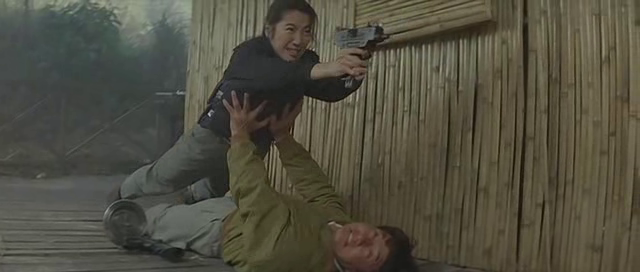
However, Jackie was not the only person whom the movie has taken its toll on. Michelle Yeoh not only had to jump with a bicycle on a train, but she also had to jump on the hood of a car, which required multiple painful takes. In addition, Maggie Cheung badly injured herself while performing an actual fall out of a helicopter. If you have doubts as to how much blood, sweat, and tears went into making this sequel, all the evidence is present in the end credits’ outtakes.
 
In terms of trivia, it should be mentioned that this was the first Hong Kong film to use sync sound; thus, you can hear Jackie’s original voice (in Police Story 1 and 2, he was dubbed by a professional voice actor). Also, Police Story 3 got butchered by the Dimension Films in 1996: standard crappy English dub, music score replacement, scenes cut out, and some fight screams added. Sadly, the Dimension version is the most prevalent one on DVD for years.
 
Throughout the film, Jackie Chan is basically Jackie Chan, but Michelle Yeoh provides a worthy addition as his sidekick, Inspector Yang, (she rightfully deserved a spin-off movie called Project S (1993), directed by Stanley Tong). Maggie Cheung reprises her role as May, but her character is used mostly for comedic effects. Yuen Wah proves to be a great baddie with a prowess strong enough that he could carry the film as the lead, whereas Kenneth Tsang does a commendable job as the villainous, James Bond-like, madman. Interestingly, Josephine Koo, an award-winning actress still in the movie business, plays the supporting role of a wife in distress.
 
Recommendations
Highly recommended to anyone who is into action or new to Jackie Chan’s classics. Police Story 3 delivers everything required from an action flick and to date remains a steadfast point of Jackie’s filmography. I always enjoy going back to it in the moment of need. This movie is an excellent showcase of great stunt work before the advent of the CGI era. Putting it short, Police Story 3: Super Cop is a definite must-see.
Overall score: 9/10

A Better Tomorrow II (1987) [Film Review]

A Better Tomorrow II; or, Milking the Brand
     There’s only one way out and you’re coming with me. If we don’t fight, we’ll both die here. If we win, we’ll start all over again. I know you can do it, come on!
After the overwhelming success of the original A Better Tomorrow in 1986, the release of a sequel was only a matter of time. A Better Tomorrow II not only aspires to be bigger, louder, and more explosive, but also reunites the original cast for another triad tragedy epic. Does the sequel live up to the grandeur of the first movie? Let’s find out.
Release Info
Directed by: John Woo Starring: Ti Lung, Chow Yun-fat, Leslie Cheung, Deng Shek
Language: Cantonese Original Title: 英雄本色2 Runtime: 104 min
 
Plot
Sung Tse-Ho serves his time in prison after the events from the original film. The police offer him early parole in exchange for doing a spy job on Ho’s ex-mentor, Lung Sei (Dean Shek), who is suspected of counterfeiting. Ho agrees when his brother’s wife Jackie (Emily Chu) tells him that Kit (Leslie Cheung) is working on the case. Ho reunites with his brother and they decide to work together, but soon after, Lung is framed for murder and he flees to New York. Ho and Kit try to protect his daughter, but she is killed by the triads. Upon hearing devastating news, Lung loses his sanity. Meanwhile, it turns out that Mark had a twin brother called Ken... (Chow Yun-fat) who also happens to live in New York. After Ho’s phone call, Ken finds Lung and nurses him back to health while attempting to flee from assassins sent by the triads. Eventually, Ken, Lung, Ho and Kit reunite together in Hong Kong and they decide to take down the man who betrayed Lung and took over his organisation, Ko Ying-pui (Kwan Shan).
 
True Colours of a Hero Fading Out
I have to be honest here, this movie is a real mess. It is not entirely bad, in fact it has many redeeming features, but the visible issue that ruins the whole story is an obvious lack of a coherent screenplay. The original A Better Tomorrow was a perfectly enclosed story and it didn’t need to have a follow-up. Yet, the pressure from the studio (and possibly the producer Tsui Hark) forced John Woo to come up with something that could ensure a lot of action and Chow Yun-fat’s comeback.
 
The plot is the first and foremost disadvantage of A Better Tomorrow II as it has so many twists and turns that it took me quite a while to logically sum it up above. It feels almost as if the film has no leading character. It is Lung? Is it Ken? Is it Ho? Is it Kit? The numerous shifts in tone and focus leave you wondering about this without providing any answer. In the first movie, Ho was the clear protagonist, but the sequel doesn’t dare establish its hero as if being afraid to undermine the dominating presence of Chow Yun-fat.
 
Chow Yun-fat is another issue of the picture. Naturally not the actor himself as he tries to do the best he can with the new material, but the creative decision to bring him back by the lamest excuse ever: Mark Lee had a twin brother (A twist certainly taken from a Brazilian drama). So, what we get to see as the final product is Chow Yun-fat trying not to play Mark Lee... while playing Mark Lee at the same time. A truly dissociative experience which is enhanced further by an unintentional parody of Rain Man as Lung, Deng Shek’s character, goes full retard and Ken has to watch over him even during shootouts and explosions. Bottom line: never go full retard.
 
Another creative decision which I found controversial was (spoilers!) killing off Kit. Getting rid of his character completely contradicts the ending of the first movie which clearly emphasised that brothers should always stick together. Even in the middle of this sequel, there’s a great fight scene in which Ho (while being undercover) has to prove his loyalty to Ko Ying-pui by killing Kit. Of course, everything is done in such a way that Kit survives, but even this scene underlines the bond between Ho and Kit. However, everything is thrown out the window 20 minutes later when Kit gets shot by Vernon Wells’ impersonator in a super cheesy and overly melodramatic showdown.
 
Alas, it is not the end of Kit’s misery in the movie as he bleeds to death in a phone booth, held firmly by Chow Yun-fat, while speaking over the receiver to Jackie who just gave birth to their daughter. Kit names the child Sung Ho-yin (literally: the Spirit of Righteousness) and finally keels over in vain. The scene is so over the top that it could have very well been used in Loaded Weapon 1 (1993). The only positive thing about this moment is Emily Chu’s performance who gets to shine for a brief moment after being underused in the first movie.
 
Now, moving on to the positives. While definitely not being better than the original, A Better Tomorrow is indeed louder, bigger, and more explosive. While the action is kept mostly low-key throughout the first half, it shifts into high gear halfway through the picture. Chow Yun-fat makes killing the baddies almost as easy as mowing the lawn and this is the movie’s primary entertaining factor. In addition, I have to mention the memorable finale in which Lung, Ken, and Ho (with the assistance of the great Kenneth Tsang) kill over a hundred of miserable triad cannon fodder.
 
Also the soundtrack definitely improved in comparison with the first movie. However, Peter Gabriel’s cues from Birdy’s Escape can be heard here and there. Additionally, the visuals and fight choreography headed by Ching Siu-tung are great. Unfortunately, the movie led to a split between John Woo and Tsui Hark, with the latter singlehandedly directing A Better Tomorrow III: Love & Death in Saigon.
 
Recommendations
Summing up, A Better Tomorrow II is only for the hardcore fans of John Woo. If you really want to check it out, I suggest turning a blind eye on the shortcomings which I have discussed in this review and enjoy the movie for the many of Woo’s trademarks and some great action. In my opinion, the story should have gone in a completely different direction, but, in spite of its flaws, what’s left still makes up for a good entertainment. Only for one time view. Now moving on to A Better Tomorrow III!
Overall score: 5/10
[Update: Tsui Hark provides some stories about the making of ABT II in this interview.]

A Better Tomorrow (1986) [Film Review]

A Better Tomorrow; or, Friends will be Friends
     You should quit. Your brother doesn't know what you have been doing. Still remember? You two played cop & thief when you were kids. He almost lost, but he still wanted to be a cop. I don't want you to play the same game again.
My re-discovery of Asian crime drama classics continues, this time with John Woo’s unforgettable A Better Tomorrow, starring Ti Lung, Chow Yun-fat, and Leslie Cheung. A bloody epic about friendship, brotherhood, and moral integrity which paved the way for a whole genre of triad movies.
Release Info
Directed by: John Woo Starring: Ti Lung, Chow Yun-fat, Leslie Cheung
Language: Cantonese Original Title: 英雄本色 Runtime: 95 min
Synopsis
Sun Tse-Ho (Ti Lung) is a trusted triad member who deals with distributing counterfeit dollars. His loyal helper and best friend is Mark (Chow Yun-fat) who is a cool-hand shooter. On the other hand, there is Kit (Leslie Cheung), Ho’s younger brother who joined the police academy and intends to become an officer. Ho supports his brother’s career choice, but does not reveal to him his real line of business. Ho decides that he will make a one more distributing deal in Taiwan and then leave the Triad for good. He travels there with a new guy called Shing (Waise Lee); however, all hell breaks loose and Ho is betrayed. In order to allow Shing to escape he turns himself over to the Taiwanese police. Three years later, Ho gets out of prison and he is determined to start a new life. He comes back to Hong Kong only to find that Kit (now a police inspector) does not want to speak to him and that Mark is a crippled beggar. Shing became the new leader of the Triad and he offers Ho reinstatement in the organisation. Ho refuses, yet he quickly realises that his brother is in danger.
 
True Colours of a Hero
First off, I have to say that this John Woo at his best. I know that I’m just a foreigner who is excited upon seeing a movie that is already a cult classic in Asia, but A Better Tomorrow is so damn good. Undeniably way better than any movie Woo did during his Hollywood years. This film has the story, the stakes, the weight, the action, and the payoff. It is a beautiful, and highly romanticised, ode to male friendship which rises above the label of being just a standard “shoot’em up thriller”.
 
Well, what did I really like about this movie? Two things definitely stand out and these are the following: the screenplay and cinematography. Woo proves that he is a master of his craft with every scene that is so overloaded with aesthetics (see for example the opening sequence or Mark’s memorable restaurant assault) that they could be used for vaporwave MVs. In fact, with some soundtrack changes, A Better Tomorrow would make a great City Pop movie.
 
Even though the movie’s running time is 95 minutes, the story does not run at a rapid pace as we are allowed to get to know the main characters. The conflict of brothers, the cop vs. the thief, is perhaps the most disheartening one as we see Kit determined to prove his worth in the force by taking down the syndicate and Ho trying to live a straight path while being branded as the black sheep by his younger brother. In between them, there’s Mark- suave, almost a chivalric-like (Woo said something along these lines in an interview) avenger, who becomes Ho’s brother by friendship. These kinds of complicated relations and the tragic finale in which Ho struggles not to lose both of his brothers constitute the ultimate onscreen bromance.
 
With regard to performances, all of the main actors are unforgettable in their roles. Waise Lee effortlessly plays the villain, yet he does a much better job with similar material in Bullet in the Head. Emily Chu plays Kit’s girlfriend, Jackie, but her role is quite limited. In addition, even though Ti Lung and Leslie Cheung were very well known at the time of making the movie, Chow Yun-fat was mainly recognisable from his work on television. The portrayal of Mark became a breakthrough performance for him, although he was not the main lead. The success of A Better Tomorrow ensured Chow Yun-fat a continuous cooperation with John Woo (with The Killer (1989), Once a Thief (1991), Hard Boiled (1992)) as well as with other directors in Hong Kong and beyond. Chow Yun-fat gave life to Mark Lee, but it was Mark Lee who launched Chow Yun-fat.
 
Recommendations
If you are new to John Woo, I suggest skipping his Hollywood follies like Hard Target (1993), Face/Off (1997), or M:I-2 (2000) and try to discover the man at his roots. A Better Tomorrow is a great movie (and time) to start with. As I said earlier, it is a wonderful story about brotherhood and plain decency with gunfights and explosions in close foreground. People need more movies like this nowadays, especially when we are flooded with ideologically-driven blockbusters every month. We need modern knights with dark glasses, long coats, and pistols who take a stand in defence of their friends rather than to make a political statement. With A Better Tomorrow, as Ho and Kit are walking together handcuffed, I’m hoping for a real better tomorrow for modern cinema.
Overall score: 10/10