Showing posts with label 1992. Show all posts

Godzilla vs. Mothra (1992) [Tokusatsu Review]

Godzilla vs. Mothra; or, For Mother Earth!
     There isn't a job that is too tough for me, except, the one time I was married to a real stubborn woman.
I am back at my revisitation of Godzilla movies. This time, I would like to focus on the fourth instalment of the Heisei series, Godzilla vs. Mothra from 1992. This text is going to be actually a re-review, but I have already discussed this film on the blog years ago, but I felt that my initial reaction was too crude and too emotional. So here it is: my new thoughts on one of my least favourite Godzilla films.
Release Info
Directed by: Takao Okawara Starring: Tetsuya Bessho, Satomi Kobayashi, Takehiro Murata
Language: Japanese Original Title: ゴジラ対モスラ Runtime: 102 min
Synopsis
A large meteoroid crashes in the Ogasawara Trench and awakens Godzilla. An explorer Takuya Fujito (Tetsuya Bessho), his ex-wife Masako (Satomi Kobayashi), and a representative of the Marumoto company Ando (Takehiro Murata), go to the Infant Island and discover the hidden egg of Mothra which is guarded by two representatives of an ancient civilisation known as the Cosmos. They explain that thousands of years ago Mothra used to fight Battra, a monster created by the Earth’s ecosystem as a punishment for the Cosmos’ vanity. The team decides to transport the egg to Japan, but Mothra hatches while en route. What is more, it turns out that Battra got reawakened as well. With Godzilla thrown into the mix, all three monsters rush for a showdown in Yokohama.
Mothra Strikes Back
As I have already mentioned in my review of Godzilla vs. King Ghidorah (1991), Toho had various plans for a follow-up, including making a direct sequel that would bring back the Big G’s arch-nemesis once again. However, special effects director Koichi Kawakita together with Minoru Yoshida and Marie Terunuma submitted a script called Godzilla vs. Gigamoth, which was inspired by an unmade Mothra vs. Bagan story. In its essence, the basic storyline is very similar to the final film, but the main difference is the fact that Godzilla fights an amalgam of a good Mothra and evil Mothra in the finale. It is unknown whether the series veteran Kazuki Omori read the script for Godzilla vs. Gigamoth or maybe he based his premise on Mothra vs. Bagan, but under the supervision of producer Tomoyuki Tanaka he penned his own screenplay that was ultimately filmed.
It is clear from the get-go that Toho wanted to cater to as many groups of cinema-going audiences as possible. Women constituted the majority of moviegoers in Japan in the mid-1990s, so it goes without saying that bringing back Mothra was a logical decision. However, the film also tries as hard as possible to be family-friendly: we get light action (see the first act being a rehash of Indiana Jones), parental conflicts, twin fairies (who are not actual twins) and an Oblivion NPC child who struggles to be kawaii in every scene.
Well, the strategy worked for Toho because Godzilla vs. Mothra turned out to be a massive box office success, basically financing the rest of the Heisei era movies. Nevertheless, this movie is not by any means decent. The pacing is uneven, the editing is jarring at times, and all the action reaches a standstill in the second act because there has to be room for family-friendly drama (Fujito actually tries to sell the Cosmos, but Mothra rushes to save them).
I believe the main cause of these issues is the direction done by Takao Okawara. Indeed, this man is an experienced director who worked with the best of the best, serving as an associate director on Akira Kurosawa’s and Kihachi Okamoto’s films, but in my opinion, Okawara fundamentally does not understand Tokusatsu action. He finds it hard to tell a compelling story with Kaiju monsters at the helm. All of his Godzilla films have grand finales, but the middle segments are frequently forgettable.
With regard to special effects and cinematography, Godzilla vs. Mothra is the film that has the best looking Heisei Godzilla. I just love all the close ups of the new BattleGoji suit worn by Kenpachiro Satsuma. What is more, Koichi Kawakita did an amazing job with the battles between Godzilla, Battra, and Mothra; however, the moves of the latter two monsters are a bit clunky at times. The underwater sequences are also great to look at.
Speaking about additional advantages, Akira Ifukube obviously delivers yet another brilliant music score as the film’s composer. Of course, he reuses and repurposes Yuji Koseki’s Song of Mothra from the original 1961 film, but this piece of music is so synonymous with the Queen of the Monsters that it is a given it accompanies her all the time.
With regard to performances, all the actors and actresses feel like a wasted opportunity. Tetsuya Bessho has a more commanding presence than Isao Toyohara from the previous film, but most of the time he is forced to play an Indiana Jones/Han Solo type of guy, which does not add anything to the film. The always-wonderful Satomi Kobayashi plays a bitter ex-wife and her character's objective is to either comment on the monster action or carry the Cosmos around in a special basket. Veterans of the series, such as Akira Takarada, Megumi Odaka, Akiji Kobayashi, and Yoshiko Tanaka do not have anything compelling to do apart from standing in front of giant monitors and observing the monster rumble.
Recommendations
All things considered, I did not hate Godzilla vs. Mothra as much as I did during the first viewing. Still again, I regard it as a deeply flawed entry in the Godzilla franchise. The Big G deserved better and Mothra deserved better as well. Ultimately, she received better treatment in the Rebirth of Mothra Trilogy, and Millennium entry Godzilla: Tokyo SOS (2003).
Overall score: 6/10
«Enjoyed this post? Never miss out on future posts by following us»

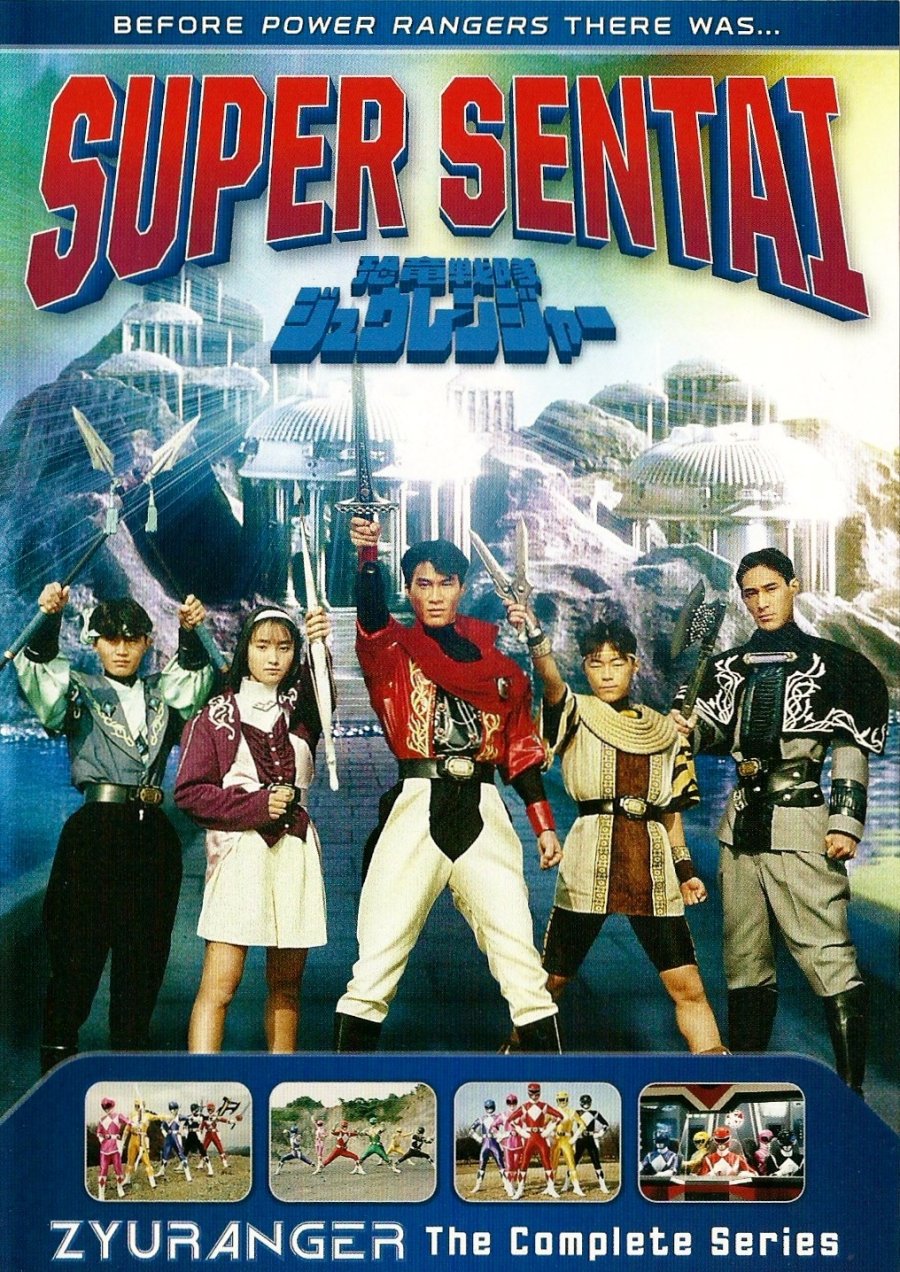
Kyōryū Sentai Zyuranger (1992) [Tokusatsu Review]

Kyōryū Sentai Zyuranger; or, The Heroes’ Journey
     Five warriors from the prehistoric era of dinosaurs have been reborn in the present day!
I think that time has come for me to tackle one of the most popular Super Sentai shows out there. For two years now, I have been meaning to review Kyōryū Sentai Zyuranger [Dinosaur Squadron BeastRanger] (1992), but considering the fact that the show is as old as I am, all was said and done about it already. Even though my thoughts may turn out to be bland, I still want to share an opinion on the show without which we would not have Mighty Morphin Power Ranger in the West.
Release Info
Developed by: Noboru Sugimura Starring: Yuuta Mochizuki, Seiju Umon, Hideki Fujiwara, Takumi Hashimoto, Reiko Chiba, Shirou Izumi, Machiko Soga
Language: Japanese Original Title: 恐竜戦隊ジュウレンジャー No. of eps.: 50
Synopsis
170 million years ago, there was an ancient civilisation of humans who evolved from dinosaurs. They defeated an evil witch called Bandora (Machiko Soga) and locked her away on a distant planet. In the present day, Bandora is accidentally reawakened and now she tries to conquer Earth yet again. Barza (Jun Tatara), an ancient wizard, wakes up five young warriors: Geki [TyrannoRanger] (Yuuta Mochizuki), Goushi [MammothRanger] (Seiju Umon), Dan [TriceraRanger] (Hideki Fujiwara), Boi [TigerRanger] (Takumi Hashimoto), and Mei [PteraRanger] (Reiko Chiba), from suspended animation. With the power of prehistoric dinosaurs known as Guardian Beasts, they have to stop Bandora before it’s too late.
 
Zyuranger vs. Power(ful) Rangers
Kyōryū Sentai Zyuranger comes as a sort of an odd entry in the Super Sentai franchise because it tried to distance itself from other shows. Its immediate predecessor, Chōjin Sentai Jetman [Birdman Squadron Jetman] won the viewers with a serious tone and complex characters. Zyuranger, on the other hand, not only broke with the science-fiction convention (choosing fantasy, instead), but also became more lighter in tone, seeking to recapture the child audience.
 
The result is the story about courageous warriors who bring the sword of justice upon an evil witch. Indeed, the series is full of monster-of-week shenanigans with the heavy-handed usage of children as supporting characters in many episodes; however, there is also a place for much needed pathos, interesting subplots, and character development. Probably, this is why I like Zyuranger so much.
 
If you’re patient, after getting through a dozen of episodes involving children in distress (and after wondering about how ancient warriors can befriend random children so easily, with their parents being totally fine with this), you are in for a real treat. For the first 20 episodes, Zyuranger conditions the viewers to believe in certain patterns, but thankfully, these are done away with when the heroes find themselves in the darkest hour. For instance, I love the subplot involving Burai [DragonRanger] (Shirou Izumi). In addition, the evil witch turns out to be actually a complex character with a backstory. These aspects really seem as if taken from Joseph Campbell’s monumental work The Hero of a Thousand Faces (1949).
 
Zyurangers themselves also experience a fair share of trials and tribulations along the way, be it resurrecting the Guardian Beasts or fighting with Great Satan. After 50 episodes, you feel that you went to hell and back together with these rangers. I really liked their personalities and the fact that they never gave up, even in the silliest stand-alone episodes.
 
Speaking about stand-alone stories not connected with the overarching arc of defeating Bandora, not all of them are weak. For example, I loved such episodes as when Mei [PteraRanger] had to single-handedly fight against Lami (Ami Kawai), Bandora’s secret agent, or when Dan [TriceraRanger] tried to make a living by working at a ramen shop. Also, I absolutely liked the stories with full fantasy vibes (saving dinosaur eggs, battling Genie, fighting in the spiritual world).
 
It has to be noted that without Zyuranger, there would be no Power Rangers. Producer Haim Saban tried to adapt Super Sentai since he saw Bioman on TV, but the production was green-lit only around the time when Zyuranger hit the TV screens. It still boggles my mind that as a young lad I was watching half of an American show and half of a Japanese one. Thankfully, Kyōryū Sentai Zyuranger was released on DVD in its unaltered form by Shout Factory! in 2015.
 
Recommendations
Zyuranger is an awesome Super Sentai series due to plenty of action, great music (that theme song!), and the wonderful fantasy world with mecha dinosaurs. Zyuranger is the hero journey unlike any other. Maybe I’m too subjective, maybe it’s because the show aired during the year of my birth, but I will always look at Kyōryū Sentai Zyuranger with fondness and nostalgia. If you want to start your journey with Super Sentai, then give Zyurangers a chance. Minna Henshin! Dino Buckler!

Police Story 3: Super Cop (1992) [Film Review]

Police Story 3; or, Super Cop with a Vengeance
     Super cops in Hong Kong are cheap and plentiful like commodities in supermarkets.
It took 5 years for Jackie Chan to become convinced by a young, up-and-coming director Stanley Tong to make a third Police Story movie. The end result became an unforgettable rollercoaster of awesome action set pieces and the finest entry in the Police Story trilogy. I’m talking about Police Story 3: Super Cop.
Release Info
Directed by: Stanley Tong Starring: Jackie Chan, Michelle Yeoh, Yuen Wah, Maggie Cheung
Language: Cantonese Original Title: 警察故事3超级警察 Runtime: 95 min
 
Synopsis
Chinese authorities are plagued with drug smuggling business run by a ruthless criminal called Chaibat (Kenneth Tsang). They decide to carry out a joint HK-China operation in order to break up the crime lord’s smuggling ring. Inspector Ka-kui is sent to Guangzhou where he teams up with Inspector Jessica Yang (Michelle Yeoh). The two go undercover and rescue Panther (Yuen Wah), Chaibat’s right-hand man. This becomes their pass into the organisation, and they soon after find themselves helping to stage a jailbreak of Chaibat’s wife (Josephine Koo) in Kuala Lumpur. However, Ka-kui’s real identity is exposed and now he has to save his girlfriend May (Maggie Cheung) as well as chase after Chaibat.
 
Think Fast, Look Alive, Kick Hard
Police Story 3 does not waste time as it goes from a straightforward exposition into breathtaking stunts. Contrary to the previous two movies, the storylines of which seemed to have been crafted around action set pieces, the plot line in this one appears to be the easiest to follow as Jackie and Michelle work together to get through Yuen Wah to Tsang.
 
However, while I personally find this part as the best of the series, it still carriers some of the series’ shortcomings, like, for example, evident absence of grittiness (serious stuff is only subtly hinted at: girls dying from drug overdose) which got replaced by usual Jackie’s shenanigans (hiding from May; Inspector Yang posing as Ka-kui’s sister), but these quickly pale in the blinding light of fast-paced action.
 
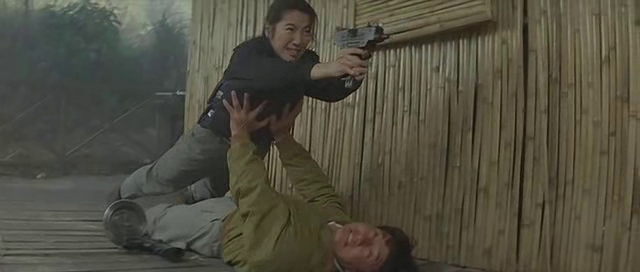
Super Cop does not offer a bus chase or exploding factory, but in turn, we get to see a boat chase, criminals’ base camp scorched to bits, and the outstanding finale in Kuala Lumpur which is a top-notch 10 minutes long sequence. Basically, everybody just remembers the moment of a helicopter landing on a speeding train (no CGI!), but for me, the best part is Jackie hanging hundreds of feet above Kuala Lumpur's downtown. In an interview, Jackie recalled fearing this stunt as he was attached to the helicopter’s ladder only by steel wires.
 
However, Jackie was not the only person whom the movie has taken its toll on. Michelle Yeoh not only had to jump with a bicycle on a train, but she also had to jump on the hood of a car, which required multiple painful takes. In addition, Maggie Cheung badly injured herself while performing an actual fall out of a helicopter. If you have doubts as to how much blood, sweat, and tears went into making this sequel, all the evidence is present in the end credits’ outtakes.
 
In terms of trivia, it should be mentioned that this was the first Hong Kong film to use sync sound; thus, you can hear Jackie’s original voice (in Police Story 1 and 2, he was dubbed by a professional voice actor). Also, Police Story 3 got butchered by the Dimension Films in 1996: standard crappy English dub, music score replacement, scenes cut out, and some fight screams added. Sadly, the Dimension version is the most prevalent one on DVD for years.
 
Throughout the film, Jackie Chan is basically Jackie Chan, but Michelle Yeoh provides a worthy addition as his sidekick, Inspector Yang, (she rightfully deserved a spin-off movie called Project S (1993), directed by Stanley Tong). Maggie Cheung reprises her role as May, but her character is used mostly for comedic effects. Yuen Wah proves to be a great baddie with a prowess strong enough that he could carry the film as the lead, whereas Kenneth Tsang does a commendable job as the villainous, James Bond-like, madman. Interestingly, Josephine Koo, an award-winning actress still in the movie business, plays the supporting role of a wife in distress.
 
Recommendations
Highly recommended to anyone who is into action or new to Jackie Chan’s classics. Police Story 3 delivers everything required from an action flick and to date remains a steadfast point of Jackie’s filmography. I always enjoy going back to it in the moment of need. This movie is an excellent showcase of great stunt work before the advent of the CGI era. Putting it short, Police Story 3: Super Cop is a definite must-see.
Overall score: 9/10

Hard Boiled (1992) [Film Review]

Hard Boiled; or, Die Hardest
     Give a guy a gun, he thinks he's Superman. Give him two and he thinks he's God. Give a guy a gun, he thinks he's Superman. Give him two and he thinks he's God.
Cited by many as “the greatest action film of all time” and “arguably Woo’s masterpiece” which is “more exciting than a dozen Die Hards”, Hard Boiled was the last movie before John Woo’s departure to Hollywood in the early 1990s. Having seen it years ago (and being blown away by the action), I wonder how the movie holds up when revisited today. Without further due, let’s take a look at Hard Boiled.
Release Info
Directed by: John Woo Starring: Chow Yun-fat, Tony Leung Chiu-wai, Teresa Mo, Anthony Wong Chau-sang
Language: Cantonese Original Title: 辣手神探 Runtime: 128 min
 
Synopsis
Hong Kong, 1992. Police officer “Tequila” Yuen (Chow Yun-fat) tries to eradicate the gun smuggling business which is being controlled by rival Triad syndicates. However, this results in a brutal war between the police and the Triads. In the meantime, Superintendent Pang (Philip Chan) has placed his own trusted man, Tony (Tony Leung Chiu-Wai), as an undercover cop in one of the syndicates. Tequila is not aware of this and he quickly escalates the situation with one of the Triad bosses, Wong (Anthony Wong Chau-sang), while relying on info from his own informant in the syndicate. Soon after, Tequila crosses paths with Tony and learns about his true identity. The two cops discover that Wong has a huge weapons warehouse beneath Maple Group Hospital. They step into action, but the psychotic gangster does not let himself get busted that easily as he takes all patients hostage at the hospital.
 
Hard Boiled Action, Soft Boiled Screenplay
Without a doubt, Hard Boiled is a classic picture and a landmark of action cinema, praised by the critics and film scholars, which still looks impressive today. Nevertheless, I disagree with the claims that this film is Woo’s finest directorial achievement. Naturally, it cemented his reputation as the master of action genre and it also allowed him to break away from the label of a guy who can only make gangster epics, as this film definitely glamorises the police. Still again, apart from mind-blowing stunts, great ensemble cast, and jazz music score, Hard Boiled suffers greatly in terms of a screenplay.
 
Evidently the plot as a whole is not the issue, because it serves, similarly to Die Hard (1988), as an excuse to provide breathtaking action set pieces, but the very little connections here and there which tie the events together (getting the characters from point A to point B) are the excruciating disadvantages which negatively influenced my enjoyment of the movie. Here are some of the examples:
 
1. After finding the way to the gun warehouse, Tony closes the door behind him and Tequila. He just shrugs it off as if nothing happened and later they are forced to blast their way out with grenades. (Quick fix: the door automatically shuts behind them.)
 
2. Tequila informs Teresa (Teresa Mo) that he will send her flowers as a signal to begin the evacuation of the patients (after which he puts a flower in her pocket). (Quick fix: Wouldn’t it be easier just to tell her to begin the evacuation in about 20 minutes?) What would have happened if she had not found a flower in her pocket?
 
3. The ambiguous “dead cop” subplot: In the teahouse, it is clearly visible that Tequila does not shoot any cop, but his partner is killed by one of the gangsters. Later in the film, Tequila tells Tony that he “killed a cop” during the teahouse raid. How? When? (My guess: this scene was cut out).
 
4. Tequila takes Foxy (Tung Wei) to Maple Group hospital after he told him that the Triads stash their guns there! (Quick fix: Foxy should tell him that already in the hospital).
 
5. Putting out the fire with piss… This sequence is so hilarious that it’s forgivable.
Well, I have enumerated a handful of issues which result from incoherent script. I am not a nitpicker and I really hate calling out such things. Hard Boiled aspires to bring out the best out of visual entertainment and it certainly delivers on that front, but the plot holes make the memorable characters look like idiots running in a fog.
 
Yet, I guess that I should be grateful for what the screenplay officially became in the end, as John Woo and his team had so many difficulties with developing it (for example, the original plot about Tony Leung poisoning children was dropped). Then, the screenwriter Barry Wong passed away halfway through the rewrites and the teahouse raid was filmed without any script whatsoever.
 
Summing up, here is my conclusion about this movie: action-wise: it knocks off every competition; story-wise: it lags behind. Hence, I do not regard it as John Woo’s “all time best of the best”. This status rightfully belongs to Bullet in the Head (1990). However, Hard Boiled is still a wonderful fun as well a great lesson in filmmaking for any prospective action director. My praise goes especially to Chow Yun-fat and Tony Leung who work so well together on screen. It’s also great to see Teresa Mo, but she has only one shootout scene in the entire film. In addition, Anthony Wong shines as the bad guy, but he is significantly overshadowed by Philip Kwok as Mad Dog.
 
Recommendations
Hard Boiled is the equation mark between John Woo and action. Go ahead, grab the movie, and check it out for its stunning stunts, explosions, and shootouts. At the same time, make sure to suspend your disbelief during blatantly obvious plot holes which disrupt the flow of the picture. Upon further thought, it is quite a shame that we were given a sequel to Hard Boiled only in form of a video game. Officer Tequila deserves a movie comeback.
Overall score (screenplay: 4/10, action 10/10, thus ultimately): 7/10