Showing posts with label post-war. Show all posts

Stray Dog (1949) [Film Review]

Stray Dog; or, Lethal Weapon in Japanese style
If it wasn't a Colt...
         ...it'd have been a Browning.
Before Akira Kurosawa became famous internationally with his critically acclaimed picture called Rashomon, he directed a string of seven movies that made his name recognisable throughout Japan. The last of these early movies, made in 1949, was Kurosawa’s take on the noir genre entitled Stray Dog.
Release Info
Directed by:Akira Kurosawa Starring: Toshiro Mifune, Takashi Shimura, Keiko Awaji
Language: Japanese Original Title: Nora Inu Runtime: 122 min
Plot
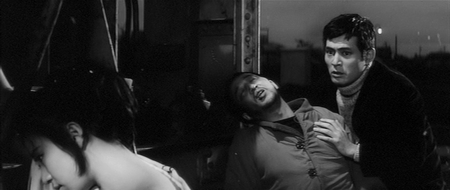
It’s a same old story. A cop is riding in a trolley, he is surrounded by a thick crowd of passengers, exhausting heat is pouring down from the sky, and the cop’s gun gets snatched... Thus, a rookie detective Murakami has to delve deep into the underworld of poverty and crime in order to retrieve his precious colt. When it turns out that the stolen gun is used in a robbery and later in a murder, Murakami teams up with an experienced homicide detective Sato and now the two cops are chasing after a mysterious culprit with the colt, nicknamed by them as Stray Dog.
Cops’n Guns
Stray Dog is a highly unusual selection in Kurosawa’s repertoire. Hell, it stands out as a sore thumb from his tales about samurai, nostalgic dramas, or human interest stories. Actually, Stray Dog is the very first type of a buddy cop movie. Even though Kurosawa did not have high regard for this particular entry in his filmography, it cannot be denied that even today the movie has a real impact on the viewer.
We follow the story of Murakami, a hard-boiled and impatient police officer who acts first and thinks later. The cop is so ashamed by the loss of his gun that is even able to spend days and nights hopelessly looting on the backstreets of Tokyo so as to track down any gun dealer. Unfortunately, his official gun is already in usage of a very dangerous man and only the assistance of a police veteran Sato can help Murakami to stop the menace. Surprisingly, during an intensive investigation, the involuntary partners grow quite fond of each other. Murakami’s youthful spirit is a great equaliser for Sato’s sentimentality forbearing, which enables them to get closer and closer to Stray Dog by following a long line of questionable leads. As a result, it is even more heartbreaking to watch when the two cops have to risk with their lives in the final, extremely ironic and grotesque, sequence of the movie.
Another social statement from good old Kurosawa
Of course, it wouldn’t be his movie, if there hadn’t been a special message for the audience. In Stray Dog, Kurosawa makes his first attempt to “justify the wrongdoer”. As the story develops, the viewers together with Murakami and Sato gradually discover that Stray Dog is just a scared and desperate man, a pitiful victim of circumstances who made some bad choices after WWII. However, such presentation of a villain does not clearly work here, at least in my perception. I can understand that a man pushed to his limits can eventually resolve to buy an illegal gun and rob somebody, but also resort to murdering someone? This is way out of the line. Kurosawa did much better job with transforming a villain into an anti-hero in case of his later movie called High and Low (already reviewed). At least in that movie, the kidnapper wasn’t shooting anybody.
Recommendations
I safely recommend this film to everyone who is a fan of Kurosawa and noir genre in general. Because honestly, this is a detective/buddy cop flick at its best with awesome performances delivered by young Toshiro Mifune and already acclaimed Takashi Shimura. Stray Dog is a unique gem that every movie buff should watch.
Overall Score: 8/10

Cash Calls Hell (1966) [Film Review]


I never imagined you would be so stupid when I chose you...
            Now,  to save a little girl,  I decided to be stupid.
This week’s review will be about one of the earliest and a somewhat forgotten movie from Hideo Gosha’s rich directorial repertoire. A black-and-white picture from 1966 about a decadent lifestyle of the citizens of post-war Japan as well as an unexpected bond formed between a stranger and a child.
Release Info
Directed by: Hideo Gosha Starring: Tatsuya Nakadai, Yukari Uehara, Kunie Tanaka, Kaneko Iwasaki
Language: Japanese Original Title: Gohiki no shinshi Runtime: 92 min
Plot
Oida (played by always amazing Tatsuya Nakadai) used to be a lower-class guy who through a hard work managed to get at the top. He is due to marry a wealthy woman and takeover a prosperous company. However, one night, Oida causes a traffic accident in which a bystander and his daughter die. Thus, in a split second, he loses everything he struggled so long to achieve and gets sentenced to prison. After serving his time, on the last day of his stay, Oida decides to accept an interesting offer from his cell-mate: kill three specific people and get 15 million yen for the job. When finally out, Oida reluctantly tracks down his first victim, but it turns out that somebody else already killed the guy. Oida has found himself in the middle of a dangerous mystery and the key to unravel it is to find the two other listed men and discover what happened on a certain tramway depot two years earlier.

Blood Money 
Cash Calls Hell may be neither a crime film, nor a noir one, but certainly it is a night movie, for the majority of the action happens under cover of darkness. Tatsuya Nakadai’s Oida is a standard everyman who by a malicious twist of fate becomes an ex-convict. He finds himself on the run through dark and devastated back-allies of Tokyo, shabby cabarets, old docks, and dilapidated buildings; all of which are inhabited by people just like him, individuals who had a shiny future before them, but fell from grace right at the very bottom of the social ladder.
Oida feels quite uncomfortable with the job he has to do, but nevertheless, he knows that there is no coming back to luxurious lifestyle for the ones of his kind. He makes a shy attempt to kill the first victim, but fails to do so. Instead, mobsters from Hong Kong do the job and leave Oida with the victim’s orphaned daughter who constantly follows our hero and calls him “Uncle”. Oida realises that he can’t bring himself to kill anyone despite his new role of a criminal in the Japanese society, but he resolves to press on and find out into what exactly he got himself involved.
The truth is quite unnerving. Three ordinary men, who used have big dreams in the past, committed a robbery. As a result, these men end up exactly like Oida. Even more so, they are ruthlessly murdered by mobsters who want to reclaim their stolen commodities. Hideo Gosha’s presentation of visually morbid murder scenes became an irreplaceable trademark throughout his films, but those scenes always served a certain purpose. Gosha provides a comment on the socio-economic situation of post-war Japan, through stories of people who in order to escape the constraints of their degrading lives commit a crime and thus end up dead in abandoned, almost post-apocalyptic, back-streets and gutters. Even Akira Kurosawa didn’t manage to make his moralistic points so clear in, for instance, Stray Dog (1949) or The Bad Sleep Well (1960).
Interesting in Cash Calls Hell is also the parallelism of Oida’s life. At the beginning of the movie, he accidentally runs over a father and his daughter, whereas, towards the end, he himself becomes “a father” for orphaned Tomoe. Needless to say, these little moments between Oida and Tomoe throughout the film are the true highlights of this picture. The little girl becomes a sort of a redemption, atonement for the past misdeeds of Oida, which is visible especially in the scene when witnessing a heated argument between Oida and one of the men who participated in the heist, the girl throws a shoe so as to defend her Uncle. To me, this film provides the best depiction of a relationship between an adult and a child, even surpassing such an immortal classic as Charlie Chaplin’s The Kid (1921).
Recommendations
If you want to see morally conscious cinema with a bit of action and drama, Cash Calls Hell is the movie for you. Unlike Gosha’s other flicks, this is not a chambara film, yet it is by no means an inferior picture. Give it a go and you won’t be disappointed. Just remember to prepare a packet of tissues beforehand.
Overall score: 8/10