Showing posts with label tatsuya nakadai. Show all posts

Yojimbo (1961) [Film Review]

Yojimbo; or, A Fistful of Ryo
      Listen, old man. I’ll get paid for killing. And this town is full of men who deserve to die. Think about it. Sebei, Ushitora, the gamblers and drifters; with them gone, the town would have a fresh start.
Yojimbo (1961) is yet another classic samurai film directed by the master of filmmaking Akira Kurosawa. The story about a mysterious ronin who cleans up the town from bad guys became so popular that it spawned a sequel, Sanjuro (1962), two unofficial continuations (Incident at Blood Pass and Zatoichi Meets Yojimbo from 1970), and countless remakes, the most popular of which is Sergio Leone’s A Fistful of Dollars (1964). Let’s take a look at Toshiro Mifune’s, arguably, most iconic role:
Release Info
Directed by: Akira Kurosawa Starring: Toshiro Mifune, Tatsuya Nakadai, Eijiro Tono
Language: Japanese Original Title: 用心棒 Runtime: 110 min
 
Synopsis
Japan, 1860s. After the fall of the Tokugawa Shogunate, many samurai became masterless. One of them, calling himself Kuwabatake Sanjuro (Toshiro Mifune), wanders aimlessly through a desolate countryside. He eventually reaches a small town that is the battle ground between two rival gangs. Ushitora (Kyu Sazanaka), with the help of the town’s major (Kamatari Fujiwara), wants to fully control the town, but Sebei (Seizaburo Kawazu), supported in turn by the sake brewer (Takashi Shimura), also has the same aspirations. Sanjuro wittingly decides to set in motion a game that will lead to the annihilation of the two gangs. Unfortunately, his plans are interrupted with the arrival of Unosuke (Tatsuya Nakadai), the younger brother of Ushitora.
The Honour of a Samurai
I have seen Yojimbo for the first time 6 years ago, on Criterion DVD, and it instantly became one of my all-time movies, together with Kurosawa’s direct sequel Sanjuro. Toshiro Mifune is undeniably too cool for school as a shabby ronin who tricks the baddies and settles the score.
 
The story itself may be a bit hard to follow upon initial viewing because there is a short exposition riddled with many characters, but you can get the gist of what is going on as Kuwabatake Sanjuro slashes his way through expendable rogues. I will never get enough of a scene in which he rescues a family in distress!
 
If you are a Star Wars fan, then keep an eye out for an “arm cut” sequence that George Lucas repeated verbatim in A New Hope. Part of me likes to think that the plotline of Yojimbo is exactly what happens to Obi-Wan during his 20-year-long stay on Tatooine. (On a side note, did you know that Toshiro Mifune was originally offered the part of Obi-Wan Kenobi?)
Going back to the movie, Yojimbo was allegedly inspired by a 1942 film called The Glass Key, but the researchers of Kurosawa also point at Dashiell Hammett’s Red Harvest (1929) novel as a major source of inspiration. Regardless of the influences, Yojimbo remains one of the first action stories with a nameless hero as the protagonist (Sanjuro actually makes up his name in the two movies).
 
With regard to performances, Toshio Mifune is evidently awesome as Sanjuro. Second best performance is the one of Tatsuya Nakadai as the malevolent samurai with a revolver. Nakadai is currently 87 and I wish him long, healthy years, because he is one of the few living legends from the Kurosawa era who are still around. Yojimbo has also many supporting parts done by frequent collaborators of Kurosawa, including Takashi Shimura, Eijiro Tono, and Susumu Fujita.
 
In addition, the music score by Masaru Sato is just amazing. It feels very experimental, yet it perfectly fits every scene. I absolutely agree with an interpretation that the jaunty sounds of flutes and big band are meant to reflect Sanjuro’s state of mind.
Recommendations
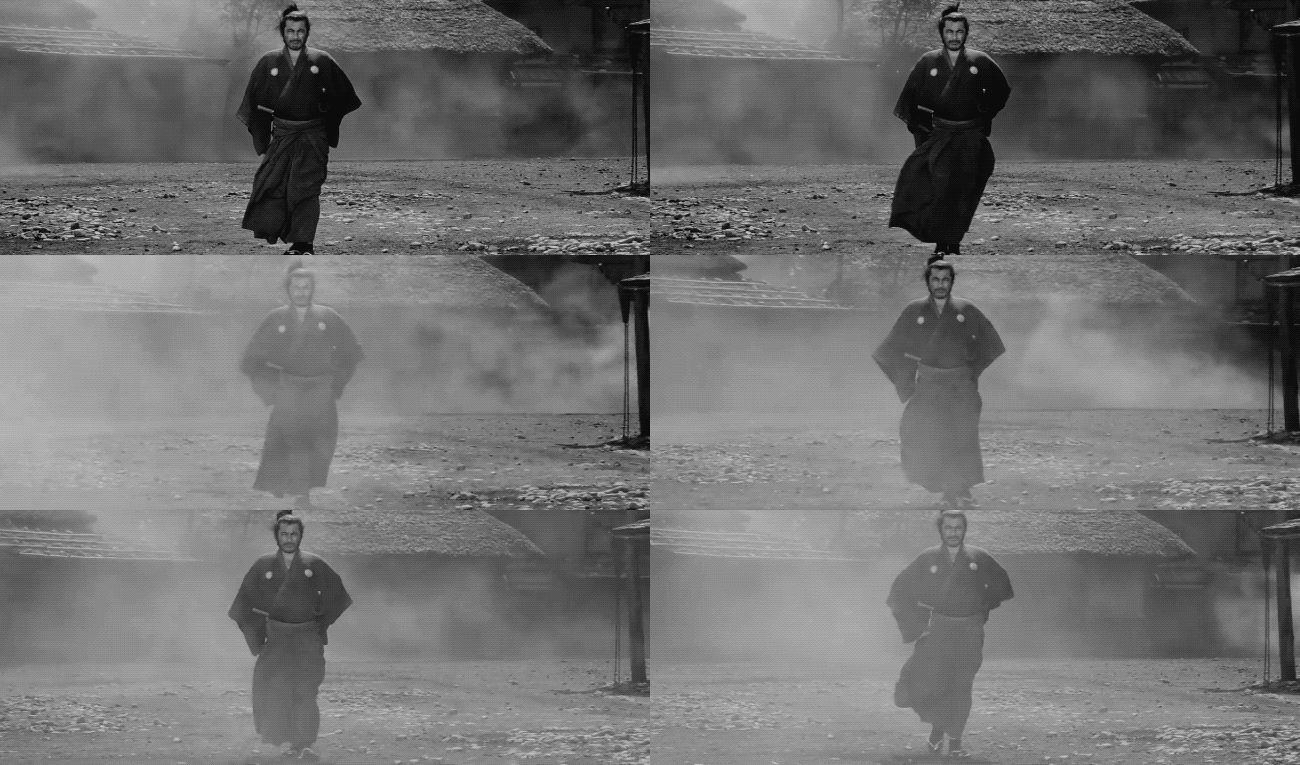
Highly recommended to anyone who wants to explore the lighter stuff of Akira Kurosawa’s impressive filmography. Yojimbo is a wonderful story that blends action, satire, and folk tale. If you have enjoyed a Fistful of Dollars with Clint Eastwood, then Yojimbo will be even greater entertainment. Check it out if you can because this film is a true 60-year-old gem. Gusts of wind have never been so epic.
Overall score: 9/10

Ran (1985) [Re-upload] [Film Review]

Ran; or, King Lear done right
     In a world gone mad, it’s madness to be sane.
The herein review was created out of my conference presentation about King Lear in late 2015. Later, the post-conference publication was in preparations, so I deleted the review as I incorporated some of the excerpts into the article. However, the publication never came to fruition, thus I decided to re-upload the original review.
Release Info
Directed by: Akira Kurosawa Starring: Tatsuya Nakadai, Daisuke Ryû, Mieko Harada, Yoshiko Miyazaki
Language: Japanese Original Title: Ran Runtime: 160 min
 
Plot
Set in the Sengoku period, we follow the life of Lord Hidetora Ichimonji (played by the epic Tatsuya Nakadai) who decides that it’s high time to retire and thus divides the kingdom between his three sons Taro (Akira Terao), Jiro (Jinpachi Nezu), and Saburo (Daisuke Ryû). Needless to say, Saburo is the only son sane enough to warn his father about probable disloyalty of his offspring, but Hidetora rejects such accusation and banishes the youngest heir, giving only Taro and Jiro a share in the land. Well, not very long afterwards, it turns out that indeed Hidetora’s sons turn against him, stripping him of his title and massacring his troops. Devastated and on the brink of madness Hidetora, with a faithful Fool (Pîtâ) to accompany him, is on the run through a raging war in Ichimonji kingdom. The father’s only hope for redemption is his rejected son Saburo.
 
The pain of adapting Shakespeare
Obviously, as with the rest of Shakespeare’s plays, King Lear has had countless cinematic adaptations with many big-name actors starring in the leading role, and Kurosawa already had his takes on Shakespeare before with the famous Throne of Blood and The Bad Sleep Well. However, it was twenty years after these two films when he finally decided to make Ran. On a side note, the title is not an English verb, but a Japanese word meaning “chaos”. In a nutshell, we can sum up Ran as a pessimistic study of the lust for power, betrayal of the father, and the outbreak of morbid wars. This film is the most grim, dark, and depressing motion picture out of the whole of Kurosawa’s repertoire, completely contradicting the social and often optimistic messages of his previous films (such as Seven Samurai, Yojimbo, and Sanjuro).
 
Lesson of the Three Arrows
Allegedly, Kurosawa became inspired by the so-called “Lesson of the Three Arrows,” a tale about a Japanese warlord who handed each of his sons an arrow, asking each to break it. Then handed each son three arrows, requesting all three be broken together. The inability to do so implied the message “united we stand”. However, Kurosawa stated the following: “When I read that three arrows together are invincible, that’s not true. I started doubting, and that’s when I started thinking: the house was prosperous and the sons were courageous. What if this fascinating man had bad sons?”
That’s why Lord Hidetora has sons in the story (not daughters, as in the play): Taro (first son), Jiro (second son), and Saburo (third son); and it’s the youngest of the whole bunch who breaks the three arrows by snapping them against his knee, reiterating in this way the horrible truth to his ignorant father.
King Lear vs. Lord Hidetora
Highly interesting is the also the change which Kurosawa made with regard to the main character of the tragedy. In the play, we get to know that Lear was the king of Britain, a man “more sinned against than sinning”, and a blind ignorant trying to be the king without any responsibilities. Paradoxically, Kurosawa wanted to create “Lear with history,” a man haunted by his past misdeeds. In contrast to Lear, Hidetora is, or used to be, a bloodthirsty monster, a tyrant who created his kingdom out of the ashes of conquered lands by ruthlessly killing women and children. Naturally, the obvious choice to play such a badass character would be Toshiro Mifune who did an amazing job in the previous Kurosawa’s adaptations of Shakespeare, yet considering the fact that Mifune and Kurosawa were cross with each other since the making of Red Beard, a not so obvious second-choice man was hired for the part.
 
In my opinion, Tatsuya Nakadai in Ran gave the most outstanding performance in his entire acting career. Crappy latex make-up to make him look like an 80-year-old did not stop Nakadai from the stealing the show for himself and providing one of the most interesting as well as menacing interpretations of Lear. In addition, it should be pointed out that the actor did most of the stunts himself, including getting out of the castle that was really on fire! (The best sequence in the whole picture).
 
Frail men, strong women 
Another interesting addition to the original story is also the preservation of a woman as the evildoer. In King Lear, the daughters do the dirty job, but in the movie it’s Lady Kaede (Mieko Harada) who pulls the strings. She encourages the two sons to rebel against their father and later turn against each other, thus leading to the fall of the Ichimonji clan. That wicked witch is literally an impersonation of bad karma.
 
Nevertheless, on the other hand, Kurosawa does not so much amplify female viciousness but puts it in question. Apart from Kaede there’s also Sue (Yoshiko Miyazaki), a girl whose family was slaughtered by Hidetora, but the king spared her and treated… as a sort of a pet in his court. She is the only one apart from Saburo who is truly kind to Hidetora for she finds strength and consolation in the teachings of Buddha, informing Hidetora about the working of Karma before all hell breaks loose.
Last but not least, there’s also the issue of irony presented in the movie. When running along with the Fool, the two engage into pondering upon existential matters. When mad Hidetora states pitifully “I’m lost”, the Fool replies ironically “All men are lost,” enhancing the nihilistic tone of the whole picture.
 
Recommendations
All in all, what makes Ran such a unique adaptation of Shakespeare? Well, it’s certainly a visual masterpiece that everyone should watch before they die, but it’s great for it transposes the themes from the original play (chaos, injustice, madness, reconciliation), and also adds new motifs which amplify the original ones (gender reversal, irony, religion, violence, and bloodshed). I even dare say that the relation of Ran to King Lear can be described as the same of an exceptionally beautiful painting to a well written description of it. In other words, Ran is the visual extension of Lear.
Overall score: 10/10
If you're interested in finding out more about Ran, check out the following books:
Galloway, Patrick. 2009. Warring Clans, Flashing Blades: A Samurai Film Companion. Berkeley: Stone Bridge Press. (p. 63-69)
Prince, Stephen. 1991. The Warrior’s Camera. Princeton: Princeton University Press. (p. 284-291)

Goyokin (1969) [Film Review]

Goyokin; or, Gold for Official Use
      We made a promise three years ago. But I broke that promise. Magobei, I will break that promise over and over as many times... as I have to. In order to keep the world running, we samurai must dirty our hands with blood.
When thinking about samurai movies, people immediately think about Kurosawa’s immortal Yojimbo (1961) or Kobayashi’s all-time classic Harakiri (1962). While these films are the hallmarks of excellence, they do not constitute the whole of this genre. Similarly to other cinematic trends, samurai films were also made by lesser known filmmakers– not omnipotent geniuses but craftsmen, hardworking and efficient, like Hideo Gosha. Though his productions were domestically successful, the global audience was not really aware of their existence until after the director’s death. One of such modernly rediscovered gems made by Gosha is Goyokin from 1969. An action-adventure flick with the great Tatsuya Nakadai in the lead, which involves revenge, sword-fights, slaughter, and shogun’s gold.
Release Info
Directed by: Hideo Gosha Starring: Tatsuya Nakadai, Tetsuro Tamba, Ruriko Asaoka
Language: Japanese Original Title: 御用金 Runtime: 124 min
Synopsis
It’s the year 1833, the heyday of the Tokugawa Shogunate. Magobei Wakizaka (Tatsuya Nakadai) is a ronin living in Edo. Three years ago, he left the Sabai Clan when its chamberlain, Rokuko Tatewaki (Tetsuro Tamba) used the crash of shogun’s ship to his advantage and stole the state gold. In order to cover it up, he massacred the fishermen from the nearby village who recovered the gold. Now, the ruthless chamberlain wants to save the finances of his clan by staging another ship accident and massacre of innocent people. Magobei gets to know about the devious plan of his brother-in-law and he rushes from Edo to stop him. Along the way, he is joined by the sole survivor of the original slaughter Oriha (Ruriko Asaoka), her brother Rokuzo (Ben Hiura), and a shogun’s spy, Samon Fujimaki (Kinnosuke Nakamura).
 
Samurai’s Funeral
Goyokin (along with Tenchu!) is frequently called the best samurai film from Gosha and I find it hard to disagree. This might not be a black-and-white, ironic examination of humanity (hint: Kurosawa), yet the story is rich enough and professionally executed to be considered a legit period piece. Nevertheless, the film’s main advantage is action. Toshiro Mifune may be the cinematic master swordsman, but Gosha’s quick cuts, zooms, and angle shots render Nakadai’s fighting in this movie unforgettable. It’s been a few years since my first viewing of the film and yet I still vividly remember Magobei’s slashing of the bad guys in pitch darkness.
 
Apart from the entertaining value, there’s also Gosha’s historical commentary. As much as Kurosawa desired to change the course of Japanese history with Yojimbo, Gosha resents and criticises the samurai code of honour. Magobei is a fallen hero who was unable to object to his brother-in-law as he committed the slaughter. Magobei’s quest to stop the chamberlain is a journey of self-redemption, of defying the rotten code of silent obedience when bad things happen. The samurai finally has to do the right thing in order to redeem himself.
 
In addition, I especially love the tiny historical notches provided by Gosha. The story of the samurai clan being desperate enough so as to steal the shogun’s gold makes perfect sense since those are the Tokugawa times, a period of peace and stagnation when samurai were no longer needed as warriors, hence their status almost degraded to that of farmers. Also, we have a scoundrel-like heroine, Oriha, who is not afraid of dealing with the yakuza (Gosha’s exploitation of the yakuza theme here), and she is determined to know what happened to her fellow villagers. What is more, Shino (Yoko Tsukasa), Magobei’s wife, is torn between being loyal to her husband and to her brother, which distorts the image of a proper samurai wife.
 
Nevertheless, a great spirit of adventure is the driving force of Goyokin as we see Magobei and his merry band of avengers (Samon, Oriha, and Rokuzo) kick a lot of sorry samurai butts in the film's fiery finale. Also, Nakadai’s duel with dauntless Tetsuro Tamba amidst the snowy plains of Northern Japan is a definite must-see.
 
In terms of performances, Tatsuya Nakadai as always does splendidly in a role which does not require his character getting killed off by Toshiro Mifune. A word of trivia here: Mifune was actually slated to play in Goyokin as Samon, but he argued with Gosha about the necessity of shooting the picture in the cold parts of Niigata Prefecture and eventually dropped out (shame! yet, Kinnosuke Nakamura provides a decent replacement). Tetsuro Tamba is classic as a commanding samurai leader, having already marked his place in chambara films with Harakiri (1962) and Three Outlaw Samurai (1964). Yoko Tsukasa makes another gracious appearance, yet her role is quite limited. Ruriko Asaoka does magnificently well as Oriha, though pretending to play an 18-year-old when she was actually 28.
 
Recommendations
Highly recommended to anyone who is interested in Hideo Gosha’s work. Goyokin is a wonderfully entertaining instance of a samurai film. It has all of the necessary ingredients: Nakadai, great story, sword fights, and the tranquilizing score by Masaru Sato. Basically, this film is an obvious highlight of the 1960s, the golden period of samurai movies. If you’re into chambara, give it a go anywhere, anytime.
Overall score: 10/10