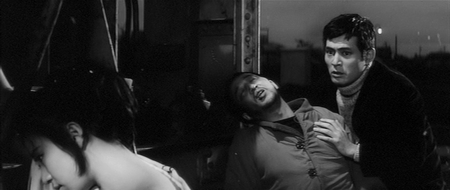
Goyokin; or, Gold for Official Use
We made a promise three years ago. But I broke that promise.
Magobei, I will break that promise over and over as many times... as I have to.
In order to keep the world running, we samurai must dirty our hands with blood.
When thinking about samurai movies, people immediately think
about Kurosawa’s immortal Yojimbo (1961) or Kobayashi’s all-time classic Harakiri
(1962). While these films are the hallmarks of excellence, they do not
constitute the whole of this genre. Similarly to other cinematic trends,
samurai films were also made by lesser known filmmakers– not omnipotent
geniuses but craftsmen, hardworking and efficient, like Hideo Gosha. Though his
productions were domestically successful, the global audience was not really
aware of their existence until after the director’s death. One of such modernly
rediscovered gems made by Gosha is Goyokin from 1969. An action-adventure flick
with the great Tatsuya Nakadai in the lead, which involves revenge, sword-fights,
slaughter, and shogun’s gold.
Release Info
Directed by: Hideo Gosha Starring: Tatsuya Nakadai, Tetsuro Tamba, Ruriko Asaoka
Language: Japanese Original Title: 御用金 Runtime: 124 min

Synopsis
It’s the year 1833, the heyday of the Tokugawa Shogunate.
Magobei Wakizaka (Tatsuya Nakadai) is a ronin living in Edo. Three years ago,
he left the Sabai Clan when its chamberlain, Rokuko Tatewaki (Tetsuro Tamba)
used the crash of shogun’s ship to his advantage and stole the state gold. In
order to cover it up, he massacred the fishermen from the nearby village who recovered
the gold. Now, the ruthless chamberlain wants to save the finances of his clan
by staging another ship accident and massacre of innocent people. Magobei gets
to know about the devious plan of his brother-in-law and he rushes from Edo to
stop him. Along the way, he is joined by the sole survivor of the original
slaughter Oriha (Ruriko Asaoka), her brother Rokuzo (Ben Hiura), and a shogun’s
spy, Samon Fujimaki (Kinnosuke Nakamura).


Samurai’s Funeral
Goyokin (along with Tenchu!) is frequently called the best
samurai film from Gosha and I find it hard to disagree. This might not be a
black-and-white, ironic examination of humanity (hint: Kurosawa), yet the story
is rich enough and professionally executed to be considered a legit period
piece. Nevertheless, the film’s main advantage is action. Toshiro Mifune may be
the cinematic master swordsman, but Gosha’s quick cuts, zooms, and angle shots
render Nakadai’s fighting in this movie unforgettable. It’s been a few years
since my first viewing of the film and yet I still vividly remember Magobei’s
slashing of the bad guys in pitch darkness.


Apart from the entertaining value, there’s also Gosha’s
historical commentary. As much as Kurosawa desired to change the course of
Japanese history with Yojimbo, Gosha resents and criticises the samurai code of
honour. Magobei is a fallen hero who was unable to object to his brother-in-law
as he committed the slaughter. Magobei’s quest to stop the chamberlain is a
journey of self-redemption, of defying the rotten code of silent obedience when
bad things happen. The samurai finally has to do the right thing in order to
redeem himself.


In addition, I especially love the tiny historical notches
provided by Gosha. The story of the samurai clan being desperate enough so as
to steal the shogun’s gold makes perfect sense since those are the Tokugawa
times, a period of peace and stagnation when samurai were no longer needed as
warriors, hence their status almost degraded to that of farmers. Also, we have
a scoundrel-like heroine, Oriha, who is not afraid of dealing with the yakuza
(Gosha’s exploitation of the yakuza theme here), and she is determined to know
what happened to her fellow villagers. What is more, Shino (Yoko Tsukasa),
Magobei’s wife, is torn between being loyal to her husband and to her brother,
which distorts the image of a proper samurai wife.


Nevertheless, a great spirit of adventure is the driving
force of Goyokin as we see Magobei and his merry band of avengers (Samon,
Oriha, and Rokuzo) kick a lot of sorry samurai butts in the film's fiery finale.
Also, Nakadai’s duel with dauntless Tetsuro Tamba amidst the snowy plains of
Northern Japan is a definite must-see.


In terms of performances, Tatsuya Nakadai as always does splendidly
in a role which does not require his character getting killed off by Toshiro
Mifune. A word of trivia here: Mifune was actually slated to play in Goyokin as
Samon, but he argued with Gosha about the necessity of shooting the picture in
the cold parts of Niigata Prefecture and eventually dropped out (shame! yet,
Kinnosuke Nakamura provides a decent replacement). Tetsuro Tamba is classic as
a commanding samurai leader, having already marked his place in chambara films
with Harakiri (1962) and Three Outlaw Samurai (1964). Yoko Tsukasa makes another gracious appearance, yet her role is quite limited. Ruriko Asaoka does
magnificently well as Oriha, though pretending to play an 18-year-old when she was actually 28.


Recommendations
Highly recommended to anyone who is interested in Hideo
Gosha’s work. Goyokin is a wonderfully entertaining instance of a samurai film.
It has all of the necessary ingredients: Nakadai, great story, sword fights,
and the tranquilizing score by Masaru Sato. Basically, this film is an obvious
highlight of the 1960s, the golden period of samurai movies. If you’re into
chambara, give it a go anywhere, anytime.
Overall score: 10/10