Showing posts with label 1961. Show all posts

The Story of Osaka Castle (1961) [Film Review]

The Story of Osaka Castle; or, The Longest Day
     Although we lost to the Eastern army at the Battle of Sekigahara, it's an insult they should treat our 650,000 koku family like an ordinary daimyo and tell us to make a trip to Kyoto for greetings. Send back the messenger now. I, Yodo, cannot accept such an order. Never!
Being in the mood for a period picture, I decided to search for a film I have not seen yet. Therefore, I picked Hiroshi Inagaki’s The Story of Osaka Castle, a 1961 colour production with Toshiro Mifune and Kyoko Kagawa in the leading roles.
Release Info
Directed by: Hiroshi Inagaki Starring: Toshiro Mifune, Kyoko Kagawa, Danko Ichikawa
Language: Japanese Original Title: 大阪城物語 Runtime: 95 min
 
Synopsis
10 years after the famous Battle of Sekigahara, the Toyotomi clan initiates a conspiracy in order to stop Lord Ieyasu Tokugawa’s political activities to take over Japan. A wandering samurai called Mohei (Toshiro Mifune) arrives at Osaka and immediately gets entangled in a maze of intrigues together with a servant Ai (Kyoko Kagawa) and a ninja spy Saizo Kirigakure (Danko Ichikawa). The protagonists eventually discover a betrayal of the clan and they rush to Osaka castle to stop the bloodshed.
 
Black Ships, Damsels, and Samurai
I did not have any expectations for The Story of Osaka Castle, but I have to honestly say that the first act left me disappointed. The exposition is very chaotic and lots of characters are not helping in figuring out what the story is about. Nevertheless, when Toshiro Mifune steps into action, the viewers instantly know that he is the main protagonist.
 
Boring first act ends with Mifune’s character sent on a stealth mission, which he miserably fails. From this point on, the action picks up and the story itself becomes much clearer. I particularly liked that the Portuguese colonisers play a small part in the conspiracy. I love this part of Japanese history when the country was open to Western influences, and it is a real shame that the only major production that focuses on this aspect is the TV series Shogun from 1980, based on James Clavell’s popular novel.
 
When the third act started, I found myself thoroughly enjoying the film. It went from a boring flick to sheer epicness, as if straight from The Guns of Navarone (1961). It’s a blast seeing Mifune riding at a breakneck pace through the middle of a battlefield! The Osaka Castle looks really beautiful, indeed. The crew evidently shot a lot of footage on location and I hope that someday I will be able to see this famous landmark with my own eyes. Additionally, the magnificent music score by Akira Ifukube cannot go unnoticed.
 
With regard to performances, Toshiro Mifune is as great as in many other period pieces he did. Kyoko Kagawa has a great role as his love interest, but unfortunately, she disappears from the film’s finale. The amazing Akihiko Hirata has a small part as Mifune’s relative/foe (it’s complicated). Danko Ichikawa steals every scene as the happy-go-lucky warrior, similar to Robin Hood.
Recommendations
If you want to experience some traditional Japanese story, then check out The Story of Osaka Castle. The first third of the film is an exercise in patience, but the story significantly improves later. It may not be Hiroshi Inagaki’s wonderful Samurai Trilogy (1954–1956), but The Story of Osaka’s Castle definitely deserves attention nowadays.
Overall score: 7/10

Yojimbo (1961) [Film Review]

Yojimbo; or, A Fistful of Ryo
      Listen, old man. I’ll get paid for killing. And this town is full of men who deserve to die. Think about it. Sebei, Ushitora, the gamblers and drifters; with them gone, the town would have a fresh start.
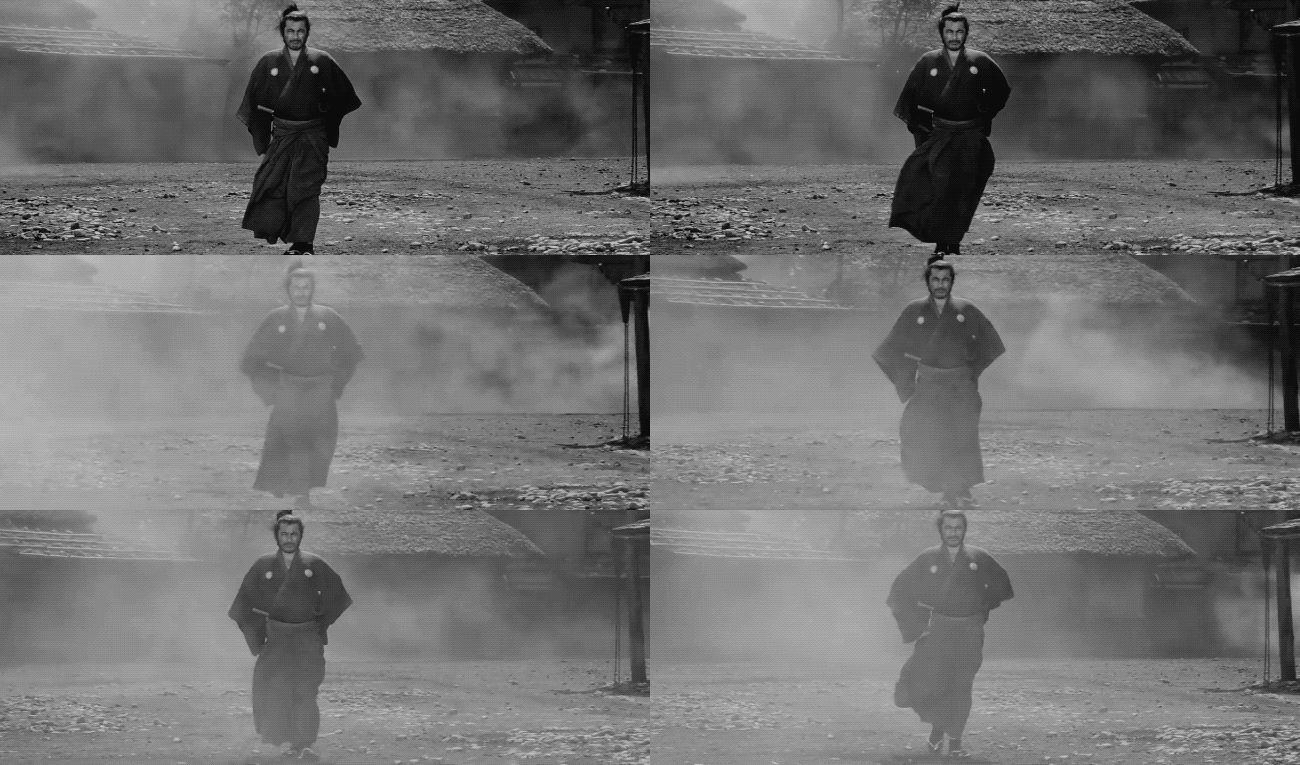
Yojimbo (1961) is yet another classic samurai film directed by the master of filmmaking Akira Kurosawa. The story about a mysterious ronin who cleans up the town from bad guys became so popular that it spawned a sequel, Sanjuro (1962), two unofficial continuations (Incident at Blood Pass and Zatoichi Meets Yojimbo from 1970), and countless remakes, the most popular of which is Sergio Leone’s A Fistful of Dollars (1964). Let’s take a look at Toshiro Mifune’s, arguably, most iconic role:
Release Info
Directed by: Akira Kurosawa Starring: Toshiro Mifune, Tatsuya Nakadai, Eijiro Tono
Language: Japanese Original Title: 用心棒 Runtime: 110 min
 
Synopsis
Japan, 1860s. After the fall of the Tokugawa Shogunate, many samurai became masterless. One of them, calling himself Kuwabatake Sanjuro (Toshiro Mifune), wanders aimlessly through a desolate countryside. He eventually reaches a small town that is the battle ground between two rival gangs. Ushitora (Kyu Sazanaka), with the help of the town’s major (Kamatari Fujiwara), wants to fully control the town, but Sebei (Seizaburo Kawazu), supported in turn by the sake brewer (Takashi Shimura), also has the same aspirations. Sanjuro wittingly decides to set in motion a game that will lead to the annihilation of the two gangs. Unfortunately, his plans are interrupted with the arrival of Unosuke (Tatsuya Nakadai), the younger brother of Ushitora.
The Honour of a Samurai
I have seen Yojimbo for the first time 6 years ago, on Criterion DVD, and it instantly became one of my all-time movies, together with Kurosawa’s direct sequel Sanjuro. Toshiro Mifune is undeniably too cool for school as a shabby ronin who tricks the baddies and settles the score.
 
The story itself may be a bit hard to follow upon initial viewing because there is a short exposition riddled with many characters, but you can get the gist of what is going on as Kuwabatake Sanjuro slashes his way through expendable rogues. I will never get enough of a scene in which he rescues a family in distress!
 
If you are a Star Wars fan, then keep an eye out for an “arm cut” sequence that George Lucas repeated verbatim in A New Hope. Part of me likes to think that the plotline of Yojimbo is exactly what happens to Obi-Wan during his 20-year-long stay on Tatooine. (On a side note, did you know that Toshiro Mifune was originally offered the part of Obi-Wan Kenobi?)
Going back to the movie, Yojimbo was allegedly inspired by a 1942 film called The Glass Key, but the researchers of Kurosawa also point at Dashiell Hammett’s Red Harvest (1929) novel as a major source of inspiration. Regardless of the influences, Yojimbo remains one of the first action stories with a nameless hero as the protagonist (Sanjuro actually makes up his name in the two movies).
 
With regard to performances, Toshio Mifune is evidently awesome as Sanjuro. Second best performance is the one of Tatsuya Nakadai as the malevolent samurai with a revolver. Nakadai is currently 87 and I wish him long, healthy years, because he is one of the few living legends from the Kurosawa era who are still around. Yojimbo has also many supporting parts done by frequent collaborators of Kurosawa, including Takashi Shimura, Eijiro Tono, and Susumu Fujita.
 
In addition, the music score by Masaru Sato is just amazing. It feels very experimental, yet it perfectly fits every scene. I absolutely agree with an interpretation that the jaunty sounds of flutes and big band are meant to reflect Sanjuro’s state of mind.
Recommendations
Highly recommended to anyone who wants to explore the lighter stuff of Akira Kurosawa’s impressive filmography. Yojimbo is a wonderful story that blends action, satire, and folk tale. If you have enjoyed a Fistful of Dollars with Clint Eastwood, then Yojimbo will be even greater entertainment. Check it out if you can because this film is a true 60-year-old gem. Gusts of wind have never been so epic.
Overall score: 9/10