Showing posts with label samurai. Show all posts

After the Rain (1999) [Film Review]

After the Rain; or, Purification
     With this current… even if the rain stops, the river will remain insuperable.
If I understand correctly, After the Rain is one of the few Akira Kurosawa’s projects that were made after his passing in 1998. I believe these were mentioned in a documentary devoted to the filmmaker called A Message from Akira Kurosawa: For Beautiful Movies (2000), but I am uncertain if the movies were made posthumously because Kurosawa wanted them completed or if his friends decided to honour the director in such a way. Either way, I would like to talk about one of the movies from this 2000-ish lineup; that is, After the Rain directed by Takashi Koizumi.
Release Info
Directed by: Takashi Koizumi Starring: Akira Terao, Yoshiko Miyazaki, Shiro Mifune
Language: Japanese Original Title: 雨あがる Runtime: 91 min
Synopsis
Ihei Misawa (Akira Terao) is a ronin who roams through princely states in search of a new master. He is accompanied by his loyal wife Tayo (Yoshiko Miyazaki). They shelter themselves in an inn waiting for the rain to stop in order to cross the mountain. The Misawas help out the poor who also try to avoid heavy rainfall. When the sky clears, Ihei stops a fight between youngsters in the woods. This mature act draws the attention of a local master Lord Nagai Izuminokami Shigeaki (Shiro Mifune) who invites Ihei to his castle.
S
pectres in the Woods
Evidently, After the Rain was only based on Akira Kurosawa’s screenplay, but you can tell from the get-go that a great care was undertaken to replicate the feel of the master’s auteur cinematic style. Takashi Koizumi himself served as an assistant director on Kurosawa’s movies raging from Kagemusha to Madadayo. In addition, legendary composer Masaru Sato was brought on board to provide a film score. In addition, Kurosawa’s frequent performers also appear in the film.
What truly grabbed my heart was the sense of tranquillity oozing from this movie. Amazing cinematography wonderfully captures vivid images of nature, forests, and rivers. Indeed, the film could have been made back in the 1960s, but I really appreciate the fact that it took 30 years to make because we can appreciate all the sequences in colour.
The story itself cannot go unnoticed as well. The main character is a different type of regular on-screen samurai. Ihei Misawa is a man known for his kindness and generosity. Paradoxically, these are the personality traits that frequently get him in trouble and render him unemployed. With its narrative structure (memories and flashbacks), After the Rain feels like a classic fairy tale.
Some viewers on letterboxd expressed disappointment with regard to the ending of the film, but I think it could not have been more perfect. It is touching and at the same time witty conclusion of the misunderstanding between Misawa and the local master.
With regard to performances, Akira Terao (who already appeared in Ran, Dreams, and Madadayo) really shines as the main hero. The same can be said about Yoshiko Miyazaki who plays the graceful wife. Shiro Mifune is very convincing as the hot-headed Lord Shigeaki, but he also gives his character a touch of comedy. The legendary Tatsuya Nakadai appears in a cameo role as the mentor figure of the main character.
I did manage to see the film by complete accident because I spotted a DVD at a book exchange point in my local shopping centre. The disc was issued in 2004 by Tantra distribution label and it is a widescreen version placed within 4:3 aspect ratio, so to get out the original resolution of the film, I had to scale the film via VLC software. There are no bonus features on the disc, but at least the translation seems okay and you have the option to choose between Polish subtitles and Polish voiceover. Interestingly, the distribution label was issued the film on VHS, but I don’t know if it was a 4:3 pan-and-scan version or the widescreen release as on the DVD.
Recommendations
All in all, I extremely enjoyed this film and I wholeheartedly recommend it to not only Akira Kurosawa’s fans but also to viewers who look for peaceful movies to pass their free time. After the Rain is undoubtedly for keeps.
Overall score: 10/10
«Enjoyed this post? Never miss out on future posts by following us»

The Monk and The Samurai (2022) [Short Film Review]

The Monk and The Samurai
     The lives of two men, a monk and a samurai suffer unbearable loss. Heroic to the end their tales intertwine as they battle with the chaos, redemption, justice and vengeance within.
Recently, I was approached with a review offer from Troy’s Team group located in Beijing. From what I know, they are a team of martial artists who worked on several big Chinese productions, such as Kung Fu Yoga (2017) or Ip Man 4 (2019), but they focus on movie production as well.
The latest result of their efforts is a short film called The Monk and The Samurai (2022). A 10 minutes long tale about two individuals influenced and moulded by a traumatic event. The film is primarily a collection of animated images intertwined with live-action clips. I am not an expert in editing, but the seamless transition between the effects made me think whether the filmmakers had use the popular rotoscoping technique to achieve the desired effect. All in all, the visuals are indeed pleasant for the eye.
With regard to the storyline, it is straightforward and easy to follow; this is mainly thanks to a skilful narration by John M. Shang. In fact, director Troy Sandford stated that the film was inspired by an idea to create a book “of short bed time martial art stories ideal for kids and adults” (source: presskit). Indeed, The Monk and The Samurai short feels very much like a bedtime tale to be enjoyed by parents and their children. The film perfectly encapsulates in a nutshell the spirit of ancient Asian myths about gallant warriors trying to do justice in the times of hardship.
All things considered, The Monk and The Samurai is a well-made short film, and I sincerely hope that more “episodic tales” like that will be made in the future by Troy’s Team. My respect goes to the creators and all the actors involved in the project.
 
«Enjoyed this post? Never miss out on future posts by following us»

Ichi (2008) [Film Review]

Ichi; or, The Tale of Female Warrior
     Those who cannot see... do not know where the boundaries are. We can't see boundaries, like whether it's day or night right now, or where the path we're walking on suddenly disappears. And since we can't see, it's terrifying. Who is good, and who is bad? Where are the boundaries for that?! I don't even know that much! I can't even see for sure whether I'm alive, or whether I'm dead!
Ichi is a 2008 adaptation of a manga series created by Hana Shinohara. Inspired by the Zatoichi figure, the manga centers around the character of Ichi, a blind woman who wanders through Japan in search of her mentor, the man who taught her the art of swordsmanship. Interestingly, the fans of the manga were disappointed with many differences conveyed in the movie adaptation.
Release Info
Directed by: Fumihiko Sori Starring: Haruka Ayase, Takao Osawa, Shido Nakamura
Language: Japanese Original Title: Ichi Runtime: 120 min

Synopsis
Ichi (a m a z i n g Haruka Ayase) searches for her mentor, the master of backhanded, straight-stroke style. While confronting a gang of thugs, she encounters Fujihira Toma (Takao Osawa), a wandering samurai who was expelled from his clan. The two venture into a village that is plagued by savage bandits. Contrary to Toma, Ichi does not want to get involved. Eventually, she faces off against the bandits when discovering that their leader might have some information about her mentor’s whereabouts…
Like Father Like Daughter
I have to admit that I did not read the manga, so I am writing this review from a standpoint of a person who has seen only Zatoichi movies. In this regard, that is Ichi being a modern take on the Zatoichi myth with double twist, the movie works flawlessly. However, I can understand the outrage of manga fans that the screenplay gives little care to the supporting characters.
The secret as to why Ichi works is primarily due to Haruka Ayase’s crazy awesome performance. I have seen the actress previously in such dramas as Hero and Mr Brain, but I have never suspected that she is capable of playing such a complex and kick-ass character. She absolutely owns the movie.
Another great advantage are the fight scenes, which seem to be an improvement over good-looking action set pieces from Takeshi Kitano’s Zatoichi (2003). It is exhilarating to see how Ichi obliterates the bad guys in slow motion.
Additionally, there is a variety of great actors in supporting roles, including Yosuke Kobuzoka as the righteous villager, Akira Emoto as the village leader, Eri Watanabe as the maid, and Shido Nakamura as bat-shit crazy samurai who went rogue.
The only thing that I disliked about the movie is that there are a bit generic villains. The screenplay desperately tries to make them come off as brutal and gruesome, but in reality they are no match for the main heroine.
Recommendations
If you want to experience a Zatoichi story from a different perspective, then Ichi is the movie for you. I’m not going to lie that I fell in love with Haruka Ayase after watching it. Hopefully, I will be able to check out the manga series in the future as well. Ichi definitely deserves another movie or even a drama series.
Overall score: 9/10
«Enjoyed this post? Never miss out on future posts by following us»

The Tale of Zatoichi (1962) [Film Review]

The Tale of Zatoichi; or, Inconspicuous Masseur This Way Comes
     What I do is no different than the tricks street vendors use to attract customers. Enough about me...
The Tale of Zatoichi from 1962 marks the first movie in the long-running series about a blind swordsman who wanders through Japan and experiences numerous adventures. Produced by the studio Daiei and directed by Kenji Musumi (best known for Lone Wolf and a Cub series), this adaptation of Kan Shimozawa’s novel presents Zatoichi not as a larger-than-life hero, but as a compassionate, Sherlock Holmes-like keeper of justice. 
Release Info
Directed by: Kenji Misumi Starring: Shintaro Katsu, Shigeru Amachi, Eijiro Yanagi
Language: Japanese Original Title: 座頭市物語 Runtime: 95 min
Synopsis

Zatoichi (Shintaro Katsu) reaches a yakuza den in Iioka. He is provided shelter and care by the gang-leader Sukegoro (Eijiro Yanagi) who knows about Zatoichi’s extraordinary fight skills and wants to use them for his own advantage. It turns out that Sukegoro is preparing to attack a rival yakuza boss Shigezo (Ryuzo Shimada). In consequence, Shigezo hires a renowned ronin, Miki Hirate (Shigeru Amachi). Due to a coincidence, Zatoichi and Hirate befriend each other. The two warriors are not keen on fighting each other in some petty gang war, especially in view of the fact that Zatoichi is blind and Hirata suffers from tuberculosis. Nevertheless, both gangs press for a conflict.
Where the Devil Says Goodnight
I have to admit that I did not expect much from The Tale of Zatoichi, but now I understand why it kick-started the popular movie series. Unlike other samurai epics of that time, such as Yojimbo (1961) or Harakiri (1962), The Tale of Zatoichi is a radically different film. With slow-pace, Buddhist undertones, and innovative (for that time) cinematography, it is more similar to Woman in the Dunes (1964), a perfect example of Japanese New Wave, rather than standard chanbara motion pictures. Also, the sombre music score by the legendary Akira Ifukube increases the viewing experience.
The movie about people whose activity is mostly talking in enclosed spaces does not seem to be encouraging, but the character of Zatoichi glues everything together. He is the symbolic fool who is frowned upon by almost everybody, but he presents extraordinary skills, not only in fighting, but also in gambling, and solving mysteries. My all-time favourite scenes are 1) touching the face of Otane (Masayo Banri) in the moonlight and 2) Zatoichi giving Hirata a massage. The conversation between the two protagonists is so soothing and tranquil, which only increases the bromance level between them.

There are some scenes in which too many random characters plot against each other, which, in my opinion, is the only disadvantage of the film. Yet. the story is straightforward enough to follow without the necessity of having a repeated viewing.
With regard to performances, I have to say that I like Shintaro Katsu’s interpretation of Zaotichi more than Takeshi Kitano’s. This classic Zatoichi can be funny, cheerful, but also incredibly humble and sorrowful (Kitano’s Zatoichi’s seems to be a bit too angry in the 2003 remake). I also enjoyed the performance of Shigeru Amachi as Harata. The two actors had amazing chemistry on the screen. There is also some nice acting done by Masayo Banri, a woman who falls hopelessly in love with Zatoichi.
Recommendations
If you want to see a classic Japanese production which does not necessarily follow the chanbara formula, then I recommend The Tale of Zatoichi. This movie is definitely classic and it encouraged me to check out the remaining sequels. Hopefully, I will be able to review all of them soon.
Overall score: 8/10
«Enjoyed this post? Never miss out on future posts by following us»

The Story of Osaka Castle (1961) [Film Review]

The Story of Osaka Castle; or, The Longest Day
     Although we lost to the Eastern army at the Battle of Sekigahara, it's an insult they should treat our 650,000 koku family like an ordinary daimyo and tell us to make a trip to Kyoto for greetings. Send back the messenger now. I, Yodo, cannot accept such an order. Never!
Being in the mood for a period picture, I decided to search for a film I have not seen yet. Therefore, I picked Hiroshi Inagaki’s The Story of Osaka Castle, a 1961 colour production with Toshiro Mifune and Kyoko Kagawa in the leading roles.
Release Info
Directed by: Hiroshi Inagaki Starring: Toshiro Mifune, Kyoko Kagawa, Danko Ichikawa
Language: Japanese Original Title: 大阪城物語 Runtime: 95 min
 
Synopsis
10 years after the famous Battle of Sekigahara, the Toyotomi clan initiates a conspiracy in order to stop Lord Ieyasu Tokugawa’s political activities to take over Japan. A wandering samurai called Mohei (Toshiro Mifune) arrives at Osaka and immediately gets entangled in a maze of intrigues together with a servant Ai (Kyoko Kagawa) and a ninja spy Saizo Kirigakure (Danko Ichikawa). The protagonists eventually discover a betrayal of the clan and they rush to Osaka castle to stop the bloodshed.
 
Black Ships, Damsels, and Samurai
I did not have any expectations for The Story of Osaka Castle, but I have to honestly say that the first act left me disappointed. The exposition is very chaotic and lots of characters are not helping in figuring out what the story is about. Nevertheless, when Toshiro Mifune steps into action, the viewers instantly know that he is the main protagonist.
 
Boring first act ends with Mifune’s character sent on a stealth mission, which he miserably fails. From this point on, the action picks up and the story itself becomes much clearer. I particularly liked that the Portuguese colonisers play a small part in the conspiracy. I love this part of Japanese history when the country was open to Western influences, and it is a real shame that the only major production that focuses on this aspect is the TV series Shogun from 1980, based on James Clavell’s popular novel.
 
When the third act started, I found myself thoroughly enjoying the film. It went from a boring flick to sheer epicness, as if straight from The Guns of Navarone (1961). It’s a blast seeing Mifune riding at a breakneck pace through the middle of a battlefield! The Osaka Castle looks really beautiful, indeed. The crew evidently shot a lot of footage on location and I hope that someday I will be able to see this famous landmark with my own eyes. Additionally, the magnificent music score by Akira Ifukube cannot go unnoticed.
 
With regard to performances, Toshiro Mifune is as great as in many other period pieces he did. Kyoko Kagawa has a great role as his love interest, but unfortunately, she disappears from the film’s finale. The amazing Akihiko Hirata has a small part as Mifune’s relative/foe (it’s complicated). Danko Ichikawa steals every scene as the happy-go-lucky warrior, similar to Robin Hood.
Recommendations
If you want to experience some traditional Japanese story, then check out The Story of Osaka Castle. The first third of the film is an exercise in patience, but the story significantly improves later. It may not be Hiroshi Inagaki’s wonderful Samurai Trilogy (1954–1956), but The Story of Osaka’s Castle definitely deserves attention nowadays.
Overall score: 7/10

Yojimbo (1961) [Film Review]

Yojimbo; or, A Fistful of Ryo
      Listen, old man. I’ll get paid for killing. And this town is full of men who deserve to die. Think about it. Sebei, Ushitora, the gamblers and drifters; with them gone, the town would have a fresh start.
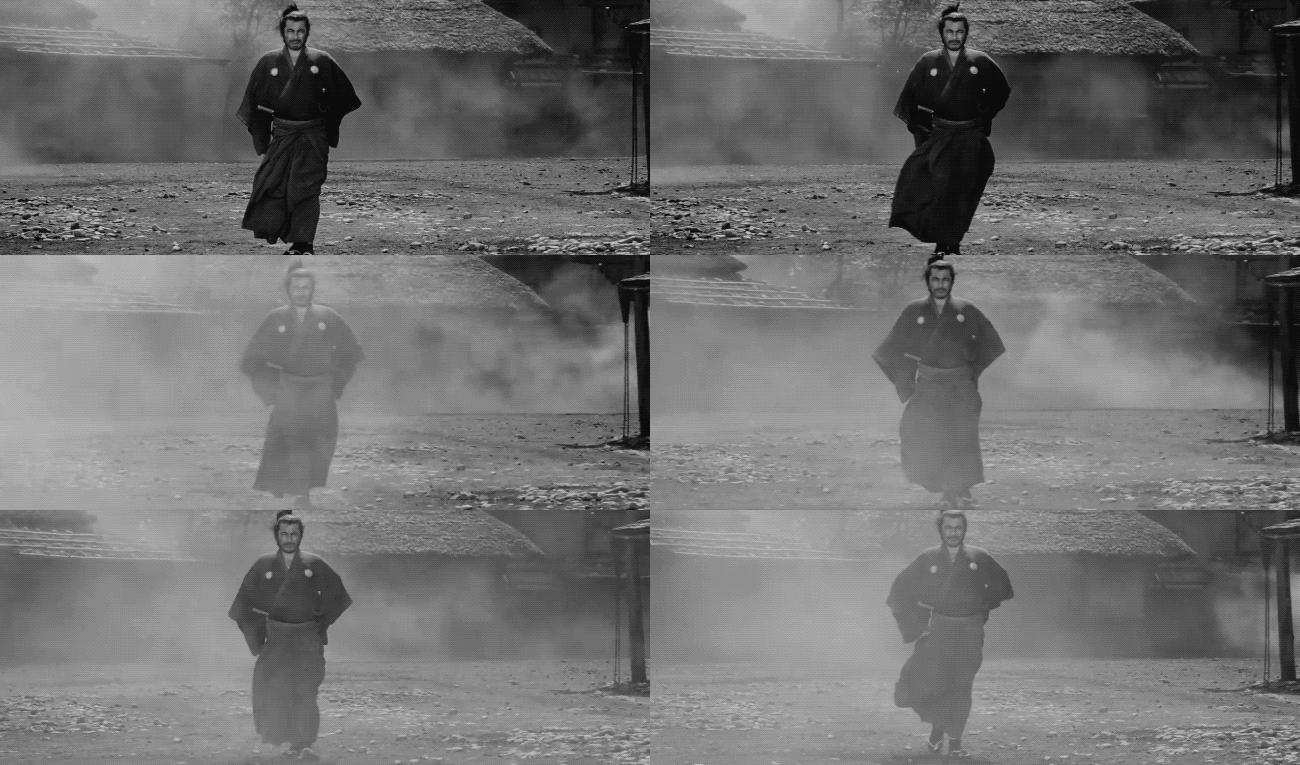
Yojimbo (1961) is yet another classic samurai film directed by the master of filmmaking Akira Kurosawa. The story about a mysterious ronin who cleans up the town from bad guys became so popular that it spawned a sequel, Sanjuro (1962), two unofficial continuations (Incident at Blood Pass and Zatoichi Meets Yojimbo from 1970), and countless remakes, the most popular of which is Sergio Leone’s A Fistful of Dollars (1964). Let’s take a look at Toshiro Mifune’s, arguably, most iconic role:
Release Info
Directed by: Akira Kurosawa Starring: Toshiro Mifune, Tatsuya Nakadai, Eijiro Tono
Language: Japanese Original Title: 用心棒 Runtime: 110 min
 
Synopsis
Japan, 1860s. After the fall of the Tokugawa Shogunate, many samurai became masterless. One of them, calling himself Kuwabatake Sanjuro (Toshiro Mifune), wanders aimlessly through a desolate countryside. He eventually reaches a small town that is the battle ground between two rival gangs. Ushitora (Kyu Sazanaka), with the help of the town’s major (Kamatari Fujiwara), wants to fully control the town, but Sebei (Seizaburo Kawazu), supported in turn by the sake brewer (Takashi Shimura), also has the same aspirations. Sanjuro wittingly decides to set in motion a game that will lead to the annihilation of the two gangs. Unfortunately, his plans are interrupted with the arrival of Unosuke (Tatsuya Nakadai), the younger brother of Ushitora.
The Honour of a Samurai
I have seen Yojimbo for the first time 6 years ago, on Criterion DVD, and it instantly became one of my all-time movies, together with Kurosawa’s direct sequel Sanjuro. Toshiro Mifune is undeniably too cool for school as a shabby ronin who tricks the baddies and settles the score.
 
The story itself may be a bit hard to follow upon initial viewing because there is a short exposition riddled with many characters, but you can get the gist of what is going on as Kuwabatake Sanjuro slashes his way through expendable rogues. I will never get enough of a scene in which he rescues a family in distress!
 
If you are a Star Wars fan, then keep an eye out for an “arm cut” sequence that George Lucas repeated verbatim in A New Hope. Part of me likes to think that the plotline of Yojimbo is exactly what happens to Obi-Wan during his 20-year-long stay on Tatooine. (On a side note, did you know that Toshiro Mifune was originally offered the part of Obi-Wan Kenobi?)
Going back to the movie, Yojimbo was allegedly inspired by a 1942 film called The Glass Key, but the researchers of Kurosawa also point at Dashiell Hammett’s Red Harvest (1929) novel as a major source of inspiration. Regardless of the influences, Yojimbo remains one of the first action stories with a nameless hero as the protagonist (Sanjuro actually makes up his name in the two movies).
 
With regard to performances, Toshio Mifune is evidently awesome as Sanjuro. Second best performance is the one of Tatsuya Nakadai as the malevolent samurai with a revolver. Nakadai is currently 87 and I wish him long, healthy years, because he is one of the few living legends from the Kurosawa era who are still around. Yojimbo has also many supporting parts done by frequent collaborators of Kurosawa, including Takashi Shimura, Eijiro Tono, and Susumu Fujita.
 
In addition, the music score by Masaru Sato is just amazing. It feels very experimental, yet it perfectly fits every scene. I absolutely agree with an interpretation that the jaunty sounds of flutes and big band are meant to reflect Sanjuro’s state of mind.
Recommendations
Highly recommended to anyone who wants to explore the lighter stuff of Akira Kurosawa’s impressive filmography. Yojimbo is a wonderful story that blends action, satire, and folk tale. If you have enjoyed a Fistful of Dollars with Clint Eastwood, then Yojimbo will be even greater entertainment. Check it out if you can because this film is a true 60-year-old gem. Gusts of wind have never been so epic.
Overall score: 9/10