Showing posts with label chambara. Show all posts

Ichi (2008) [Film Review]

Ichi; or, The Tale of Female Warrior
     Those who cannot see... do not know where the boundaries are. We can't see boundaries, like whether it's day or night right now, or where the path we're walking on suddenly disappears. And since we can't see, it's terrifying. Who is good, and who is bad? Where are the boundaries for that?! I don't even know that much! I can't even see for sure whether I'm alive, or whether I'm dead!
Ichi is a 2008 adaptation of a manga series created by Hana Shinohara. Inspired by the Zatoichi figure, the manga centers around the character of Ichi, a blind woman who wanders through Japan in search of her mentor, the man who taught her the art of swordsmanship. Interestingly, the fans of the manga were disappointed with many differences conveyed in the movie adaptation.
Release Info
Directed by: Fumihiko Sori Starring: Haruka Ayase, Takao Osawa, Shido Nakamura
Language: Japanese Original Title: Ichi Runtime: 120 min

Synopsis
Ichi (a m a z i n g Haruka Ayase) searches for her mentor, the master of backhanded, straight-stroke style. While confronting a gang of thugs, she encounters Fujihira Toma (Takao Osawa), a wandering samurai who was expelled from his clan. The two venture into a village that is plagued by savage bandits. Contrary to Toma, Ichi does not want to get involved. Eventually, she faces off against the bandits when discovering that their leader might have some information about her mentor’s whereabouts…
Like Father Like Daughter
I have to admit that I did not read the manga, so I am writing this review from a standpoint of a person who has seen only Zatoichi movies. In this regard, that is Ichi being a modern take on the Zatoichi myth with double twist, the movie works flawlessly. However, I can understand the outrage of manga fans that the screenplay gives little care to the supporting characters.
The secret as to why Ichi works is primarily due to Haruka Ayase’s crazy awesome performance. I have seen the actress previously in such dramas as Hero and Mr Brain, but I have never suspected that she is capable of playing such a complex and kick-ass character. She absolutely owns the movie.
Another great advantage are the fight scenes, which seem to be an improvement over good-looking action set pieces from Takeshi Kitano’s Zatoichi (2003). It is exhilarating to see how Ichi obliterates the bad guys in slow motion.
Additionally, there is a variety of great actors in supporting roles, including Yosuke Kobuzoka as the righteous villager, Akira Emoto as the village leader, Eri Watanabe as the maid, and Shido Nakamura as bat-shit crazy samurai who went rogue.
The only thing that I disliked about the movie is that there are a bit generic villains. The screenplay desperately tries to make them come off as brutal and gruesome, but in reality they are no match for the main heroine.
Recommendations
If you want to experience a Zatoichi story from a different perspective, then Ichi is the movie for you. I’m not going to lie that I fell in love with Haruka Ayase after watching it. Hopefully, I will be able to check out the manga series in the future as well. Ichi definitely deserves another movie or even a drama series.
Overall score: 9/10
«Enjoyed this post? Never miss out on future posts by following us»

Yojimbo (1961) [Film Review]

Yojimbo; or, A Fistful of Ryo
      Listen, old man. I’ll get paid for killing. And this town is full of men who deserve to die. Think about it. Sebei, Ushitora, the gamblers and drifters; with them gone, the town would have a fresh start.
Yojimbo (1961) is yet another classic samurai film directed by the master of filmmaking Akira Kurosawa. The story about a mysterious ronin who cleans up the town from bad guys became so popular that it spawned a sequel, Sanjuro (1962), two unofficial continuations (Incident at Blood Pass and Zatoichi Meets Yojimbo from 1970), and countless remakes, the most popular of which is Sergio Leone’s A Fistful of Dollars (1964). Let’s take a look at Toshiro Mifune’s, arguably, most iconic role:
Release Info
Directed by: Akira Kurosawa Starring: Toshiro Mifune, Tatsuya Nakadai, Eijiro Tono
Language: Japanese Original Title: 用心棒 Runtime: 110 min
 
Synopsis
Japan, 1860s. After the fall of the Tokugawa Shogunate, many samurai became masterless. One of them, calling himself Kuwabatake Sanjuro (Toshiro Mifune), wanders aimlessly through a desolate countryside. He eventually reaches a small town that is the battle ground between two rival gangs. Ushitora (Kyu Sazanaka), with the help of the town’s major (Kamatari Fujiwara), wants to fully control the town, but Sebei (Seizaburo Kawazu), supported in turn by the sake brewer (Takashi Shimura), also has the same aspirations. Sanjuro wittingly decides to set in motion a game that will lead to the annihilation of the two gangs. Unfortunately, his plans are interrupted with the arrival of Unosuke (Tatsuya Nakadai), the younger brother of Ushitora.
The Honour of a Samurai
I have seen Yojimbo for the first time 6 years ago, on Criterion DVD, and it instantly became one of my all-time movies, together with Kurosawa’s direct sequel Sanjuro. Toshiro Mifune is undeniably too cool for school as a shabby ronin who tricks the baddies and settles the score.
 
The story itself may be a bit hard to follow upon initial viewing because there is a short exposition riddled with many characters, but you can get the gist of what is going on as Kuwabatake Sanjuro slashes his way through expendable rogues. I will never get enough of a scene in which he rescues a family in distress!
 
If you are a Star Wars fan, then keep an eye out for an “arm cut” sequence that George Lucas repeated verbatim in A New Hope. Part of me likes to think that the plotline of Yojimbo is exactly what happens to Obi-Wan during his 20-year-long stay on Tatooine. (On a side note, did you know that Toshiro Mifune was originally offered the part of Obi-Wan Kenobi?)
Going back to the movie, Yojimbo was allegedly inspired by a 1942 film called The Glass Key, but the researchers of Kurosawa also point at Dashiell Hammett’s Red Harvest (1929) novel as a major source of inspiration. Regardless of the influences, Yojimbo remains one of the first action stories with a nameless hero as the protagonist (Sanjuro actually makes up his name in the two movies).
 
With regard to performances, Toshio Mifune is evidently awesome as Sanjuro. Second best performance is the one of Tatsuya Nakadai as the malevolent samurai with a revolver. Nakadai is currently 87 and I wish him long, healthy years, because he is one of the few living legends from the Kurosawa era who are still around. Yojimbo has also many supporting parts done by frequent collaborators of Kurosawa, including Takashi Shimura, Eijiro Tono, and Susumu Fujita.
 
In addition, the music score by Masaru Sato is just amazing. It feels very experimental, yet it perfectly fits every scene. I absolutely agree with an interpretation that the jaunty sounds of flutes and big band are meant to reflect Sanjuro’s state of mind.
Recommendations
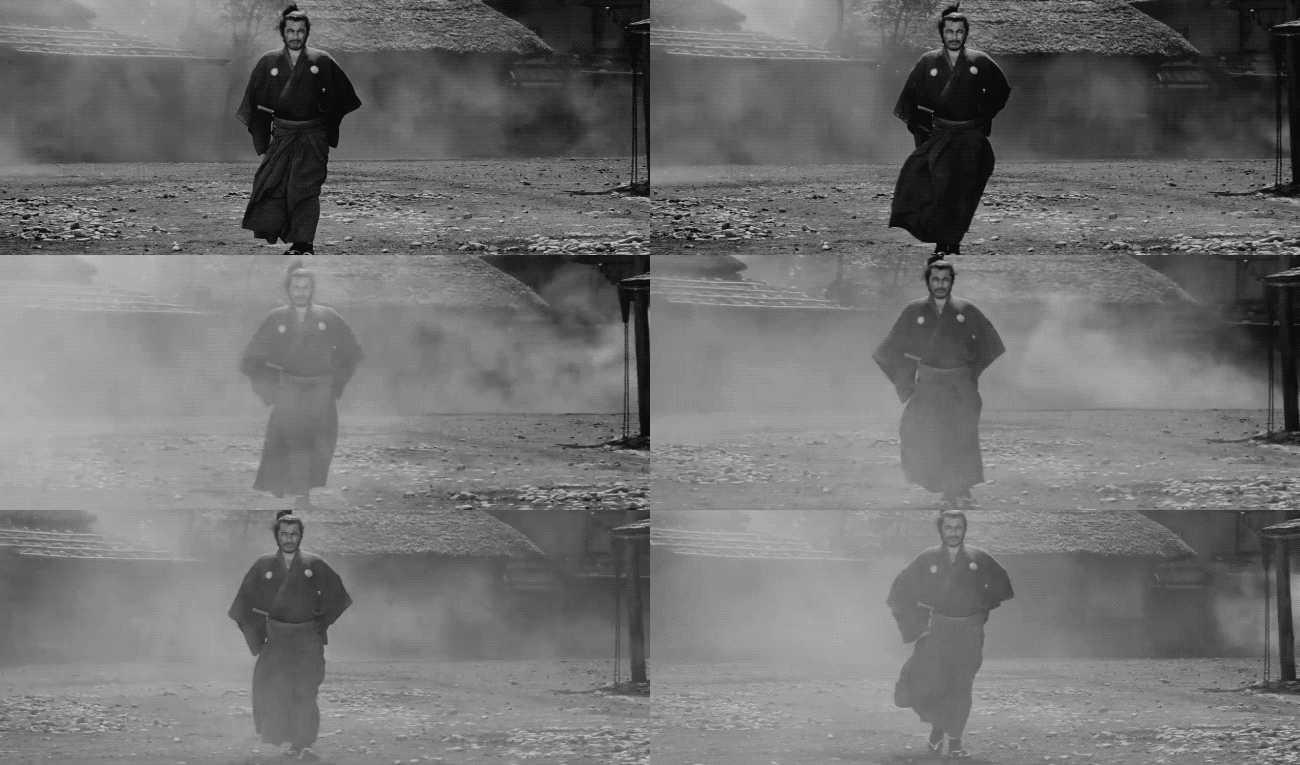
Highly recommended to anyone who wants to explore the lighter stuff of Akira Kurosawa’s impressive filmography. Yojimbo is a wonderful story that blends action, satire, and folk tale. If you have enjoyed a Fistful of Dollars with Clint Eastwood, then Yojimbo will be even greater entertainment. Check it out if you can because this film is a true 60-year-old gem. Gusts of wind have never been so epic.
Overall score: 9/10

Goyokin (1969) [Film Review]

Goyokin; or, Gold for Official Use
      We made a promise three years ago. But I broke that promise. Magobei, I will break that promise over and over as many times... as I have to. In order to keep the world running, we samurai must dirty our hands with blood.
When thinking about samurai movies, people immediately think about Kurosawa’s immortal Yojimbo (1961) or Kobayashi’s all-time classic Harakiri (1962). While these films are the hallmarks of excellence, they do not constitute the whole of this genre. Similarly to other cinematic trends, samurai films were also made by lesser known filmmakers– not omnipotent geniuses but craftsmen, hardworking and efficient, like Hideo Gosha. Though his productions were domestically successful, the global audience was not really aware of their existence until after the director’s death. One of such modernly rediscovered gems made by Gosha is Goyokin from 1969. An action-adventure flick with the great Tatsuya Nakadai in the lead, which involves revenge, sword-fights, slaughter, and shogun’s gold.
Release Info
Directed by: Hideo Gosha Starring: Tatsuya Nakadai, Tetsuro Tamba, Ruriko Asaoka
Language: Japanese Original Title: 御用金 Runtime: 124 min
Synopsis
It’s the year 1833, the heyday of the Tokugawa Shogunate. Magobei Wakizaka (Tatsuya Nakadai) is a ronin living in Edo. Three years ago, he left the Sabai Clan when its chamberlain, Rokuko Tatewaki (Tetsuro Tamba) used the crash of shogun’s ship to his advantage and stole the state gold. In order to cover it up, he massacred the fishermen from the nearby village who recovered the gold. Now, the ruthless chamberlain wants to save the finances of his clan by staging another ship accident and massacre of innocent people. Magobei gets to know about the devious plan of his brother-in-law and he rushes from Edo to stop him. Along the way, he is joined by the sole survivor of the original slaughter Oriha (Ruriko Asaoka), her brother Rokuzo (Ben Hiura), and a shogun’s spy, Samon Fujimaki (Kinnosuke Nakamura).
 
Samurai’s Funeral
Goyokin (along with Tenchu!) is frequently called the best samurai film from Gosha and I find it hard to disagree. This might not be a black-and-white, ironic examination of humanity (hint: Kurosawa), yet the story is rich enough and professionally executed to be considered a legit period piece. Nevertheless, the film’s main advantage is action. Toshiro Mifune may be the cinematic master swordsman, but Gosha’s quick cuts, zooms, and angle shots render Nakadai’s fighting in this movie unforgettable. It’s been a few years since my first viewing of the film and yet I still vividly remember Magobei’s slashing of the bad guys in pitch darkness.
 
Apart from the entertaining value, there’s also Gosha’s historical commentary. As much as Kurosawa desired to change the course of Japanese history with Yojimbo, Gosha resents and criticises the samurai code of honour. Magobei is a fallen hero who was unable to object to his brother-in-law as he committed the slaughter. Magobei’s quest to stop the chamberlain is a journey of self-redemption, of defying the rotten code of silent obedience when bad things happen. The samurai finally has to do the right thing in order to redeem himself.
 
In addition, I especially love the tiny historical notches provided by Gosha. The story of the samurai clan being desperate enough so as to steal the shogun’s gold makes perfect sense since those are the Tokugawa times, a period of peace and stagnation when samurai were no longer needed as warriors, hence their status almost degraded to that of farmers. Also, we have a scoundrel-like heroine, Oriha, who is not afraid of dealing with the yakuza (Gosha’s exploitation of the yakuza theme here), and she is determined to know what happened to her fellow villagers. What is more, Shino (Yoko Tsukasa), Magobei’s wife, is torn between being loyal to her husband and to her brother, which distorts the image of a proper samurai wife.
 
Nevertheless, a great spirit of adventure is the driving force of Goyokin as we see Magobei and his merry band of avengers (Samon, Oriha, and Rokuzo) kick a lot of sorry samurai butts in the film's fiery finale. Also, Nakadai’s duel with dauntless Tetsuro Tamba amidst the snowy plains of Northern Japan is a definite must-see.
 
In terms of performances, Tatsuya Nakadai as always does splendidly in a role which does not require his character getting killed off by Toshiro Mifune. A word of trivia here: Mifune was actually slated to play in Goyokin as Samon, but he argued with Gosha about the necessity of shooting the picture in the cold parts of Niigata Prefecture and eventually dropped out (shame! yet, Kinnosuke Nakamura provides a decent replacement). Tetsuro Tamba is classic as a commanding samurai leader, having already marked his place in chambara films with Harakiri (1962) and Three Outlaw Samurai (1964). Yoko Tsukasa makes another gracious appearance, yet her role is quite limited. Ruriko Asaoka does magnificently well as Oriha, though pretending to play an 18-year-old when she was actually 28.
 
Recommendations
Highly recommended to anyone who is interested in Hideo Gosha’s work. Goyokin is a wonderfully entertaining instance of a samurai film. It has all of the necessary ingredients: Nakadai, great story, sword fights, and the tranquilizing score by Masaru Sato. Basically, this film is an obvious highlight of the 1960s, the golden period of samurai movies. If you’re into chambara, give it a go anywhere, anytime.
Overall score: 10/10

Sanjuro (1962) [Film Review]

Sanjuro; or, Return of Yojimbo
      It's a stupid plan, but some excitement might keep me awake.
This week’s review will be about the only sequel in Akira Kurosawa’s career. Following the overwhelming success of Yojimbo in 1961, Toho executives pressed Kurosawa to make a follow-up story. As a result, Sanjuro was released a year later with Toshiro Mifune reprising his role of a wandering ronin, marking the 14th successful picture in the Kurosawa-Mifune collaboration
Release Info
Directed by: Akira Kurosawa Starring: Toshiro Mifune, Tatsuya Nakadai, Yuzo Kayama, Takashi Shimura
Language: Japanese Original Title: 椿三十郎 Runtime: 95 min
 
Synopsis
Eight samurai led by Iori Izaka (Yuzo Kayama) meet together in an isolated shrine and discuss their issues. Iori suspects that his uncle, Chamberlain Mutsuta (Yunosuke Ito), might be involved in corruption since he tore up his nephew’s petition against organised crime. Thus, Iori went to the Superintendent for help and the latter reluctantly agreed. Nevertheless, it turns out that the Chamberlain was never involved in any dubious activity and that the Superintendent is the real villain. After imprisoning Mutsuta and his family, nine helpless samurai have nobody else to rely on than a shabby, yet extremely wise ronin who was sleeping in the shrine and overheard their conversation, Sanjuro Tsubaki (Toshiro Mifune).
Sanjuro vs. Yojimbo
After making Yojimbo, Kurosawa wanted to move on to something different in the samurai genre and, for instance, make a movie about a day in life of a samurai who is about to die, but due to Toho’s decision about Yojimbo’s sequel, he proceeded to adapt a story by Shugoro Yamamoto called Peaceful Days and positioned Mifune’s ronin as the story’s protagonist.
 
Interestingly, Kihachi Okamoto’s Kill! (1968) was also based on this novel and a number of similarities can be observed between the two films. However, they differ significantly in their tone. Whereas Kill was a parody of chanbara films and a satire on samurai lifestyle in general, Sanjuro poses a question of what it takes to be a good samurai. In Yojimbo, Sanjuro was acting for his own personal gain when playing off the leaders of two rival clans against each other, but in the sequel, we see him taking action due to his empathy for nine samurai in need. He wants to help because it is a right thing to do, yet, rest assured, he does not go soft on killing bad guys.
I admit that Yojimbo is a masterpiece which made its impact on popular culture, sparking numerous remakes and references, but storywise, Sanjuro feels to be a superior picture. Yojimbo provided great fun and action, but never really explored its protagonist’s personality. The sequel complements that hole and goes even further. Sanjuro becomes almost like a father figure to the young and impulsive samurai and, at the same time, he learns from the gracious Lady Mutsuta (Takako Irie) that “the best sword stays in its scabbard”. In consequence, Sanjuro has greater understanding for his adversary, the Superintendent’s henchman, Hanbei Muroto (played by the legendary Tatsuya Nakadai) whom he has to face in the finale’s electrifying showdown.
In terms of behind the scenes trivia, the morbid death of Nakadai’s character was allegedly done in one take and, accidentally, turned out to be more spectacular than intended. Supposedly, a compressor hose attached to Nakadai burst at one spot and a much larger gush of fake blood spilled out. The impact of the hose’s pressure was so strong that Nakadai was nearly lifted off the ground (which can explain the quick cut to Sanjuro’s close-up). Nevertheless, the death itself still looks impressive.
Recommendations
To sum up, Sanjuro is a great continuation of Yojimbo. Professionally directed (as always by Kurosawa), brilliantly acted (not only by Mifune but by Nakadai and other cast members as well), and with a great music score (composed by Masaru Sato- yet Yojimbo’s original theme can’t be heard until the closing shot of the film). It’s a shame that the third part was never conceived, because out of Kurosawa’s filmography, Yojimbo seemed the best material for a series. Although Mifune made unofficial sequels in 1970 with Hiroshi Inagaki (Incident at Blood Pass) and Kihachi Okamoto (Zatoichi vs. Yojimbo), I would love to see Kurosawa’s continuation of the ronin’s adventures.
Overall score: 8/10