Showing posts with label politics. Show all posts

The Journalist (2022) [Drama Review]

The Journalist; or, Checks and Balances
     After seeing how Ms Matsuda strives to give a voice to the voiceless no matter how difficult it may be, I became interested in becoming a journalist.
The Journalist a.k.a. Shinbun Kisha is a 2022 Netflix JDrama directed by Michihito Fujii and based on the director’s previous movie of the same title. The original story was inspired by a nonfiction book by Isoko Mochizuki, which centered on the Moritomo Gakuen scandal. I am always a sucker for political thrillers, so let’s see how this particular drama manages to penetrate through the red tape of corporate greed and media censorship.
Release Info
Directed by: Michihito Fujii Starring: Ryoko Yonekura, Go Ayano, Ryusei Yokohama
Langauge: Japanese Original Title: 新聞記者 No. of eps.: 6
Synopsis

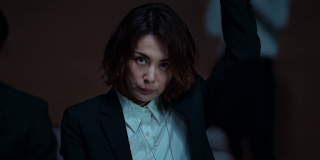
Tokyo, 2019. The government prepares for the upcoming Olympic games. Anna Matsuda (Ryoko Yonekura) is a nonconformist reporter working for the Touto News network. Driven by personal tragedy, she is determined to expose corrupt officials and their shady deals. Matsuda investigates the case concerning a certain Eishin Academy. In the course of her work, the journalist discovers how IRS agents were framed by the government which desperately wants to protect the Prime Minister.
A Few Good Men
When I heard about the drama for the first time on social media, I mistakenly thought that it was going to be released in 2023, so I was pleasantly surprised when the show premiered in January, 2022. I am always up for a drama with the wonderful Ryoko Yonekura in the lead, but this role marks a departure from her iconic performances in Doctor X, Legal V, and The Negotiator.
What I mean is that The Journalist is not an over-the-top entertainment with epic moments and scenes played for laughs. This is a realistic story about a real tragedy. In the present-day political climate, when we see ultra nationalists and oligarchs accumulating power, it is important to stress the independence of free media and the right of ordinary voters to know the truth.
The first episode of the drama is very dire, to be honest. The viewers are presented with a lot of information, names, and characters. It is really hard to get into the thick of the intrigue, but it gets easier in episode 2. Ryoko Yonekura plays a fallen character. Anna Matsuda is by no means heroic or infallible. In fact, I would not even say that she is the main protagonist. The newspaper reporter relentlessly tracks down the people involved in the scandal and the narrative unfolds through their perspectives.
Hidetaka Yoshioka is freaking amazing as Mr Suzuki throughout the first three episodes, then the focus shifts to Shinbou Terajima as Mrs Suzuki, Go Ayano as Shinichi Murakami, and Ryusei Yokohama as Ryo Kinoshita. It is all about the determination of these few good people (their guilt and struggles) that makes this drama an interesting watch.
With regard to the supporting parts, it was great to see such veteran actors as Shiro Sano, Yusuke Santamaria, Tetsushi Tanaka, and Go Riju as the baddies. In my opinion, Yusuke Santamaria stole the show with his villainous performance. Although working mainly as a comedian, he proves once again (after Cold Case drama) how great a dramatic actor he can actually be. In addition, it was great to spot Satoshi Miki’s regulars: Ryo Iwamatsu and Eri Fuse in small roles.
Recommendations
All in all, The Journalist is an enjoyable slow burner. It manages to capture the greatness of several newspaper-oriented thrillers like Zodiac (2007) or Spotlight (2016), but the resolution in the final episode is a bit underwhelming. Personally, I believe that there is no potential to make a second season unless the writing team has some good ideas about developing the real estate/Eishin Academy intrigue further. I recommend The Journalist primarily because of the aforementioned performances and outstanding cinematography.
Overall score: 7/10
«Enjoyed this post? Never miss out on future posts by following us»

Honest Candidate (2020) [Film Review]

Honest Candidate; or, Vote for Joo Sang Seok!
      But we're platonic at this point. Our home is the capital of friendzone and I'm the mayor!
When the first trailer for Honest Candidate dropped in December, 2019, I was extremely hyped because of the amazing Ra Mi Ran, but due to the raging pandemic, the premiere passed me by and, just recently, I remembered about the film and checked it out. The movie directed by Chang Yoo Jung, and inspired by a 2014 Brazilian production O Candidato Honesto is a clever reinvention of the not-being-able-to-lie formula, introduced by Liar, Liar (1997) film with Jim Carrey.
Release Info
Directed by: Chang Yoo Jung Starring: Ra Mi Ran, Kim Mu Yeol, Na Moon Hee
Language: Korean Original Title: 정직한 후보 Runtime: 104 min
Synopsis
Joo Sang Seok (Ra Mi Ran) is a third-term congresswoman who tries to get re-elected for the fourth time. Although she started out as an honest social activist, raised by her grandmother, Kim Ok Hee (Na Moon Hee), she gradually became a standard, untruthful politician, doing shady deals with other congressmen. While Joo Sang Seok hopes to win the elections, her grandmother makes a wish that Joo Sang Seok become an honest person again. As a result, the politician suddenly finds herself unable to tell a lie. In order to protect Joo Sang Seok from uncomfortable situations during the campaign, her personal advisor, Park Hee Chul (Kim Mu Yeol), and family members step into action. Eventually, they decide to use Joo Sang Seok’s truthfulness as the game-changing aspect of the elections. She becomes an honest candidate.
Lie to Me
I gave the film a try thinking that it will be a well-made remake of Liar, Liar, but it turned out to be much more than that! Honest Candidate is a fast roller coaster filled with comedy, brutal satire of modern politics, and a touch of family drama. Ra Mi Ran steals this movie from the very minute with her epic acting.
Having known the actress from Sympathy for Lady Vengeance (2005) and Reply 1988 (2015), I am completely gobsmacked by her acting range and excellent comedic timing. I could not get enough of Ra Mi Ran’s hilarious facial expressions and fits of rage. She totally rocks and carries the whole movie.
Apart from the comedy, I also appreciated the light moments with Joo Sang Seok’s husband (Yon Gyung Ho) and son (Jang Dong Jo). Evidently, the most touching scenes of the film are the ones with the grandma character, but they surprisingly work in the story. Actor Kim Mu Yeol also has an opportunity to shine, even though his role is just a supporting one. The interactions between the main heroine and the advisor are really sweet.
Director Chang Yoo Jung might not have extensive filmography, but she certainly knows how to cook up light-hearted flicks with heartwarming messages (for instance, Finding Mr. Destiny (2010) and The Bros (2017)). Honest Candidate may be considered to be a remake but thanks to a thoughtful script and brilliant performance of Ra Mi Ran it very much stands on its own.
Recommendations
If you are in the mood for a happy-go-lucky comedy without unnecessary ideological preaching, then I recommend Honest Candidate. Get that ballot and cast your vote for her. Once you hear “Candidate no.1 Joo Sang Seok” election song, you won’t be able to get it out of your head! Here’s hoping that Ra Mi Ran will continue making more movies like this one.
Overall score: 8/10
«Enjoyed this post? Never miss out on future posts by following us»

Samurai Assassin (1965) [Film Review]

Samurai Assassin; or, The Never-Ending Bloodshed
      There are a total of thirty-six gates into Edo Castle. Eighteen of these cross the Outer Moat. The other eighteen cross the Inner Moat. In essence, they are the bottlenecks that control access to the Castle. The Daimyo enter the Castle through one of the gates usually, the one closest to their Edo mansions. Thus, each Daimyo has chosen one entrance as his favorite.
Toshiro Mifune strikes again with his samurai blade of justice. Obviously, it goes without saying that we can expect piles of disembodied corpses along his quest in Kihachi Okamoto's chanabra flick from 1965, Samurai Assassin.
Release Info
Directed by:Kihachi Okamoto Starring: Toshiro Mifune, Reiji Miwa, Masao Suzuki, Tomoyuki Tanak
Language: Japanese Original Title: 侍 Runtime: 123 min
 
Synopsis
The film focuses on a samurai called Niiro Tsuruchiyo (Toshiro Mifune) who gets himself involved in a conspiracy plot of samurai clans from Satsuma, Mito, and Choshu provinces. Their aim is to assassinate the Shogunate’s official li Naosuke. Initially, everything seems quite clear, but when Tsuruchiyo is ordered to kill his best friend, and later falls in love with a geisha, the situation gets out of hand.
Sakuradamon no Hen
The plot for this movie was allegedly based on the real historical event called the Sakuradamon Incident (1860), during which the real li Naosuke was murdered shortly after leaving the Sakurada Gate of Edo Castle. The victim was drawn out of his palanquin by a samurai, Arimura Jisaemon, and then decapitated. After Naosuke’s death, historical accounts vary. According to one version Jisaemon committed seppuku immediately after the murder, whereas other account claims that the samurai stuck Naosuke’s head on his sword and ran away with it. Nevertheless, it is true that the event did take place and that the samurai murdered the minister, because they found the new policy of Japan’s opening to commercial trade with foreigners as unacceptable.
The movie quite faithfully depicts the struggle of the Mito samurais but also adds a few twists to the whole narrative. Namely, the film opens with the first attempt to assassinate Naosuke which failed because the Minister did not leave Edo Castle. The group of conspirators suspecting a traitor being among them, conduct a quiet investigation. Therefore, by a series of flashbacks we get to how such a shabby recluse as Niiro Tsuruchiyo joined the cause of the rebel samurai. Nevertheless, the samurai’s past remains partially dubious for the viewers throughout the film. When it is finally revealed in the plot twist of the finale, you wonder about one word that can best describe this picture: irony.
Although Samurai Assassin was directed by the brilliant Kihachi Okamoto (who made The Sword of Doom and Kill), it does not seem to be as epic and filled with grandeur as the rest of his films. Primarily, this movie focuses on politics and convoluted conspiracies, which makes it very difficult to relate to the character played by Mifune (especially when he portrayed such positive samurai as Musashi Miyamoto and Sanjuro), who is basically a thug who does not know what to do with himself.
Yet, such a grim and dark tone of the film (amplified by black and white colours) only reinforces the on-going critique of the samurai class. Okamoto again shows us they are not romantic warriors of valour, willing to battle for honour, but rather they are insidious villains who thrive on manipulating the weak-minded minions. In consequence, Niiro becomes such a victim of their evil-doings and, unfortunately, a prime hero of their morbid play.
Recommendations
If you are more into classical samurai stuff, be careful with Samurai Assassin. It may not be as entertaining as other chanbara flicks, but it is certainly interesting for its plot which grows on you after a while. Although it may seem difficult to get into the film, it is definitely worth watching at least one time.
Overall score: 6/10