Tokyo Olympiad or, Faster, Higher, Stronger The Olympics are a symbol of human aspiration When it comes to sports-oriented movies, there are three titles which immediately come to my mind: Hoosiers (1986), Chariots of Fire (1981), and Tokyo Olympiad (1964). Indeed, the last picture is primarily a documentary, but in my opinion, it is so much more than a record of the 1964 Summer Olympics in Tokyo. To be specific, this film is also a record of human society from another period, from a different geo-political and cultural climate.
Release Info
Directed by: Kon IchikawaLanguage: Japanese
Original Title: 東京オリンピック Runtime: 169 min
A New Beginning It goes without saying that ever since its inception, the Olympics constitute a prestigious promotional opportunity for a country hosting the games. Japan understood and took great advantage of that chance. After the horrible period of WWII, the country sought to reform and reintroduce itself into the public spotlight. The 1964 Olympics were exactly the boost they needed. For this occasion, the Japanese government commissioned the making of a documentary that would serve as a special memorandum of this grand event.
Originally, the authorities reached out to the legend himself, Akira Kurosawa, but getting the director in the saddle proved too cumbersome. Allegedly, Kurosawa demanded full control over the opening as well as the closing ceremony of the Olympics in order to fully realise his directorial vision. Consequently, Kon Ichikawa was brought in as a replacement.
From the opening moments, you know that Tokyo Olympiad is more than just another documentary. It is an artistic reflection on sportsmanship, fair play, new Japan, and (most importantly) world peace. Ichikawa’s cinematic approach to the strictly journalistic subject matter creates an image of people locked in time: an image of athletes competing against each other and an image of spectators, Japanese citizens, cheering for those striving to win.
I think one has to be in the right state of mind to fully appreciate Tokyo Olympiad. This documentary is especially important today in view of many changes on the international stage. Evidently, Japan tried to catch lighting in a bottle for the second time in 2020 when they were supposed to organise the new Summer Olympics. Nevertheless, the pandemic struck and the whole preparation turned into a mess that was accompanied by a re-enactment of one scene from Akira (1988).
Ichikawa’s picture shows that the 1964 event was a one-shot deal for Japan to show the world how cool it was. Without a doubt, it was a unique occasion, made exciting by unique sportswomen and sportsmen, which could not have been repeated decades later.
There exist multiple cuts of the documentary, but the one which bears Ichikawa’s seal of approval is the 169 minutes cut released by The Criterion Collection and Tartan Video. Luckly, you can check out Tokyo Olympiad fair and square on the official Olympics Channel website. Please refer here.
Recommendations All things considered, with its depth and brisk pace Tokyo Olympiad is one of the best documentaries out there. It comes as no surprise that Tokyo Olympiad was the highest grossing film in the Japanese box office until the release of Hayao Miyazaki’s Spirited Away in 2001. The closing credits of the documentary are especially chilling and touching in view of the modern-day context.
Overall score: 9/10
«Enjoyed this post? Never miss out on future posts by following us»
Look
at the court. You are the youngest and you have the strongest attack. I
called you up to the national team when you were 18. Everything I've
put you through, all leads up to today. China relentlessly keeps
churning out blockbuster pictures inspired by true events for a few good
years now. Peter Chan’s production from 2020 is no exception from this
trend, yet it manages to accomplish much more than recent state-approved
movies made for the sole purpose of glorifying the might of the
People’s Republic of China. Better warm yourselves up because we are
taking a look at Leap.
Release Info
Directed by: Peter ChanStarring: Gong Li, Huang Bo, Bai Lang, Wu Gang, Peng Yuchang
Language: MandarinOriginal Title: 奪冠 Runtime: 134 min
Synopsis The film tells the story of how
the Chinese National Women's Volleyball Team developed and entered the
hallmarks of sports history. Throughout the period of 40 years, we see
various generations of sports women pushing their efforts to the limits
in order to win the Olympic championships. We follow the character of
Lang Ping who was originally a member of the team in the early 1980s.
After retiring from active sportsmanship, she became a coach, training
various teams abroad, including the American one. After the shocking
defeat of China at the 2008 Olympics, Lang Ping assumes the position of
the head coach of the China national team. Sport enthusiasts and experts
are not too hopeful about the team’s success at the approaching 2016
Olympics in Rio de Janeiro…
Crown Players Leap was originally
supposed to premiere to celebrate the Chinese New Year at the beginning
of 2020, but it was pushed back to Fall because of the raging pandemic.
In my opinion, the release delay works in the movie’s favour. Its
motivational tone and zero-to-hero story arc is exactly what we the
viewers need for 2021.
The beginning of the film might be slightly
confusing at first. We start off with the match at the 2008 Olympics and
the set up suggests that we are in for some kind of epic anime-like
duel of fates between the coaches, Lang Ping (Gong Li) and Cheng Zhong
He (Huang Bo). However, a lengthy flashback rushes to unravel the true
story behind the protagonists. The journey begins in the 1980s when the
up-and-coming volleyball players are training in spartan conditions
under the watchful eye of the head coach Yuan Wei Min (Wu Gang). The
trainer is just as merciless as Mickey from Rocky movies as he makes the
team shed blood, sweat, and tears on the court while reminding them that
they fight for the glory of China. At the same time, we see the
formation of friendship between the team’s helper, young Cheng Zhong He
(Peng Yuchang), and a young player, Lang Ping (played by Bai Lang, real
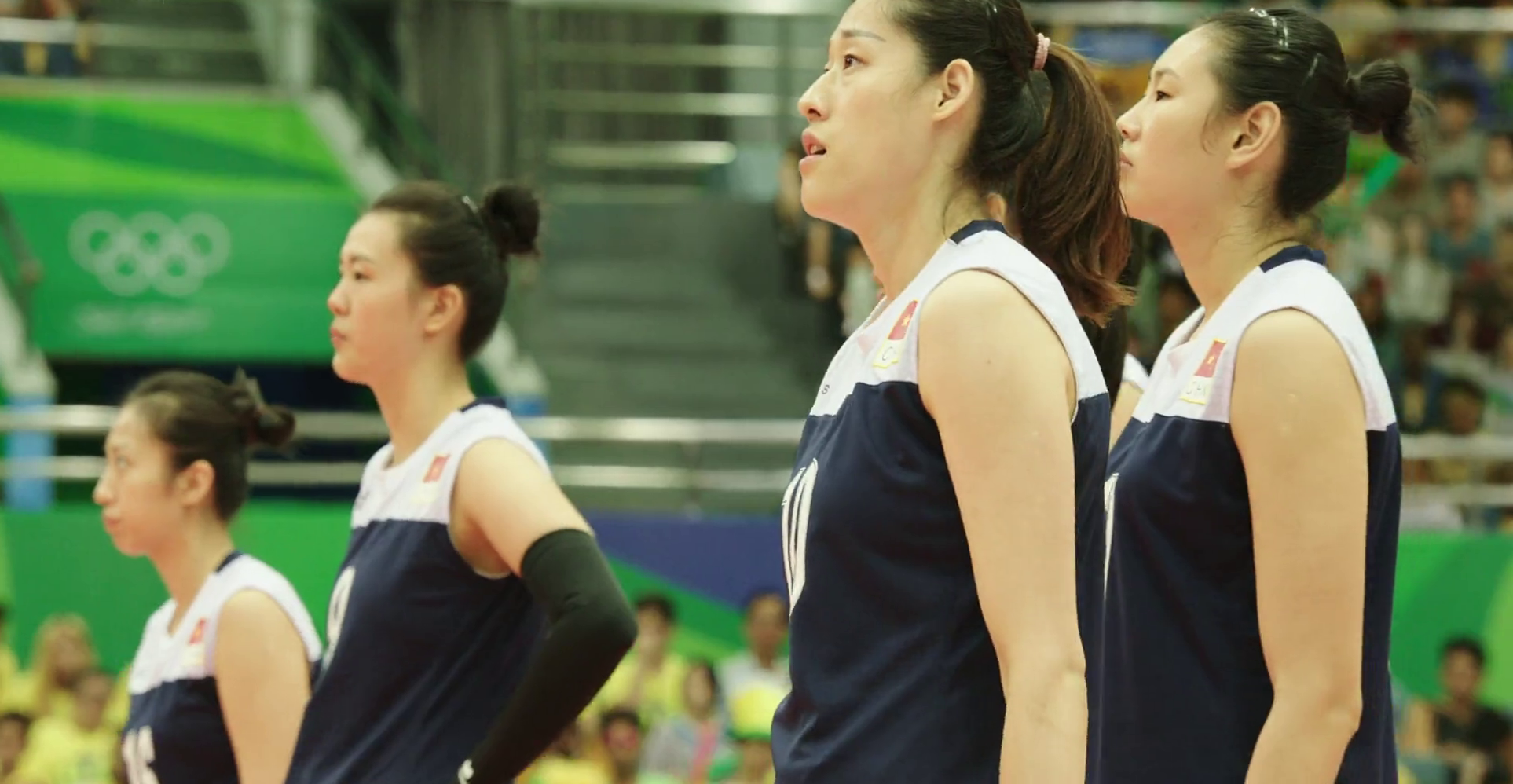
Lang Ping’s daughter- picture above).
Initially, I thought that the introductory
part of the film is a bit of a generic remix of sports drama tropes.
However, when the second act kicked in, everything started making sense.
Leap is not about being the champ all the time, but about conflicting
approaches towards sports. The authority suits obviously demand results,
but Lang Ping, after years of experience in the field, thinks that
being the best is not the point. Giving all the effort during the
challenge, regardless of the outcome, is what matters the most.
Leap
may be the story about the team of underdogs; however, it also presents a
wonderful friendship between Lang Ping and Cheng Zhong He that stands
the test of time. It is so rare nowadays to see a fellow colleague in a
professional field who is so supportive of your actions!
The movie
also goes at lengths with regard to historical accuracy, providing the
viewers with four most important events for the Chinese National Women's
Volleyball Team: the practice match with the Jiangsu team (1980), the
World Cup final game with Japan (1981), the Beijing Olympics (2008),
and the quarterfinals in the Rio Olympics (2016). The last match is
especially significant because the filmmakers brought on board real
female players from that time. Yes, you see in the film real
participants of that event, not actors. Interestingly, there was always
an acting coach who aided the athletes during the shooting.
With
regard to performances, Gong Li is magnificent as always. The role of
Lang Ping, the true heroine of Chinese sports, is quite a breakaway from
Gong Li’s standard drama roles, but the actress gives a flawless
performance. I also greatly enjoyed Hung Bo as Cheng Zhong He. I guess
everyone would like to have such a kind-hearted guy as their P.E.
teacher. It was also interesting to see Bai Lang “portraying” her own
mother.
Recommendations All things considered, Leap is an
enjoyable biographical sports film. It may not be as awesome as my
all-time fave Hoosiers (1986), but it is really high up there. If you
look for a decent motivational tale, then this is the movie for you.
Wait till the end credits and you will be rewarded with some real
footage of the national women’s team in action.
Overall score: 8/10
«Enjoyed this post? Never miss out on future posts by following us»
Mixed Doubles; or, The Winner Takes It All Don't act spoiled! What you feel doesn't matter. You should shine! Don't run away! One step in front! Tough days at work? Strained relations with other people? Don’t you just want to unwind yourself and forget about everything? Then, take that table tennis racket and join the ping pong competition together with the legendary Gakki and Eita in the movie Mixed Doubles.
Language: JapaneseOriginal Title: ミックス。Runtime: 114 min
Synopsis Tamako Tomita (Yui Aragaki) was forced by her mother (Yoko Maki) to practice table tennis and participate in many championships since childhood. After her mother’s passing, Tamako moves to a city and tries to live an ordinary life. She gets a job in a corporation and meets a nice boyfriend, Ejima (Koji Seto), who is a company’s representative at table tennis tournaments. It turns out that Ejima cheats on Tamako with a table tennis partner, Airi (Mei Nagano). Tamako quits the job and returns heartbroken to her hometown. Her father (Fumiyo Kohinata) encourages her to start giving lessons at a table tennis club which was run by her late mother. Tamako gives it a try and she meets Hisashi Hagiwara (Eita), a former boxer who tries to win back the favours of his family. In order to help promote the club and settle the score with her ex-boyfriend, Tamako decides to take part in a mixed doubles table tennis tournament.
Never Giving Up
Mixed Doubles (original title Mikkusu) is a 2017 Japanese production directed by Junichi Ishikawa (who is perhaps best known for his work Legal High drama). I had completely no idea about the existence of this movie until I accidentally saw a poster online featuring Yui Aragaki and Eita! I was all the more surprised when it turned out that apart from the great leads there is also an ensemble cast composed out of many recognisable J-movie/drama actors and actresses.
The movie is a well made mixture of light-hearted rom-com and sports drama. Thankfully, the script is not too cheesy and clichéd (however, who in the right state of mind would cheat on Gakki?). In addition, the overall tone of the film is very earnest and warm. It is a sweet story about finding self-confidence and love akin to Shinobu Yaguchi’s Wood Job! (2014).
Of course, Mixed Doubles would not be so enjoyable without stellar performances. Gakki and Eita have perfect chemistry on the screen and I wish we could get more movies with them. Furthermore, I loved Ryoko Hirouse’s appearance as a rebel hillbilly, Yayoi. Nevertheless, I completely lost it when I saw Kenichi Endo, Fumiyo Kohinata, Yu Aoi, and Mei Nagano in supporting roles (plus cameos from Kotaro Yoshida, Anne Nakamura, and Katsuhisa Namase). Also, am I the only one who thinks that the appearance of Yoko Maki was an in-joke reference to Saikou no Rikon fans? Yoko appeared in only two scenes, but she totally rocked as a crazy mom obsessed with table tennis. The cast of this movie is so perfect!
Recommendations To conclude, Mixed Doubles may not be a zany comedy like Fumihiko Sori’s Ping Pong (2002), but it is a heart-warming flick which will definitely make you feel good. Go ahead and watch it with your family if you can. Even though I suck at table tennis, I wholeheartedly recommend Mixed Doubles.
Overall score: 8/10
«Enjoyed this post? Never miss out on future posts by following us»
Real synchronised swimmers perform in deep pools, but we’ll
manage. The truth is I got super depressed when I heard this was a boys school.
I’ve always dreamed of coaching my own team. Why can't boys do it? Let’s go for
it. Synchro swim!
I finally brought myself round and it’s time to begin my
Shinobu Yaguchi month. I intend to review four of his movies (excluding the
already reviewed Survival Family) throughout the four next weeks. So today, I
would like to discuss his first major success which spawned a two-season drama and
a two-part special; that is, Waterboys from 2001.
Language: JapaneseOriginal Title: ウォーターボーイズ Wōtā Bōizu Runtime: 90 min
Plot
Kawagoe High School is a boy’s prep school in Saitama
Prefecture. Their students are keen on sports, but some who suck at everything
attend swimming classes. Soon, a beautiful new female coach (Kaori Manabe) is
hired and she presents to the group the idea of preparing a synchronised
swimming event for their school festival. However, the coach suddenly goes into
labour and takes maternity leave. Suzuki (Satoshi Tsumabuki) always wanted to
be somebody, but he never had the guts to do it. He and his four other
colleagues: Sato (Hiroshi Tamaki), Saotome (Takatoshi Kaneko), Kanazawa (Koen
Kondo), and Ohta (Akifumi Miura) decide to learn synchro swimming for the
event and they ask a certain dolphin trainer (Naoto Takenaka) to help them out.
Go For It!
Waterboys was a massive success in Japan back in 2001 due
its unusual subject and the way it was executed. Yaguchi had already been an
established director with four theatrical movies on his account (which I
have yet to check out), but it was the Waterboys movie which gave him a wider
recognition.
One can regard the film as a teenage-comedy with a bit of
sports, but to me this is foremost an excellent zero-to-hero story, the format
which Yaguchi would repeat later in Swing Girls (2003) and Wood Job! (2014).
The best thing in Waterboys is this happy-go-lucky
feel which Yaguchi successfully invokes. Whenever the music kicks in (plus
great locations on a beach), I feel as if it’s already vacation time! The
comedy is also extremely well written and it works perfectly in every scene (be
it fishing in a pool or failed synchro attempt). In other words, Waterboys
immediately puts you in a good mood.
Speaking about the movie, I can’t omit its definite
highlights. I absolutely loved the sequences in the aquarium where the gang is
cleaning the tanks and they familiarise themselves with its inhabitants. Also,
Naoto Takenaka nails it while riding a giant orca! The Dance Dance Revolution scene
is hilarious as well. One cannot forget about the standard appearance of Akira
Emoto in a supporting role, who this time around shows up in a drag and a make-up
that almost turns him into Joker! Additionally, Tetta Sugimoto has a minor but
funny role as a furious P.E. teacher.
Oh, and I have to mention the awesome finale with all these
synchro acts done to catchy songs. I guess that the cast and crew must have
worked really hard to get these done. The composers Gakuji Matsuda and Hitomi
Shimizu did a fine job with providing the score, which goes well with the
stunts.
The actors who played Satoshi Tsumabuki as Suzuki and Aya
Hirayama as Shizuko, his love interest, were picked perfectly as the chemistry
of that innocent teenagers’ love is vividly noticeable on screen. The
supporting actors who played the rest of the swimming team did very well, but the
90-minute screen time does not allow them to explore their characters in greater
depth. Synchro is what matters the most.
Recommendations
If you are looking for something to relax and unwind
yourself on a summer afternoon, then Waterboys is the film definitely for you.
Now, I really want to check out the 2003 drama, although I wish there was an
official sequel to this movie. Summing up, it’s a funny and witty film that
leaves you wanting for more.