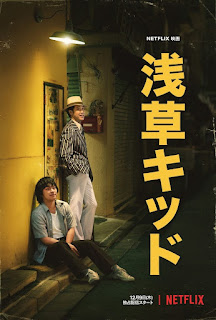
Asakusa Kid; or, Make’em Laugh Listen, Take. Don’t suck up to your audience. You tell them what’s funny. I have been waiting patiently for over a year and finally the movie is out! I refer to Netflix’s latest production Asakusa Kid, which is based on an autobiographical novel by none other than Takeshi Kitano himself.
Language: JapaneseOriginal Title: 浅草キッド Runtime: 123 min
Synopsis In 1965, young Takeshi (Yuya Yagira) dropped out of college. He searches for work in the popular Asakusa district. He eventually becomes an elevator boy at France-Za, a club owned by Senzaburo Fukami (Yo Oizumi) who is a revered comedian in the vicinity. Takeshi begs Fukami to teach him the art of comedy, and the owner reluctantly agrees. Gradually, Fukami discovers Kitano’s talent for on-stage performances.
In Pursuit of Dreams Asakusa Kid is not so much about the whole career of Takeshi Kitano, but rather it focuses on the legend’s humble beginnings. It is a touching story centering on a relationship between a mentor and his student. We see how “Take” learns tap dancing, performance wit, and comedic timing. Eventually, he becomes “Beat” Takeshi we all know and love, but this kind of transformation comes with a price.
If I were to make a cheesy cinematic comparison, I would say that Asakusa Kid is a heartbreaking callback to Rocky V (1990), but the difference is that the movie we discuss is based on real events. Consequently, we are given an insight not only into Takeshi Kitano’s trials and tribulations as a young comedian, but also into the world of Japanese stage comedy of the 1970s. From erotic cabarets to manzai skits, the realm of entertainment outside of Television (which was a groundbreaking novelty at that time) feels stale and outdated. This stark contrast marks a conflict between Master Fukami who clings to the traditional stage and Take who desires to make a name for himself.
I really have to give a shout out to top notch production design. Just as with The Naked Director drama, the viewers are transported back in time to Japan of pre-Bubble era. Interestingly, apart from a closing song by Keisuke Kuwata, we can also hear Takeshi Kitano himself singing the Asakusa Kid song. The music from the master himself really enhances the film’s finale.
With regard to performances, Yo Oizumi really steals the movie with his wonderful portrayal of Senzaburo Fukami. You can’t help but feel the character’s pain, especially in the second half of the story. Additionally, Yuya Yagira is amazing as young (and old) Takeshi Kitano. He got all the tics and mannerisms right. Additional praise goes to supporting actresses, in particular, Mugi Kadowaki as Chiharu and Honami Suzuki as Mari.
Recommendations All things considered, Asakusa Kid is not about gore, violence, and exploitation, which were so popular in the 1970s. It is a delicate coming-of-age tale about a student who feels indebted to his wonderful teacher. By knowing Kitano’s beginnings, you become more appreciative of his cinematic endeavours. This movie is definitely worth a try.
Overall score: 9/10
«Enjoyed this post? Never miss out on future posts by following us»
Look
at the court. You are the youngest and you have the strongest attack. I
called you up to the national team when you were 18. Everything I've
put you through, all leads up to today. China relentlessly keeps
churning out blockbuster pictures inspired by true events for a few good
years now. Peter Chan’s production from 2020 is no exception from this
trend, yet it manages to accomplish much more than recent state-approved
movies made for the sole purpose of glorifying the might of the
People’s Republic of China. Better warm yourselves up because we are
taking a look at Leap.
Release Info
Directed by: Peter ChanStarring: Gong Li, Huang Bo, Bai Lang, Wu Gang, Peng Yuchang
Language: MandarinOriginal Title: 奪冠 Runtime: 134 min
Synopsis The film tells the story of how
the Chinese National Women's Volleyball Team developed and entered the
hallmarks of sports history. Throughout the period of 40 years, we see
various generations of sports women pushing their efforts to the limits
in order to win the Olympic championships. We follow the character of
Lang Ping who was originally a member of the team in the early 1980s.
After retiring from active sportsmanship, she became a coach, training
various teams abroad, including the American one. After the shocking
defeat of China at the 2008 Olympics, Lang Ping assumes the position of
the head coach of the China national team. Sport enthusiasts and experts
are not too hopeful about the team’s success at the approaching 2016
Olympics in Rio de Janeiro…
Crown Players Leap was originally
supposed to premiere to celebrate the Chinese New Year at the beginning
of 2020, but it was pushed back to Fall because of the raging pandemic.
In my opinion, the release delay works in the movie’s favour. Its
motivational tone and zero-to-hero story arc is exactly what we the
viewers need for 2021.
The beginning of the film might be slightly
confusing at first. We start off with the match at the 2008 Olympics and
the set up suggests that we are in for some kind of epic anime-like
duel of fates between the coaches, Lang Ping (Gong Li) and Cheng Zhong
He (Huang Bo). However, a lengthy flashback rushes to unravel the true
story behind the protagonists. The journey begins in the 1980s when the
up-and-coming volleyball players are training in spartan conditions
under the watchful eye of the head coach Yuan Wei Min (Wu Gang). The
trainer is just as merciless as Mickey from Rocky movies as he makes the
team shed blood, sweat, and tears on the court while reminding them that
they fight for the glory of China. At the same time, we see the
formation of friendship between the team’s helper, young Cheng Zhong He
(Peng Yuchang), and a young player, Lang Ping (played by Bai Lang, real
Lang Ping’s daughter- picture above).
Initially, I thought that the introductory
part of the film is a bit of a generic remix of sports drama tropes.
However, when the second act kicked in, everything started making sense.
Leap is not about being the champ all the time, but about conflicting
approaches towards sports. The authority suits obviously demand results,
but Lang Ping, after years of experience in the field, thinks that
being the best is not the point. Giving all the effort during the
challenge, regardless of the outcome, is what matters the most.
Leap
may be the story about the team of underdogs; however, it also presents a
wonderful friendship between Lang Ping and Cheng Zhong He that stands
the test of time. It is so rare nowadays to see a fellow colleague in a
professional field who is so supportive of your actions!
The movie
also goes at lengths with regard to historical accuracy, providing the
viewers with four most important events for the Chinese National Women's
Volleyball Team: the practice match with the Jiangsu team (1980), the
World Cup final game with Japan (1981), the Beijing Olympics (2008),
and the quarterfinals in the Rio Olympics (2016). The last match is
especially significant because the filmmakers brought on board real
female players from that time. Yes, you see in the film real
participants of that event, not actors. Interestingly, there was always
an acting coach who aided the athletes during the shooting.
With
regard to performances, Gong Li is magnificent as always. The role of
Lang Ping, the true heroine of Chinese sports, is quite a breakaway from
Gong Li’s standard drama roles, but the actress gives a flawless
performance. I also greatly enjoyed Hung Bo as Cheng Zhong He. I guess
everyone would like to have such a kind-hearted guy as their P.E.
teacher. It was also interesting to see Bai Lang “portraying” her own
mother.
Recommendations All things considered, Leap is an
enjoyable biographical sports film. It may not be as awesome as my
all-time fave Hoosiers (1986), but it is really high up there. If you
look for a decent motivational tale, then this is the movie for you.
Wait till the end credits and you will be rewarded with some real
footage of the national women’s team in action.
Overall score: 8/10
«Enjoyed this post? Never miss out on future posts by following us»
Samurai of the Sky; or, Divine Winds You are not here to die but to fight! When
looking at the legacy of Japanese filmography, it becomes apparent that
the industry always had an affinity for making war dramas. From Fires
on the Plain (1959) to Yamato (2005), war movies made in Japan
communicated distinct themes, such as exploitation of an individual or heroism of soldiers. Albeit forgotten,
Seiji Maruyama’s Samurai of the Sky is a perfect exemplification of the
latter concept. The movie is an adaptation of memoirs written by Saburo
Sakai, a naval aviator of the Imperial Japanese Navy during World War
II.
Language: JapaneseOriginal Title: 大空のサムライ Runtime: 102 min
Synopsis The Solomon Islands, 1943. Saburo Sakai (Hiroshi
Fujioka) is the leader of an aerial squadron which takes down enemy
planes and protects Japanese bombers. He frequently clashes with
basically everybody in his outfit because he wants to get things done
and protect his men. Sakai is perfectly aware of the fact that the
battle in the sky is the “kill or be killed” kind of situation. During
one of the battles, the pilot gets badly injured and he loses his squad.
Will he be able to make it back to the base?
The Zero Fighter Interesting
thing about Samurai of the Sky is the fact that it does not try to be a
stereotypical tale about Japanese pilots who are only capable of
killing themselves while ramming their planes into enemy fighters. In
the first act, we see Saburo reprimanding his new commanding officer
that the most important thing is to survive and keep on fighting.
Throughout
the film we see various subplots concerning the squadron members. How
stupidity becomes their damnation or how they can’t handle the pressure.
Saburo, on the other hand, behaves like a vicious animal just because
he desires to stay alive.
In terms of special effects, the crew clearly used
miniatures of zero aircrafts and a lot of wire work. The
fights are done fairly well, but you can see that they are not entirely
up to par when compared with Kinji Fukasaku’s segments for Tora Tora
Tora (1970), filmed just 6 years before Samurai of the Sky.
With
regard to performances, Hiroshi Fujioka is undeniably a perfect choice
to play Saburo Sakai. After doing Kamen Rider in 1971, the actor’s
career really took off in the 1970s, especially within the Tokusatsu
genre. My praise also goes to Naoko Otani who provided a subtle
portrayal of Japanese nurse trying to deal with the war turmoil. In
addition, Tetsuro Tamba also makes a brief appearance as Captain Saito,
the direct superior of Sakai.
Recommendations If you are in the
mood for a film that praises the bravado of Japanese pilots, then I
recommend Samurai of the Sky. It is a bit dated, but Hiroshi Fujioka
makes it an enjoyable ride with a touch of pathos. Interestingly, it was
Seiji Maruyama’s penultimate picture before his retirement. I got it
dirt cheap on DVD in my country.
Overall score: 7/10
«Enjoyed this post? Never miss out on future posts by following us»
Everyday Hero (2017); or, Saving the Village I never thought I would come to a place like Li Tan Village. But now, when I’m together with the folks, working on these trivial, petty matters, I feel happy. I’m very happy! Everyday Hero is a 2017 biopic based on the real-life figure of Guo Jian Nan, a local activist who was in charge of the Poverty Alleviation Programme. Director Zheng Hua crafts a calm story about a determined man who wanted to make a difference in a poverty-stricken Chinese countryside.
Release Info
Directed by: Zheng HuaStarring: Sun Hong Tao, Ru Ping, Ai Liya
Language: MandarinRuntime: 90 min
Synopsis Meet Brother Nan (Sun Hong Tao). He is an ordinary engineer who is full of resilience and optimism. He is ordered by his superiors to go to a local village called Li Tan and prepare the construction for the factory. When it turns out that there’s not enough space for the factory, Nan decides to stay in the village and think of other ways to get it out of poverty. However, his duties begin to take a toll on his family life.
Pushing it to the limit Everyday Hero seems to be just an educational picture showing how poverty alleviation committees work in China, but it is also a charming slice-of-life story. Brother Nan is a kind everyman who wants to do a good deed. The tone of the film and how the simple country life was presented reminded me about Bill Forsyth’s Local Hero (1983).
Evidently, the Chinese government wanted to underline the fact that poverty still exists in the rural parts of PRC and that they are going to fight it. Brother Nan is the symbolic government emissary who does everything in his power to help the villagers, yet most of the action to get things done comes from people he interacts with.
I particularly enjoyed the interactions of Nan with the locals as well as his relationship with a loving wife (Ru Ping) and a daughter. The idealism of Nan is the central focus the story, but some things could have been given greater exposition. At times, it is hard to understand some activities undertaken by Nan which are meant to help the village. More information would definitely benefit the script.
With regard to performances, the performance of the main lead actor, Sun Hong Tao, is solid. In addition, there was also a wonderful supporting part done by an actress Ai Liya who played a deaf-mute woman. She was a true highlight of the film.
Recommendations All things considered, if you are in the mood for a peaceful biopic with picturesque Chinese landscapes, then Everyday Hero is the movie for you. It is interesting that the Chinese filmmakers devoted a film to a local activist rather than some kind of popular artist or celebrity. It is a thoughtful insight into modern topical problems. My thanks go to TriCoast Studios for sharing the screener. They released the film under their TriCoast Entertainment label. See the trailer below:
Overall score: 7/10
«Enjoyed this post? Never miss out on future posts by following us»
Attention passengers, I am the purser of this flight. The pilot and flight attendants are trained day to day, in order to ensure everyone's safety. That is our purpose on-board this aircraft. Please trust our captain. We will go home together. After Operation Mekong (2016), Operation Red Sea (2018), and
The Bravest (2019), the Chinese cinema industry continues on with the series of
epic tales about infallible servicemen. Andrew Lau’s The Captain is such a
movie and it was inspired by a true story of the Sichuan Airlines flight 3U8633
incident.
Release Info
Directed by: Andrew LauStarring: Zhang Hanyu, Yuan Quan, Ou Hao, Du Jiang
Language: MandarinOriginal Title: 中国机长 Runtime: 111 min
Synopsis
The story takes place on the 14th of May, 2018. Captain Liu
Chuanjian (Zhang Hanyu) prepares for a standard flight from Chongquing to Lhasa together with
his two co-pilots as well as the flight attendants supervised by a Chief Purser (Yuan Quan).
Passengers board an Airbus A319 plane and everything seems to be in order.
Forty minutes after take-off, on the altitude of 32,000 feet, the windshield
blows out, sucking one of the co-pilots halfway out of the cockpit. The plane
is now depressurized and with inoperative radio communication. To make matters
worse, the flight is cut off on the Tibetan Plateau from the nearest emergency
landing site because of the raging storm. The only hope for the survival of 119
passengers are Captain Liu Chuanjian and his crew.
Plane vs. Nature
The Captain is a fascinating disaster movie which, instead
of descending into slow-paced American procedural dramas like Flight (2012) or
Sully (2016), goes all action and throws callbacks to such memorable motion
pictures like Airport (1970) and Miracle Landing (1990). Even though Zhang
Hanyu dominates the screen with his charismatic presence, The Captain is not a
one-man show because it strives to faithfully retell the tragedy of Sichuan
Airlines flight. The movie goes to such an extent on this matter that it even
pays a beautiful tribute to the real heroes in the end credits.
The movie’s primary assets are awesome visuals, evidently
improved with decent CGI effects. In addition, elaborate action sequences will
certainly keep the viewers on the edge of their seats. However, some should
prepare for a little dose of clichés (flashbacks about loved ones, passengers
having panic attacks) and pathos (trusting the crew) which are, in a way, obligatory
for this kind of movie.
With regard to performances, Zhang Hanyu is obviously too
cool for school as the captain saving the day. Second best performer, and a
true highlight of this picture, is Yuan Quan as the Chief Purser. There are
also some really good performances from the actors and actresses playing the
passengers in distress.
Recommendations
If you have a chance, then get on board with The Captain,
fasten your seat belts, and experience the worst case scenario with a
miraculous ending. Apart from being an informative account of the crew’s
heroism, it is also one gripping story. The Captain will keep you entertained
from beginning to the end.
This time,
I would like to make an exclusive mini-review of the South Korean drama film
called The Crucible (released internationally as Silenced).
Release Info
Directed by: Hwang Dong Hyuk
Starring: Gong Yoo, Jung Yu Mi, Kim Hyung Soo
Language: Korean
Original Title: 도가니
Runtime: 125 min
I picked it
up because I have recently seen Train to Busan(2016), as I have wanted to check out
something more of Gong Yoo and Jung Yu Mi. Well, after checking out The
Crucible, the film left me completely gobsmacked. I was so shocked that, in my
view, a regular review of the film seems pointless, because it will not give it
enough justice.
Don’t get
me wrong, The Crucible is a great movie, but I would like to refer to the
sensitive topic that it explores. The story is based on real events which took
place at Gwangju Inhwa School (go here for further details) and, in short, the movie
focuses on a teacher who discovers that faculty members of a school for deaf
children are sexually assaulting their students. The highlight, as well as the
issue, of the film is that it does not present its topic subtly. It grips the
viewer by the throat and slaps him in the face with highly explicit content.
The first half of the film is a brutal exposition as the main character, Kang
In Ho (Gong Yoo), unravels the uncomfortable truth; whereas the second part is a
nasty courtroom drama as he and human rights activist Seo Yoo Jin (Jung Yu Mi)
struggle to make the offenders pay for their crimes.
To be
honest, it is not a movie for everyone. If you’re faint-hearted or feel very distressed
about sensitive issues, then give this film a pass. However, if you feel up to
going through some upsetting sequences, then The Crucible will provide you some
intellectual food for thought. It is no wonder that the film actually led to
some legislative reforms in South Korea.