Showing posts with label romance. Show all posts

The Sea Is Watching (2002) [Film Review]

The Sea Is Watching; or, The Measure of Love
     Misfortune added to misfortune only doubles the misery.
The Sea Is Watching is yet another Akira Kurosawa’s project that did not see its realisation before the director’s death. As a result, it was made as a tribute to Kurosawa after his passing. I have been meaning to watch the movie together with After the Rain (1999), but somehow something kept coming up and I kept forgetting about it. Thankfully, I finally managed to check it out and I share my thoughts on the film.
Release Info
Directed by: Kei Kumai Starring: Nagiko Tono, Hidetaka Yoshioka, Masatoshi Nagase
Language: Japanese Original Title海は見ていた Runtime: 119 min
Synopsis
Japan, 19th century. Oshin (Nagiko Tono) works as a prostitute. She lives in a house inhabited by other ladies for company. One day, a samurai named Fusanosuke (Hidetaka Yoshioka) arrives in a house looking for safety after injuring a man in a fight. Oshin shelters Fusanosuke and falls in love with him. Unfortunately, the samurai breaks her heart by marrying somebody else. Then, Oshin meets a wanderer Ryosuke (Masatoshi Nagase).
Distant Stillness
Maybe it’s an insane wall of expectations from myself, but I think that The Sea Is Watching is an inferior film when compared to After the Rain. Indeed, both have the spirit and charm of Akira Kurosawa, yet the story of The Sea Is Watching feels so out of place from the director’s dramatic repertoire. All in all, the centre focus of the script is a prostitute with romantic feelings.
Come to think of it, if I hadn't known anything about the film, I would have assumed it was crafted by Nobuhiko Obayashi because of the female-oriented plot, traditional Japan setting, rich colour palette, and a touch of violence. That being said, we know Kurosawa is the one who wrote the script and director Kei Kumai did the directorial chores, and he pulled off the job in a satisfactory way.
While watching the film, I really sympathised with the difficult plight of Oshin, but at the same time, I thought her profession is overly romanticised in the film. Oshin’s professional friends are wholeheartedly supportive of the main heroine while dealing with their own share of toxic relationships. To be honest, all of the them function like remixed variations of Cinderella waiting to be saved and there is no Cruella de Vil in sight to stir things up for Oshin.
Still again, Kurosawa’s story is very poignant and it highlights the unpredictability as well as the sad uncertainty of life. You invest yourself emotionally into another person only to discover that this person does not understand you at all.
With regard to performances, Nagiko Tono played Oshin beautifully and it makes me all the more surprised that this actress did not have greater gigs in historical dramas. Super young Hidetaka Yoshioka convincingly portrays a scared samurai, whereas Masatashi Nagase does a great job as a disillusioned and pitiful loner. A word of mention also goes to Misa Shimizu who portrayed Kikuno.
Recommendations
I won’t write “if you like Kurosawa, then…” Just watch The Sea Is Watching and judge for yourselves if you sense the cinematic master’s vibe. It’s a well made slice-of-life tale, but After the Rain resonated better with me.
Overall score: 6/10
«Enjoyed this post? Never miss out on future posts by following us»

His Motorbike, Her Island (1986) [Film Review]

His Motorbike, Her Island; or, Crazy Thunder Road 2: Love Warrior
     She was there from one summer to the next. She became my story.
I press on with my mini-marathon through Obayashi’s Kadokawa endeavours. This time, I am focusing on his 1986 bosozoku-centered picture called His Motorbike, Her Island, based on a romance novel by Yoshio Kataoka, with Riki Takeuchi and Kiwako Harada in the leading roles.
Release Info
Directed by: Nobuhiko Obayashi Starring: Riki Takeuchi, Kiwako Harada
Language: Japanese Original Title: 彼のオートバイ、彼女の島 Runtime: 90 min
Synopsis
Koh Hashimoto (Riki Takeuchi) is a young, rebellious student who after a failed romance goes on a bike ride through a rural town on an island, and meets a carefree girl Miyoko Shiraishi (Kiwako Harada). Gradually, a relationship forms between the two, but Miyoko gets increasingly drawn to the bike…
Speed Our Destination
The bosozoku subculture was truly at its peak in Japan of the 1980s, making forays into such domains as literature, manga, anime, television, and of course cinema. Undoubtedly, Sogo Ishii’s Crazy Thunder Road (1980), which was already discussed on this blog, serves as the best example of a film that depicted this phenomenon, but also took it to another level in aesthetic terms. It comes as no surprise that Nobuhiko Obayashi dipped his toes into the popular genre as well.
Although His Motorbike, Her Island is not as wacky as Crazy Thunder Road, I dare to say that Obayashi’s film functions very much like its companion piece. What makes His Motorbike, Her Island stand out from a whole slew of numerous bosozoku flicks is the fact that Obayashi for the first time in his career tells an essentially failed romance story. Koh is a social outcast, whereas Miyoko is just a rural girl. One would expect a passionate romance to catch on fire between the two, but it is only a dream, an illusion Miyoko at one point says to Koh: “In Shinshu… When I saw you on top of that Kawasaki, I was so jealous… I envied that Kawasaki. I wanted to ride it myself. And I wanted to be loved as much as that Kawasaki.”
Obayashi explores the unlikely romance through monochromatic shots as well as vividly colourful ones, blurring the lines between a dream, a memory, and reality. What makes the story more interesting is that it is told through the perspective of now adult Koh, which is an indication that he eventually matured, and we, the viewers, relive the glory days together with him. Nevertheless, the conclusion of the tale is unnerving to say the least. Allow me to refrain from giving away any major spoilers, but let me just say that Obayashi presents us with a seemingly bittersweet ending, but at its core, it is deeply heartbreaking.
With regard to performances, if you had not known that piece trivia, His Motorbike, Her Island is the debut appearance of the legendary actor Riki Takeuchi. Indeed, he has a dominating presence as the male lead, but one should also appreciate the youthful gentleness and vulnerability which he displays in this picture. Kiwako Harada is without a doubt memorable as Miyoko, but I would not call her the most assertive Obayashi heroine out there. Truth be told, her character is independent but lost at the same time. My praise also goes to Noriko Watanabe and Tomokazu Miura for appearing in the supporting parts.
Recommendations
I really do not want to use the word “esoteric”. I guess ethereal would be more suitable for His Motorbike, Her Island. Indeed, I appreciate the film for its ethereal ambience and the wonderful riding sequences through urban cityscapes as well as rural landscapes. It is yet another beautifully crafted picture by Nobuhiko Obayashi. The Third Window release of the film contains such bonus features as an archival interview with Nobuhiko Obayashi, an audio commentary by Tom Mes, and an original theatrical trailer.
Overall score: 7/10
«Enjoyed this post? Never miss out on future posts by following us»

The Girl Who Leapt Through Time (1983) [Film Review]

The Girl Who Leapt Through Time: or, Lavender Day
     The fruit of love is at the bottom of the sea. The sky's sigh has turned into stars. It takes millions of years for people to meet.
It’s Obayashi time on this blog again. I finally manage to sit down and revisit four films of the late master, which were recently released in a limited boxset by Third Window Films. Allow me to start my revisitation with Toki o Kakeru Shōjo, or, using the English title, The Girl Who Leapt Through Time from 1983 with Tomoyo Harada in the leading role.
Release Info
Directed by: Nobuhiko Obayashi Starring: Tomoyo Harada, Toshinori Omi, Ryoichi Takayanagi
Language: Japanese Original Title: 時をかける少女 Runtime: 104 min
Synopsis
Meet Kazuko Yoshiyama (Tomoyo Harada). She is an ordinary girl and an average student at a local high school. She is a good friend of Goro Horikawa (Toshinori Omi), whom she has known since childhood, and also of Kazuo Fukamachi (Ryoichi Takayanagi). After a sudden accident while cleaning the science lab, Kazuko discovers that she has the power to travel in time. Little does know that her extraordinary ability is linked to the boy she falls for, Fukamachi.
If I Could Turn Back Time
Let me say right off the bat that The Girl Who Leapt Through Time is often unfairly labelled among Western viewers as Obayashi’s take on the Groundhog Day (1993) formula. In my opinion, this is more of a consequence of Yasutaka Tsutsui’s original novel's premise rather than of misinterpretation of the movie adaptation. Indeed, many Obayashi’s films made in the 1980s were based on some kind of external source material, be it a book or a manga series, but regardless of the story constraints, the auteur director always managed to leave his personal imprint on the subject matter, and The Girl Who Leapt Through Time is no exception from this.
To be specific, rather than reliving the same day over and over again, Kazuko finds herself unwittingly jumping between various points of her life. She literally “cuts through time” as the alternative English title suggests. Personally, I regard this approach as quite refreshing because Obayashi does not make “time travel” as the main MacGuffin or the axis that drives the action forward. Kazuko’s ability serves as the lead-in for discovering her love for Fukamachi. Therefore, the movie is first and foremost a teenage romantic drama suffused with sentimentality and otherworldly strangeness (keep an eye out for The Wizard of Oz easter eggs in the film).
If I were to choose another Obayashi film that is stylistically similar to The Girl Who Leapt Through Time, it would have to be The Visitor in the Eye (1977) because the cinematography as well as the thoughtful usage of music goes hand in hand in both pictures. However, in the case of The Girl Who Leapt Through Time, Obayashi manages to employ his full on visual bizarness in the final act. The stop-motion spectacle as Kazuko travels through time and space is a true invasion of the spectator’s senses, in a positive way of course.
With regard to performances, if I am not mistaken, this is the first instance when Obayashi collaborated with the idol actress Tomoyo Harada (She went on to appear later in The Island Closest to Heaven, Kenya Boy, and Samurai Kids). In my opinion, out of all her appearances in Obayashi’s films, Harada gives her best performance in The Girl Who Leapt Through Time. She gives off the vibe of an innocent girl with pure intentions who is not too egotistical or absent-minded. I have to say that she had a great onscreen chemistry with Obayashi’s regular, Toshinori Omi.
The same, unfortunately, cannot be said fot Ryoichi Takayanagi who plays the main love interest. His delivery of lines is wooden and off-putting to say the least. Still, it did not discourage Kadokawa from utilising the young actor in Obayashi’s other productions cooked up for the studio. In terms of supporting parts, it is great to see Ittoku Kishibe and Wakaba Irie.
Recommendations
If you are looking for a peaceful and unpredictable coming-of-age drama, then I recommend The Girl Who Leapt Through Time. The Third Window limited release of the film comes with such bonus features as an archival interview with Nobuhiko Obayashi, a featurette devoted to Tomoyo Harada, a music video, and an original theatrical trailer. Out of the many adaptations of the original novel, this is the best one.
Overall score: 8/10
«Enjoyed this post? Never miss out on future posts by following us»

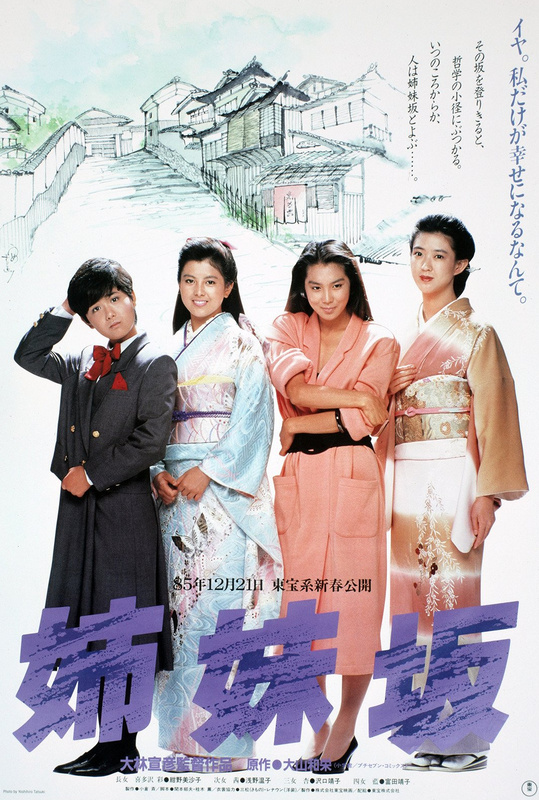
Four Sisters (1985) [Film Review]

Four Sisters; or, Bildungsroman: The Movie
     My dear sister. You've done nothing wrong. Not wanting to let her go shows that you've really taken up the role as her mother.
The year 2022 is slowly but surely nearing its end. A lot of stuff has happened to me personally, but in terms of movies, the running theme through many months was the filmography of Nobuhiko Obayashi. From Third Window’s Anti-War Trilogy release to their recent Kadokawa Years boxset, I have been fuelled by a desire to discover the idiosyncratic grandeur of this auteur filmmaker. As some of the blog readers already know, the result of my deep dive became An Ultra Fan’s Guide to Obayashi Nobuhiko. However, I believe there is still more to be said about this particular director and his movies. To be specific, I would like to talk about one of his motion pictures which is calm, romantic, and deeply melancholic. That is, Four Sisters, a perfect fit for a windy Autumn evening.
Release Info
Directed by: Nobuhiko Obayashi Starring: Atsuko Asano, Yasuko Sawaguchi, Misako Konno, Yasuko Tomita
Language: Japanese Original Title:  姉妹坂 Runtime: 101 min
Synopsis
Meet the Kitazawa family. Four sisters: Aya (Misako Konno), Akane (Atsuko Asano), Anzu (Yasuko Sawaguchi), and Ai (Yasuko Tomita) live in their parental household in Kyoto. Two high school friends, Ryo (Toshinori Omi) and Togo (Ichirota Miyakawa) compete against each other to win the heart of Anzu, which sets in motion a chain of events in the course of which the sisters discover that they are not related by blood. Each sister will have to cross into adulthood on her own terms, facing hardships and real-life drama along the way.
Shoujo Magic
I have to say that Four Sisters does not get a lot of recognition among Obayashi fans because it is not (for lack of a better word) “Obayashi-enough”. There are no vampires, evil children, or pianos that eat people. Four Sisters is what the title suggests: a story about four sisters. The editing itself and Obayashi’s visual stylistics are quite reserved indeed, but it does not mean they are totally absent. Obayashi divides the film into three separate chapters which, thanks to director’s wit and perceptive eye for details, function as memoirs taken straight out of a photo album. In fact, the beginning and end of each section are reminiscent of Polaroid photographs.
There is not a lot of information about the film online, but it seems clear that after Obayashi’s successes at Kadokawa with such movies as School in the Crosshairs (1981), The Girl Who Leapt Through Time (1983), and The Island Closest to Heaven (1984), the Toho Studios wanted to profit from the emerging trend of idol eiga, so they brought the director on board, gave him a shoujo manga called Shimaizaka to adapt, and showered him with their most promising pop stars they had at that time.
Evidently, as usual throughout the 1980s, Obayashi did his magic and put a personal spin on the source material while trying hard to bring out the best performance out of the leading ladies. Consequently, Four Sisters is a compelling coming-of-age drama. It is a story about growing up and finding love as well as inner peace, but certainly not in a conventional way.
Common criticism of the film is that it is too short and some of the subplots concerning the titular four sisters are not greatly elaborated upon. In my opinion, Obayashi was not going for a three-hour epic, but he wanted to create this bildungsroman-like ambience done in the style of the Brontës’ novels. Consequently, the movie is not so much about the exposition but about emotion: motherly love for a child, and longing for a loved one.
This aspect takes me back to the issue of visuals and editing. As I stated previously, Obayashi does not use fast cutting, different frame rates, or a mix of coloured scenes with black-and-white ones. In Four Sisters, when Obayashi wants to convey something intimate, he places a character in front of a camera and uses a really big close up. When he wants to get an unnerving feeling, he plays with the geography of a scene, changing a character’s position in a conversation (see Akane’s medical appointment).
What is more, Obayashi presents us with truly outstanding cinematography. Each and every scene: the framing of characters, their placement within glorious outdoor settings, all of it has meaning! To me, some of the shots like, for example, Akane crying over her mother’s grave, Anzu dancing, or Ryo standing near a stream next to a hospital, are just absolutely breathtaking.
Speaking of the performances, undoubtedly, each and every leading lady gets to shine on the screen, but the true show stealer is Atsuko Asano as Akane. Had the movie been made and released today, I am positive that she would have won an Oscar for her role of a bitter, yet deeply mature and sensitive sister. More words of praise go to Toshinori Omi who, in my opinion, delivered in Four Sisters his best performance out of all Obayashi films he appeared in. Omi no longer plays a sweet schoolboy but a real man who is head over heels in love with Akane.
Yasuko Sawaguchi, known from The Return of Godzilla (1984) does a great job as Anzu. Misako Konno is memorable and graceful as the oldest sister Aya; whereas, Yasuko Tomita is indeed noticeable as the youngest sister Ai. Tomita also played the leading part in Obayashi’s Lonely Heart which was released the same year as Four Sisters. In addition, a whole array of Obayashi’s frequent collaborators such as Yumiko Fujita, Wakaba Irie, Akiko Kitamura, and Toru Minegishi make short appearances as well. Four Sisters was also one of the first major pictures for actor Ichirota Miyakawa who played Anzu’s love interest, Togo.
Recommendations
All things considered, I personally think that Four Sisters is Obayashi’s highly underrated masterpiece. In fact, allow me to say (write) a bit more. It is one of the few movies out there that actually made me cry. I am not ashamed to admit it. And I cried again as I rewatched it for the purposes of this review. I can only hope that sometime in the future the Criterion Collection of some other company will strike a deal with Toho and release this outstanding film on physical media in Europe and the US. There are so many Obayashi movies out there apart from House (1977) that people need to see!
Overall score: 10/10
«Enjoyed this post? Never miss out on future posts by following us»

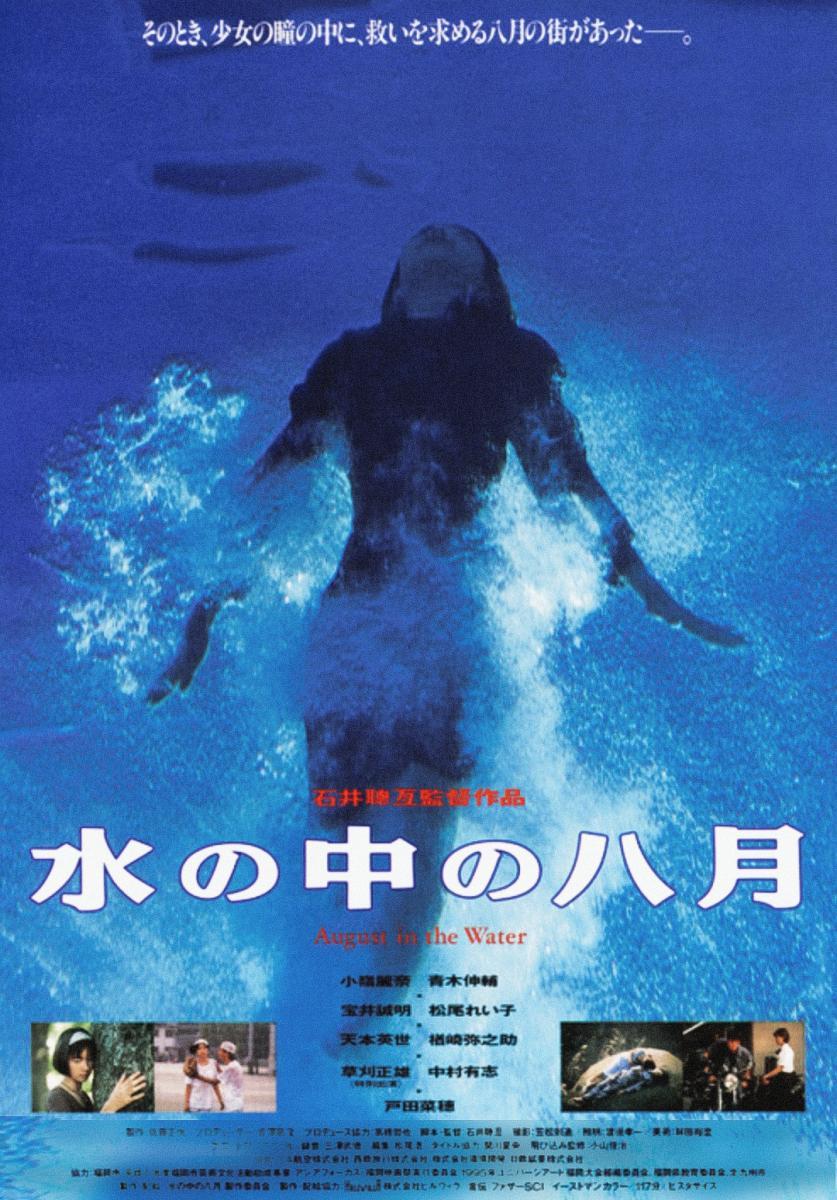
August in the Water (1995) [Film Review]

August in the Water; or, Melancholic Blue
     Sometimes I become uncertain if it was… real, dream or just memories, and whether I'm alive or not.

Allow me to say out-front that I approach this particular review with great trepidation. This is caused by the fact that I have seen Gakuryu (Sogo) Ishii’s August in the Water for the fourth time already in the course of a year and still I do not feel I have digested it fully. On the other hand, I do not want to wait indefinitely, because I am not sure if I will ever be able to fully comprehend this film. In consequence, I apologise if my opinions will not be articulate enough.
Release Info
Directed by: Gakuryu (Sogo) Ishii Starring: Rena Komine, Shinsuke Aoki, Masaaki Takarai
Language: Japanese Original Title: 水の中の八月 Runtime: 127 min
Synopsis
Two high-school students, Mao (Shinsuke Aoki) and Ukiya (Masaaki Takarai) befriend a girl called Izumi (Rena Komine). She practices high diving and participates in competitions organised by the city of Fukuoka. In the meantime, the world is plagued by drought and an unknown outbreak known as the stone disease. The only hope to restore balance is to perform an ancient ritual during a full moon. Izumi suffers an accident while jumping from a pool platform and, in consequence, she gains special powers. She can communicate with dolphins and plants. What is more, she gains an understanding of humanity’s place in the universe.
Water Sensitive
Many people across the internet refer to this movie as a mix between science-fiction and fantasy with a touch of teenage romance. In my opinion, August in the Water is neither of these things. It is most certainly not a narrative-driven picture. In fact, Gakuryu Ishii goes out of his way to enhance the viewing experience by putting emphasis on mesmerising visuals and extremely ethereal music score. As a result, the film very much feels like a dream, an illusive vision that stimulates your senses, yet it is not entirely comprehensible.
The story is there of course but it does not take the center stage. In his own auteur manner, Gakuryu Ishii presents the viewers with glimpses of events, filling in blanks by putting necessary exposition into conversations done by side-characters, TV clips, interviews, or newspaper articles. Therefore, the audience has to assemble the pieces of the puzzle on their own, which is a very challenging task indeed, and opens room to many interpretations of the film.
The way in which I personally understand the film is that the drought and stone disease function as an allegory for a topical problem of modern society, which is lack of empathy. People in the world of today are so dissociated from reality, from contact with another human being that they function as automatons. Hence, their inwards turn to stone. By falling in love with Izumi, Mao understood the value of positive emotions which allowed him to live to the fullest, appreciate nature, and wait decades for the return of the love of his life.
What is more, Ishii can’t help himself but question the organisational order yet again (*Crazy Thunder Road flashbacks*). In spite of drought and disease, the city of Fukuoka organises the high diving competition. Consequently, the country of Japan functions as normally as possible regardless of the immediate threat.
The editing and cinematography of August in the Water deserve a scientific monograph, so I shall limit myself and just say that Ishii really achieved the impossible. Just by camera movement and the marriage of visuals and sound, he creates a one-of-a-kind ambience which covers as well as overshadows the main themes of his picture. Even without the English subtitles, you come to appreciate what is presented on the screen. My favourite sequences, without a doubt, are the opening intro and a water-throwing festival. Had there been a Blu-ray edition of the film in the West, it would have certainly made a great demo disc to test your home cinema setup.
I could devote many more paragraphs to August in the Water, but I feel I would not give justice to the film, so let me end my thoughts here. I know I have to go back and watch it for the fifth time because with each viewing I interpret this film, and Hiroyuki Onogawa’s music, differently. If you wish to read more on the film, then please refer to this informative article at Dazed which has lots of sources.
Unfortunately, the DVD edition of the movie is out of print, so do not get fooled by some preachy sites that refer you to expired offers from Amazon or Yes Asia because most certainly the writers themselves had not seen the film on a physical disc. As of now, the film frequently pops up on YouTube, which is sadly the only way to watch it. I sincerely hope that either Criterion or Eureka! will buy the distribution rights and give August in the Water a proper release it very much deserves. 
Recommendations
I recommend August in the Water if you seek for a magical, other-worldly experience. People need to be more aware of Japanese productions like this one. It is truly idiosyncratic but not by any means pretentious or quirky. It is an emotion rather than a tale.
Overall score: 8/10
«Enjoyed this post? Never miss out on future posts by following us»

Love and Leashes (2022) [Film Review]

Love and Leashes; or, In the Realm of Domination
     I told you I don't think you're a pervert. Or maybe you are. Aren't we all somewhat perverted?
Well, that escalated quickly. As I have previously stated in my review of The Naked Director (2019-2021), I am not really into kinky stuff, so I initially avoided the hype for Love and Leashes, a 2022 South Korean rom-com based on a webtoon called Moral Sense. However, after reading positive reviews on MyDramaList, I decided to give the film a chance. Here are my thoughts on it.
Release Info
Directed by: Park Hyun Jin Starring: Seo Hyun, Lee Jun Young, Lee El, Kim Bo Ra
Language: Korean Original Title: 모럴센스 Runtime: 117 min
Synopsis
Jung Ji Woo (Seo Hyun) is an efficient and straight-to-the-point worker at a company which promotes toys. Jung Ji Hoo (Lee Jun Young) also works at the same company and he has recently been transferred to Ji Woo’s department. Considering the fact that the two have similar names, it comes as no surprise that Jung Ji Woo accidentally opens a package addressed for Ji Hoo. Consequently, the woman discovers her colleague's personal secret. Namely, he is into BDSM…
Office Secrets
On the basis of the title alone, it is easy to imagine that the film is another studio-made flick filled with NSFW content similar in style to, for instance, Love Clinic (2015). In my opinion, Love and Leashes is worth checking out simply because it does not purely focus on the erotic aspect. The BDSM topic is not introduced to provide relief for porn viewers, but it serves as a metaphor of love relations at a workplace. Is it even possible to fall for a colleague? Is it curiosity or attraction? What about the excitement which comes with the infuatuation?
The erotic scenes are present because they reflect the mental state of the main characters. I noticed that lighting in the movie plays an important part. Daily interactions between Ji Woo and Ji Hoo are accompanied by a variety of vibrant colours (see the hilarious package faux-pas or storage room interaction). However, when they engage in a BDSM role play (either in a hotel room or at an office), they are immediately framed within warm colours.
Obviously, the two leads are ridiculous eye candies. Lee Jun Young is so darn adorable, even when he does not pretend to be a puppy, whereas Seo Hyun is enchanting as an office worker who tries to fill in the mistress’ heels. Unfortunately, the supporting parts are a bit bland and forgettable.
Truth be told, the sexual content in Love and Leashes is very mild. The movie’s focus is romance, and I appreciate it for that, but the final act felt too clichéd. It seemed almost as if the writers ran out of ideas, so they remixed the ending of Working Girl (1988) with Melanie Griffith and Harrison Ford, just to wrap up the story.
Recommendations
All in all, I recommend Love and Leashes if you are a fan of the leading actors or if you just want some light entertainment. Nevertheless, the movie has zero rewatch value, at least for me. It is a nicely done one-time comedy.
Overall score: 7/10
«Enjoyed this post? Never miss out on future posts by following us»

House of Flying Daggers (2004) [Film Review]

House of Flying Daggers; or, Triangle Love Affair
     I want the wind to stop and think.
House of Flying Daggers is one of the few Yimou Zhang’s movies which I own on physical media. Still, it has taken me a couple of years to get myself round to watching it. Is it a decent wuxia feature? Let’s explore the film together.
Release Info
Directed by: Yimou Zhang Starring: Zhang Ziyi, Takeshi Kaneshiro, Andy Lau
Language: Mandarin Original Title: 十面埋伏 Runtime: 119 min
Synopsis
China, the second half of the 9th century marks the decline of the Tang Dynasty. The changing political climate leads to the emergence of a rebel group opposing the Emperor known as the House of Flying Daggers. The imperial police relentlessly hunts down the deadly group. Two captains, Leo (Andy Lau) and Jin (Takeshi Kaneshiro), suspect that a blind dancer Mei (Zhang Ziyi), at their local Peony Pavilion, may be a member of Flying Daggers. They arrest the girl, but Leo wants to up the game and expose the whole group. He encourages Jin to stage Mei’s rescue from the prison. Jin does not realise that he will fall for the charms of the beautiful girl…
Into the Woods
Director Yimou Zhang started working on House of Flying Daggers right after wrapping the post-production of Hero (2002). It comes as no surprise that both wuxia spectacles function as companion pieces in terms of stunning visuals, the usage of colour, and stunning cinematography.
Interestingly, the late actress Anita Mui was supposed to play a big part in the film, but the plans fell through because of her untimely death in 2003. This led Zhang to slightly alter the script, which unlike Hero (2002) or Curse of the Golden Flower (2006), focuses more on the love story aspect rather than martial arts.
From the first confrontation in the Peony Pavilion to Jin and Mei’s arduous journey through the woods, House of Flying Daggers becomes a compelling, Shakespearean tragedy about the pitfalls of passion and lust. The storyline in itself is pretty straightforward but the masterful execution made me feel as if I am reading an ancient Chinese tale.
This is not to say that the movie is absolutely flawless. It came out at the height of Matrix films’ popularity, which undoubtedly influenced the CGI sequences. Although these did not age badly, they unfortunately give off an uncanny feeling upon modern viewing. Still, the camera work and the brilliant usage of white, yellow, and green are outstanding to date.
With regard to performances, Zhang Ziyi is undeniably at her prime here. I am convinced she would have been a perfect choice to play Mulan had there been a Chinese adaptation in the mid 2000s. Andy Lau repeats ambiguous vibes from the Infernal Affairs trilogy because we see him as a character operating from the shadows. Takeshi Kaneshiro is brilliant as Jin, who undergoes a change from a sleazy drunkard to a loving warrior.
Recommendations
If you are not into action-packed wuxia tales directed by Yimou Zhang, then give House of Flying Daggers a try. It is a beautiful love story perfect for a peaceful Sunday afternoon. My DVD edition from Fox also contains an audio commentary by Yimou and Ziyi with English subtitles. The end credits contain an in memoriam dedication to Anita Mui.
Overall score: 7/10
«Enjoyed this post? Never miss out on future posts by following us»