Showing posts with label naoto takenaka. Show all posts

A Night in Nude: Salvation (2010) [Film Review]

A Night in Nude: Salvation; or, Living in Disgrace
     Ren… you’re an angel!
It took me a while but, as promised, I return to the exploitation-charged world of neo-noir crafted by the late director Takashi Ishii. A Night in Nude: Salvation is a continuation of the original film from 1993, in which we see the return of the main protagonist played by Naoto Takenaka.
Release Info
Directed by: Takashi Ishii Starring: Naoto Takenaka, Machiko Kochi, Harumi Inoue
Language: Japanese Original Title: ヌードの夜/愛は惜しみなく奪う Runtime: 127 min
Synopsis

Jiro (Naoto Takenaka) continues his work as a handyman for hire, 17 years after the Nami Tsuchiya case. While working, he is caught by the police. They initially consider him to be a burglar, but after clearing the matter, Jiro is released. Guilt-ridden police officer Chichiro Anzai (Machiko Kochi) apologises to Jiro and frequently visits him at his homestead. In the meantime, Jiro is hired by a mysterious woman (Harumi Inoue) to help her find a precious watch in the woods. When Jiro finds the watch, it turns out there are remains of human flesh on it.
Angels and Demons
Well, perhaps my expectations were too high, but I was not as shocked as I thought I would be by this modern-day sequel. Indeed, A Night in Nude: Salvation is a NSFW picture that takes the exploitation factor to another level, but the engaging storyline takes centerstage.
Whereas the original film provided a broad commentary on the post-Bubble state of Japanese society, the sequel chooses to focus on people from the social margin. Naoto Takenaka’s character feels even more like a private detective (similar to Nic Cage from 8mm) who goes through many levels of human depravity to uncover family abuse, prostitution, and even worse practices.
The sequel indeed has the similar feel like the original 1993 film, but it is not a rehash. The only major similarity that stood out for me were the neon scenes. Personally, I think they symbolise in both films the peaceful emotional state the protagonist aspires to achieve when interacting with femme fatales, but inevitably he is unable to do so because femme fatales being femme fatales lead to their own damnation.
The subtitle “Salvation” is also interesting. Takashi Ishii woves into the story the motif of an angel; that is, the main heroine perceives herself to be such and desires to be saved, but the movie is in fact about Jiro’s salvation, about his return from the gutters to human life thanks to the sacrifice of an unlikely ally.
With regard to performances, Naoto Takenaka is absolutely amazing in the lead and has even more opportunities to show his acting range than in the original film. Machiko Kochi is equally outstanding and it is a real shame that she is not very recognizable in the movie industry. Harumi Inoue really overplays her part of a femme fatale, but I think there was no better way to portray such a complex character.
Recommendations

All in all, if you like neo-noir vibes and you do not mind the exploitation aspect, I recommend A Night in Nude: Salvation. In fact, this movie motivated me to check out more unusual roles done by Naoto Takenaka. As for the late director Takashi Ishii, I respect his courage to explore the dark depths of the human psyche.
Overall score: 7/10
«Enjoyed this post? Never miss out on future posts by following us»

A Night in Nude (1993) [Film Review]

A Night in Nude; or, Life on Lease
      Whatever it is, we do it for you, so you don’t have to do it.
The late Takashi Ishii is one of the few Japanese directors that never won me over, mainly because of the fact that the genre he specialises in was never right up my alley. Erotic crime thrillers and straight up exploitation flicks are just too much for me, but I decided to give the director a chance when I found out about A Night in Nude, starring one of my fave veteran actors out there: Naoto Takenaka.
Release Info
Directed by: Takashi Ishii Starring: Naoto Takenaka, Kimiko Yo, Kippei Shiina
Language: Japanese Original Title: ヌードの夜 Runtime: 110 min
Synopsis
Jiro (Naoto Takenaka) is a guy for hire. He basically serves as a stand-in at events which nobody wants to attend, but he will do any kind of job for money. One day, his agency is visited by a woman called Nami Tsuchiya (Kimiko Yo). She hires Jiro to be her tour guide in Tokyo. The next day, Jiro receives a phone call instructing him to visit Nami’s room in a hotel and clean it up. When Jiro arrives, he discovers that there is a dead body in a bathtub…
The Days of Being Prosperous
A Night in Nude is, thankfully, more of a crime flick than pinku production; however, it does contain a fair share of NSFW sequences, especially in the third act. On the whole, the movie feels very neo-noir with its dense atmosphere, night scenes, and just breathtaking cinematography that captured the image of post-Bubble Japan. You could literally frame all the master shots from the film and hang them on your wall.
Come to think of it, the story of A Night in Nude is a social commentary on the situation of Japan in the 1990s. Jiro is a man without a purpose who lives in a country that desperately wants to keep up appearances of glamour and lavish lifestyle, but the whole thing is an illusion because they are living on a lease, borrowing stuff rather than paying for it.
This is very much the case with femme fatale of the picture, Nami, who desperately tries to breakaway from the roots in poverty and criminal underworld to finally become a respectable member of the fake society. However, what she does in order to fulfil her dream only consumes her morality, in a very Dostoevsky-like manner.
With regard to performances, it is a weird experience for me watching young Naoto Takenaka in action, but he effortlessly portrays a sympathetic guy who is knee-deep in an affair that is beyond his professional expertise. Kimiko Yo is absolutely outstanding in the role of a tragic woman who commits a crime. It is a real shame that this actress gets mainly supporting roles nowadays. Kippei Shiina is, unfortunately, unconvincing as a homosexual yakuza sidekick. Jinpachi Nezu is okay as the villain of the picture, but his screen time is limited.
Recommendations
All things considered, I do not regret watching this film. It was an interesting experience indeed, but I think the movie would have been better had the last 20 minutes got cut. Sadly, this final section of the film only washes over a satisfying resolution and provides only the shock value. Then again, cinematography in the film is just beautiful. Interestingly, Ishii made a sequel to this film 17 years later called A Night in Nude: Salvation (2010). So I may give it a try, just to see my boy Naoto Takenaka in noir action again.
Overall score: 7/10
«Enjoyed this post? Never miss out on future posts by following us»

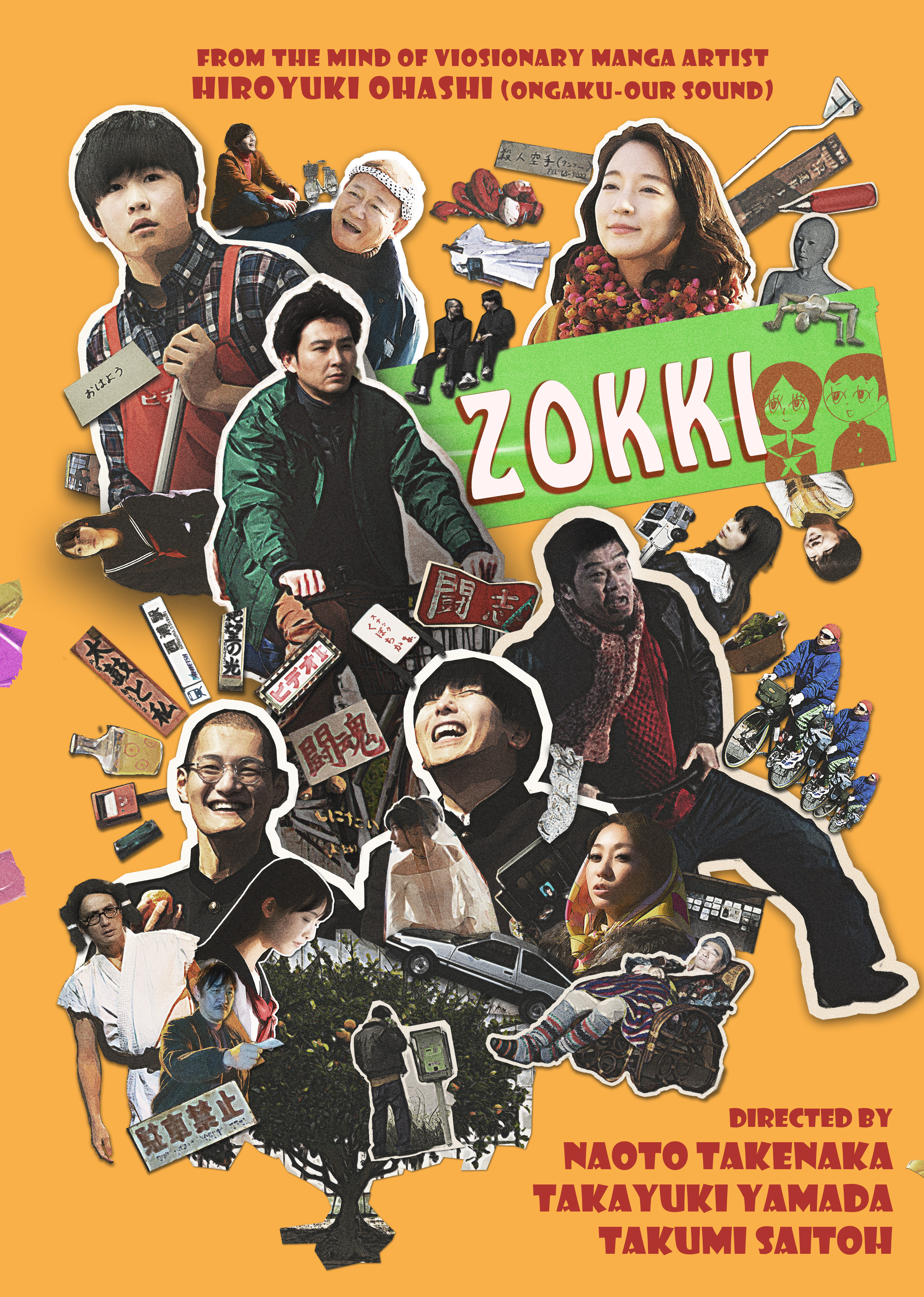
Zokki (2021) [Film Review]

Zokki; or, Too Many Secrets
     Lately, I've been thinking. If a living creature loses what it keeps secret, maybe it can't go on living. Once we finish confessing all our secrets... Or rather... If we confessed all our secrets, would we die, I wonder? So Ryoko, take care of your secrets. Keep as many as you can.
If I were to tell you that there is a Naoto Takenaka, Takayuki Yamada, and Takumi Saitoh movie out there, you would probably wonder who managed to bring together such a mind-blowing cast of excellent actors. In this case, nothing could be further from the truth! The three gentlemen joined forces… as directors(!) and brought to the screen an adaptation of the manga series by Hiroyuki Ohashi called Zokki.
Release Info
Directed by: Naoto Takenaka, Takayuki Yamada, Takumi Saitoh Starring: Riho Yoshioka, Ryuhei Matsuda, Joe Kujo
Language: Japanese Original Title: ゾッキ Runtime: 113 min
Synopsis (issued by the distributor)
There’s an old man who feels the need to impart his knowledge to a grown-up granddaughter; a quiet loner seeking self-discovery on his bike and the fisherman he encounters who invites him to a special meal; a school friendship that turns awkward because of an infatuation with an older sibling; a boy and his father who have very different ideas about how to enjoy themselves; and a friendship between two neighbours that revolves around a series of notes. Scripted by Yutaka Kuramochi, Zokki is less an anthology than a series of snapshots of a strange and quirky world.
Made in Japan
In my opinion, Zokki fits very much into the same narrative stylistics as Survive Style 5+ (2004) and Fish Story (2009). What I mean is that the viewers are presented with a series of vignettes, which gradually cross over into their respective contexts and ultimately constitute one whole. I would not say that Zokki is a wild comedy, but if you have seen Satoshi Miki's flicks, then you will recognise the flavour of distinct quirkiness that could have been manufactured only in Japan.
Although there are five stories featured, the three main ones caught my attention: The first story feels as if it had been penned by Haruki Murakami himself. A guy who clearly has issues with intimate stuff embarks on a bike journey. The second story revolves around two high school students who befriend each other and, consequently, one of them develops an unhealthy obsession. The third one is that of a complex relationship between a father and a son with a touch of horror. To be honest, I think the movie would have been better had the third tale been trimmed a little because it feels prolonged and, in a way, lacks resolution. Still, I very much enjoyed the first two segments, especially the part about high-schoolers.
With regard to performances, unfortunately we are not getting to see Naoto Takenaka, Takayuki Yamada, and Takeru Saitoh in action, but watch out for the leading parts done by Riho Yoshioka, Ryuhei Matsuda, and Joe Kujo. There are also wonderful cameo appearances from Jun Kunimura, Shinnosuke Mitsushima, Yurina Yanagi, Masanobu Ando, and Mai Kiryuu.
Recommendations
If you are in need of yet another set of happy-go-lucky short stories sprinkled with Japanese sensibility, then I recommend Zokki. The movie comes out on Blu-ray from Third Window on the 25th of April. This edition is going to contain such bonus features as interviews with all three directors, a look at behind the scenes, and a theatrical trailer.
Overall score: 7/10
«Enjoyed this post? Never miss out on future posts by following us»

Samurai Marathon (2019) [Film Review]

Samurai Marathon; or, What Samurai Talk When They Talk About Running
     If there is a turbulence in the atmosphere, you need to report immediately back to us. Have no hesitation... And don't be found by others.
Samurai Marathon is the latest jidaigeki, directed by Bernard Rose and based on a 2014 novel by Akihiro Dobashi. This period picture focuses on the origins of marathons in Japan at the end of the Edo period.
Release Info
Directed by: Bernard Rose Starring: Takeru Sato, Nana Komatsu, Mirai Moriyama, Shota Sometami
Language: Japanese Original Title: サムライマラソン Runtime: 104 min
 
Synopsis
When American troops led by Commodore Perry (Danny Huston) arrive at the Japanese shoreline, this causes quite a commotion among the officials. Local leaders are afraid of potential attacks from foreign invaders and, one of them, Lord Itakura (Hiroki Hasegawa), announces a 60-kilometre marathon contest in order to strengthen his samurai. One of the loyal warriors, Jinnai Karasawa (Takeru Sato), is actually a spy working for the shogunate. Jinnai misinterprets his lord’s intention as a call to arms and sends a wrong message to the capital. As a  result of this, a squad of assassins is dispatched in order to suppress the presumed uprising.
 
The Hidden Blades
Samurai Marathon may have a bit of a confusing introduction in view of many characters and plotlines interwoven with each other, but the further the film goes, the better it gets. The story greatly reminded me about such classics as Hideo Gosha’s Three Outlaw Samurai (1964) and Kihachi Okamoto’s Kill! (1968). There are multiple perspectives focusing on the characters who participate in the marathon. Eventually, everything comes together when the assassins arrive and the samurai have to race against time to save Lord Itakura.
 
Additional advantage is the beautiful cinematography done by Takuro Ishikaza. The atmospheric forest setting and smooth camera work really evoke early films of Akira Kurosawa. Also, the music score composed by Phillip Glass gives a breath of fresh air and emphasises the gravity of the difficult situation the samurai have found themselves in.
 
The all-star cast cannot go unnoticed as well. Takeru Sato’s portrayal of a conflicted samurai became his second nature (*Rurouni Kenshin flashbacks*). His performance is aided by those of Nana Komatsu, Shota Sometami, and Mirai Moriyama in supporting roles. Surprisingly, Naoto Takenaka has a small but great part as a retired mentor.
 
Recommendations
If you like historical movies, then you can safely check out Samurai Marathon. It is a well-made drama which provides nods to the golden age of samurai flicks. It will certainly keep you entertained. I wish more historical dramas like that could be made nowadays.
Overall score: 8/10

Swing Girls (2004) [Film Review]

Swing Girls; or, Strike That Beat!
     He said we gotta have swing. That hitting the same groove matters more than the notes.
Swing Girls is a comedy film from 2004 directed by Shinobu Yaguchi. After the enormous success of Waterboys (2001), Yaguchi set out to make a movie similar in tone, but this time featuring schoolgirls and music. Based on the real Tateshina High School Jazz Club, the result is a heart-warming comedy about the pursuit of one’s passion. I have been meaning to review this film for a long time but never got round to do it until now.
Release Info
Directed by: Shinobu Yaguchi Starring: Juri Ueno, Yuta Hiraoka, Shihori Kanjiya, Yuika Motokariya
Language: Japanese Original Title: スウィングガールズ Runtime: 105 min
 
Synopsis
It’s vacation time. Instead of enjoying summer, a group of inept girls is dying of boredom during their make-up class. Tomoko (Juri Ueno) and her friends persuade the math teacher, Mr Ozawa (Naoto Takenaka), to let them deliver the bento boxes for the brass band. However, the girls accidentally spoil the food en route and the band suffers from poisoning. Takuo (Yuta Hiraoka), the only brass band member who did not eat the lunch, forces Tomoko and the other girls into joining the band as substitutes. Due to their number, he turns the girls into a big band performing jazz. Consequently, they become “Swing Girls and a Boy”.
 
Swing, Swing, Swing!
In the style resembling that of Waterboys, Swing Girls focuses on a group of youngsters who engage into an unlikely activity. All of this, of course, is framed within Yaguchi’s favourite zero-to-hero story arc. Interestingly, rather than seeking out experienced young musicians, the director went with the traditional casting process and, later, put the actresses through the exhausting process of learning how to play instruments. Just take a look at Juri Ueno trying to hit that groove!
 
The movie certainly proved to be the challenging endeavour because each girl had to know her specific place in the band. What is more, they had to actually play like professional musicians on a stage. Considering the final effect, I personally think that Swing Girls easily beats other music comedies like, for example, The Blues Brothers (1980).
 
With regard to the actual storyline, I loved all the interactions between the girls. A clear progression was visible of them transforming from the newbies into the pros. There were also lots of funny moments which had me chuckle, especially done by Tomoko, the main heroine. It’s difficult to imagine that this was Juri Ueno's first motion picture she ever did, and what a breakthrough it was for her!
 
Speaking about performances, evidently, Juri Ueno is the best. However, there is a whole slew of supporting girls who later went on to become successful actresses as well, including Shihori Kanjiya, Yuika Motokariya, and Yukari Toyoshima. They had the best onscreen chemistry together. A wonderful addition was also Yuta Hiraoka as Takuo/”The Boy”. Naoto Takenaka broke the system as always with his performance of a clumsy mentor. There are also some great cameos by Fumiyo Kohinata, Eriko Watanabe, Naomi Nishida, and Kei Tani.
 
Swing Girls became such a huge hit in Japan that the movie spawned a few media events, including the so-called Swing Girls: First and Last Concert (2005). Unfortunately, the girls never formed an official band, but they sure stirred the domestic market in the early 2000s. Interestingly, the movie’s official site is still operational, 15 years after the film’s release.
 
Recommendations
Swing Girls is another great comedy from Shinobu Yaguchi. If you like his films, such as Waterboys or Wood Job! (2014), then Swing Girls is the film for you. It has happy-go-lucky vibes, great cinematography, and some catchy jazz beats (even though I’m not a fan of jazz). Check it out if you can because this film deserves it.
Overall score: 9/10

Waterboys (2001) [Film Review]

Waterboys; or, Synchro Revolution
     Real synchronised swimmers perform in deep pools, but we’ll manage. The truth is I got super depressed when I heard this was a boys school. I’ve always dreamed of coaching my own team. Why can't boys do it? Let’s go for it. Synchro swim!
I finally brought myself round and it’s time to begin my Shinobu Yaguchi month. I intend to review four of his movies (excluding the already reviewed Survival Family) throughout the four next weeks. So today, I would like to discuss his first major success which spawned a two-season drama and a two-part special; that is, Waterboys from 2001.
Release Info
Directed by: Shinobu Yaguchi Starring: Satoshi Tsumabuki, Hiroshi Tamaki, Takatoshi Kaneko, Koen Kondo
Language: Japanese Original Title: ウォーターボーイズ Wōtā Bōizu Runtime: 90 min
 
Plot
Kawagoe High School is a boy’s prep school in Saitama Prefecture. Their students are keen on sports, but some who suck at everything attend swimming classes. Soon, a beautiful new female coach (Kaori Manabe) is hired and she presents to the group the idea of preparing a synchronised swimming event for their school festival. However, the coach suddenly goes into labour and takes maternity leave. Suzuki (Satoshi Tsumabuki) always wanted to be somebody, but he never had the guts to do it. He and his four other colleagues: Sato (Hiroshi Tamaki), Saotome (Takatoshi Kaneko), Kanazawa (Koen Kondo), and Ohta (Akifumi Miura) decide to learn synchro swimming for the event and they ask a certain dolphin trainer (Naoto Takenaka) to help them out.
 
Go For It!
Waterboys was a massive success in Japan back in 2001 due its unusual subject and the way it was executed. Yaguchi had already been an established director with four theatrical movies on his account (which I have yet to check out), but it was the Waterboys movie which gave him a wider recognition.
 
One can regard the film as a teenage-comedy with a bit of sports, but to me this is foremost an excellent zero-to-hero story, the format which Yaguchi would repeat later in Swing Girls (2003) and Wood Job! (2014).
 
The best thing in Waterboys is this happy-go-lucky feel which Yaguchi successfully invokes. Whenever the music kicks in (plus great locations on a beach), I feel as if it’s already vacation time! The comedy is also extremely well written and it works perfectly in every scene (be it fishing in a pool or failed synchro attempt). In other words, Waterboys immediately puts you in a good mood.
 
Speaking about the movie, I can’t omit its definite highlights. I absolutely loved the sequences in the aquarium where the gang is cleaning the tanks and they familiarise themselves with its inhabitants. Also, Naoto Takenaka nails it while riding a giant orca! The Dance Dance Revolution scene is hilarious as well. One cannot forget about the standard appearance of Akira Emoto in a supporting role, who this time around shows up in a drag and a make-up that almost turns him into Joker! Additionally, Tetta Sugimoto has a minor but funny role as a furious P.E. teacher.
 
Oh, and I have to mention the awesome finale with all these synchro acts done to catchy songs. I guess that the cast and crew must have worked really hard to get these done. The composers Gakuji Matsuda and Hitomi Shimizu did a fine job with providing the score, which goes well with the stunts.
 
The actors who played Satoshi Tsumabuki as Suzuki and Aya Hirayama as Shizuko, his love interest, were picked perfectly as the chemistry of that innocent teenagers’ love is vividly noticeable on screen. The supporting actors who played the rest of the swimming team did very well, but the 90-minute screen time does not allow them to explore their characters in greater depth. Synchro is what matters the most.
 
Recommendations
If you are looking for something to relax and unwind yourself on a summer afternoon, then Waterboys is the film definitely for you. Now, I really want to check out the 2003 drama, although I wish there was an official sequel to this movie. Summing up, it’s a funny and witty film that leaves you wanting for more.
Overall score: 9/10