Farida Jalal Appreciation Post

I have just seen this little sweet short and it reminded me how brilliant Farida Jalal is. Please stop making horrendous jokes about her performance in Kuch Kuch Hota Hai (1998) (SRK movies are not the only ones in which she played). Also, stop spreading false rumours about her death. Farida is well and alive. Even though she is 68 years old, she is still going strong as Bollywood’s veteran actress.
Instead of making fun of her SRK movies, small-minded whiners should watch such classics as Aradhana (1969), Bobby (1973) or Henna (1992). For your own sake, read this great article by Khalid Mohamed which sums up Farida Jalal's career: Happy Birthday Farida Jalal: B-Town’s Most Dependable Co-Actor; or even better, watch this heart-warming interview in which the actress discusses her life and film career.
Starting as a pretty young lady in Taqdeer (1967) and performing as "cute and bubbly" heroine throughout the 1970s, she eventually became the paragon of everyday mommy, aunty and granny. Observe her onscreen transformation through the decades here. Nevertheless, in my personal opinion,  Farida Jalal's greatest achievement is her performance as Mehmooda Begum in Shyam Benegal's Mammo.
Farida Jalal is the driving force of this motion picture. Apart from the fact that she was not the first choice to play the leading part, she did the job flawlessly. Though she has many memorable roles, like, for instance, as the mother in Dilwale Dulhania Le Jayenge (1995), I will associate her with this loud and big-hearted extrovert who Mammo Nani was. Farida Jalal is a true gem and a cinematic treasure of India. I wish you many more outstanding performances!
 

Sources used:
https://www.youtube.com/watch?v=HnkwY6FT6PE
https://www.thequint.com/entertainment/celebrities/farida-jalal-from-rajesh-khanna-sweetheart-to-dilip-kumar-sister-to-aapa-in-student-of-the-year
https://www.youtube.com/watch?v=DeI7D109-iI
http://www.farnazfever.com/article/magnificent-transformation-farida-jalal-over-years

In Silence Is Our Strength: Understanding Martin Scorsese’s Spiritual Odyssey [Editorial]

Disclaimer: This is not a regular review. Instead, the herein post is a collection of interpretations and my personal thoughts on the movie.

Ordinary films come and go; that’s why we call them forgettable. Great films stand the test of time, that’s why they are called timeless. Into which of these two categories does Martin Scorsese’s latest movie, Silence (2016), fit in? Various award committees have already made their choice. Now, it’s up to us - the viewers - to break away from the dogma of aesthetics-dictated-by-the-mainstream and discover the true value of a story about two Jesuits making it Big in Japan.

As soon as I saw the first trailer for Silence in November 2016, I got hooked. This was not just a new film from Martin Scorsese, it was based on a novel by the awesome Shusaku Edo, and had an amazing cast (Spider-Man, Kylo Ren, and Qui Gon-Jin in one movie). The trailer left me with an impression that this is going to be Masaki Kobayashi’s Harakiri (1962) meets The Ten Commandments (1956). Needless to say, I couldn’t wait to see Silence on the big screen.
However, it turned out that the film will not hit the Polish screens until after two months after its premiere in America. This was a kind of a disappointment but an expected one from the Polish distributor. Nevertheless, I was determined to wait patiently. In the meantime, I have fallen gravely ill. My condition became quite serious and I had to take a leave of absence from university and undergo a long and exhausting treatment. When I found myself in this difficult in-disposition, I unconsciously began evaluating my life: my successes, my failures, my beliefs, and convictions. I have always regarded myself as an Agnostic Deist and I still do. I won’t force anyone into believing that God indeed exists. It’s just a matter of my own belief system. Thus, I believe in the existence of a higher power out there.
I was too sick to check out Silence when it finally arrived in Polish cinemas. Fortunately, I eventually got round to see the movie when it came out on Blu-ray and... I can only describe it in this way: a complete catharsis.
Evidently, Silence is a movie which focuses on religious issues. Martin Scorsese himself described it as a story about a man who gives up his faith to gain his faith. The plot goes like this: It’s the 17th century, the Tokugawa Shogunate is brutally eradicating Christianity in Japan. Two Jesuit priests, Rodrigues (Andrew Garfield) and Garupe (Adam Driver), secretly travel there so as to find their missing mentor, father Ferreira (Liam Neeson), who is rumoured to have committed apostasy.
Since its cinematic release, there’s been a lot of internet discussion going on the internet with people trying to make out the meaning of Silence. Undoubtedly, it’s a story about religion. The main question posed by the film is: Can people freely practise their own beliefs? That’s the general theme with the Japanese being oppressed by the government, yet there’s so much more than this issue. Silence endows us with problems of personal faith, torture-enforced-apostasy, and shame.
Of all the interpretations out there, two really got my attention: the one by Bishop Barron and Wesley Tomsky. Both extremely insightful and interesting, but tackling the movie entirely from a Catholic perspective. Bishop Barron nails it to the cross when talking about the cultural elite who likes the Christianity to be just about ambiguity, complexity, difficulty, etc, which is the mainstream perspective of Silence: nothing is clear, God is uncertain, Christianity is vague– it’s just a touching story about a priest who is forced to commit apostasy. Then, there’s the Catholic stance: Bishop Barron provides an intriguing example of Jesuits being like Special Ops in the war zone. Would it be okay for soldiers commit betrayal and go over the enemy’s side? Not so much. Wesley Tomsky supports this way of thinking by further analysis of father Rodrigues. The Jesuit supports the sacrilege of Christian iconography so that the Japanese could stay alive. This is what, according to Tomsky, already makes Rodrigues an anti-hero. Father Garupe does not deny his faith at any point and he dies in consequence. Rodrigues, on the other hand, finally gives in because he can’t stand the sufferings of Christian believers anymore.
Thus, the central problem unfolds before us: eternal life vs. earthly life. Which of the two is more important? Father Garupe chose the first, whereas Rodrigues and Ferrera were brought down to their knees and supported the latter. Like I said, Bishop Barron’s Special Ops-parallel is very descriptive, but Rodrigues and Ferrera did what they did to stop the killings of innocent people. Of course, in religious terms, they did not survive the task of God. Instead, they became the government puppets, symbols of propaganda. However, did they really renounce their faith? Ferrera at one point says: “Only our Lord can judge your heart”, whereas Rodrigues holds a tiny crucifix in his hand at the very end of the movie. Yet, in my opinion, the most important scene of the film is towards the end as Kichijiro (Yosuke Kubozuka), the story's Judas, begs already-converted Rodrigues to hear his confessions. It is at that moment when Rodrigues utters: ”It was in the silence that I heard your voice” and shares a religious moment with Kichijiro.
I don’t deny Catholic interpretations of Silence, yet the film is so multidimensional with its story that I think we can step outside the box for a moment. To me, this is a story about staying true to personal convictions. In case of Rodrigues, these were Christian beliefs. I would like to use my own analogy here: You have specific political views and a group of close followers, but there’s a whole society of people with completely different political views and they begin to kill your followers. Would you publicly renounce your views in order to save them?
I titled this post “In Silence is Our Strength”, because that’s how I understand the message of this movie. External forces may smear you, break you, destroy you, but deep deep down your heart, you will never reject what you believe in. That’s why Rodrigues heard the voice of Jesus in silence. To him, silence became the message of God. To others, silence is means of survival in this ideologically-driven world of political correctness, atheism, double standards, and postmodernity.

A fact to conclude: Japanese Christians remained silent for 200 years until they were granted religious freedom after the Meiji Restoration.

The Great Wall (2016) [Film Review]

The Great Wall; or, #MakeChinaGreatAgain
     Here? This army? Our flag? We fight for more than food or money. We give our lives to something more. Xin ren is our flag. Trust in each other. In all ways. At all times.
Two years ago, the Chinese brought Matt Damon from Mars. Now, it’s time to return the favour and stand together with an ensemble cast of great Chinese actors in the first line of the humanity’s last stand. In this “Legendary” China-US co-production by prominent director Yimou Zhang, Matt Damon has to save the world from a horde of dragon-like aliens!
Release Info
Directed by: Zhang Yimou Starring: Matt Damon, Jing Tian, Pedro Pascal, Andy Lau
Language: English, Mandarin Runtime: 103 min
 
Plot
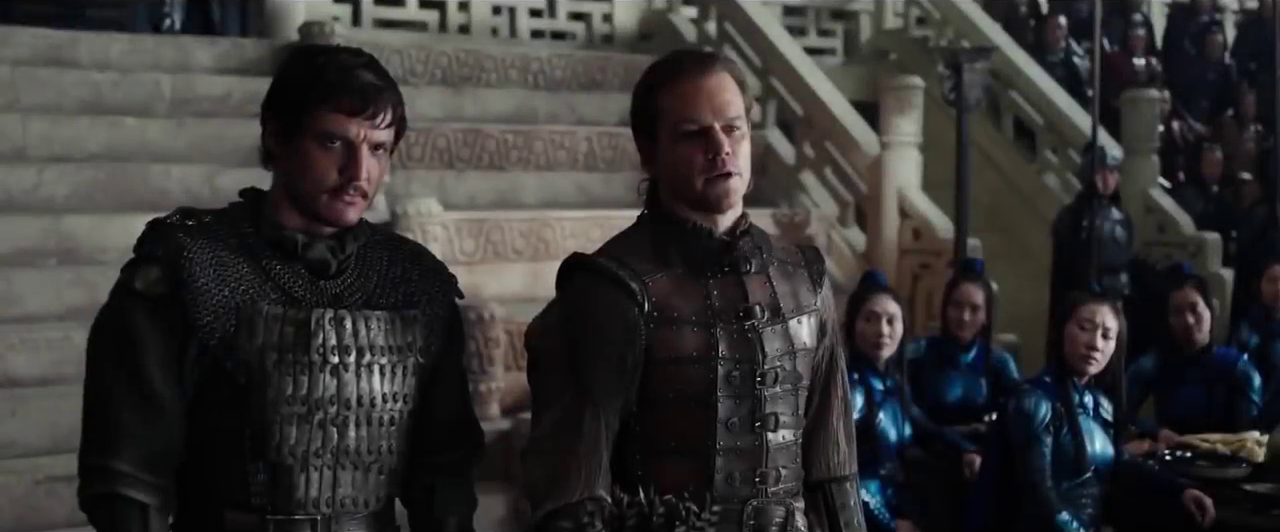
William (Matt Damon) and his companion Tovar (Pedro Pascal) are European mercenaries on the search for the mythical Chinese “black powder”. Other members of their group are killed off during the raid on a desert. While escaping, William and Tovar discover the Great Wall and surrender themselves to the so-called Nameless Order. It turns out that the Order built the Wall and every 60 years the army prepares itself for the battle against the Tao Tei. These mythical creature came from space as a punishment for the Emperor’s vanity. Each time the Tao Tei grow more intelligent in their fight. William resolves to help Commander Lin (Jing Tian) and Strategist Wang (Andy Lau) in their struggle to stop the invasion of the Tao Tei and kill their queen.
 
Wishy-washy whitewashing
The Great Wall completely passed me by when it came out in December 2016. Apart from work and lack of time, I also wasn’t too keen on checking it out due to the supposed “white saviour narrative” (The Last Samurai (2003) seems the definite example). I’m convinced that Asian movies are so good that they don’t need Hollywood shoving in its all-American hero.
 
Thankfully, when I finally overcame my resentment and watched the film, I was pleasantly surprised. The Great Wall is nothing about white saviour and whitewashing. The screenplay convincingly justifies the presence of white characters in non-white environment and treats with respect Chinese culture. It is not Tom-Cruise-turning-Japanese all over again. Granted, Matt Damon is in the lead but he is not the white saviour. Rather than that, his character is an outsider who discovers the awe-inspiring epicness of China. I second Zhang’s statement against the libtard-y allegations:
In many ways The Great Wall is the opposite of what is being suggested. For the first time, a film deeply rooted in Chinese culture, with one of the largest Chinese casts ever assembled, is being made at tentpole scale for a world audience. I believe that is a trend that should be embraced by our industry. (source: Wikipedia)
 
Excluding racial concerns, The Great Wall is one huge rollercoaster of entertainment. We barely get to the 15th minute of the film and the spectacular assault on the wall ensues! Here I have to praise the special effects. Many shots were done purposely for IMAX 3D (greater shame that I missed it in the cinema!) and they look impressive even on standard FullHD TV. The CGI creatures are fairly well made. Their only flaw is probably not the digital execution but the creative design. I just feel they lack something distinguishing, even though they look good on screen. Additionally, the battle scenes and overview shots are simply great, because apart from CGI there’s a lot of real, tangible scenography (all in all, it is Zhang’s movie), which only perfects the visual effects. The music score composed by Ramin Djawadi neatly enhances the viewing experience. If I hadn’t known that he composed it, I could have sworn that the main theme was written by Klaus Badelt.
 
Focusing on performances, Matt Damon is more than believable as a stranger-in-a-strange-land (up until the point when he shaves off a beard...) Pedro Pascal is a wonderful addition as ruthless Tovar but he falls victim of lazy writing in the movie’s third act. Willem Dafoe is always a joy to watch, yet his character suffers the same fate as Pascal’s. Andy Lau does a better job in a supporting role. It is Jing Tian as Commander Lin who deserves the highest praise (A female in charge of an ancient Chinese army? Take that Hollywood!). She is determined, gracious, brave, and most importantly, treats Damon’s character as her equal, not as a love interest.
 
Recommendations
The Great Wall is a safe choice. It is an entertaining, 90 minutes long, break from reality into the world of fantasy. Great direction, awesome music score, wonderful cast, and harmless fun. Poor character development may be the film’s only flaw. Don’t be afraid of whitewashing issue and instead of Ghost in the Shell (2017) go ahead and check out The Great Wall (2016). This movie provides the ultimate proof why the walls are great! Go China!
Overall score: 8/10