Showing posts with label andy lau. Show all posts

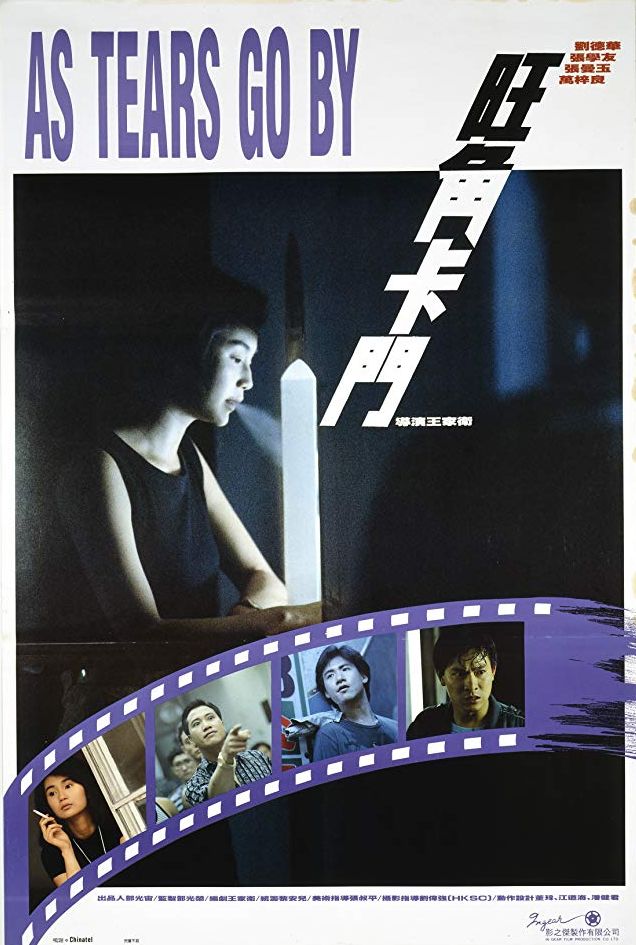
As Tears Go By (1988) [Film Review]

As Tears Go By: or, Stand By Me Older Brother
     At least you were a hotshot for a while. But what about me? Everyone looks down on me. Does that make you happy? People think I'm nothing, like some stray dog just following you around. Did you know that? I'd rather be a hero for one day than go on being a fly all my life.
Charged by Wong Kar Wai's ambience from the previous week, I decided it is high time to watch the director’s film I have not yet seen. That is, his directorial debut, which is often not discussed or mentioned among the critics’ top rundowns of Wong Kar Wai’s filmography. So please, put on your shades, switch on your CRT TV, and let’s take a closer look at As Tears Go By.
Release Info
Directed by: Wong Kar Wai Starring: Andy Lau, Jacky Cheung, Maggie Cheung
Language: Cantonese Original Title: 旺角卡门 Runtime: 102 min
Synopsis
Wah (Andy Lau) is working for the triad gang as an enforcer. All of a sudden, his distant cousin from Lantau Island called Ngor (Maggie Cheung) comes to Hong Hong to have a medical procedure. Wah hangs out with his best friend Fly (Jacky Cheung), who often gets in trouble with other mobsters because of his hot-headed attitude. When Wah falls for Ngor, Fly has to fight for survival to pay off his debt. Wah rushes to help him.
Glass in the Heart
Evidently, As Tears Go By stands out from the rest of Wong Kar Wai’s auteur masterpieces. It is not a bad movie by any means, but it is apparent from the get-go that the young director desperately wanted to break into the cinematic mainstream, and in the process of doing so, he sacrificed his artistic intentions for the purpose of entertaining the audience.
I believe “commercial product” is the best way to describe this motion picture. As Tears Go By really tries to tap into the typical 1980s trend of violent tales about the triads. Wong Kar Wai even borrows from John Woo and Ringo Lam the familiar motives of modern chivalry and overt bromance vibes between the male protagonists. We get blood, gunfights, and Shakespearean drama. Unfortunately, the love subplot is just for the sake of being there, so the audience could have some emotional anchor to root for the hero.
Under many of these commercial layers, it is hard to uncover the Wong Kar Wai we all know and love, but it is not impossible. By means of cinematography and editing, the auteur filmmaker weaves his passion and sensibility into the fabric of As Tears Go By. In the foreground, it is a story about brotherhood and innocent love, but in the background, the core of everything is Wah who becomes an adult and has to come to terms with decisions he makes.
Perhaps the best example of Wong Kar Wai’s visual subtlety is the 6-minute-long sequence in the course of which Wah is reminiscing among Ngor while listening to Sandy Lam’s sensual cover of “Take My Breath Away”. This sequence is a tell-tale foreshadowing of similar scenes involving music and lyrical loneliness as featured in Days of Being Wild, Chungking Express, In the Mood for Love, and beyond. Interestingly, this song was removed in the Mandarin dub of the film and replaced with “You Are The Eternal Pain In My Heart” by Dave Wang and Augustine Yeh.
With regard to performances, Andy Lau is absolutely outstanding as the upright lead with a moral backbone. Maggie Cheung is just as memorable as Ngor, even though her role is very one-dimensional because she plays a kind-hearted love interest. I always found Jacky Cheung to be a very expressive actor, and he cranks up this aspect to the max in his supporting role as Fly.
Recommendations
If you think of WKW’s movies as refined dishes, then this one is junk food. It is delicious, but you know it is junk food nonetheless. Yet, this should not prevent you from enjoying it! In fact, I like this film a bit more than Days of Being Wild mainly because the plot itself was more understandable and accessible. The movie was released in 2021 on Blu-ray by the Criterion Collection as part of a special boxset devoted to Wong Kar Wai. I watched my own copy of the film from Mayfly’s double-disc DVD edition, which also contains Days of Being Wild.
Overall score: 8/10
«Enjoyed this post? Never miss out on future posts by following us»

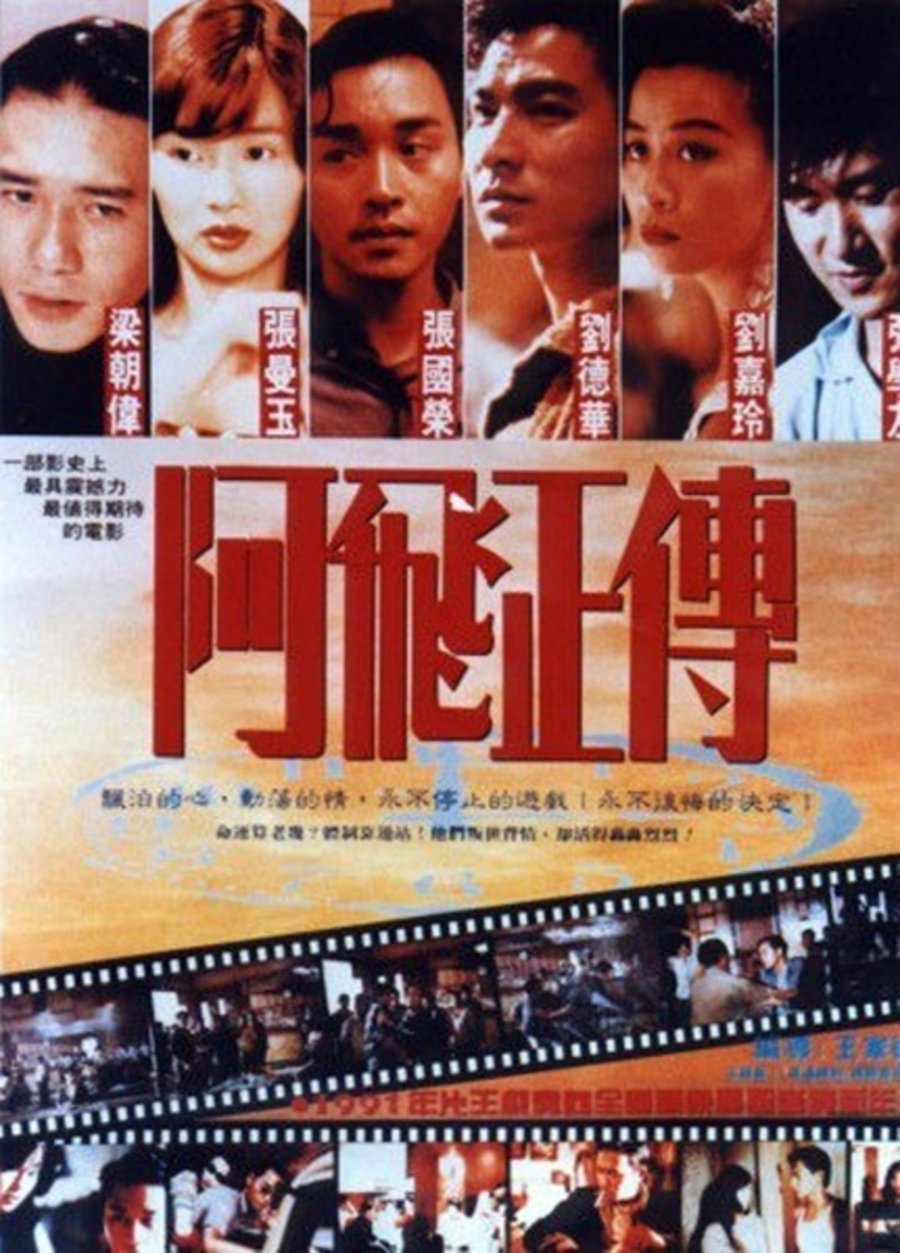
Days of Being Wild (1990) [Film Review]

Days of Being Wild; or, As Minutes Go By
     I've heard that there's a kind of bird without legs that can only fly and fly, and sleep in the wind when it is tired. The bird only lands once in its life... that's when it dies.
In the world of today, Wong Kar Wai seems to be one of the most undisciplined artists out there. In the 2010s, a lot of projects helmed by the director were announced but devoted fans still await their completion. Wong Kar Wai certainly does not care about production deals or shooting schedules. Indeed, his main concern is pursuit of inspiration, thanks to which he became a renowned auteur filmmaker. As a way of coping with my personal bout of melancholy, I decided to revisit his earlier movies, and today I would like to discuss Days of Being Wild.
Release Info
Directed by: Wong Kar Wai Starring: Leslie Cheung, Carina Lau, Maggie Cheung, Andy Lau, Jacky Cheung
Language: Cantonese Original Title:  阿飛正傳 Runtime: 94 min
Synopsis
Hong Kong, 1960. Yuddy (Leslie Cheung) seduces Li-zhen (Maggie Cheung) who works at a ticket stall, but he quickly breaks up with her. While standing in defence of his adoptive mother (Rebecca Pan), he meets a cabaret dancer Mimi (Carina Lau) who falls for him. Yuddy desperately wants to know the whereabouts of his biological mother and meet her. In the meantime, police officer Tide (Andy Lau) befriends Li-zhen, and Yuddy’s friend Zeb (Jacky Cheung) develops feelings for Mimi.
2 Lonely 2 Calm
I have been meaning to review Days of Being Wild for a long time; basically, ever since I saw it in 2015, but I was never sure my words would be sufficient enough to describe the film. It was the very first Wong Kar Wai movie I have ever seen, and in my opinion, it was a challenging introduction. It is clearly visible that the director was still playing with the language of cinema, looking for his personal style.
There is little dialogue in the film, and when it is present, it feels deeply poetic yet irrelevant. Wong Kar Wai, rather than telling, is showing to the audience what happens with the story of Yuddy, a young self-destructive nonconformist, a sigma male before being sigma was mainstream, who suffers from attachment issues.
It is really hard to sympathise with the main protagonist because of the way he treats people around him. He does not want to be loved, because he had not experienced motherly love, but it is almost as if he derives pleasure in degrading people and burning bridges behind him. All of the characters who interact with him: Li-zhen, Mimi, Tide, and Zeb are victims of his fatalistic attitude. This longing for love pushes them to question their own sense of identity.
I have to say that I enjoyed this movie more after rewatching it today than eight years ago. Evidently, my sensibilities and attention span have changed, but it does not change the fact that if you want to begin your own journey through Wong Kar Wai’s filmography, Days of Being Wild is not a good place to start. The film has sublime cinematography and top-notch ambience of Hong Kong of the 1960s, but you really have to focus on the story in order to get it.
With regard to performances, Leslie Cheung is (as always) amazing as the leading man. His presence is both charismatic and mesmerising throughout the entire film. The same can be said about Carina Lau who really gave a stand-out performance as an extroverted and emotionally-charged love interest. Maggie Cheung, Andy Lau, and Jacky Cheung are memorable in their supporting roles, even though their screen time is limited.
Last but not least, I have to address the handsome elephant in the room. That is to say, this movie ends with one of the most soothing scenes in the history of cinema. We see Tony Leung Chiu-Wai as an unnamed character who prepares for a gambling night. It is incredibly comforting just watching this man filling his pockets and having a smoke in a dilapidated apartment. Undoubtedly, the scene must have served as a lead-in for In the Mood for Love and we can only wonder how that film would have looked like had it been made immediately after Days of Being Wild.
Recommendations
All things considered, if you are new to Wong Kar Wai, then be wary of this film. However, if you are an old-timer who has already been through such classics as Chungking Express, Fallen Angels, and 2046, then Days of Being Wild is a perfect choice for you. Sometimes watching Wong Kar Wai’s films out of order is more rewarding than doing it chronologically.
Overall score: 7/10
«Enjoyed this post? Never miss out on future posts by following us»
House of Flying Daggers (2004) [Film Review]

House of Flying Daggers; or, Triangle Love Affair
     I want the wind to stop and think.
House of Flying Daggers is one of the few Yimou Zhang’s movies which I own on physical media. Still, it has taken me a couple of years to get myself round to watching it. Is it a decent wuxia feature? Let’s explore the film together.
Release Info
Directed by: Yimou Zhang Starring: Zhang Ziyi, Takeshi Kaneshiro, Andy Lau
Language: Mandarin Original Title: 十面埋伏 Runtime: 119 min
Synopsis
China, the second half of the 9th century marks the decline of the Tang Dynasty. The changing political climate leads to the emergence of a rebel group opposing the Emperor known as the House of Flying Daggers. The imperial police relentlessly hunts down the deadly group. Two captains, Leo (Andy Lau) and Jin (Takeshi Kaneshiro), suspect that a blind dancer Mei (Zhang Ziyi), at their local Peony Pavilion, may be a member of Flying Daggers. They arrest the girl, but Leo wants to up the game and expose the whole group. He encourages Jin to stage Mei’s rescue from the prison. Jin does not realise that he will fall for the charms of the beautiful girl…
Into the Woods
Director Yimou Zhang started working on House of Flying Daggers right after wrapping the post-production of Hero (2002). It comes as no surprise that both wuxia spectacles function as companion pieces in terms of stunning visuals, the usage of colour, and stunning cinematography.
Interestingly, the late actress Anita Mui was supposed to play a big part in the film, but the plans fell through because of her untimely death in 2003. This led Zhang to slightly alter the script, which unlike Hero (2002) or Curse of the Golden Flower (2006), focuses more on the love story aspect rather than martial arts.
From the first confrontation in the Peony Pavilion to Jin and Mei’s arduous journey through the woods, House of Flying Daggers becomes a compelling, Shakespearean tragedy about the pitfalls of passion and lust. The storyline in itself is pretty straightforward but the masterful execution made me feel as if I am reading an ancient Chinese tale.
This is not to say that the movie is absolutely flawless. It came out at the height of Matrix films’ popularity, which undoubtedly influenced the CGI sequences. Although these did not age badly, they unfortunately give off an uncanny feeling upon modern viewing. Still, the camera work and the brilliant usage of white, yellow, and green are outstanding to date.
With regard to performances, Zhang Ziyi is undeniably at her prime here. I am convinced she would have been a perfect choice to play Mulan had there been a Chinese adaptation in the mid 2000s. Andy Lau repeats ambiguous vibes from the Infernal Affairs trilogy because we see him as a character operating from the shadows. Takeshi Kaneshiro is brilliant as Jin, who undergoes a change from a sleazy drunkard to a loving warrior.
Recommendations
If you are not into action-packed wuxia tales directed by Yimou Zhang, then give House of Flying Daggers a try. It is a beautiful love story perfect for a peaceful Sunday afternoon. My DVD edition from Fox also contains an audio commentary by Yimou and Ziyi with English subtitles. The end credits contain an in memoriam dedication to Anita Mui.
Overall score: 7/10
«Enjoyed this post? Never miss out on future posts by following us»

The Great Wall (2016) [Film Review]

The Great Wall; or, #MakeChinaGreatAgain
     Here? This army? Our flag? We fight for more than food or money. We give our lives to something more. Xin ren is our flag. Trust in each other. In all ways. At all times.
Two years ago, the Chinese brought Matt Damon from Mars. Now, it’s time to return the favour and stand together with an ensemble cast of great Chinese actors in the first line of the humanity’s last stand. In this “Legendary” China-US co-production by prominent director Yimou Zhang, Matt Damon has to save the world from a horde of dragon-like aliens!
Release Info
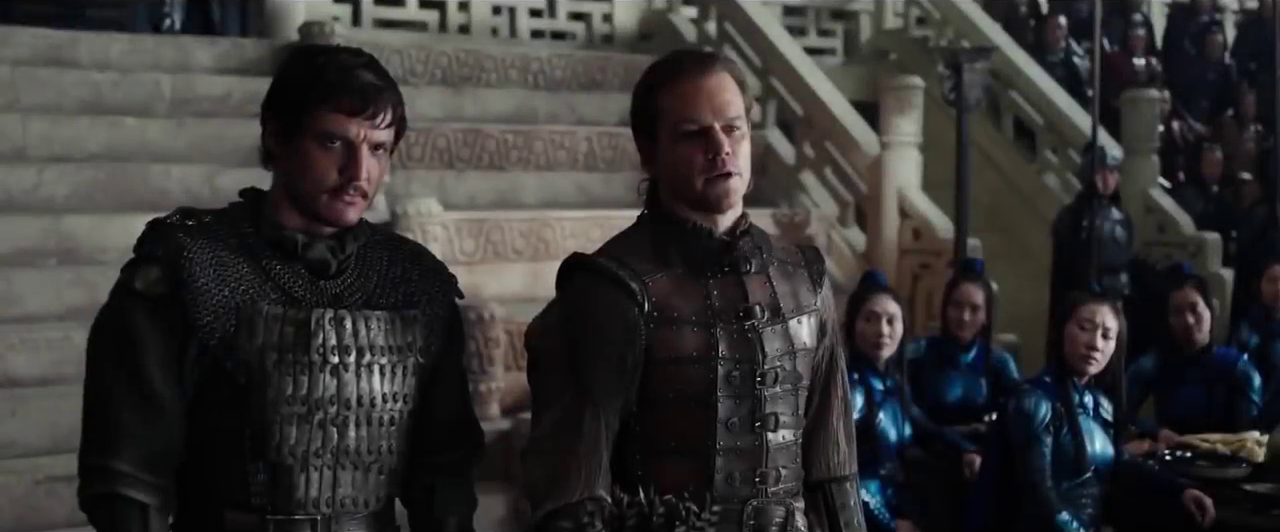
Directed by: Zhang Yimou Starring: Matt Damon, Jing Tian, Pedro Pascal, Andy Lau
Language: English, Mandarin Runtime: 103 min
 
Plot
William (Matt Damon) and his companion Tovar (Pedro Pascal) are European mercenaries on the search for the mythical Chinese “black powder”. Other members of their group are killed off during the raid on a desert. While escaping, William and Tovar discover the Great Wall and surrender themselves to the so-called Nameless Order. It turns out that the Order built the Wall and every 60 years the army prepares itself for the battle against the Tao Tei. These mythical creature came from space as a punishment for the Emperor’s vanity. Each time the Tao Tei grow more intelligent in their fight. William resolves to help Commander Lin (Jing Tian) and Strategist Wang (Andy Lau) in their struggle to stop the invasion of the Tao Tei and kill their queen.
 
Wishy-washy whitewashing
The Great Wall completely passed me by when it came out in December 2016. Apart from work and lack of time, I also wasn’t too keen on checking it out due to the supposed “white saviour narrative” (The Last Samurai (2003) seems the definite example). I’m convinced that Asian movies are so good that they don’t need Hollywood shoving in its all-American hero.
 
Thankfully, when I finally overcame my resentment and watched the film, I was pleasantly surprised. The Great Wall is nothing about white saviour and whitewashing. The screenplay convincingly justifies the presence of white characters in non-white environment and treats with respect Chinese culture. It is not Tom-Cruise-turning-Japanese all over again. Granted, Matt Damon is in the lead but he is not the white saviour. Rather than that, his character is an outsider who discovers the awe-inspiring epicness of China. I second Zhang’s statement against the libtard-y allegations:
In many ways The Great Wall is the opposite of what is being suggested. For the first time, a film deeply rooted in Chinese culture, with one of the largest Chinese casts ever assembled, is being made at tentpole scale for a world audience. I believe that is a trend that should be embraced by our industry. (source: Wikipedia)
 
Excluding racial concerns, The Great Wall is one huge rollercoaster of entertainment. We barely get to the 15th minute of the film and the spectacular assault on the wall ensues! Here I have to praise the special effects. Many shots were done purposely for IMAX 3D (greater shame that I missed it in the cinema!) and they look impressive even on standard FullHD TV. The CGI creatures are fairly well made. Their only flaw is probably not the digital execution but the creative design. I just feel they lack something distinguishing, even though they look good on screen. Additionally, the battle scenes and overview shots are simply great, because apart from CGI there’s a lot of real, tangible scenography (all in all, it is Zhang’s movie), which only perfects the visual effects. The music score composed by Ramin Djawadi neatly enhances the viewing experience. If I hadn’t known that he composed it, I could have sworn that the main theme was written by Klaus Badelt.
 
Focusing on performances, Matt Damon is more than believable as a stranger-in-a-strange-land (up until the point when he shaves off a beard...) Pedro Pascal is a wonderful addition as ruthless Tovar but he falls victim of lazy writing in the movie’s third act. Willem Dafoe is always a joy to watch, yet his character suffers the same fate as Pascal’s. Andy Lau does a better job in a supporting role. It is Jing Tian as Commander Lin who deserves the highest praise (A female in charge of an ancient Chinese army? Take that Hollywood!). She is determined, gracious, brave, and most importantly, treats Damon’s character as her equal, not as a love interest.
 
Recommendations
The Great Wall is a safe choice. It is an entertaining, 90 minutes long, break from reality into the world of fantasy. Great direction, awesome music score, wonderful cast, and harmless fun. Poor character development may be the film’s only flaw. Don’t be afraid of whitewashing issue and instead of Ghost in the Shell (2017) go ahead and check out The Great Wall (2016). This movie provides the ultimate proof why the walls are great! Go China!
Overall score: 8/10