Showing posts with label yimou zhang. Show all posts

House of Flying Daggers (2004) [Film Review]

House of Flying Daggers; or, Triangle Love Affair
     I want the wind to stop and think.
House of Flying Daggers is one of the few Yimou Zhang’s movies which I own on physical media. Still, it has taken me a couple of years to get myself round to watching it. Is it a decent wuxia feature? Let’s explore the film together.
Release Info
Directed by: Yimou Zhang Starring: Zhang Ziyi, Takeshi Kaneshiro, Andy Lau
Language: Mandarin Original Title: ει’εŸ‹δΌ Runtime: 119 min
Synopsis
China, the second half of the 9th century marks the decline of the Tang Dynasty. The changing political climate leads to the emergence of a rebel group opposing the Emperor known as the House of Flying Daggers. The imperial police relentlessly hunts down the deadly group. Two captains, Leo (Andy Lau) and Jin (Takeshi Kaneshiro), suspect that a blind dancer Mei (Zhang Ziyi), at their local Peony Pavilion, may be a member of Flying Daggers. They arrest the girl, but Leo wants to up the game and expose the whole group. He encourages Jin to stage Mei’s rescue from the prison. Jin does not realise that he will fall for the charms of the beautiful girl…
Into the Woods
Director Yimou Zhang started working on House of Flying Daggers right after wrapping the post-production of Hero (2002). It comes as no surprise that both wuxia spectacles function as companion pieces in terms of stunning visuals, the usage of colour, and stunning cinematography.
Interestingly, the late actress Anita Mui was supposed to play a big part in the film, but the plans fell through because of her untimely death in 2003. This led Zhang to slightly alter the script, which unlike Hero (2002) or Curse of the Golden Flower (2006), focuses more on the love story aspect rather than martial arts.
From the first confrontation in the Peony Pavilion to Jin and Mei’s arduous journey through the woods, House of Flying Daggers becomes a compelling, Shakespearean tragedy about the pitfalls of passion and lust. The storyline in itself is pretty straightforward but the masterful execution made me feel as if I am reading an ancient Chinese tale.
This is not to say that the movie is absolutely flawless. It came out at the height of Matrix films’ popularity, which undoubtedly influenced the CGI sequences. Although these did not age badly, they unfortunately give off an uncanny feeling upon modern viewing. Still, the camera work and the brilliant usage of white, yellow, and green are outstanding to date.
With regard to performances, Zhang Ziyi is undeniably at her prime here. I am convinced she would have been a perfect choice to play Mulan had there been a Chinese adaptation in the mid 2000s. Andy Lau repeats ambiguous vibes from the Infernal Affairs trilogy because we see him as a character operating from the shadows. Takeshi Kaneshiro is brilliant as Jin, who undergoes a change from a sleazy drunkard to a loving warrior.
Recommendations
If you are not into action-packed wuxia tales directed by Yimou Zhang, then give House of Flying Daggers a try. It is a beautiful love story perfect for a peaceful Sunday afternoon. My DVD edition from Fox also contains an audio commentary by Yimou and Ziyi with English subtitles. The end credits contain an in memoriam dedication to Anita Mui.
Overall score: 7/10
«Enjoyed this post? Never miss out on future posts by following us»

Raise the Red Lantern (1991) [Film Review]

Raise the Red Lantern; or, Desperate Housewives
     “If I’m able”… You just wait and see what I can do!
Raise the Red Lantern is a 1991 drama film directed by Zhang Yimou and based on a novel "Wives and Concubines" by Su Tong. It is frequently cited as one of the best Chinese movies of all time. It even received the Academy Awards’ nomination for the Best Foreign Language Film in 1992. Being a sceptic at first, the movie struck me with its gripping storyline, wonderful art design, and breathtaking cinematography.
Release Info
Directed by: Zhang Yimou Starring: Gong Li, He Saifei, Cao Cuifen
Language: Mandarin Original Title: ε€§η΄…η‡ˆη± ι«˜ι«˜ζŽ› Runtime: 125 min
 
Synopsis
China, the 1920s. Songlian (Gong Li) is a university student who mourns the death of her father. After nagging from her step-mother, and in view of dire financial situation, she drops studying and decides to become a wife of a wealthy businessman. She marries into the Chen family, acquiring the status of the Fourth Mistress. Songlian familiarises herself with all the peculiar customs at the house, many of which involve the usage of lanterns. Little does she know that there is a strong competition among the Mistresses for the favours of Master Chen (Ma Jingwu). Songlian has to find her way through the maze of conspiracies and compete with Yuru (Jin Shuyuan), Zhuoyun (Cao Cuifen), Meishan (He Saifei), and her servant Yan’er (Kong Lin).
 
The House of Intrigues
Even though I have not read Su Tong’s novel, the style of Raise the Red Lantern reminded me greatly about the works of Anchee Min, and Lisa See. Probably because the two authors also explore the relations between women in their novels. Similarly, Raise the Red Lantern predominantly focuses on women rather than men. We never see the close up of Master Chen, loyal servants are always in the background, whereas Chen’s eldest son, Feipu (Xiao Chu), has only two brief exchanges with Songlian which do not go particularly well. Men are only the burden in this story, tricking women into obedience and submission.
 
In the case of women, on the other hand, the situation is a bit different. When someone is outwardly arrogant, you would think that this person is the baddie; but in fact, the worst kind of a villain is the one with the warmest smile. Women compete between each other ruthlessly in order to acquire higher status, which is a part of Sailong’s tragedy because she does not know how to stay afloat in this dying ground filled with customs and colours. Speaking of which, red colour plays the pivotal role in the film. You can see the whole courtyard and rooms being lit with red, or even characters dressed up in red. In my opinion, red lanterns stand for the tragic fate of Chinese women.
 
From the technical side, the aforementioned cinematography elevates the viewing experience. The movie was shot on location in old Qiao’s Family Courtyard, a lavish, extremely symmetrical residential compound built in the 18th century. Every shot of that compound can be framed and hanged on a wall. It’s that beautiful. In addition, the haunting music score by Zhao Jiping cannot go unnoticed. In many scenes, the music transpires naturally from the film (for instance, playing vinyl records or Meishan's (the Third Mistress) wonderful courtyard singing sequence); however, the music can also be heard in the background of the key scenes.
 
With regard to performances, Gong Li is absolutely amazing in the leading role. However, Cao Cuifen and He Saifei are also brilliant as the competing Mistresses. Relatively young Kong Lin has a very good role as Songlian’s servant.
 
Recommendations
If you have not yet seen Raise the Red Lantern, then please watch it. The film is a wonderful story that will certainly leave you thinking about many social issues. Be careful to grab a decent DVD edition of the film because many releases had quite bad picture quality. All in all, Raise the Red Lantern is Zhang Yimou’s best of the best.
Overall score 8/10

The Great Wall (2016) [Film Review]

The Great Wall; or, #MakeChinaGreatAgain
     Here? This army? Our flag? We fight for more than food or money. We give our lives to something more. Xin ren is our flag. Trust in each other. In all ways. At all times.
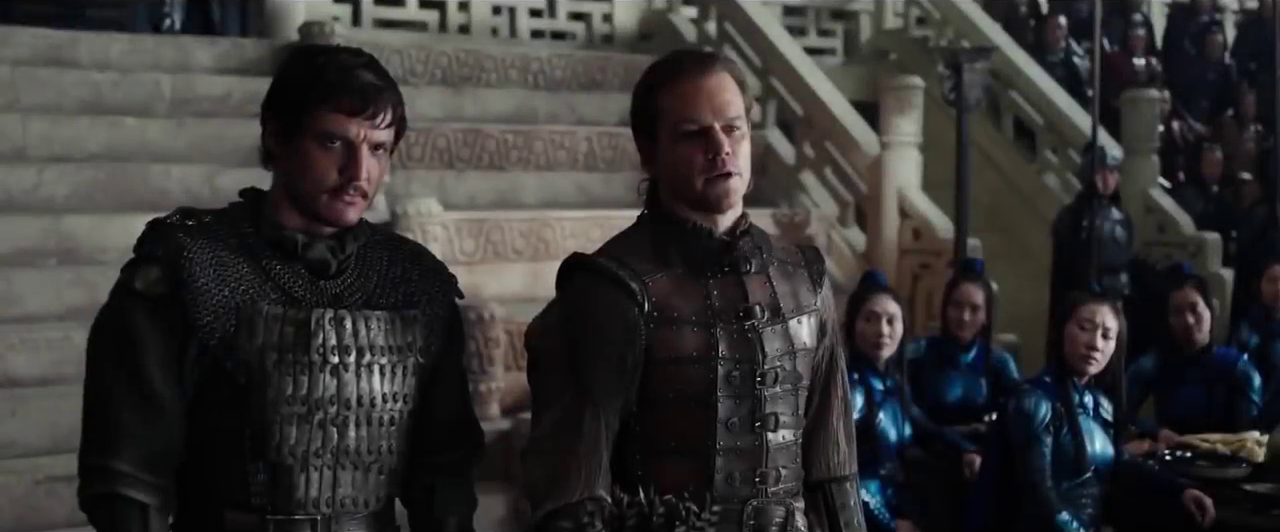
Two years ago, the Chinese brought Matt Damon from Mars. Now, it’s time to return the favour and stand together with an ensemble cast of great Chinese actors in the first line of the humanity’s last stand. In this “Legendary” China-US co-production by prominent director Yimou Zhang, Matt Damon has to save the world from a horde of dragon-like aliens!
Release Info
Directed by: Zhang Yimou Starring: Matt Damon, Jing Tian, Pedro Pascal, Andy Lau
Language: English, Mandarin Runtime: 103 min
 
Plot
William (Matt Damon) and his companion Tovar (Pedro Pascal) are European mercenaries on the search for the mythical Chinese “black powder”. Other members of their group are killed off during the raid on a desert. While escaping, William and Tovar discover the Great Wall and surrender themselves to the so-called Nameless Order. It turns out that the Order built the Wall and every 60 years the army prepares itself for the battle against the Tao Tei. These mythical creature came from space as a punishment for the Emperor’s vanity. Each time the Tao Tei grow more intelligent in their fight. William resolves to help Commander Lin (Jing Tian) and Strategist Wang (Andy Lau) in their struggle to stop the invasion of the Tao Tei and kill their queen.
 
Wishy-washy whitewashing
The Great Wall completely passed me by when it came out in December 2016. Apart from work and lack of time, I also wasn’t too keen on checking it out due to the supposed “white saviour narrative” (The Last Samurai (2003) seems the definite example). I’m convinced that Asian movies are so good that they don’t need Hollywood shoving in its all-American hero.
 
Thankfully, when I finally overcame my resentment and watched the film, I was pleasantly surprised. The Great Wall is nothing about white saviour and whitewashing. The screenplay convincingly justifies the presence of white characters in non-white environment and treats with respect Chinese culture. It is not Tom-Cruise-turning-Japanese all over again. Granted, Matt Damon is in the lead but he is not the white saviour. Rather than that, his character is an outsider who discovers the awe-inspiring epicness of China. I second Zhang’s statement against the libtard-y allegations:
In many ways The Great Wall is the opposite of what is being suggested. For the first time, a film deeply rooted in Chinese culture, with one of the largest Chinese casts ever assembled, is being made at tentpole scale for a world audience. I believe that is a trend that should be embraced by our industry. (source: Wikipedia)
 
Excluding racial concerns, The Great Wall is one huge rollercoaster of entertainment. We barely get to the 15th minute of the film and the spectacular assault on the wall ensues! Here I have to praise the special effects. Many shots were done purposely for IMAX 3D (greater shame that I missed it in the cinema!) and they look impressive even on standard FullHD TV. The CGI creatures are fairly well made. Their only flaw is probably not the digital execution but the creative design. I just feel they lack something distinguishing, even though they look good on screen. Additionally, the battle scenes and overview shots are simply great, because apart from CGI there’s a lot of real, tangible scenography (all in all, it is Zhang’s movie), which only perfects the visual effects. The music score composed by Ramin Djawadi neatly enhances the viewing experience. If I hadn’t known that he composed it, I could have sworn that the main theme was written by Klaus Badelt.
 
Focusing on performances, Matt Damon is more than believable as a stranger-in-a-strange-land (up until the point when he shaves off a beard...) Pedro Pascal is a wonderful addition as ruthless Tovar but he falls victim of lazy writing in the movie’s third act. Willem Dafoe is always a joy to watch, yet his character suffers the same fate as Pascal’s. Andy Lau does a better job in a supporting role. It is Jing Tian as Commander Lin who deserves the highest praise (A female in charge of an ancient Chinese army? Take that Hollywood!). She is determined, gracious, brave, and most importantly, treats Damon’s character as her equal, not as a love interest.
 
Recommendations
The Great Wall is a safe choice. It is an entertaining, 90 minutes long, break from reality into the world of fantasy. Great direction, awesome music score, wonderful cast, and harmless fun. Poor character development may be the film’s only flaw. Don’t be afraid of whitewashing issue and instead of Ghost in the Shell (2017) go ahead and check out The Great Wall (2016). This movie provides the ultimate proof why the walls are great! Go China!
Overall score: 8/10

To Live (1994) [Film Review]

To Live; or, The Irony of Existence
What did you name our son?
           “Don’t-Gamble”
This weeks’ review will be about a Chinese historical epic film directed by Zhang Yimou and the only motion picture from his filmography that was actually banned in mainland China.
Release Info 
Directed by: Zhang Yimou Starring: Ge You, Gong Li, Liu Tanchi, Fei Deng
Language: Mandarin Original Title: HuΓ³zhe Movie Industry: PRC Runtime: 125 min
Plot
Meet Xu Fugui (Ge You), a wealthy property owner and a compulsive gambler with a strong tendency to lose. At one of the gambling sessions, he actually loses his family house, rendering in this way his wife Jiazhen (Gong Li) and children homeless. Nevertheless, Fugui finds a way to make a living. He travels through China with a shadow puppet troupe, raising in this manner enough money to open up a shop. Unfortunately, his run of luck is abruptly stopped by the Second World War, or, to be more precise, the conflict between the Kuomitang and the Communists. When Fugui returns to his hometown as Mao Zedong takes control of the country, a penniless family has to learn how to survive in the People’s Republic of China.
The irony of fate
The movie is based on a novel by the Chinese novelist Yu Hua who grew up in the times of Cultural Revolution which had a profound, and negative, influence on him. Both the book and the film are a direct critique of Communism. The action of To Live begins in the 1930s, the period when there were still class boundaries within Chinese society. Thus obviously, Fugui, with his family fortune, belonged to the Upper Class. However, losing everything he owned paradoxically saved him from getting killed by the Communists. Instead of him, the guy who won the house was publically slaughtered. In addition, Fugui assured the kindness of local authorities by presenting a congratulatory letter from the revolutionary army (for entertaining the communist soldiers with his puppets everyday). These are the elements of black comedy that Zhang Yimou conveys in the story. Nevertheless, To Live is primarily a hardcore drama.
Parental instincts
The story is not so much about the survival of a nuclear family in extreme circumstances, but the inevitable failure to do so. Whereas Fugui entertains fellow comrades with his feudal puppets, Jiazhen works hard every morning distributing water, not mentioning the children: Fengxia (Fei Deng) and Youqing (Liu Tanchi) who constantly have to show their “spirit of comradeship” at school. Yet, Communism as an unlawful system, in fact, deprives Fugui and Jiazhen of their children in the most tragic way possible. In the end, the family survives the worst (sort of) but the price they had to pay for “life” involved a lot of suffering.
Recommendations
I recommend this movie to anyone who is very into political matters and would like to finally see something that exposes Communism for what it actually is, a ruthless brain-washing criminal system run by the tyrants, for the tyrants. Yet, the image of China presented in the picture may seem as an already outdated one (for as we all know China is constantly expanding economically); nevertheless, the movie’s still worth watching for a vivid depiction of the Cultural Revolution. In addition, if you enjoy Zhang Yimou films, it’s a must watch.
Overall score: 8/10