Operation Red Sea (2018) [Film Review]

Operation Red Sea; or, China for the Win!
     Our mission this time is to give a message to all terrorists that you can never harm a Chinese citizen.
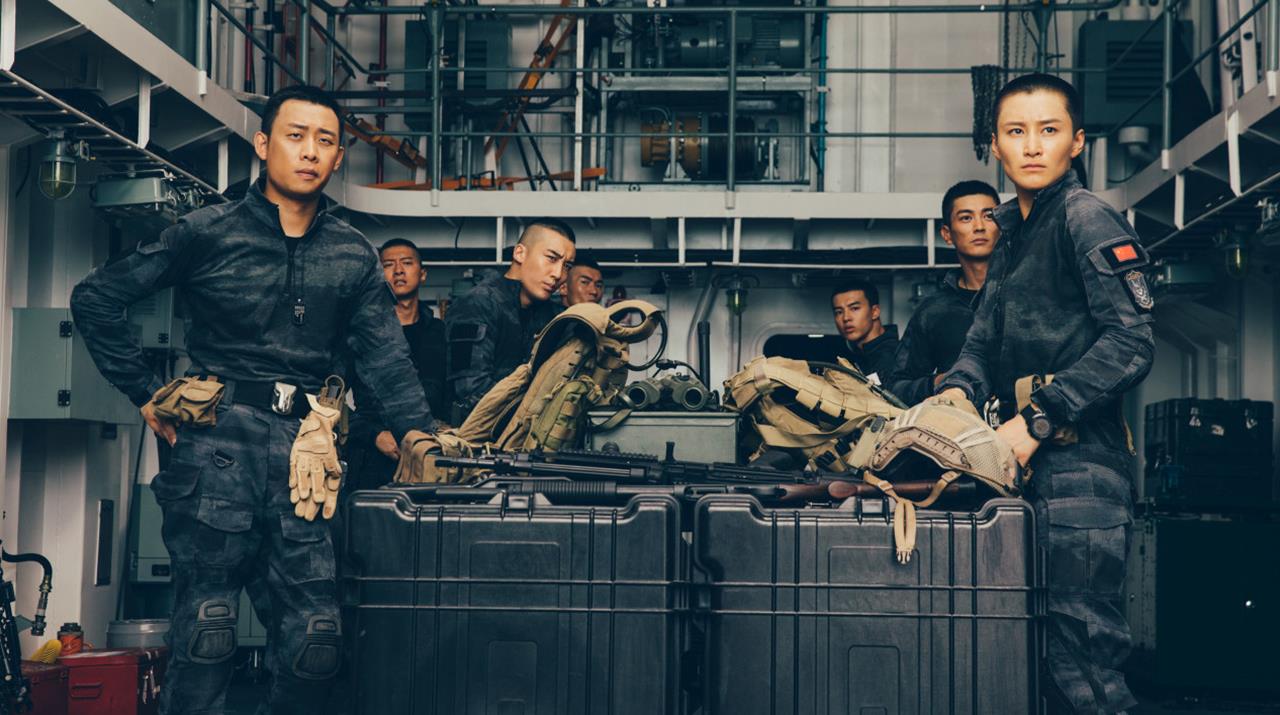
If you thought that Operation Mekong (2016) was the definite representation of China’s power, then you clearly have not seen Operation Red Sea, Dante Lam’s yet another action war film which is currently the fifth-highest-grossing film ever in the Chinese box office. The movie was loosely inspired by the real-life evacuation of Chinese citizens during the Yemeni Civil War in 2015.
Release Info
Directed by: Dante Lam Starring: Zhang Yi, Hai Qing, Du Jiang, Huang Jingyu, Wang Yutian, Yin Fang, and Henry Prince Mak, Jiang Luxia, Zhang Hanyu
Language: Mandarin Original Title: 红海行动 Runtime: 139 min
 
Synopsis
The Chinese Navy is deployed to the country of Yewaire on the Arabian Peninsula. The orders of the Jiaolong Assault Team are to protect Chinese citizens and assist them in the evacuation. The country is in the middle of a civil war between the local government and a morbid terrorist organisation called Zaka. The terrorists kidnap a Western engineer who has the plans needed to make dirty bombs. When Zaka takes a Chinese citizen hostage, they demand from the Chinese Navy the release of the Yewairian President. In the meantime, the Jiaolong squad suffers heavy losses while escorting the Chinese consul as well as the Moroccan locals. Nevertheless, they make an attempt to infiltrate the terrorists’ den and save the hostages.
 
#ChinaFirst
If you could not stand the over-the-top craziness of Wolf Warrior 1 and 2, then Operation Red Sea is the perfect choice for you. It is a wonderfully executed war film with all the right ingredients to make it an enjoyable flick. Just as Operation Mekong was echoing 80s American action movies (*whispers* Delta Force (1986)), then Operation Red Sea provides a similar The Best of compilation of war classics.
 
As a result, we get to see the mash up of Platoon (1986), Sahara (1995), Saving Private Ryan (1998), Black Hawk Down (2001), and (yes) Seven Samurai (1954). Needless to say, the sheer awesomeness starts oozing from the screen right from the opening scene and the fast-paced action lets go only for a couple of exposition moments.
 
Allegedly, this film is considered to be China’s first “modern naval film,” but I think that this is debatable because 80% of the movie happens on land. Evidently, the Chinese Navy are the main good guys and they leave a scorching trail of glory along their path to save every single Chinese citizen in distress. In addition, I was quite surprised that the baddies were not Westerners, but, you know… actual terrorists from the Middle East.
 
What is more, apart from the visually beautiful action, there are some bombastic explosions, and quite realistic bloody stuff. The Chinese are really not bothered by something as petty as MPAA ratings. In fact, many of the scenes (be it shootouts, hand-to-hand-combats, or stealthy sneaking) were so intense that they really had me sitting on the edge of my seat! By far, my most favourite sequence is the “desert tank chase”. Yes, this movie has freaking tanks chasing each other and firing missiles!
 
With regard to performances, all of the actors playing the soldiers did a great job. Zhang Yi was the best as the team leader. The second lead, Hai Qing, also did well as the French-Chinese journalist who voluntarily helps out the squad. I also appreciated the memorable performances of Du Jiang, Huang Jingyu, Wang Yutian, Yin Fang, and Henry Prince Mak. However, the one that stood out the most for me was Jiang Luxia as Tong Li, the only female member of the squad. There was also a decent supporting part done by the ever-great Zhang Hanyu.
 
Recommendations
If you feel the need for some action-packed viewing experience, then Operation Red Sea is one of the best choices for you. Apart from providing an explosive spectacle, the film also communicates the educational message for modern viewers: “If you mess with China, then China will mess with you”. To sum up, you really do not want to make the Chinese Navy angry, because otherwise, they will blow up half of your country and hunt you down.
Overall score: 9/10

A Class to Remember (1993) [Film Review]

A Class to Remember; or, The Power of Education
     Classes are sessions that teachers and students cooperate in building. I realize it now. A fine class!
Yoji Yamada is a legendary Japanese director known for helming the famous Tora-san franchise (1969-1995), Free and Easy series (1988-2009), and Gakko (1993-2000). The last one of the three is a set of four movies focusing on education (Gakko meaning literally school). The first film in the series is A Class to Remember from 1993, the movie I have long sought for and finally found it. How Yamada evaluates Japanese schooling in his motion picture? Let’s find out in this review:
Release Info
Directed by: Yoji Yamada Starring: Toshiyuki Nishida, Keiko Takeshita, Kunie Tanaka
Language: Japanese Original Title: 学校 Runtime: 128 min
 
Synopsis
Kuroi (Toshiyuki Nishida) is a teacher at a city night school. Every evening he teaches the basics like reading and writing to his students who differ in age and, for some reason, could not receive conventional education. In a series of flashbacks, we are presented with the progression of each student: Kaji (Masato Hagiwara), Eriko (Yuri Nakae), Midori (Nae Yuki), Chang (Kaei Okina), Shigeru (Senri Oe), Kim Jun-Hes (Eiko Shinya), and Ino (Kunie Tanaka). During their final lesson, Kuroi receives tragic news which he has to share with the class.
 
The Learning Cycle
A Class to Remember immediately startles with its slow, documentary-like pace. It is neither a comedy nor a serious drama. The movie feels like a slice-of-life story, greatly focusing on the advantages of night schooling. Yet, the action of the story does not happen entirely in a classroom. The camera goes outside in order to show the everyday lives of the teacher as well as his students.
 
One would think that Japan does not have problems with education, but Yamada intimately portrays a group of people who, in one way or another, could not attend daily school. We have elderly people who were so busy with hard work that they never learnt to read or write. There are people with traumas and cognitive deficiencies, or even lazy ones. There are also those who were abused by pathological families. All of them attend a night school, which is surprisingly free of charge, in order to learn something in life.
 
Of course, the figure of the teacher is central to the story. Thankfully, Yamada does not go full GTO by turning Kuroi into an unconventional eccentric. Instead, Kuroi is a warm individual who always tries to reach out to his students. He is not able to fix their problems like Onizuka, but he gives a lending hand when a situation requires it. First and foremost, Kuroi is dedicated to teaching and tries to pass his passion for life to his students.
 
With regard to performances, Toshiyuki Nishida did a great job as Kuroi. I have known him mostly from Doctor X series, but now I want to check out his earlier works, especially collabs with Yamada. Keiko Takeshita was also convincing as another school teacher, Tajima. All of the actors who played the students did very well, but the true highlight was the veteran actor Kunie Tanaka as Ino, the elderly student. Oh, and keep your eyes open for Kiyoshi Atsumi's cameo!
 
Recommendations
The end credits state that (as of 1993) approximately 45 junior high night schools function in Japan. The movie got me so interested about the subject that I started to search for more info about the so-called yakan gakko (night schools). I  was unable to find their exact number in 2019, but, allegedly, they function pretty well today, providing education even for non-Japanese students. Summing up, A Class to Remember is a well made and quite touching film. It leaves you thinking afterwards.
Overall score: 9/10

If you would like to read about Japanese night schools, then I recommend these articles I found.

Swing Girls (2004) [Film Review]

Swing Girls; or, Strike That Beat!
     He said we gotta have swing. That hitting the same groove matters more than the notes.
Swing Girls is a comedy film from 2004 directed by Shinobu Yaguchi. After the enormous success of Waterboys (2001), Yaguchi set out to make a movie similar in tone, but this time featuring schoolgirls and music. Based on the real Tateshina High School Jazz Club, the result is a heart-warming comedy about the pursuit of one’s passion. I have been meaning to review this film for a long time but never got round to do it until now.
Release Info
Directed by: Shinobu Yaguchi Starring: Juri Ueno, Yuta Hiraoka, Shihori Kanjiya, Yuika Motokariya
Language: Japanese Original Title: スウィングガールズ Runtime: 105 min
 
Synopsis
It’s vacation time. Instead of enjoying summer, a group of inept girls is dying of boredom during their make-up class. Tomoko (Juri Ueno) and her friends persuade the math teacher, Mr Ozawa (Naoto Takenaka), to let them deliver the bento boxes for the brass band. However, the girls accidentally spoil the food en route and the band suffers from poisoning. Takuo (Yuta Hiraoka), the only brass band member who did not eat the lunch, forces Tomoko and the other girls into joining the band as substitutes. Due to their number, he turns the girls into a big band performing jazz. Consequently, they become “Swing Girls and a Boy”.
 
Swing, Swing, Swing!
In the style resembling that of Waterboys, Swing Girls focuses on a group of youngsters who engage into an unlikely activity. All of this, of course, is framed within Yaguchi’s favourite zero-to-hero story arc. Interestingly, rather than seeking out experienced young musicians, the director went with the traditional casting process and, later, put the actresses through the exhausting process of learning how to play instruments. Just take a look at Juri Ueno trying to hit that groove!
 
The movie certainly proved to be the challenging endeavour because each girl had to know her specific place in the band. What is more, they had to actually play like professional musicians on a stage. Considering the final effect, I personally think that Swing Girls easily beats other music comedies like, for example, The Blues Brothers (1980).
 
With regard to the actual storyline, I loved all the interactions between the girls. A clear progression was visible of them transforming from the newbies into the pros. There were also lots of funny moments which had me chuckle, especially done by Tomoko, the main heroine. It’s difficult to imagine that this was Juri Ueno's first motion picture she ever did, and what a breakthrough it was for her!
 
Speaking about performances, evidently, Juri Ueno is the best. However, there is a whole slew of supporting girls who later went on to become successful actresses as well, including Shihori Kanjiya, Yuika Motokariya, and Yukari Toyoshima. They had the best onscreen chemistry together. A wonderful addition was also Yuta Hiraoka as Takuo/”The Boy”. Naoto Takenaka broke the system as always with his performance of a clumsy mentor. There are also some great cameos by Fumiyo Kohinata, Eriko Watanabe, Naomi Nishida, and Kei Tani.
 
Swing Girls became such a huge hit in Japan that the movie spawned a few media events, including the so-called Swing Girls: First and Last Concert (2005). Unfortunately, the girls never formed an official band, but they sure stirred the domestic market in the early 2000s. Interestingly, the movie’s official site is still operational, 15 years after the film’s release.
 
Recommendations
Swing Girls is another great comedy from Shinobu Yaguchi. If you like his films, such as Waterboys or Wood Job! (2014), then Swing Girls is the film for you. It has happy-go-lucky vibes, great cinematography, and some catchy jazz beats (even though I’m not a fan of jazz). Check it out if you can because this film deserves it.
Overall score: 9/10