Showing posts with label 2004. Show all posts

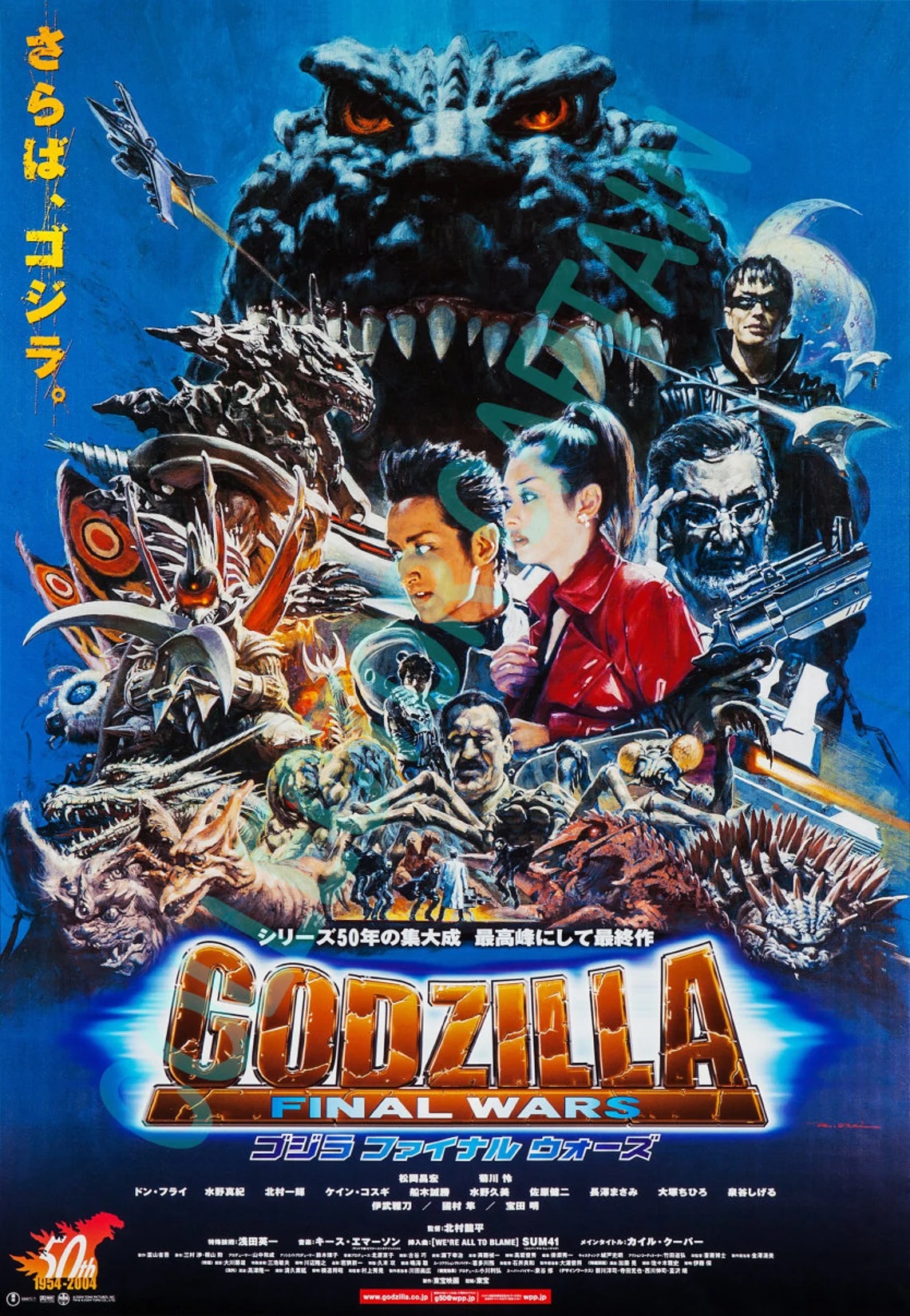
Godzilla: Final Wars (2004) [Tokusatsu Review]

Godzilla: Final Wars; or, Last Hurrah for Monster Rumble
     The world is ruined, and the war is already lost. Now it's a matter of pride. We either die hiding... or die fighting.
Even though this review is already quite belated, I am glad that I finally found the time to talk about my final Godzilla movie for the year 2023; that is, Godzilla: Final Wars, the last instalment of the Millennium series directed by Ryuhei Kitamura and released in 2004 for the 50th anniversary of the franchise.
Release Info
Directed by: Ryuhei Kitamura Starring: Masahiro Matsuoka, Rei Kikukawa, Maki Mizuno
Language: Japanese Original Title ゴジラ ファイナルウォーズ Runtime: 125 min
Synopsis
Godzilla has been defeated and buried in ice imprisonment beneath the South Pole. However, the world was plagued by many disasters and wars that caused the awakening of many monsters. All of a sudden, an alien race calling themselves Xiliens arrives and neutralises the monsters. The aliens want to negotiate a treaty with humans. However, the real motive of the aliens is to conquer Earth. When the monsters get unleashed, Godzilla breaks free from the South Pole as well. Operation Final War is set in motion.
Out with a Bang
After the release of Godzilla: Tokyo SOS, the Toho Studios arrived at a conclusion that Godzilla movies are no longer that profitable as they used to be in the past, so the executives considered axing the franchise. However, producer Shogo Tomiyama decided it would be a good idea to end the series on a high note with a commemorative movie that would retire the King of Monsters for a decade or longer.
To fill in the director’s chair, Tomiyama hired a young director Ryuhei Kitamura who was already known for such films as Versus (2000), Aragami (2003), and Azumi (2003). However, Kitamura had no experience with the Tokusatsu genre, even though he was a Godzilla fanboy since childhood.
Kitamura’s personal auteur style and enthusiasm for the series allowed him to create a unique take on the Big G. Together with writers Wataru Mimura and Isao Kiriyama, he developed an action-packed story that functions as a stand-alone movie in the franchise. At best, you can regard Final Wars as a multiverse finale, but I like to think of it as the missing 16th movie of the Showa era because it follows the wacky science-fiction style of these movies from the 1970s.
It goes without saying that Final Wars is very divisive among the fanbase. Many viewers embrace the batshit craziness that oozes from the screen, whereas others just can’t stand the shifts in tone that alter between the Matrix vibes and traditional monster rumble. I admit that even for me watching this film for the first time ten years ago was just too much. It felt like a sensory overload with too many characters and too many bombastic subplots, but as I matured, I learned to appreciate it for what it is. By no means it is a standard Godzilla flick, but an event film, the purpose of which was to celebrate the 50 year-long legacy of the King.
I have to say that I appreciate top-notch action and special effects helmed by Eiichi Asada that preserved the traditional suitmation technique while utilising CGI in demanding shots. The same kind of praise, however, cannot be said about the music score composed by the late Keith Emerson, Nobuhiko Morino, and Daisuke Yano. The music is more all-over-the-place than the film itself, which really affects the viewing experience. There are some nice action cues, but on the whole, the score is bland and uneventful. Final Wars would have benefited more from Akira Ifukube’s classic themes.
With regard to performances, the leading stars of the film do a great job indeed and they are quite memorable in this whole shabang of insanity. Masahiro Matsuoka does okay as the standard hero who strives to save the day. Rei Kikukawa and Maki Mizuno rock as the Otonashi sisters. Interesting fun fact is that Maki Mizuno is the granddaughter of the legendary Kumi Mizuno who has a small supporting part in the film. We can also spot other Tokusatsu veterans: Kenji Sahara, Masato Ibu, Jun Kunimura, Koichi Ueda, Akira Emoto, and Akira Takarada. Kazuki Kitamura is simply too outlandish as the main villain, but I love him anyway. Last but not least, Don Frye plays Captain Douglas Gordon, and this character is simply too-cool-for-school with his over-the-top gigachad demeanour.
Even though Toho made money from the buzz surrounding the movie (merch, video games, re-release of the 1954 original, etc.), Final Wars itself was a box office failure, recouping approximately half of its original budget. Still, it appears that director Ryuhei Kitamura was satisfied from the movie he delivered.
Personally, I was dying to see the film back in 2004, but there was no theatrical release in the land of forgotten ghosts where I live. However, a distribution label Monolith did issue the film on DVD in a special edition, but the price for it was insane. It was not until 2023 that I was able to get this DVD edition which includes a making-of documentary as well as featurettes from the LA premiere of the film. Unfortunately, the audio on the release is either English or Polish. So, I still have to rely on a bootleg DVD from Hong Kong just to be able to hear the unaltered Japanese audio track. 
Recommendations
All things considered, the aim of the Millennium series was to keep the flame of Big G’s popularity going and to attract new fanbase, but the results were mixed. Godzilla: Final Wars marks the end of an era whether you like it or not. This is the last film that used the suitmation technique. This is the last film that features so many cameos from Tokusatsu veterans. This is the last film that was shot on Toho’s famous pool and backlot before these got restructured. This is the last film that was dedicated to the memory of Ishiro Honda, Eiji Tsuburaya, and Tomoyuki Tanaka, the creators of Godzilla. It was not until the year 2014 when Godzilla was reintroduced into the public spotlight with the American remake that ushered in the MonsterVerse series. However, this is a story for another time.
Overall score: 6/10
«Enjoyed this post? Never miss out on future posts by following us»

House of Flying Daggers (2004) [Film Review]

House of Flying Daggers; or, Triangle Love Affair
     I want the wind to stop and think.
House of Flying Daggers is one of the few Yimou Zhang’s movies which I own on physical media. Still, it has taken me a couple of years to get myself round to watching it. Is it a decent wuxia feature? Let’s explore the film together.
Release Info
Directed by: Yimou Zhang Starring: Zhang Ziyi, Takeshi Kaneshiro, Andy Lau
Language: Mandarin Original Title: 十面埋伏 Runtime: 119 min
Synopsis
China, the second half of the 9th century marks the decline of the Tang Dynasty. The changing political climate leads to the emergence of a rebel group opposing the Emperor known as the House of Flying Daggers. The imperial police relentlessly hunts down the deadly group. Two captains, Leo (Andy Lau) and Jin (Takeshi Kaneshiro), suspect that a blind dancer Mei (Zhang Ziyi), at their local Peony Pavilion, may be a member of Flying Daggers. They arrest the girl, but Leo wants to up the game and expose the whole group. He encourages Jin to stage Mei’s rescue from the prison. Jin does not realise that he will fall for the charms of the beautiful girl…
Into the Woods
Director Yimou Zhang started working on House of Flying Daggers right after wrapping the post-production of Hero (2002). It comes as no surprise that both wuxia spectacles function as companion pieces in terms of stunning visuals, the usage of colour, and stunning cinematography.
Interestingly, the late actress Anita Mui was supposed to play a big part in the film, but the plans fell through because of her untimely death in 2003. This led Zhang to slightly alter the script, which unlike Hero (2002) or Curse of the Golden Flower (2006), focuses more on the love story aspect rather than martial arts.
From the first confrontation in the Peony Pavilion to Jin and Mei’s arduous journey through the woods, House of Flying Daggers becomes a compelling, Shakespearean tragedy about the pitfalls of passion and lust. The storyline in itself is pretty straightforward but the masterful execution made me feel as if I am reading an ancient Chinese tale.
This is not to say that the movie is absolutely flawless. It came out at the height of Matrix films’ popularity, which undoubtedly influenced the CGI sequences. Although these did not age badly, they unfortunately give off an uncanny feeling upon modern viewing. Still, the camera work and the brilliant usage of white, yellow, and green are outstanding to date.
With regard to performances, Zhang Ziyi is undeniably at her prime here. I am convinced she would have been a perfect choice to play Mulan had there been a Chinese adaptation in the mid 2000s. Andy Lau repeats ambiguous vibes from the Infernal Affairs trilogy because we see him as a character operating from the shadows. Takeshi Kaneshiro is brilliant as Jin, who undergoes a change from a sleazy drunkard to a loving warrior.
Recommendations
If you are not into action-packed wuxia tales directed by Yimou Zhang, then give House of Flying Daggers a try. It is a beautiful love story perfect for a peaceful Sunday afternoon. My DVD edition from Fox also contains an audio commentary by Yimou and Ziyi with English subtitles. The end credits contain an in memoriam dedication to Anita Mui.
Overall score: 7/10
«Enjoyed this post? Never miss out on future posts by following us»

New Police Story (2004) [Film Review]

New Police Story: or, The Long Arm of the Law
     There are so many great things waiting for you. Forget the past, turn your pain into your power.
9 years after the previous Police Story instalment, Jackie Chan returns to the series with a complete remake, simply called New Police Story. Directed by Benny Chan, the movie distances itself from the previous entries due to much grittier tone and heavy violence. Is this a decent action flick or yet another refurbished old chestnut? Let’s find out together.
Release Info
Directed by: Benny Chan Starring: Jackie Chan, Nicholas Tse, Charlie Yeung, Charlene Choi
Language: Cantonese Original Title: 新警察故事 Runtime: 123 min
Synopsis
A group of five anonymous youngsters conducts a series of bank heists in Hong Kong. Apart from stealing money, they gained notoriety for violently killing police officers who rushed to the scene. Inspector Chan Kwok-wing (Jackie Chan) is sent together with a squad to track down and arrest the gang. Unfortunately, Chan’s team members fall into a trap and get killed. Chan himself barely makes it out alive. Depressed and ashamed, Chan turns to alcohol, but a transfer cop, Frankie Cheng (Nicholas Tse), suddenly appears and identifies himself as Chan’s new partner. With the help of Frank, Chan pulls himself together and begins the search for ruthless killers.
Death Wish
I clearly remember seeing New Police Story in the mid 2000s on television, but the teenager me just could not handle all the violence (the squad decimation scene). It was only 10 years later when I revisited the movie and I found it to be extremely gripping.
What I like the most about New Police Story is the change in tone. From the opening scene, we see Jackie as a fallen cop. He is no longer “Mr. Nice Guy” who gets himself in trouble only to heroically save the day. His new interpretation of a police officer is that of a vulnerable man who seeks redemption. Indeed, it is a great story arc. In addition, the plot itself about a gang of game-addicted youngsters (no longer gangsters or terrorists as in previous films) is excellent and accurately reflects the high-tech feels of the early 2000s.
In terms of action, there are lots of amazing sequences. We get a new double-decker bus chase, disarming the bomb scene, and final confrontation at a convention centre, to name but a few. Definitely, my favourite action set piece is the building wall drop. The blooper reel at the end of film clearly shows what an arduous sequence it was to shoot (without any CGI!).
With regard to disadvantages, the film tends to be a bit over-melodramatic in places. There are some moments when the viewer wants to catch a breath, but the drama just presses on. Nevertheless, there’s still some space for humour, mostly coming from the characters of Frankie (who in terms of appearance is an obvious rip-off of Detective Aoshima from Bayside Shakedown).
Speaking about performances, New Police Story serves as one of the notable examples which prove that Jackie can be not only a stuntman but also an actor. In addition, I enjoyed the light-hearted performances of Nicholas Tse as Frankie Cheng and Charlene Choi as officer Sa Sa. Charlie Yeung also gives a compelling performance as Chan’s love interest, in spite of limited screen time. Also, Yu RongGuang (who appeared in Project S (1993)) plays the supporting part of Chan’s superior.
Recommendations
All things considered, I’m very fond of New Police Story and I like coming back to it every now and then. I safely recommend it to the fans of Jackie Chan as well as enthusiasts of police drama. This movie is undoubtedly one of the strongest entries in the series. Jackie went in an entirely new direction and it paid off. Stay tuned for my review of Police Story 2013.
Overall score: 8/10

«Enjoyed this post? Never miss out on future posts by following us»

Ghost in the Shell 2: Innocence (2004) [Anime Review]

Ghost in the Shell 2: Innocence; or, A Cop and His Dog
     Don’t forget, Batou. Whenever you get online, I will be with you.
9 years after the original movie, Mamoru Oshii returns to the world of Ghost in the Shell with the sequel, Ghost in the Shell 2: Innocence. The film was given the title of the best sci-fi movie at the 2004 Nihon SF Taisho Awards and it also was in competition at the 2004 Cannes Film Festival. Does the sequel live up to the standards set by the first movie? Let’s find out together.
Release Info
Directed by: Mamoru Oshii Voice actors: Akio Otsuka, Atsuko Tanaka, Koichi Yamadera, Tamio Oki
Language: Japanese Original Title: イノセンス Inosensu Runtime: 98 min
 
Synopsis
Roughly 3 years after Major Motoko Kusanagi disappeared in the Net, Batou and Togusa, members of Public Security Section 9, investigate a series of gruesome murders committed by gynoids, sex robots with doll-like features. After examining the gynoids’ remains and even “questioning” the Yakuza, the partners determine that every gynoid had an “illegal ghost” contained in their brains. After confronting a master hacker, Batou attempts to infiltrate the headquarters of Locus Solus, a company responsible for the production of faulty gynoids. He discovers that the consciousnesses of the dolls were duplicated from the ghosts of real people…
 
Scientific Love
Between 2002 and 2005, Ghost in the Shell exploded in popularity due to its two-season anime series Stand Alone Complex. Possibly, this might have served as some encouragement for Oshii to come back to the project. With a multi-company production and a budget of 2 billion yen, the director had more creative freedom in crafting a new story set in this universe. Even though Oshii himself claimed that Innocence is not entirely a sequel, the film clearly addresses the events from the first film.
 
Because Major Kusanagi disappeared at the end of Ghost in the Shell (1995), the main protagonists are actually Batou and Togusa. These are the characters with whom we spend most of the time. They engage into a nifty police procedural in the first half of the movie. However, the story takes a U-turn in the middle in order to become a hallucinatory psychological thriller with a bit of action elements. Is it a bad thing? On the contrary, Innocence benefits greatly from well-written protagonists and storyline shifts.
 
In addition, the animation work done on this film is really great (the Basset Hound is adorable!). Unfortunately, it does not match the 2D greatness of the first film because of a lot of CGI sequences. Some of these look really good (the parade scene) and some not so much (flying birds or the opening shot). However, even so-so CGI did not distract me from enjoying my viewing experience. Shoving CGI on force into the re-release of the first movie, on the other hand, is a real crime.
 
Ghost in the Shell 2: Innocence has an interesting script and engaging three acts. Nevertheless, what makes it inferior in comparison to the first movie are loads of philosophical quotations uttered by nearly every single character in this film. While the same thing was done more gently in the first part, here you just can’t escape the philosophical ponderings which are thrown at you from every side. I do not want to say that this is a bad thing. It is Oshii’s style of story-telling and I accept it, but some of the dialogue could have been less heavy-handed. As a result, you really have to dig through the citations in order to understand what is going on with the story.
 
Still again, I appreciate the script that actually builds upon what was done in the first film. The animation is very good for mid-2000s standards and I appreciate what the animators wanted to achieve. In addition, the voice acting is top notch. Akio Otsuka and Atsuko Tanaka will always be Batou and Major, respectively. I also loved the small parts done by Yoshiko Sakakibara and Naoto Takenaka. I will recognise their voices everywhere! The music score by Kenji Kawaii is just as awesome as in the first film.
 
Recommendations
To sum up, Ghost in the Shell 2: Innocence is just a little bit weaker from its predecessor, but it is still an enjoyable sequel. Give it a try if you have a chance. Make sure to grab a proper release, though, because there have been a lot of licensing drama going on around this film. I personally recommend the Funmation release from 2017. When time allows, I should be able to review the Stand Alone Complex show. Ghost in the Shell enjoys recent resurgence in popularity due to the upcoming (and already controversial) Netflix show. Thankfully, there are always Oshii’s films to rely on.
Overall score: 7/10

Swing Girls (2004) [Film Review]

Swing Girls; or, Strike That Beat!
     He said we gotta have swing. That hitting the same groove matters more than the notes.
Swing Girls is a comedy film from 2004 directed by Shinobu Yaguchi. After the enormous success of Waterboys (2001), Yaguchi set out to make a movie similar in tone, but this time featuring schoolgirls and music. Based on the real Tateshina High School Jazz Club, the result is a heart-warming comedy about the pursuit of one’s passion. I have been meaning to review this film for a long time but never got round to do it until now.
Release Info
Directed by: Shinobu Yaguchi Starring: Juri Ueno, Yuta Hiraoka, Shihori Kanjiya, Yuika Motokariya
Language: Japanese Original Title: スウィングガールズ Runtime: 105 min
 
Synopsis
It’s vacation time. Instead of enjoying summer, a group of inept girls is dying of boredom during their make-up class. Tomoko (Juri Ueno) and her friends persuade the math teacher, Mr Ozawa (Naoto Takenaka), to let them deliver the bento boxes for the brass band. However, the girls accidentally spoil the food en route and the band suffers from poisoning. Takuo (Yuta Hiraoka), the only brass band member who did not eat the lunch, forces Tomoko and the other girls into joining the band as substitutes. Due to their number, he turns the girls into a big band performing jazz. Consequently, they become “Swing Girls and a Boy”.
 
Swing, Swing, Swing!
In the style resembling that of Waterboys, Swing Girls focuses on a group of youngsters who engage into an unlikely activity. All of this, of course, is framed within Yaguchi’s favourite zero-to-hero story arc. Interestingly, rather than seeking out experienced young musicians, the director went with the traditional casting process and, later, put the actresses through the exhausting process of learning how to play instruments. Just take a look at Juri Ueno trying to hit that groove!
 
The movie certainly proved to be the challenging endeavour because each girl had to know her specific place in the band. What is more, they had to actually play like professional musicians on a stage. Considering the final effect, I personally think that Swing Girls easily beats other music comedies like, for example, The Blues Brothers (1980).
 
With regard to the actual storyline, I loved all the interactions between the girls. A clear progression was visible of them transforming from the newbies into the pros. There were also lots of funny moments which had me chuckle, especially done by Tomoko, the main heroine. It’s difficult to imagine that this was Juri Ueno's first motion picture she ever did, and what a breakthrough it was for her!
 
Speaking about performances, evidently, Juri Ueno is the best. However, there is a whole slew of supporting girls who later went on to become successful actresses as well, including Shihori Kanjiya, Yuika Motokariya, and Yukari Toyoshima. They had the best onscreen chemistry together. A wonderful addition was also Yuta Hiraoka as Takuo/”The Boy”. Naoto Takenaka broke the system as always with his performance of a clumsy mentor. There are also some great cameos by Fumiyo Kohinata, Eriko Watanabe, Naomi Nishida, and Kei Tani.
 
Swing Girls became such a huge hit in Japan that the movie spawned a few media events, including the so-called Swing Girls: First and Last Concert (2005). Unfortunately, the girls never formed an official band, but they sure stirred the domestic market in the early 2000s. Interestingly, the movie’s official site is still operational, 15 years after the film’s release.
 
Recommendations
Swing Girls is another great comedy from Shinobu Yaguchi. If you like his films, such as Waterboys or Wood Job! (2014), then Swing Girls is the film for you. It has happy-go-lucky vibes, great cinematography, and some catchy jazz beats (even though I’m not a fan of jazz). Check it out if you can because this film deserves it.
Overall score: 9/10