Showing posts with label 1993. Show all posts

A Night in Nude (1993) [Film Review]

A Night in Nude; or, Life on Lease
      Whatever it is, we do it for you, so you don’t have to do it.
The late Takashi Ishii is one of the few Japanese directors that never won me over, mainly because of the fact that the genre he specialises in was never right up my alley. Erotic crime thrillers and straight up exploitation flicks are just too much for me, but I decided to give the director a chance when I found out about A Night in Nude, starring one of my fave veteran actors out there: Naoto Takenaka.
Release Info
Directed by: Takashi Ishii Starring: Naoto Takenaka, Kimiko Yo, Kippei Shiina
Language: Japanese Original Title: ヌードの夜 Runtime: 110 min
Synopsis
Jiro (Naoto Takenaka) is a guy for hire. He basically serves as a stand-in at events which nobody wants to attend, but he will do any kind of job for money. One day, his agency is visited by a woman called Nami Tsuchiya (Kimiko Yo). She hires Jiro to be her tour guide in Tokyo. The next day, Jiro receives a phone call instructing him to visit Nami’s room in a hotel and clean it up. When Jiro arrives, he discovers that there is a dead body in a bathtub…
The Days of Being Prosperous
A Night in Nude is, thankfully, more of a crime flick than pinku production; however, it does contain a fair share of NSFW sequences, especially in the third act. On the whole, the movie feels very neo-noir with its dense atmosphere, night scenes, and just breathtaking cinematography that captured the image of post-Bubble Japan. You could literally frame all the master shots from the film and hang them on your wall.
Come to think of it, the story of A Night in Nude is a social commentary on the situation of Japan in the 1990s. Jiro is a man without a purpose who lives in a country that desperately wants to keep up appearances of glamour and lavish lifestyle, but the whole thing is an illusion because they are living on a lease, borrowing stuff rather than paying for it.
This is very much the case with femme fatale of the picture, Nami, who desperately tries to breakaway from the roots in poverty and criminal underworld to finally become a respectable member of the fake society. However, what she does in order to fulfil her dream only consumes her morality, in a very Dostoevsky-like manner.
With regard to performances, it is a weird experience for me watching young Naoto Takenaka in action, but he effortlessly portrays a sympathetic guy who is knee-deep in an affair that is beyond his professional expertise. Kimiko Yo is absolutely outstanding in the role of a tragic woman who commits a crime. It is a real shame that this actress gets mainly supporting roles nowadays. Kippei Shiina is, unfortunately, unconvincing as a homosexual yakuza sidekick. Jinpachi Nezu is okay as the villain of the picture, but his screen time is limited.
Recommendations
All things considered, I do not regret watching this film. It was an interesting experience indeed, but I think the movie would have been better had the last 20 minutes got cut. Sadly, this final section of the film only washes over a satisfying resolution and provides only the shock value. Then again, cinematography in the film is just beautiful. Interestingly, Ishii made a sequel to this film 17 years later called A Night in Nude: Salvation (2010). So I may give it a try, just to see my boy Naoto Takenaka in noir action again.
Overall score: 7/10
«Enjoyed this post? Never miss out on future posts by following us»

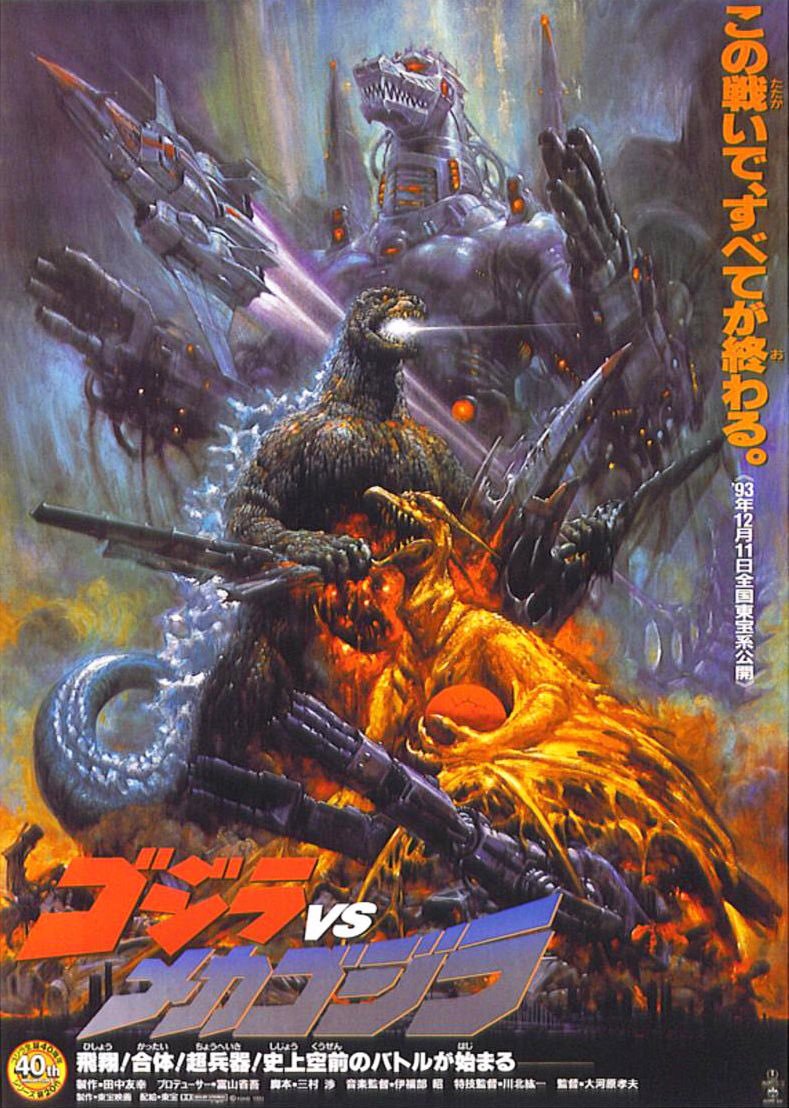
Godzilla vs. Mechagodzilla II (1993) [Tokusatsu Review]

Godzilla vs. Mechagodzilla II; or, Superior Firepower
     The time has come to finally put our technology to the test.
I continue to press on with my journey through the Godzilla Heisei movies. This time, I am focusing on the 5th movie of the series; that is, Takao Okawara’s Godzilla vs. Mechagodzilla from 1993. For clarity’s sake, I will be using the English title Godzilla vs. Mechagodzilla II throughout the review so as to differentiate this movie from the Showa series original made in 1974.
Release Info
Directed by: Takao Okawara Starring: Masahiro Takashima, Ryoko Sano, Megumi Odaka
Language: Japanese Original Title: ゴジラ対メカゴジラ Runtime: 107 min
Synopsis
The United Nations came to the conclusion that they have to do anything in their power to stop Godzilla. For this reason, a special Godzilla Countermeasures Center was created. Their job was to utilise the futuristic technology from the remains of Mecha-King Ghidorah and create a technologically advanced robot that could surpass Godzilla’s might. The final outcome of this research materialised in the form of Mechagodzilla. In the meantime, the Japanese team of scientists on Adona Island finds an egg which gives off a telepathic signal that attracts Godzilla and Rodan. The two monsters rush to protect the contents of the egg, but the military sends Mechagodzilla to intercept them… 
Natural Life vs. Artificial Life
Immediately after the overwhelming success of Godzilla vs. Mothra, Toho greenlit another Godzilla picture. Initially, the producers were toying with the idea of bringing back the good old King Kong, but the studio no longer had the rights to the iconic creature. Consequently, the decision was made to pit the Big G against another classic foe, Mechagodzilla.
In contrast to previous films, Godzilla vs. Mechagodzilla II was not penned by director/writer Kazuki Omori. The screenwriting duties were given to a series newcomer, a major sci-fi buff, Wataru Mimura. The writer realised that writing a Godzilla project may be a one-shot deal for him, so he gave it his all in the screenplay by incorporating lots of action and providing the King of the Monsters with the much-needed dosage of pathos and character motivation.
Unlike the erratic shenanigans of Godzilla vs. Mothra, the Big G is no longer just an angry monster. Godzilla vs. Mechagodzilla II marks his progression from a force of nature to a loving parent because the film presents the viewers with Godzilla Junior! Initially, Takao Okawara was against the idea of bringing back Godzilla’s son, but I have to say the director handled all the sequences involving the creature perfectly. In addition, the design of Baby Godzilla is also extremely kawaii. What is more, the presence of the baby in the finale adds additional gravitas to the kaiju confrontation because viewers start to really root for Godzilla.
Speaking about special effects, these were once again helmed by Koichi Kawakita and all the heavy action scenes are top notch across the board. I am actually surprised that there are a lot of “beam fights” in this movie. Undoubtedly, the epic final battle must have served as direct inspiration for the culminating point of Godzilla: King of the Monsters (2019).
Thankfully, Akira Ifukube returned to compose a music score for the film, and his contributions are simply breathtaking. The main theme of Mechagodzilla is sombre and militaristic at the same time. It grabs your attention from the opening scene! The haunting chorus song accompanying Baby Godzilla is also a composition to be cherished.
With regard to performances, this time round Masahiro Takashima plays the male lead. He already had an experience with Tokusatsu flicks because of his appearance in Gunhed (1989). His presence does not have much impact on the story. To be honest, Ryoko Sano steals the spotlight as a scientist who looks after Baby Godzilla (played by suitmation actor Hurricane Ryu). Their scenes are easily the best in the film.
Evidently, the movie also features many Tokusatsu veterans, such as Akira Nakao, Koichi Ueda, Kenji Sahara, and of course Kenpachiro Satsuma as Godzilla. Megumi Odaka reprises her role as Miki Saegusa once again and her character has surprisingly a lot of stuff to do in this picture. Miki initially helps the team of scientists who are with Baby Godzilla, but the military actually forces her to help them neutralise Godzilla. It is quite an intriguing twist in the story arc of this particular heroine. There is even a deleted scene from the film in which Baby is afraid of Miki because of her psychic connection with the King.
When it comes to home media releases, the distribution duties of Godzilla vs. Mechagodzilla II were mainly handled by Columbia TriStar who produced their English dub for the film. Interestingly, Toho commissioned their own international translation in 1994, but this version is considered to be “lost”. Fragments of it were unearthed a few years ago through Hindi releases of the film, and snippets can be watched here.
Recommendations
If you enjoy Godzilla’s monster rumble at its purest form, the I recommend Godzilla vs. Mechagodzilla II. Toho initially wanted to end the series with this movie, but they changed their mind in view of the delays concerning the American remake. I must say that Godzilla vs. Mechagodzilla II is a solid, action-packed entry of the Heisei era, but it would not be a strong enough conclusion of the series. What is more important, we would not get Godzilla vs. Spacegodzilla and Godzilla vs. Destoroyah (to be reviewed soon).
Overall score: 9/10
«Enjoyed this post? Never miss out on future posts by following us»
Farewell My Concubine (1993) [Film Review]

Farewell My Concubine; or, The Hegemon-King Bids Farewell to His Concubine
     I am by nature a boy… not a girl.
Today’s review is something really special, dear readers. I have heard about this movie for so many years. Even before the internet era, in special film guidebooks, this particular motion picture was frequently mentioned alongside Akira Kurosawa’s Seven Samurai as one of the all-time best Asian productions. It comes as no surprise that to date this is the only Chinese production movie that won the Palme d'Or at the 1993 Cannes Film Festival. In addition, it was also listed as one of the 100 Best Films in Global History by Time magazine. Let’s take a closer look at Chen Kaige’s Farewell My Concubine.
Release Info
Directed by: Chen Kaige Starring: Leslie Cheung, Zhang Fengyi, Gong Li
Language: Mandarin Original Title: 霸王别姬 Runtime: 171 min (unaltered version)
Synopsis
It is the year 1924, China after the fall of the Qing Dynasty. Dou Zi and Shi Tou are brought up together in an acting troupe under the strict regime of an opera master. Thirteen years later, the two friends become big stars, assume new names: Cheng Dieyi (Leslie Cheung) and Duan Xiaolou (Zhang Fengyi); and they act out together on stage the famous play known as “Farewell My Concubine”. World War II comes and goes, the Republic of China falls, yet in spite of hardships, Dieyi and Xiaolou continue their acting profession. A major blow comes for Dieyi when Xiaolou decides to marry a woman from the House of Blossoms known as Juxian (Gong Li).
Sentimental Haze
I was surprised to learn that Farewell My Concubine is actually based on a novel of the same name written by a Hong Kong novelist Lilian Lee. The book was pitched to director Chen Kaige who felt that the story lacked the emotional impact, so he recruited the services of Lu Wei, a screenwriter who later went on to pen Yimou Zhang’s To Live (1994).
Interestingly, the release of the film was quite a turmoil in itself. After the official Hong Kong premiere, the movie opened in Shanghai but was quickly removed from theatres. Only after heavy censoring, it was re-released mainly because it became a massive success at the Cannes Festival. As a result, there are many different cuts of the film out there. The full, unaltered edition runs at 171 minutes. The version I saw from local TV is 7 minutes shorter. Perhaps that is why I felt as sort of discontinuity between a couple of sequences.
The movie itself is a stunning, visual spectacle. It is one of these rare motion pictures which you can’t help but watch just for the breathtaking cinematography. Farewell My Concubine is undeniably a journey into the heart of Chinese art and culture. As for the story, it is deeply harrowing and tragic, yet incredibly romantic at the same time. This is a movie about faithfulness and forgiveness revolving around two friends and a woman who came between them. Yet, that is not all. The protagonists have to grapple with the consequences of great historical changes that influence them. Dieyi has to rescue Xiaolou from the hands of Japanese soldiers, Xiaolou has to rescue Dieyi from being persecuted by the Kuomintang. The most unsettling section is the third act of the film which depicts the horrors set in motion by the Cultural Revolution.
Many scholars focus in their analyses on the theme of homoerotics between Dieyi and Xiaolou. In my opinion, Farewell My Concubine presents this aspect in a very subtle manner (opting to show NSFW practices between patrons and actors they adore), so it is hard for me to call this film a representative instance of queer cinema. Dieyi is clearly in love with Xiaolou; that is why he opposes his relationship with Juxian, but there is a whole another layer of context between these characters in the form of an opera play itself. Dieyi acts out the part of a concubine who is loyal to her king (portrayed by Xiaolou). This blurring of boundaries between fiction and reality is what makes Farewell My Concubine an utterly enthralling and mesmerising movie.
With regard to performances, I absolutely love the late Leslie Cheung. He stole my heart with this film. I read online that supposedly Jackie Chan and John Lone were considered for the leading part, but I think none of them could channel this idiosyncratic sensibility as much as Leslie did. Zhang Fengyi is a wonderful onscreen partner of Leslie, and this really transpires in many scenes. The most heartbreaking one, in my opinion, was the moment when Xiaolou and Dieyi were forced to put on their make-ups for the shaming session. As for Gong Li, fresh after the success of Raise the Red Lantern (1991), she is drop dead gorgeous in this film. I really felt sorry for the plight of her character.
Recommendations
Farewell My Concubine is an obligatory must-watch from the time when Chinese Cinema was not beating around the bush and really faced the country’s controversial past head on. The performances of the main leads are just brilliant, cinematography unforgettable, and the story heartbreaking. This movie is a one-of-a-kind visual experience.
Overall score: 9/10
«Enjoyed this post? Never miss out on future posts by following us»

Patlabor 2: The Movie (1993) [Anime Review]

Patlabor: The Movie 2; or, Tinker, Tailor, Ingram, Spy
     The line that separates a just war from an unjust peace isn't very clear. Ever since hypocrites have made peace their just cause, we've lost faith in that peace. Just as wars give rise to peace, peace also gives rise to war. An empty, hollow "peace" that only defines itself as "not war" will eventually be replaced by something that is a state of war in all but name.
After the successful Patlabor: The Movie (1989) and Patlabor: The New Files OVA (1990-1992), Headgear decided to put the franchise to a rest with Patlabor 2: The Movie (1993) directed by the famous Mamoru Oshii. In contrast to the previous entries, the final chapter of the Patlabor series feels like an espionage thriller with philosophical ponderings about life known from Ghost in the Shell (1995). However, first and foremost, this anime feature is Oshii’s personal protest against Japanese politics.
Release Info
Directed by: Mamoru Oshii Voice actors: Yoshiko Sakakibara, Ryuusuke Oobayashi, Miina Tominaga, Toshio Furukawa
Language: Japanese Original Title: 機動警察パトレイバー2 the Movie Runtime: 108 min
Synopsis
Three years after the events from the first movie, we see that the members of SV2 Section 2 have gone their separate ways. Noa and Shinohara are now Labor testers, whereas Ota has become an instructor at the police academy, and Shinshi has been transferred to Tokyo MPD. The only people who stayed in SV2 are Hiromi Yamazaki as well as Captain Goto and Captain Nagumo. All of a sudden, the Yokohama Bay Bridge is destroyed by a military missile. This event sets into motion a domino effect which leads to a growing conflict between the Japanese government and JSDF forces. Goto and Nagumo believe that a person responsible for all this is a former UN soldier, Tsuge, who wants to stage a fake coup d’état.
All the good things…
I have to admit that I loathed reviewing this particular film because I had a really hard time understanding what exactly Mamoru Oshii tried to get across with this story. Only after rewatching the film three more times, reading a couple of online essays, and consulting fellow Patlabor fans, Oshii’s intentions became clearer to me.
Patlabor 2: The Movie, contrary to the first theatrical movie, is not an adventure story with comedy elements, but an evaluation of Japan’s participation in the Cold War. When America and the Soviet Union were putting missiles against each other and stealing vital information, Japan claimed that it was neither participating nor taking sides in the conflict. Oshii puts to the test this illusion of a peaceful nation in Patlabor 2. What is more, the existence and purpose of the Japan Self-Defense Forces seem problematic to the director. The opening sequence of the movie serves as a reference to the Cambodian incident, in the course of which two JSDF officers lost their lives. In other words, Patlabor 2 is not a story about clumsy policemen and an optimistic future, but it is about the hypocrisy of politicians who create “unjust peace.”
Oshii’s thoughtful statements uttered through the characters of Goto, Nagumo, Aragaki, and Tsuge are indeed intriguing, but they consequently slow the picture down. The director stated that a lot of action waters down the ideas conveyed in scenes, so he opted for the usage of long shots. As a result, we get a very serious and long winded movie with characters constantly talking and often doing nothing more than just sitting. These cold espionage vibes may be good for an adaptation of John Le Carre’s novel, but they do not work that well in the Patlabor world.
Interestingly, the premise of the story (former mentor of an SV2 officer trying to overthrow the government) greatly resembles the finale of Patlabor: Early Days OVA. Mamoru Oshii himself actually predicted in The Making of Patlabor 2 (1994) documentary when he stated: “So, in the third one, we’ll make an involved story and create a non Patlabor movie.” He also added that he could continue making new Patlabor stories if there were new characters and a somewhat different world  (indeed, that’s what happened with The Next Generation: Patlabor (2014) drama series).
Speaking about performances, the characters of Noa and Shinohara are a bit sidelined in this film, so do not get to her a lot from Miina Tominaga and Toshio Furukawa, respectively. However, Ryuusuke Oobayashi as Goto and Yoshiko Sakakibara as Shinobu are pushed to the foreground in this picture. I could listen to their voices all day long. There is also a great supporting part done by Naoto Takenaka.
Recommendations
All things considered, Patlabor 2: The Movie is a classic anime feature. Even though the first movie is my favourite theatrical film, I shall always regard the sequel as the final chapter of the wonderful science-fiction franchise. If you love the characters of Goto and Shinobu as much as I do, then check it out.
Overall score: 7/10
«Enjoyed this post? Never miss out on future posts by following us»

Crime Story (1993) [Film Review]

Crime Story: or, The Strike of Serious Jackie Chan
     A policeman who fires a gun has to face the following dangers: One, hurting an innocent citizen. Two, being shot when exchanging fire. Finally, killing the thug, but unable to stand the shock. You belong to the last type then, Inspector Chan. You can’t stand the shock of shooting and killing.
There was a period in Jackie Chan’s career when he was working under different directors in order to prove that he was a “manageable” actor/stuntman. As a result, in the early 1990s, he played in such movies as Tsui Hark and Ringo Lam’s Twin Dragons (1992), Wong Jing’s City Hunter (1993), and Kirk Wong’s Crime Story (1993). I have a soft spot for the last picture out of Jackie Chan’s unusual string of collaborations, mostly because it provides a completely different take on the cop movie genre than Jackie’s Police Story series.
Release Info
Directed by: Kirk Wong Starring: Jackie Chan, Kent Cheng, Puishan Au-yeung, Law Kar-ying
Language: Cantonese Original Title: 重案組 Runtime: 107 min
 
Synopsis
Inspector Eddie Chan of the Serious Crime Bureau is an efficient police officer who suffers from mild PTSD. He is assigned to protect Wong Yat-fei (Law Kar-ying), a wealthy businessman who had been kidnapped in the past. Yat-fei feels that somebody is following him and that is why he requests the assistance of the police. Unfortunately, things go terribly wrong and Yat-fei is kidnapped yet again. The assaulters demand from Yat-fei’s wife (Puishan Au-yeung) the transfer of 60 million dollars to Taiwanese bank accounts. Together with the police officer who cracked Yat-fei’s first kidnapping case, Detective Hung (Kent Cheng), Chan searches for the kidnappers. However, he does not realise that one of them is a member of the police force.
 
Police Dragon
As someone rightfully wrote in the Internet abyss: “There are Jackie Chan films and films starring Jackie Chan”. Crime Story falls under the second category and, unlike a standard action flick made by Jackie, it takes the dead serious approach in order to faithfully depict the workings of the police force. The screenwriters even credited the kidnapping case of Teddy Wang as their inspiration behind the story.
 
“What is so unique about this film, apart from the dark tone?” you may ask. Well, Jackie is not a happy-go-lucky hero who engages into fights inspired by Buster Keaton. Contrary to his portrayal of a cop in the Police Story series, Jackie plays quite a vulnerable officer who does not fool around and wants to get the job done. Have you seen the cops being brutally killed in Police Story 1-4? No? Well, Crime Story shows full morbidity. Serving justice to those who died in the line of duty and saving a victim are Chan’s primary goals.
 
In addition, Inspector Chan does not get involved in any romantic relationship. The movie baits the viewers with that motif by introducing the Psychiatrist character (played by the beautiful Pan Lingling) at the beginning of the film, but the relationship goes absolutely nowhere. If that was not enough, there is also the character of a prostitute, Ka Ka (great Christine Ng), who is in a relationship with Detective Hung. You could assume that she would help out Chan on the case, but she does the exact opposite.
 
In terms of action and cinematography, Crime Story also differs greatly from Jackie’s usual works. Of course, Jackie does what he does best with regard to kung fu showdowns, but the camera work in Crime Story is extremely dynamic and builds additional tension. Kirk Wong really did an awesome job on that. That being said, the cinematography handled by Arny Lam and Arthur Wong is just beautiful. Many Hong Kong locations look wonderful on the screen. The million dollar shot is that of Wong Yat-fei overseeing a massive building site.
 
With regard to performances, Jackie Chan does exceptionally well as a serious cop. It’s a real shame that he disliked the film because it was adult oriented (ex. Christine Ng’s steamy elevator scene), but Kirk Wong really brought out the acting out of Jackie. Second best actor is Kent Chang as Detective Hung. I have seen him mostly in comedies, but he really stole the show with his performance of a sleazy and underpaid cop. Honourable mention goes to Puishan Au-yeung as distressed Wong Yat-fei’s wife.
 
Recommendations
Check out Crime Story if you can, this movie was really ahead of its time. In fact, it was New Police Story before New Police Story was hailed as Jackie’s first grim motion picture. It is a really engaging crime drama with decent action and explosive finale. I wish we could have gotten more of such Jackie’s films in the 1990s.
Overall score 9/10

A Class to Remember (1993) [Film Review]

A Class to Remember; or, The Power of Education
     Classes are sessions that teachers and students cooperate in building. I realize it now. A fine class!
Yoji Yamada is a legendary Japanese director known for helming the famous Tora-san franchise (1969-1995), Free and Easy series (1988-2009), and Gakko (1993-2000). The last one of the three is a set of four movies focusing on education (Gakko meaning literally school). The first film in the series is A Class to Remember from 1993, the movie I have long sought for and finally found it. How Yamada evaluates Japanese schooling in his motion picture? Let’s find out in this review:
Release Info
Directed by: Yoji Yamada Starring: Toshiyuki Nishida, Keiko Takeshita, Kunie Tanaka
Language: Japanese Original Title: 学校 Runtime: 128 min
 
Synopsis
Kuroi (Toshiyuki Nishida) is a teacher at a city night school. Every evening he teaches the basics like reading and writing to his students who differ in age and, for some reason, could not receive conventional education. In a series of flashbacks, we are presented with the progression of each student: Kaji (Masato Hagiwara), Eriko (Yuri Nakae), Midori (Nae Yuki), Chang (Kaei Okina), Shigeru (Senri Oe), Kim Jun-Hes (Eiko Shinya), and Ino (Kunie Tanaka). During their final lesson, Kuroi receives tragic news which he has to share with the class.
 
The Learning Cycle
A Class to Remember immediately startles with its slow, documentary-like pace. It is neither a comedy nor a serious drama. The movie feels like a slice-of-life story, greatly focusing on the advantages of night schooling. Yet, the action of the story does not happen entirely in a classroom. The camera goes outside in order to show the everyday lives of the teacher as well as his students.
 
One would think that Japan does not have problems with education, but Yamada intimately portrays a group of people who, in one way or another, could not attend daily school. We have elderly people who were so busy with hard work that they never learnt to read or write. There are people with traumas and cognitive deficiencies, or even lazy ones. There are also those who were abused by pathological families. All of them attend a night school, which is surprisingly free of charge, in order to learn something in life.
 
Of course, the figure of the teacher is central to the story. Thankfully, Yamada does not go full GTO by turning Kuroi into an unconventional eccentric. Instead, Kuroi is a warm individual who always tries to reach out to his students. He is not able to fix their problems like Onizuka, but he gives a lending hand when a situation requires it. First and foremost, Kuroi is dedicated to teaching and tries to pass his passion for life to his students.
 
With regard to performances, Toshiyuki Nishida did a great job as Kuroi. I have known him mostly from Doctor X series, but now I want to check out his earlier works, especially collabs with Yamada. Keiko Takeshita was also convincing as another school teacher, Tajima. All of the actors who played the students did very well, but the true highlight was the veteran actor Kunie Tanaka as Ino, the elderly student. Oh, and keep your eyes open for Kiyoshi Atsumi's cameo!
 
Recommendations
The end credits state that (as of 1993) approximately 45 junior high night schools function in Japan. The movie got me so interested about the subject that I started to search for more info about the so-called yakan gakko (night schools). I  was unable to find their exact number in 2019, but, allegedly, they function pretty well today, providing education even for non-Japanese students. Summing up, A Class to Remember is a well made and quite touching film. It leaves you thinking afterwards.
Overall score: 9/10

If you would like to read about Japanese night schools, then I recommend these articles I found.