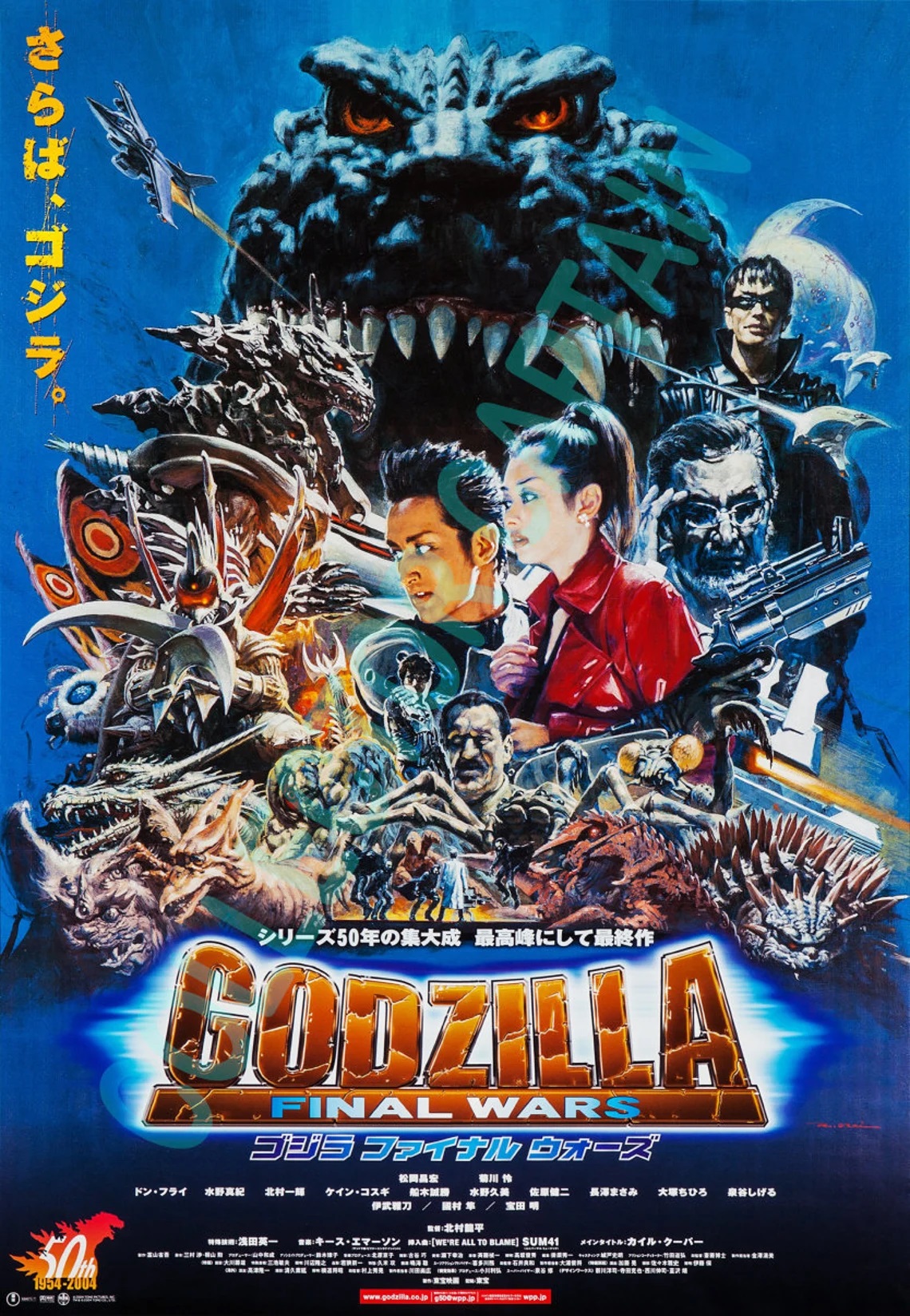
Godzilla: Final Wars; or, Last Hurrah for Monster Rumble The world is ruined, and the war is already lost. Now it's a matter of pride. We either die hiding... or die fighting. Even though this review is already quite belated, I am glad that I finally found the time to talk about my final Godzilla movie for the year 2023; that is, Godzilla: Final Wars, the last instalment of the Millennium series directed by Ryuhei Kitamura and released in 2004 for the 50th anniversary of the franchise.
Release Info
Directed by: Ryuhei KitamuraStarring: Masahiro Matsuoka, Rei Kikukawa, Maki Mizuno
Language: JapaneseOriginal Title ゴジラ ファイナルウォーズ Runtime: 125 min
Synopsis Godzilla has been defeated and buried in ice imprisonment beneath the South Pole. However, the world was plagued by many disasters and wars that caused the awakening of many monsters. All of a sudden, an alien race calling themselves Xiliens arrives and neutralises the monsters. The aliens want to negotiate a treaty with humans. However, the real motive of the aliens is to conquer Earth. When the monsters get unleashed, Godzilla breaks free from the South Pole as well. Operation Final War is set in motion.
Out with a Bang After the release of Godzilla: Tokyo SOS, the Toho Studios arrived at a conclusion that Godzilla movies are no longer that profitable as they used to be in the past, so the executives considered axing the franchise. However, producer Shogo Tomiyama decided it would be a good idea to end the series on a high note with a commemorative movie that would retire the King of Monsters for a decade or longer.
To fill in the director’s chair, Tomiyama hired a young director Ryuhei Kitamura who was already known for such films as Versus (2000), Aragami (2003), and Azumi (2003). However, Kitamura had no experience with the Tokusatsu genre, even though he was a Godzilla fanboy since childhood.
Kitamura’s personal auteur style and enthusiasm for the series allowed him to create a unique take on the Big G. Together with writers Wataru Mimura and Isao Kiriyama, he developed an action-packed story that functions as a stand-alone movie in the franchise. At best, you can regard Final Wars as a multiverse finale, but I like to think of it as the missing 16th movie of the Showa era because it follows the wacky science-fiction style of these movies from the 1970s.
It goes without saying that Final Wars is very divisive among the fanbase. Many viewers embrace the batshit craziness that oozes from the screen, whereas others just can’t stand the shifts in tone that alter between the Matrix vibes and traditional monster rumble. I admit that even for me watching this film for the first time ten years ago was just too much. It felt like a sensory overload with too many characters and too many bombastic subplots, but as I matured, I learned to appreciate it for what it is. By no means it is a standard Godzilla flick, but an event film, the purpose of which was to celebrate the 50 year-long legacy of the King.
I have to say that I appreciate top-notch action and special effects helmed by Eiichi Asada that preserved the traditional suitmation technique while utilising CGI in demanding shots. The same kind of praise, however, cannot be said about the music score composed by the late Keith Emerson, Nobuhiko Morino, and Daisuke Yano. The music is more all-over-the-place than the film itself, which really affects the viewing experience. There are some nice action cues, but on the whole, the score is bland and uneventful. Final Wars would have benefited more from Akira Ifukube’s classic themes.
With regard to performances, the leading stars of the film do a great job indeed and they are quite memorable in this whole shabang of insanity. Masahiro Matsuoka does okay as the standard hero who strives to save the day. Rei Kikukawa and Maki Mizuno rock as the Otonashi sisters. Interesting fun fact is that Maki Mizuno is the granddaughter of the legendary Kumi Mizuno who has a small supporting part in the film. We can also spot other Tokusatsu veterans: Kenji Sahara, Masato Ibu, Jun Kunimura, Koichi Ueda, Akira Emoto, and Akira Takarada. Kazuki Kitamura is simply too outlandish as the main villain, but I love him anyway. Last but not least, Don Frye plays Captain Douglas Gordon, and this character is simply too-cool-for-school with his over-the-top gigachad demeanour.
Even though Toho made money from the buzz surrounding the movie (merch, video games, re-release of the 1954 original, etc.), Final Wars itself was a box office failure, recouping approximately half of its original budget. Still, it appears that director Ryuhei Kitamura was satisfied from the movie he delivered.
Personally, I was dying to see the film back in 2004, but there was no theatrical release in the land of forgotten ghosts where I live. However, a distribution label Monolith did issue the film on DVD in a special edition, but the price for it was insane. It was not until 2023 that I was able to get this DVD edition which includes a making-of documentary as well as featurettes from the LA premiere of the film. Unfortunately, the audio on the release is either English or Polish. So, I still have to rely on a bootleg DVD from Hong Kong just to be able to hear the unaltered Japanese audio track.
Recommendations All things considered, the aim of the Millennium series was to keep the flame of Big G’s popularity going and to attract new fanbase, but the results were mixed. Godzilla: Final Wars marks the end of an era whether you like it or not. This is the last film that used the suitmation technique. This is the last film that features so many cameos from Tokusatsu veterans. This is the last film that was shot on Toho’s famous pool and backlot before these got restructured. This is the last film that was dedicated to the memory of Ishiro Honda, Eiji Tsuburaya, and Tomoyuki Tanaka, the creators of Godzilla. It was not until the year 2014 when Godzilla was reintroduced into the public spotlight with the American remake that ushered in the MonsterVerse series. However, this is a story for another time.
Overall score: 6/10
«Enjoyed this post? Never miss out on future posts by following us»
Tokyo Melody; or, Multicoloured Polyphonia I’m working on things that will only be understood by the grand-children of the 20th century ~ Claude Debussy Recently, while doing research on City Pop/Kayokyoku for a special project, I stumbled upon a French-Japanese documentary directed by photographer Elizabeth Lennard called Tokyo Melody, un film sur Ryuichi Sakamoto. I was aware of the fact that there were documentary features made about the legendary composer, but I did not know this particular one, which was released in 1985, so at the height of Pop music in Japan and YMO’s popularity.
Release Info
Directed by: Elizabeth LennardStarring: Ryuichi Sakamoto, Akiko Yano, Yukihiro Takahashi
Language: Japanese, FrenchRuntime: 62 min
In Search of Perfection The documentary is not so much about the life of Sakamoto and his rise to stardom, but about his working process. In a truly idiosyncratic way, Sakamoto exposes himself in front of a camera and talks about his inspirations, interests, perception of music as well as of time. These confessions coupled with his instrumental pieces, YMO archive footage, and the hustle and bustle of 80s Tokyo really elicit an eclectic viewing experience.
What is more interesting, we actually see Sakamoto at a recording studio during his work on the album Illustrated Musical Encyclopedia (1984). The composer demonstrates his gear and also explains the convoluted technicalities behind the high-tech equipment. To my mind, the Fairlight CMI synthesizer seems more advanced than modern-day instruments, but I am not an expert at all.
In addition, Sakamoto’s experience with Merry Christmas, Mr Lawrence (1983) is addressed. It is a real treat because the composer rarely talks about the film. In the case of this documentary, he does not even mention his onscreen performance, but he explains his creative process with regard to the music score. I also wrote about this in greater detail in my stand-alone editorial Confessions in the Jungle: Comparing The Bridge on the River Kwai (1957) and Merry Christmas Mr. Lawrence (1983).
Apart from this, there is an interesting segment in which we see Sakamoto and his wife Akiko Yano performing Tong Poo, which is intercut with Yellow Magic Orchestra’s live version of the piece recorded for YMO Propaganda film. This is a very intriguing juxtaposition of the two interpretations of the same song, which reflects Sakamoto’s own balance over the threshold between classical and pop music. The composer himself says in the documentary that he chose pop music to reach a wider audience.
All things considered, Tokyo Melody is not only an introspective look into Ryuichi Sakamoto, but also an attempt to see the world through his lens. It is a highly engaging documentary indeed, but I would appreciate it had there been some personal input from people close to Sakamoto, such as Akiko Yano or Yukihiro Takahashi.
Recommendations If you are a fan of Ryuichi Sakamoto, then this documentary is certainly for you. If you are a die-hard fan of YMO, then you will only be able to see some archive footage of their performances. I sincerely hope that the documentary will get picked up by a distribution label and properly remastered.
Overall score: 9/10
«Enjoyed this post? Never miss out on future posts by following us»
Godzilla, Mothra and King Ghidorah: Giant Monsters All-Out Attack; or, Post-War Trauma Godzilla is passé. This week is provide my penultimate review of my Godzilla Millennium series rundown. To be specific, I want to focus on a film about which I have mixed feelings. This is Godzilla, Mothra, and King Ghidorah: Giant Monsters All-Out Attack from the year 2001, directed by Shusuke Kaneko.
Language: JapaneseOriginal Title: ゴジラ・モスラ・キングギドラ 大怪獣総攻撃 Runtime: 105 min
Synopsis The Japan Self-Defense Forces are alerted about the American nuclear submarine that went missing. In the meantime, a TV reporter Yuri Tachibana (Chiharu Niiyama) films a documentary piece near Mount Myoko, which is hit by a mysterious earthquake. It turns out that Godzilla might have returned and the only way to stop the creature is to reawaken the so-called Guardian Monsters: Baragon, Mothra, and King Ghidorah.
Anger and Hatred Contrary to common misconceptions within the fandom, this movie did not come about because of the poor financial and critical reception of Godzilla vs. Megaguirus (2000). During the production of the aforementioned film, producer Shogo Tomiyama was still keen on developing the idea of revisiting Godzilla in an alternate universe with each new motion picture. Therefore, he recruited the services of an experienced Tokusatsu director Shusuke Kaneko.
Kaneko was a major Godzilla fanboy since childhood, and it was his lifelong dream to actually make a Godzilla movie. Already in the 1990s, when the Heisei movies were at their peak, young Kaneko contacted Tomiyama, but the producer politely refused his pitch to direct. Consequently, Kaneko honed his craft in the Tokusatsu genre by directing for Daiei the now-extremely popular Gamera Trilogy (1995-1999).
When Kaneko was approached with the offer in 2000, he developed several script ideas for the potential film, but the one closest to his vision involved Godzilla as the ruthless villain facing off against protectors of Earth: Varan, Baragon, and Anguirus. Toho accepted the idea, but gave the ultimatum to replace the original monsters with King Ghidorah and Mothra in order to make the film more bankable because the previous outings were box office bombs.
The movie itself certainly feels different in tone and its subject matter from other Millennium flicks crafted by Masaaki Tezuka and Takao Okawara. The GMK film is Shusuke Kaneko’s attempt to bring the King of the Monsters back to his roots, to make him not an anti-hero, but an unforeseeable force of nature that detests humans and wants to destroy all forms of life.
What is more, Kaneko not only changed Godzilla’s modus operandi and his appearance, but also gave the monster a spiritual dimension of origin. Of course, the nuclear aspect of Godzilla remains intact, but Kaneko heavily implies that the Big G is also an embodiment of souls of Japanese soldiers who were left to die by the Imperial Army during the war. In consequence, Godzilla becomes a demon that haunts Japan not only for its trauma stemming from the bombing of Hiroshima and Nagasaki, but also for the country’s war crimes. Godzilla’s mercilessness is especially telling in a scene where he slams to the ground a hospital filled with innocent people, including a girl who survived the monster’s previous attack.
It goes without saying that Mothra is always the Kaiju heroine, and she always rocks on that front, but it is impossible for me to picture King Ghidorah as the benevolent dragon who saves the day. This is the major cognitive dissonance that ruins this movie for me. King Ghidorah time and time again, for decades, was Godzilla’s arch-nemesis, not the saviour of mankind.
In terms of cinematography and special effects, the GMK movie is the most 2000-like looking production of the Millennium series. I’m not sure why it’s the cause of this apart from that Kaneko is definitely a modern filmmaker, whereas Tezuka and Okawara feel more traditional with their approach to Godzilla. There’s nothing wrong with both approaches. In fact, GMK has many cinematic nods to Godzilla from 1998, as if Kaneko was indirectly throwing shade at the American production. In addition, the special effects director Makoto Kamiya does a fine job with blending classic miniature work with CGI.
With regard to performances, Chiharu Niiyama and Ryudo Uzaki really carry the film with their performances. Uzaki is especially memorable as the army admiral who undergoes a fantastic voyage deep into the belly of Godzilla. The movie also features appearances of the veteran actors such as Shiro Sano, Masahiko Tsugawa, Hiroyuki Watanabe, and Hideyo Amamoto. There are also cameos done by Masaaki Tezuka, Koichi Kawakita, Ai Maeda and Aki Maeda (as twin sisters) as well as Mizuho Yoshida, Akira Ohashi, and Rie Ota (who were the suitmation actors for the titular monsters).
Last but not least, Kow Otani provided a truly menacing music score for the film. I will always cherish the composer’s soundtrack for the Outlaw Star anime, but his addition to the Godzilla franchise cannot go unnoticed as well. “His music was so emotional and classical; it reminds me of old-fashioned kaiju movies, (Akira) Ifukube’s sound. His music makes me excited. It makes your heart beat,” stated Shusuke Kaneko (source).
Recommendations Undoubtedly, Godzilla, Mothra and King Ghidorah: Giant Monsters All-Out Attack is a film that stood the test of time and can be watched with having the knowledge of the rest of Godzilla films. However, it is very dark indeed, so it does not have a lot of rewatch value for me. The movie was released on Blu-Ray in 2014.
Overall score: 7/10
«Enjoyed this post? Never miss out on future posts by following us»