Showing posts with label 1985. Show all posts

Tokyo Melody (1985) [Documentary Review]

Tokyo Melody; or, Multicoloured Polyphonia
     I’m working on things that will only be understood by the grand-children of the 20th century ~ Claude Debussy
Recently, while doing research on City Pop/Kayokyoku for a special project, I stumbled upon a French-Japanese documentary directed by photographer Elizabeth Lennard called Tokyo Melody, un film sur Ryuichi Sakamoto. I was aware of the fact that there were documentary features made about the legendary composer, but I did not know this particular one, which was released in 1985, so at the height of Pop music in Japan and YMO’s popularity.
Release Info
Directed by: Elizabeth Lennard Starring: Ryuichi Sakamoto, Akiko Yano, Yukihiro Takahashi
Language: Japanese, French Runtime: 62 min
In Search of Perfection
The documentary is not so much about the life of Sakamoto and his rise to stardom, but about his working process. In a truly idiosyncratic way, Sakamoto exposes himself in front of a camera and talks about his inspirations, interests, perception of music as well as of time. These confessions coupled with his instrumental pieces, YMO archive footage, and the hustle and bustle of 80s Tokyo really elicit an eclectic viewing experience.
What is more interesting, we actually see Sakamoto at a recording studio during his work on the album Illustrated Musical Encyclopedia (1984). The composer demonstrates his gear and also explains the convoluted technicalities behind the high-tech equipment. To my mind, the Fairlight CMI synthesizer seems more advanced than modern-day instruments, but I am not an expert at all.
In addition, Sakamoto’s experience with Merry Christmas, Mr Lawrence (1983) is addressed. It is a real treat because the composer rarely talks about the film. In the case of this documentary, he does not even mention his onscreen performance, but he explains his creative process with regard to the music score. I also wrote about this in greater detail in my stand-alone editorial Confessions in the Jungle: Comparing The Bridge on the River Kwai (1957) and Merry Christmas Mr. Lawrence (1983).
Apart from this, there is an interesting segment in which we see Sakamoto and his wife Akiko Yano performing Tong Poo, which is intercut with Yellow Magic Orchestra’s live version of the piece recorded for YMO Propaganda film. This is a very intriguing juxtaposition of the two interpretations of the same song, which reflects Sakamoto’s own balance over the threshold between classical and pop music. The composer himself says in the documentary that he chose pop music to reach a wider audience.
All things considered, Tokyo Melody is not only an introspective look into Ryuichi Sakamoto, but also an attempt to see the world through his lens. It is a highly engaging documentary indeed, but I would appreciate it had there been some personal input from people close to Sakamoto, such as Akiko Yano or Yukihiro Takahashi.
Recommendations
If you are a fan of Ryuichi Sakamoto, then this documentary is certainly for you. If you are a die-hard fan of YMO, then you will only be able to see some archive footage of their performances. I sincerely hope that the documentary will get picked up by a distribution label and properly remastered.
Overall score: 9/10
«Enjoyed this post? Never miss out on future posts by following us»

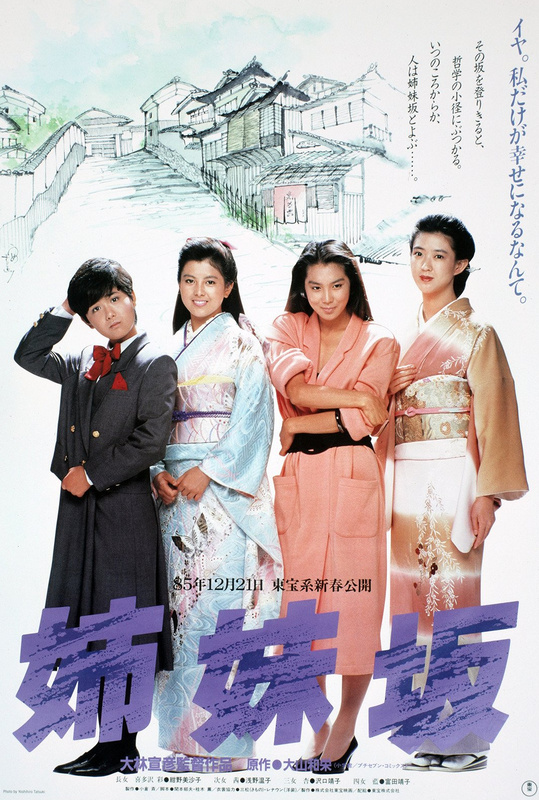
Four Sisters (1985) [Film Review]

Four Sisters; or, Bildungsroman: The Movie
     My dear sister. You've done nothing wrong. Not wanting to let her go shows that you've really taken up the role as her mother.
The year 2022 is slowly but surely nearing its end. A lot of stuff has happened to me personally, but in terms of movies, the running theme through many months was the filmography of Nobuhiko Obayashi. From Third Window’s Anti-War Trilogy release to their recent Kadokawa Years boxset, I have been fuelled by a desire to discover the idiosyncratic grandeur of this auteur filmmaker. As some of the blog readers already know, the result of my deep dive became An Ultra Fan’s Guide to Obayashi Nobuhiko. However, I believe there is still more to be said about this particular director and his movies. To be specific, I would like to talk about one of his motion pictures which is calm, romantic, and deeply melancholic. That is, Four Sisters, a perfect fit for a windy Autumn evening.
Release Info
Directed by: Nobuhiko Obayashi Starring: Atsuko Asano, Yasuko Sawaguchi, Misako Konno, Yasuko Tomita
Language: Japanese Original Title:  姉妹坂 Runtime: 101 min
Synopsis
Meet the Kitazawa family. Four sisters: Aya (Misako Konno), Akane (Atsuko Asano), Anzu (Yasuko Sawaguchi), and Ai (Yasuko Tomita) live in their parental household in Kyoto. Two high school friends, Ryo (Toshinori Omi) and Togo (Ichirota Miyakawa) compete against each other to win the heart of Anzu, which sets in motion a chain of events in the course of which the sisters discover that they are not related by blood. Each sister will have to cross into adulthood on her own terms, facing hardships and real-life drama along the way.
Shoujo Magic
I have to say that Four Sisters does not get a lot of recognition among Obayashi fans because it is not (for lack of a better word) “Obayashi-enough”. There are no vampires, evil children, or pianos that eat people. Four Sisters is what the title suggests: a story about four sisters. The editing itself and Obayashi’s visual stylistics are quite reserved indeed, but it does not mean they are totally absent. Obayashi divides the film into three separate chapters which, thanks to director’s wit and perceptive eye for details, function as memoirs taken straight out of a photo album. In fact, the beginning and end of each section are reminiscent of Polaroid photographs.
There is not a lot of information about the film online, but it seems clear that after Obayashi’s successes at Kadokawa with such movies as School in the Crosshairs (1981), The Girl Who Leapt Through Time (1983), and The Island Closest to Heaven (1984), the Toho Studios wanted to profit from the emerging trend of idol eiga, so they brought the director on board, gave him a shoujo manga called Shimaizaka to adapt, and showered him with their most promising pop stars they had at that time.
Evidently, as usual throughout the 1980s, Obayashi did his magic and put a personal spin on the source material while trying hard to bring out the best performance out of the leading ladies. Consequently, Four Sisters is a compelling coming-of-age drama. It is a story about growing up and finding love as well as inner peace, but certainly not in a conventional way.
Common criticism of the film is that it is too short and some of the subplots concerning the titular four sisters are not greatly elaborated upon. In my opinion, Obayashi was not going for a three-hour epic, but he wanted to create this bildungsroman-like ambience done in the style of the Brontës’ novels. Consequently, the movie is not so much about the exposition but about emotion: motherly love for a child, and longing for a loved one.
This aspect takes me back to the issue of visuals and editing. As I stated previously, Obayashi does not use fast cutting, different frame rates, or a mix of coloured scenes with black-and-white ones. In Four Sisters, when Obayashi wants to convey something intimate, he places a character in front of a camera and uses a really big close up. When he wants to get an unnerving feeling, he plays with the geography of a scene, changing a character’s position in a conversation (see Akane’s medical appointment).
What is more, Obayashi presents us with truly outstanding cinematography. Each and every scene: the framing of characters, their placement within glorious outdoor settings, all of it has meaning! To me, some of the shots like, for example, Akane crying over her mother’s grave, Anzu dancing, or Ryo standing near a stream next to a hospital, are just absolutely breathtaking.
Speaking of the performances, undoubtedly, each and every leading lady gets to shine on the screen, but the true show stealer is Atsuko Asano as Akane. Had the movie been made and released today, I am positive that she would have won an Oscar for her role of a bitter, yet deeply mature and sensitive sister. More words of praise go to Toshinori Omi who, in my opinion, delivered in Four Sisters his best performance out of all Obayashi films he appeared in. Omi no longer plays a sweet schoolboy but a real man who is head over heels in love with Akane.
Yasuko Sawaguchi, known from The Return of Godzilla (1984) does a great job as Anzu. Misako Konno is memorable and graceful as the oldest sister Aya; whereas, Yasuko Tomita is indeed noticeable as the youngest sister Ai. Tomita also played the leading part in Obayashi’s Lonely Heart which was released the same year as Four Sisters. In addition, a whole array of Obayashi’s frequent collaborators such as Yumiko Fujita, Wakaba Irie, Akiko Kitamura, and Toru Minegishi make short appearances as well. Four Sisters was also one of the first major pictures for actor Ichirota Miyakawa who played Anzu’s love interest, Togo.
Recommendations
All things considered, I personally think that Four Sisters is Obayashi’s highly underrated masterpiece. In fact, allow me to say (write) a bit more. It is one of the few movies out there that actually made me cry. I am not ashamed to admit it. And I cried again as I rewatched it for the purposes of this review. I can only hope that sometime in the future the Criterion Collection of some other company will strike a deal with Toho and release this outstanding film on physical media in Europe and the US. There are so many Obayashi movies out there apart from House (1977) that people need to see!
Overall score: 10/10
«Enjoyed this post? Never miss out on future posts by following us»
Taipei Story (1985) [Film Review]

Taipei Story; or, The Journey of Souls
     Look at these buildings. It's getting harder for me to tell... which ones I designed and which ones I didn't. They all look the same. Whether I'm involved or not seems less and less important.
The late director Edward Yang is, arguably, best known for his final motion picture Yi Yi (2000) but his older works also deserve attention. In 1985, he made his third feature film Taipei Story which is hailed by critics as the paragon of New Wave cinema. Starring a fellow director Hou Hsiao Hsien and a popular singer Tsai Chin in the leading roles, the movie presents a slice-of-life story about two people searching for happiness in a big city.
Release Info
Directed by: Edward Yang Starring: Tsai Chin, Hou Hsiao Hsien
Language: Mandarin, Hokkien Original Title: 青梅竹馬 Runtime: 120 min
Synopsis
Chin (Tsai Chin) is a manager’s assistant at a construction company. Due to the takeover of the business by another corporation, she loses the job. She lives at an apartment complex together with her sister and childhood love, Lung (Hou Hsiao Hsien). He is a former baseball player who remembers the good old days. Lung intends to move to the United States and start a business there, but he still has feelings for his former girlfriend who lives in Japan. On top of that, Chin and Lung are plagued by family problems as Chin’s father falls in debt. Will the two ever form a
long-term relationship?
Quiet and Restless
In Taipei Story, Edward Yang masterfully paints an image of westernized Taiwan from the 1980s. This is no longer a world of traditional values and hierarchical society. Americanization creeps into every aspect of life. At one moment you can find yourself watching aesthetically-pleasing Japanese commercials, and soon after, you suddenly dance at a nightclub to the beats of Footloose song.
Indeed, Yang positions the protagonists against the backdrop of a metropolis full of neons. How they can move on with their lives, when there’s always something holding them back? I think that the most striking scene of the film is the one in which Chin and some random guy play with a pencil on the top floor of an abandoned building. Even Haruki Murakami would not have been able to come up with such an image of two people killing time.
Although Chin tries to find her way in the abyss of urban cityscape, her boyfriend, Lung, is literally stuck in the past. He does not give a damn about the present or future consequences of his actions, he just acts, because (in view of what he experienced) it is a right thing to do (for instance, helping out Chin’s father or his baseball friend in need). Nevertheless, Yang condemns such longing for things long gone, and, as a result, Lung drifts further away from Chin.
The movie’s purpose is not to tell a story, but rather to make the viewer experience a feeling of spiritual emptiness. To be honest, I am amazed that the movie has yet been dissected into retrowave memes. It contains all the right tropes: VHS, Japan vibes, long shots of driving through a city, etc…
Recommendations
If you are in the mood for a poetic feast from Edward Yang himself, then I recommend Taipei Story. Personally, I think that it is best to watch this film back to back with Wong Kar-wai’s Chungking Express. Both movies complement each other stylistically.
Overall score: 8/10
«Enjoyed this post? Never miss out on future posts by following us»

My Lucky Stars (1985) [Film Review]

My Lucky Stars; or, Winners and Sinners 2.0
    Please do not dry your hands with the fax paper.
Two years after the success of Winners and Sinners (1983), Sammo Hung made a semi-sequel called My Lucky Stars. Written by Eric Tsang, the story follows the adventures of the characters from the previous movie, but their names and relations have been changed a bit. Nevertheless, this sequel is just as enjoyable as the original film. 
Release Info
Directed by: Sammo Hung Starring: Sammo Hung, Sibelle Hu, Jackie Chan, Stanley Fung, Eric Tsang, Richard Ng, Charlie Chin, Yuen Biao
Language: Cantonese Original Title: 福星高照 Runtime: 96 min
 
Synopsis
An undercover cop in Japan called Muscles (Jackie Chan) is infiltrating the Yakuza group. However, while trying to catch a corrupt Hong Kong cop (Lam Ching Ying), his partner, Ricky Fung (Yuen Biao), is kidnapped in the process. Muscles calls headquarters for help and they in turn reach out to Muscles’ childhood friend, Kidstuff (Sammo Hung). Not aware of the full details of the mission, Kidstuff assembles his team of small time crooks Rawhide (Stanley Fung), Herb (Charlie Chin), Sandy (Richard Ng), and Roundhead (Eirc Tsang). They are joined by Inspector Woo (Sibelle Hu) with whom they go to Japan…
 
The Team Returns
Apart from obvious continuity errors that are conveniently left unexplained, My Lucky Stars is a well made continuation in the spirit of Winners and Sinners. The gang is doing the funny shenanigans known from the first film and these are sprinkled with decent action sequences. Interestingly, Sammo Hung’s character takes the role of the leader in this picture. While John Shum is evidently replaced by Eric Tsang, Jackie Chan has a surprisingly major role in the story. His character comes off as a bit of a jerk, but he saves the day in the third act.
 
The action scenes which deserve to be mentioned are Jackie’s wild Mitsubishi chase at the very beginning and the final fight involving all the characters at the end of the film. In addition, all the scenes in which the guys try to seduce Inspector Woo are extremely hilarious.
 
I particularly appreciated that fact that actress/stuntwoman Michiko Nishiwaki has a small supporting part in the film and that she faces off against Sibelle Hu (Girls with Guns for life!). Yuen Biao also shows up (he did the action choreography as in the case of Winners and Sinners), but his character is, unfortunately, absent for the whole second act. Additionally, Bolo Yeung has a funny cameo as an enraged millionaire.
 
Recommendations
If you liked Sammo Hung’s Winners and Sinners, then you will like My Lucky Stars as well. Worth seeing for the cast, humour, and the action. Now, I’m off to check out another entry in the series called Twinkle, Twinkle Lucky Stars
Overall score 7/10

Police Story (1985) [Film Review]

Police Story; or, The Ultimate Jackie Chan
     You want glory? I will give you glory.
In all probability, Jackie Chan busted into a lot of households with the release of Police Story on VHS back in the day. I was already vividly familiar as a kid with Jackie’s skills in Rumble in the Bronx (1995) and Mr. Nice Guy (1997), but nothing could have prepared me for that epic Golden Harvest logo, catchy theme song, and lots of action set pieces. This is my review of the original Police Story from 1985.
Release Info
Directed by: Jackie Chan Starring: Jackie Chan, Brigitte Lin, Maggie Cheung, Chor Yuen
Language: Cantonese Original Title: 警察故事 Runtime: 101 min
Synopsis
Police Inspector Chan Ka-kui (Jackie Chan) participates in an undercover operation led by the Royal Hong Kong Police and the aim of which is to arrest the drug lord Chu Tao (Chor Yuen). All of a sudden, the shootout begins and Ka-kui finds himself in pursuit of fleeing Chu Tao. Inspector manages to capture and arrest the criminal, but this is not enough. Ka-kui’s superiors plan to use Chu Tao’s secretary, Selina (Brigitte Lin) as a key witness in the upcoming trial. Eventually, Chu Tao is released on bail, yet he intends to have his revenge on Ka-Kui. As a result, the inspector is framed for murder. In order to clear his name, Ka-Kui cooperates with Selina and his girlfriend May (Maggie Cheung) in order to retrieve incriminating data on Chu Tao.
 
The Protector on the Edge
Jackie Chan went to make Police Story due to his disappointment with James Glickenhaus’ The Protector (1985). He wanted to prove that he can make the best cop movie possible without the studio/director interference and what we get are 101 minutes of pure Jackie’s action/comedic style.
 
Evidently, the film’s greatest advantage is the action. Jackie swings from the side of a double-decker bus almost as if he was Harold Lloyd, later he moves on to relentless fights with the bad guys (most notably in the parking lot and in Chu Tao’s mansion), and, at the very end, the viewers are left out of breath in the movie’s thrilling shopping mall finale (sarcastically nicknamed by the crew as “Glass Story”).
 
Whereas Police Story undoubtedly delivers in the field of action, its comedic aspects constitute a totally different story. What worked in terms of gags on the set of, for example, Wheels on Meals (1984) is not particularly effective here. Don’t get me wrong, Jackie’s subtle comedy like answering multiple phones or quarrelling with Maggie Cheung is perfectly acceptable, but Jackie’s over the top shenanigans in court or staged fight with Mars greatly contradict the film’s supposed tone of grittiness.
 
Speaking about performances, Jackie is at the top of his game here, but his overall acting will significantly improve in the subsequent Police Story movies. Brigitte Lin shines not just with her beauty (apartment escape scene), but also in terms of a visual charm and physical prowess, even as damsel in distress. Maggie Cheung was severely underused in the first and third entries of the series, yet it’s always great to see her in earlier roles. Chor Yuen and Charlie Cho do great jobs playing memorable bad guys; however, they are reduced to comical figures in Police Story 2 (1988).
 
In addition, the music score composed by Michael Lai and Tang Siu Lam has that very 80’s synthesizer feel. Apart from the main theme’s instrumental version and its rearrangements, the film features a variety of different music cues in key scenes, which was not quite common at that time, because the productions' scores would be limited only to a theme or one continuous music cue.
 
Recommendations
Highly recommended to anyone who wants to see classic Hong Kong works of Jackie Chan. However, if you want to see Jackie in a dead serious cop drama, then I suggest that you check out Kirk Wong’s Crime Story (1993) instead. Apart from that, Police Story is a great film and a solid first entry in the super awesome cop series. Get on that double-decker bus and let Jackie show you how good old action set pieces were made back in the non-CGI days. Sweat and bleed in search of the Great way!
Overall score: 8/10