Showing posts with label tokusatsu. Show all posts

Mechanical Violator Hakaider (1995) [Tokusatsu Review]

Mechanical Violator Hakaider; or, Requiem for a Destroyer
     Do you want to live? Do you want to live and have a free will of your own?
It’s been quite some time since I covered Tokusatsu outside the realm of Godzilla. Actually, while being on the lookout for some Goji clips on YouTube, I spotted some random video in Japanese characters, but the thumbnail caught my attention, so I clicked on it. All I cay is that looking at unknown 90s Toku vintage action sent me on a search to find the original source. This led me to Mechanical Violator Hakaider, directed by none other than the crazy nerd himself Keita Amemiya.
Release Info
Directed by: Keita Amemiya Starring: Yuji Kishimoto, Mai Hosho, Jiro Okamoto, Yasuaki Honda
Language: Japanese Original Title: 人造人間ハカイダー Runtime: 77 min
Synopsis
A group of criminals raid an abandoned prison facility. In one of the sealed chambers, they discover a man in chains (Yuji Kishimoto). The man turns himself into an android known as Hakaider and kills the criminals. He mounts a bike and rushes to a utopian world known as Jesus Town, which was built on the ruins of Jerusalem. Jesus Town is governed by the Parliament and psychotic leader Gurjev (Yasuaki Honda). A group of outlaws led by a girl called Kaoru (Mai Hosho) plan to destroy the Parliament. Hakaider teams up with Kaoru because she believes he is the black knight who saved her in her dreams. When the outlaws are attacked, Hakaider steps into action.
Knockin’ on Heaven’s Door

Having done some research online, it turns out the character of Hakaider is actually the original creation of Shotaro Ishinomori, the mastermind behind Super Sentai and Kamen Rider. The villainous robot was part of 1970s Toku manga and TV show called Android Kikaider; however, Amemiya’s movie is not in continuity with the previous media. Instead, Mechanical Violator Hakaider is a stand-alone sci-fi spin on the side character, turning him into a sympathetic anti-hero much in the vein as Terminator from T2: Judgement Day (1991).
If you are already familiar with Keita Amemiya (see my review of the Zeiram franchise), then you know you are in for a ride filled with old-school fireworks, miniatures, model work, stop motiion, front projection, and early CGI. Amemiya uses every single trick in the book to make a satisfying dark Toku spectacle driven by ridiculously satisfying action, Mad Max-inspired production design, and moments of genuine poignancy.
The story itself is simple enough to keep you engaged. We have the main hero who doesn’t know what exactly he is: a tool of destruction or perhaps misunderstood champion of morality. It is only when Hakaider meets the cheerful Kaoru, he experiences some real happiness.
I know that I am a sucker for love subplots, but I really like the romance between Hakaider and Kaoru because it wasn’t just “love at first sight”. In fact, the majority of the thing was presented through Kaoru’s dreams, which made it extremely poetic.
Now, moving to the baddies. Amemiya does some clever deconstruction of expectations here. Gujrev looks like an angel, and he even has a bunch of fake wings. The soft way he speaks and his affection for flowers makes you think he is a kind person, but nothing could be farther from the truth. The same goes for Gujrev’s henchman, android Michael, who looks all clean and slick, as if he came out of the Timeranger show. The android even claims to be a representative of justice, but he too is driven by twisted misconceptions about life, peace, and obedience.
Oh, and a bit of trivia! Perceptible viewers may spot among the outlaws a familiar face from Zyuranger; that is, Ami Kawai who played Lami in the show. Here, unfortunately, she doesn't have much a screen time, but it's great to see her in another Tokusatsu production. 
With regard to disadvantages, the movie’s runtime is quite short and I watched the director’s cut(!) This version lasts 77 minutes, whereas the theatrical one is 26 minutes shorter. It makes me think what exactly was cut to accommodate the shorter runtime, but I have no desire to watch the original version.
Recommendations
All in all, Mechanical Violator Hakaider is a lot of fun if you’re looking for something vintage, yet without gruesome violence. It took me like a whole week to track this movie down. I’ve searched for it anywhere, until my stupid brain told me to head over to YouTube of all places, and lo and behold there it was. Now I’m so super charged that I want to check out more of Keita Amemiya’s filmography.
Overall score: 7/10
«Enjoyed this post? Never miss out on future posts by following us»

Godzilla Minus One (2023) [Tokusatsu Review]

Godzilla Minus One; or, You’re Gonna Need a Bigger Boat
     You’ve all survived a tragic war. So it pains me to ask you again to put your lives on the line. But understand this, we can’t rely on the US and Japanese government. The future of this country is in our hands.
I have to be honest and say that I was incredibly hyped when Toho announced that they were working on a new Godzilla film back in 2022. I was even more amazed to discover that Takashi Yamazaki’s Godzilla Minus One is going to be the first Goji flick to receive a wide international release in December 2023, including my homeland. Unfortunately, the screenings were very few in my region and I was about to give up my attempts to watch the film on the big screen until a local theatre in a neighbouring city made a special screening two days ago. This is my review of Godzilla Minus One.
Release Info
Directed by: Takashi Yamazaki Starring: Ryunosuke Kamiki, Minami Hamabe, Hidetaka Yoshioka
Language: Japanese Original Title: ゴジラ-1.0 Runtime: 125 min
Synopsis
Koichi Shikishima (Ryunosuke Kamiki) is a kamikaze pilot who pretends that his plane is faulty and, in consequence, lands on Odo Island for repairs. The garrison stationed on the island is attacked by a mysterious monster which is referred to by the locals as Godzilla. After the war, Shikishima comes back to Tokyo as a disgraced former-pilot. By complete accident, he starts living with a stranger woman and child who is not her own. To provide for them, he signs up for a government approved operation of clearing the sea out of mines. When performing his duties, Shikishima and his fellow crew members come face to face with Godzilla, this time much larger and much more powerful.
The Price of Sacrifice
I realise that I am quite late to the party because many movie enthusiasts out there have reviewed Godzilla Minus One through and through, but simply allow me to share my personal opinion that the film does indeed deserve the international praise it receives.
D
irector Takashi Yamazaki crafted a truly special and captivating spectacle that honours the original Ishiro Honda’s vision from 1954 as well as the essence of Godzilla’s character, being that it is an indestructible force of nature that plagues and traumatises mankind.
However, I would not say that Godzilla Minus One is a distinctively “Japanese” movie or that it beats Hollywood blockbusters because it does not communicate "the message", just as it is gloried by YouTubers across the board. Allow me to explain what I mean: If Shin Godzilla (2016) was an anti-establishment movie, then Godzilla Minus One is a full on anti-government movie. Director Yamazaki does not share Hideaki Anno’s vision of young, plucky bureaucrats saving the day. Instead, it is up to former naval soldiers suffering from war trauma to take matters into their own hands and fight for the safety of their families, not sacrifice themselves for the Emperor, honour, or the authority.
In consequence, Godzilla Minus One favours individualism rather than herd mentality and being under somebody’s thumb. This approach coupled with narrative techniques taken straight out of Steven Spielberg’s classic flicks (please refer to Jaws and Close Encounters of the Third Kind) makes Godzilla Minus One a breathtaking cinematic spectacle, a memorable period drama, and effortlessly the best anniversary movie the fans ever had the chance to get.
Even though the movie was made on a tight budget, the production value is robust. I love the 1940s production design, special effects are not wonky at all, and Godzilla’s new appearance is truly menacing. You can clearly tell that Takashi Yakazaki had a clear vision of the story, which was made (thankfully) without the studio interference.
In addition, the music score for the film was composed by Yamazaki’s frequent collaborator, Naoki Sato. Movie critic Mark Kermode said that Sato’s subtle music resembles the sounds of Earth (source). I couldn’t agree more, but in my opinion, it also perfectly captures that mental aspect of impending doom that is Godzilla due to its slow build up. By far my favourite original track is Mission. Of course, Akira Ifukube’s original compositions make a comeback in the action scenes.
With regard to performances, Ryunosuke Kamiki carries the majority of the narrative burden on his shoulders because it is through the perspective of his character that audiences experience the raw power of Godzilla. Minami Hamabe is always a class act, and she easily entered the pantheon of Godzilla’s heroines (or, more appropriately, victims). Hidetaka Yoshioka is outstanding in the supporting role as a geeky scientist that comes up with a plan to defeat Godzilla. Yuki Yamada, Munetaka Aoki, and Sakura Ando have a chance to shine on the screen in spite of their limited screen time.
Recommendations
All things considered, I highly recommend Godzilla Minus One. This is the kind of Godzilla all the moviegoers live for. If you enjoyed the original film as well as Shusuke Kaneko’s GMK: Giant Monsters All-Out Attack (2001) and Shin Godzilla (2016), then Minus One is a must see. I sincerely hope that Takashi Yamazaki will be given another go at directing a Godzilla flick. In the meantime, it was confirmed that Minus One will return to Japanese cinemas in January, 2024 in a special black-and-white edition.
Overall score: 10/10
«Enjoyed this post? Never miss out on future posts by following us»

Shin Kamen Rider (2023) [Tokusatsu Review]

Shin Kamen Rider; or, Tokusatsu: Far From Home
     Please use your power for the people. Use your power to protect the weak.
A year after the premiere of Shin Ultraman (2022), Tokusatsu fans were presented with the conclusion of the Shin Trilogy of movies cooked up by Hideaki Anno and Shinji Higuchi. The final instalment focuses on one of Toei’s greatest heroes: Kamen Rider, a motorcycle-riding fighter of justice originally created by manga artist and producer Shotaro Ishinomori.
Release Info
Directed by: Hideaki Anno Starring: Sosuke Ikematsu, Minami Hamabe, Tasuku Emoto
Language: Japanese Original Title: シン・仮面ライダー Runtime: 121 min
Synopsis

A mysterious group called the Sustainable Happiness Organization with Computational Knowledge Embedded Remodeling (in short: SHOCKER) kidnaps Takeshi Hongo (Sosuke Ikematsu) and attempts to transform him into a brainwashed synthetic animal hybrid known as Augment. Hongo undergoes a transformation into Grasshopper-Aug 01, but he retains his human willpower and identity. He is rescued by Professor Hiroshi Midorikawa (Shinya Tsukamoto) and his daughter Ruriko (Minami Hamabe). Midorikawa explains that he gave Hongo the superhuman power of prana for the purpose of defeating SHOCKER. Hongo becomes Kamen Rider and starts to fight the evil organization. Soon after, another Kamen Rider, Hayato Ichimonji (Tasuku Emoto), joins Hongo in his quest.
Fanboyism: The Motion Picture
If you go back and read my reviews of Shin Gojira and Neon Genesis Evangelion, you can tell that I have issues with the auteur artist Hideaki Anno. I try to stay open-minded and appreciate his original input into the realm of visual arts, but there are times when he just takes things way too far in order to please himself. Shin Kamen Rider reflects exactly that.
Whereas Shinji Higuchi’s Shin Ultraman was an enjoyable light-hearted ride that paid tribute to the original content, Shin Kamen Rider delivers the same format but in a very washed out manner. The dynamic, nearly break-neck action is there, but it does not feel compelling. The stakes are there, but you do not feel motivated to root for the characters who are stone cold in their expression of emotions and delivery of lines. A comfortable fanboy aura is there also, but you have experienced it already in the previous entry of Shin flicks.
Perhaps Hideaki Anno wanted to play things safe, or he might have been given a tight deadline by Toei. Either way, Shin Kamen Rider is a disjointed mess that desperately attempts to satisfy 50-something fans of the original series who were children back in the 1970s. Unfortunately, fanboyism is not enough to make this movie good. Personally, I would appreciate it more had Anno gone for a traditional remake that would reintroduce the character of Kamen Rider for a new generation of cinemagoers. Show the character’s origin and give us the standard good vs. evil story without analytical breakdown of the villain’s psyche.
That being said, there are a few things that I enjoyed in the film. For example, the 70s vintage production design, the sound effects, basically the whole showdown with Hachi Aug-01 (but mainly because of Nanase Nishino’s sismance-charged performance), and of course numerous small parts done by such actors as Shinya Tsukamoto, Mikako Ichikawa, Takumi Saitoh, and Yutaka Takenouchi. Unfortunately, Masami Nagasawa’s cameo as Scorpion-Aug seems too awkward and too out-of-the-blue for the context of this film.
Recommendations
All things considered, this is definitely the weakest entry of the Shin Trilogy. When the end credits rolled in, I experienced one of the rare moments in my life that I felt as if I wasted time. However, perhaps Hideaki Anno’s fans will react differently. Shin Kamen Rider just did not click with me. I prefer to stick with the original series and explore the franchise further.
Overall score: 5/10
«Enjoyed this post? Never miss out on future posts by following us»

To the Zone and Back Again: Exploring the Sheer Awesomeness of Zeiram [Editorial]

 
     Iria, you're definitely a fine looking woman.
 
Well, I realise I am really late to the party, but as they say, better late than never. Of course, I have been aware of the existence of Zeiram ever since a colleague recommended the film and its sequel after my enthusiastic response to Yukito Kishiro’s Gunnm/Battle Angel Alita. However, I was never in the right mood to sit down and watch (what seemed to be) yet another standard Tokusatsu production of the 1990s.
     Thankfully, I changed my sentiment and decided to give the movies a chance after reading a wonderful set of reviews penned by Rise from Phoenix Talks Pop Culture Japan. It is not my intention to rework the wheel and repeat what she did in the form of movie reviews, so allow me to share my perspective on the Zeiram franchise in this one concise editorial. At the same time, I wholeheartedly invite you to read her blog posts as well.
     Now that we have the introduction part off the agenda, it is time for a brief summary of what the heck Zeiram is about for readers unfamiliar with the series. Basically, the titular Zeiram is a gruesome monster that can be best described as an amalgam of good-old Terminator and tongue-swirling Xenomorph. Don’t let its traditional appearance from the Edo period fool you, because Zeiram is a perfect biological weapon that can clone any organism it comes in contact with. The monster’s bloody trail paved with corpses is cautiously followed by Iria (Yuko Moriyama), an intergalactic bounty hunter. Iria and her cybernetic partner Bob (voiced by Masakazu Handa) await Zeiram’s arrival on Earth. In order to limit potential casualties, Iria creates an artificial dimension known the Zone in which she entraps Zeiram; however, two unsuspecting electricians, Teppei (Kunihiro Ida) and Kamiya (Yukijiro Hotaru), end up getting entangled in the otherworldly showdown, which causes further hassle for Iria.
     On the basis of the provided synopsis, one would think that Zeiram (1991) is an adaptation of pre-existing manga or anime, but the movie is a totally original creation by Tokusatsu enthusiast Keita Amemiya, who honed his filmmaking craft in terms of directing, writing, and designing on the sets of Chojin Sentai Jetman, Kyoryu Sentai Zyuranger, and Kamen Rider. Actually, a six-episode OVA was made on the wave of the film’s popularity, but more on that later.
 
    The first Zeiram movie is like a crossover between survival horror and sci-fi adventure comedy. Many viewers out there describe it as a dark riff on Super Sentai/Power Rangers, but to me Zeiram has more in common with the classic Ultraman as well as the aforementioned Battle Angel Alita. My reasoning behind this stems from the film’s minimalist approach. You have to bear in mind that it was a passion project made on a tight budget; hence, we don’t get over-the-top CGI action done in generic Hollywood style.
     What we get, however, is a classic Toku spectacle with in-camera effects, rotoscope animation, and composite shots. This is a classic fun ride at its finest and a true labour of love made by Amemiya who had a clear vision of what he was going for.
What is more, I also have to praise the director because (unlike Shinya Tsukamoto or Koji Shiraishi) he never went full gore in terms of violent action. Zeiram, in spite of numerous mindblowing transformations of the titular creature, never veers off the P-13 territory, so the most demanding viewers may feel disappointed, but the film compensates that with thrilling stunts and loveable characters.
     Firstly, let’s talk about Iria the bounty hunter, brilliantly played by Yuko Moriyama. She is tough, she has the looks, but she is not kawaii. In fact, Iria is the antithesis of a typical Tokusatsu heroine who is frequently played by an idol and objectified on camera. With her eyes and reserved demeanour Iria oozes such confidence and equanimity that she effortlessly gives Ellen Ripley and Sarah Connor a run for their money. Hideaki Anno and Shinji Huguchi, instead of drooling over Masami Nagasawa’s legs, should start taking notes on how to create a truly strong female character.
     Secondly, we have sidekicks. Again, many modern-day viewers complain that the humour generated by Teppei and Kamiya does not work. Personally, I think that scared-to-death blue collar workers on the run from a walking biological warfare is exactly what the film needed. I can’t help but agree with a letterboxd remark that the two guys give off the vibe of Abbott and Costello meet the Thing. On top of this, they have insane teamwork chemistry with Iria in the film’s bombastic finale.
     Clearly, at this point of the editorial, you can tell that the Zeiram movie stole my heart. It is exactly the type of light entertainment I needed to kick off summertime, and I am very happy I got myself round to check it out. The same, however, cannot be said about the sequel: Zeiram 2 (1994).
     The follow-up flick suffers from the same ailment that plagues many sequels out there. That is to say, it tries to be as awesome as the original, but also twice as loud, twice as explosive, twice as action-packed. Keita Amemiya evidently tried to “up the ante” for lack of a better term, but to me, Zeiram 2 is a major step down. Sure, it has great fights and outstanding special effects, but this time we get more bounty hunters, more jumping in and out of the Zone, more blood, and even animal cruelty, which is a major NO for me in such types of films. In this regard, Zeiram 2 has more in common with Mad Max 2: Road Warrior than with the original Zeiram.
     In addition, I appreciate the fact that all of the main actors reprise their roles in the sequel, but the way they act in the film leaves a lot to be desired. Kamiya collaborates with Bob (Kazuhiko Inoue) for a change, which is a nice touch; Teppei is basically lost in the Zone for the majority of the film, and Iria has to single-handedly save her favourite electricians while looking for an artefact straight out of Indiana Jones movie and being constantly interrupted by a rival bounty hunter Fujikuro (SABU) and (of course) upgraded Zeiram. It is not until the finale when the gang is reunited, but the feels are no longer as breathtaking as in the previous outing.
     Ultimately, Zeiram 2 is an okay movie in my opinion. Amemiya tried to be more inventive this time while trying to repeat what worked in the first part. The sequel has clearly great production value because it was made on a bigger budget, but all the action, production design, and special effects did not make me love it. The overall violence should have been slightly ironed out, and the main heroes should have been given more agency in the story.
     Last but least, we arrive at the OVA, Iria: Zeiram the Animation, which was also released in 1994, but without Amemiya’s creative input. This show is often labelled as a prequel to what is presented in the movies, but I personally believe that OVA should not be regarded in such a way. At best, it is a remake that strives to retell the Zeiram shenanigans in a different medium and for a completely different target audience. The whole franchise has come full circle at this point and we finally see Iria as an anime heroine (who is more than kawaii, rest assured). However, her origin story is inextricably linked to Zeiram, which is fine in the context of the show because the creators wanted to feature the titular creature in every episode, but this kind of prequel-making in the style of Ridley Scott only ruins the awesomeness of live-action Iria who undoubtedly must have had many more bounty-hunting adventure apart from just fighting Zeiram all her life.
 
     Consequently, it is best to treat OVA as a separate entity, and I am very glad that I saved it for the end of my Zeiram marathon because had I watched before the films, it would have ruined my perception of Iria for sure. Well, I suspect that this works the other way round and the movies ruin the OVA for anime enthusiasts, but this is the kind of vicious circle that has to be broken by your own preferences.
     Personally, I like the movies more, and specifically the first movie. Check out Zeiram if you can because it is totally worth it: for the story, for the awesome monster, for the kick-ass girl with a gun. My thanks again go to Rise for her blog posts that encouraged me to embark on this sci-fi journey. Peace out to you all and see you around in the Zone.
«Enjoyed this post? Never miss out on future posts by following us»

Godzilla MonsterVerse Movies: Memories from Cinema and Sofa [Editorial]

For a very long time, I was thinking if I should take up discussion on the MonsterVerse movies. Obviously, these are American productions, so I did not want to trash my blog with separate reviews of these, even though they are technically part of the Godzilla franchise. For a moment, I considered posting my thoughts on Letterboxd, but I think the best solution is to talk about the films and my memories of them in the form of a concise editorial.

     So here we are. The MonsterVerse movies. The frenzy that started back in 2014 with the release of Gareth Edwards’s Godzilla. However, the slow built-up for the film started already before the premiere of Godzilla: Final Wars. That is to say, the Godzilla vs. Hedorah (1971) director, the late Yoshimitsu Banno, secured the rights from Toho to make a Godzilla short film using 3D technology. Banno started assembling the creative team for the project in the United States, and the idea evolved into making a 3D feature. Ultimately, Legendary Studios teamed up with Banno, and after securing a licence from Toho, they geared up for an official Godzilla live-action remake.
     Being a Godzilla fan in the 2010s, I relentlessly followed the news about the upcoming movie. I still remember the excitement when I saw a 2012 conceptual teaser video, then a leaked 2014 teaser trailer with J. Robert Oppenheimer’s voiceover and a promo photo of Gareth Edwards and Akira Takadara (the actor had a cameo in the film, which unfortunately ended up on the cutting room floor).
     Come May 2014 and I was ready for action. After a whole day at a university, I went to cinema with a colleague who was also a Godzilla enthusiast. We got tickets for late afternoon screening and barely any people were in the audience. When the lights went dark and the opening credits by Kyle Cooper rolled in, I knew I was in for a special viewing experience.
     Needless to say, I greatly enjoyed the film. Nowadays, moviegoers complain that the film does not have enough of Godzilla in it and the monster fights are scarce, but I believe Edwards’ restrained approach compensated for that lack. Godzilla (2014) is more about Kaiju ambience than the King himself. It is a film about the looming, larger-than-life danger that is beyond human comprehension. To my mind, this is the first American monster movie that actually strived to show the psychological side of dealing with monster rumble in the same vein as Spielberg dealt with fear of the unknown in Close Encounters of the Third Kind (1977).
     When the movie ended, I was the only guy at a movie theatre that was clapping. To date, I remember that some parents with children looked at me like some sort of weirdo. My colleague, on the other hand, had teary eyes because he was so moved by the final shot of Godzilla roaring and disappearing in the sea depths. I said to him, “Now, I have to wait four years for a sequel!”
     Little did I know I had to wait five years instead of four. Godzilla: King of the Monsters was plagued by production delays. Even though Gareth Edwards was slated to return as a director, he was eventually replaced by Michael Dougherty who brought the whole project home. In the meantime, I was dealing with sickness on my own, so I was unable to see Kong: Skull Island (2017) on the big screen, which (in fact) is the film that ushered in the MonsterVerse concept; that is, giant monsters having crossovers and fighting each other. For Hollywood, it sounded like a novelty in view of Marvel movies, but Toho started doing this as early as the 1960s.
     I eventually caught a copy of Skull Island on DVD and greatly enjoyed it, although I’m not a massive King Kong fan. The action and bright colours were definitely a stand-out, but some of the sequences involving the military felt dragged out to me.
     By 2018, I managed to get better, so I was ready for the premiere of King of the Monsters in June 2019. To be honest, this movie was everything I wanted it to be. The action set pieces and the monster fights were outstanding, in my opinion. In addition, some of the sequences were just really beautiful like the release of King Ghidorah from his ice imprisonment, the airplane getaway from Rodan, or Mothra’s transformation. The last moment in particular made me cry at the cinema because it was so well done. The rearrangement of Yuji Koseki’s original theme gave me incredible chills.
     All the more, it is hard for me to comprehend the hate this film gets. Evidently, it had a lot of human characters, human drama, and cheesy one-liners, but on the whole it was light-hearted fun. The creative team knew what kind of film they wanted to make, and they delivered on that front. Still, it does not change the fact that the film basically failed at the box office, barely recouping its box-office and marketing costs.
 
    It comes as no surprise that Legendary took to heart the complaints of cinemagoers and, after many delays, they re-edited the living crap out of Godzilla vs. Kong before releasing it worldwide in Spring 2021. Back then, my country was still dealing with the pandemic, so I was unable to see it in the cinema, but I watched the film on streaming, and bought a disc later on.
     Well, Adam Wingard’s Godzilla vs. Kong certainly has a briskier pace than King of the Monsters and it is definitely more colourful. Basically, it is a movie in which a giant lizard and an ape go boom boom, so I can’t complain. However, in terms of overall tone, it stands out from the previous MonsterVerse entries. In fact, I believe it can be said that each MonsterVerse Godzilla flick is actually a love letter to Toho’s classic glory days of the franchise. Godzilla (2014) pays homage to the Heisei era by reusing the theme of an old warrior showing up for one more battle, King of the Monsters to the Showa era with the multiple monster/people shenagings, and Godzilla vs. Kong to the Millennium era with its neon aesthetics and bombastic inclusion of Mechagodzilla.
     All things considered, I like MonsterVerse movies for what they are, but it is nice to live in the fourth era of the Big G’s renaissance. The question remains: How long will it last? Legendary already develops the fourth film and a TV series, but Toho also works on their 70th anniversary film Godzilla Zero (2024), and they also churn out remakes of other popular properties: Shin Ultraman (2022), Shin Kamen Rider (2023), etc. It goes without saying that sooner or later Toho will reintroduce the King yet again for a new generation of cinemagoers.
«Enjoyed this post? Never miss out on future posts by following us»

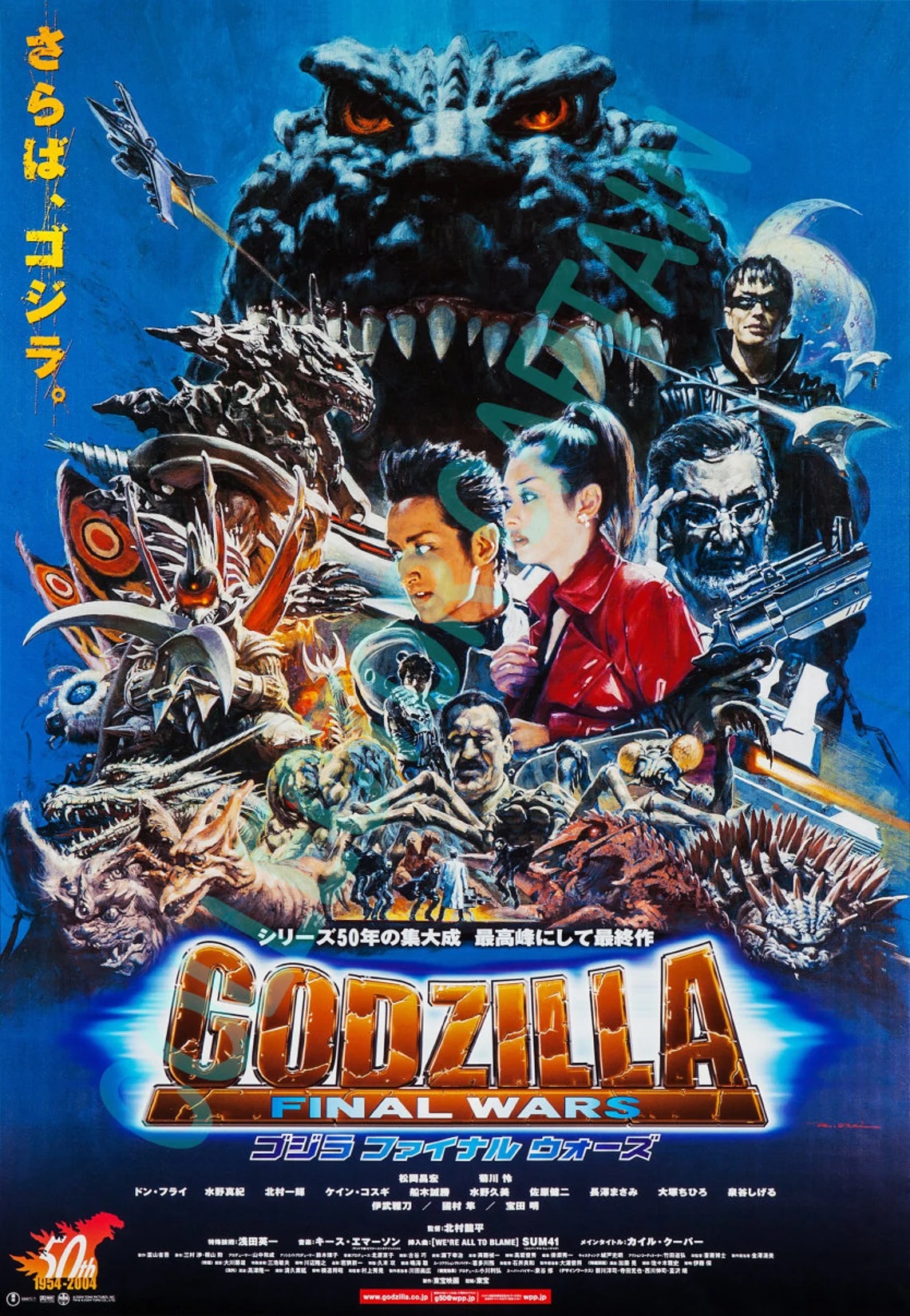
Godzilla: Final Wars (2004) [Tokusatsu Review]

Godzilla: Final Wars; or, Last Hurrah for Monster Rumble
     The world is ruined, and the war is already lost. Now it's a matter of pride. We either die hiding... or die fighting.
Even though this review is already quite belated, I am glad that I finally found the time to talk about my final Godzilla movie for the year 2023; that is, Godzilla: Final Wars, the last instalment of the Millennium series directed by Ryuhei Kitamura and released in 2004 for the 50th anniversary of the franchise.
Release Info
Directed by: Ryuhei Kitamura Starring: Masahiro Matsuoka, Rei Kikukawa, Maki Mizuno
Language: Japanese Original Title ゴジラ ファイナルウォーズ Runtime: 125 min
Synopsis
Godzilla has been defeated and buried in ice imprisonment beneath the South Pole. However, the world was plagued by many disasters and wars that caused the awakening of many monsters. All of a sudden, an alien race calling themselves Xiliens arrives and neutralises the monsters. The aliens want to negotiate a treaty with humans. However, the real motive of the aliens is to conquer Earth. When the monsters get unleashed, Godzilla breaks free from the South Pole as well. Operation Final War is set in motion.
Out with a Bang
After the release of Godzilla: Tokyo SOS, the Toho Studios arrived at a conclusion that Godzilla movies are no longer that profitable as they used to be in the past, so the executives considered axing the franchise. However, producer Shogo Tomiyama decided it would be a good idea to end the series on a high note with a commemorative movie that would retire the King of Monsters for a decade or longer.
To fill in the director’s chair, Tomiyama hired a young director Ryuhei Kitamura who was already known for such films as Versus (2000), Aragami (2003), and Azumi (2003). However, Kitamura had no experience with the Tokusatsu genre, even though he was a Godzilla fanboy since childhood.
Kitamura’s personal auteur style and enthusiasm for the series allowed him to create a unique take on the Big G. Together with writers Wataru Mimura and Isao Kiriyama, he developed an action-packed story that functions as a stand-alone movie in the franchise. At best, you can regard Final Wars as a multiverse finale, but I like to think of it as the missing 16th movie of the Showa era because it follows the wacky science-fiction style of these movies from the 1970s.
It goes without saying that Final Wars is very divisive among the fanbase. Many viewers embrace the batshit craziness that oozes from the screen, whereas others just can’t stand the shifts in tone that alter between the Matrix vibes and traditional monster rumble. I admit that even for me watching this film for the first time ten years ago was just too much. It felt like a sensory overload with too many characters and too many bombastic subplots, but as I matured, I learned to appreciate it for what it is. By no means it is a standard Godzilla flick, but an event film, the purpose of which was to celebrate the 50 year-long legacy of the King.
I have to say that I appreciate top-notch action and special effects helmed by Eiichi Asada that preserved the traditional suitmation technique while utilising CGI in demanding shots. The same kind of praise, however, cannot be said about the music score composed by the late Keith Emerson, Nobuhiko Morino, and Daisuke Yano. The music is more all-over-the-place than the film itself, which really affects the viewing experience. There are some nice action cues, but on the whole, the score is bland and uneventful. Final Wars would have benefited more from Akira Ifukube’s classic themes.
With regard to performances, the leading stars of the film do a great job indeed and they are quite memorable in this whole shabang of insanity. Masahiro Matsuoka does okay as the standard hero who strives to save the day. Rei Kikukawa and Maki Mizuno rock as the Otonashi sisters. Interesting fun fact is that Maki Mizuno is the granddaughter of the legendary Kumi Mizuno who has a small supporting part in the film. We can also spot other Tokusatsu veterans: Kenji Sahara, Masato Ibu, Jun Kunimura, Koichi Ueda, Akira Emoto, and Akira Takarada. Kazuki Kitamura is simply too outlandish as the main villain, but I love him anyway. Last but not least, Don Frye plays Captain Douglas Gordon, and this character is simply too-cool-for-school with his over-the-top gigachad demeanour.
Even though Toho made money from the buzz surrounding the movie (merch, video games, re-release of the 1954 original, etc.), Final Wars itself was a box office failure, recouping approximately half of its original budget. Still, it appears that director Ryuhei Kitamura was satisfied from the movie he delivered.
Personally, I was dying to see the film back in 2004, but there was no theatrical release in the land of forgotten ghosts where I live. However, a distribution label Monolith did issue the film on DVD in a special edition, but the price for it was insane. It was not until 2023 that I was able to get this DVD edition which includes a making-of documentary as well as featurettes from the LA premiere of the film. Unfortunately, the audio on the release is either English or Polish. So, I still have to rely on a bootleg DVD from Hong Kong just to be able to hear the unaltered Japanese audio track. 
Recommendations
All things considered, the aim of the Millennium series was to keep the flame of Big G’s popularity going and to attract new fanbase, but the results were mixed. Godzilla: Final Wars marks the end of an era whether you like it or not. This is the last film that used the suitmation technique. This is the last film that features so many cameos from Tokusatsu veterans. This is the last film that was shot on Toho’s famous pool and backlot before these got restructured. This is the last film that was dedicated to the memory of Ishiro Honda, Eiji Tsuburaya, and Tomoyuki Tanaka, the creators of Godzilla. It was not until the year 2014 when Godzilla was reintroduced into the public spotlight with the American remake that ushered in the MonsterVerse series. However, this is a story for another time.
Overall score: 6/10
«Enjoyed this post? Never miss out on future posts by following us»

Godzilla, Mothra and King Ghidorah: Giant Monsters All-Out Attack (2001) [Tokusatsu Review]

Godzilla, Mothra and King Ghidorah: Giant Monsters All-Out Attack; or, Post-War Trauma
     Godzilla is passé.
This week is provide my penultimate review of my Godzilla Millennium series rundown. To be specific, I want to focus on a film about which I have mixed feelings. This is Godzilla, Mothra, and King Ghidorah: Giant Monsters All-Out Attack from the year 2001, directed by Shusuke Kaneko.
Release Info
Directed by: Shusuke Kaneko Starring: Chiharu Niiyama, Ryudo Uzaki, Shiro Sano, Hideyo Amamoto
Language: Japanese Original Title: ゴジラ・モスラ・キングギドラ 大怪獣総攻撃 Runtime: 105 min
Synopsis
The Japan Self-Defense Forces are alerted about the American nuclear submarine that went missing. In the meantime, a TV reporter Yuri Tachibana (Chiharu Niiyama) films a documentary piece near Mount Myoko, which is hit by a mysterious earthquake. It turns out that Godzilla might have returned and the only way to stop the creature is to reawaken the so-called Guardian Monsters: Baragon, Mothra, and King Ghidorah.
Anger and Hatred
Contrary to common misconceptions within the fandom, this movie did not come about because of the poor financial and critical reception of Godzilla vs. Megaguirus (2000). During the production of the aforementioned film, producer Shogo Tomiyama was still keen on developing the idea of revisiting Godzilla in an alternate universe with each new motion picture. Therefore, he recruited the services of an experienced Tokusatsu director Shusuke Kaneko.
Kaneko was a major Godzilla fanboy since childhood, and it was his lifelong dream to actually make a Godzilla movie. Already in the 1990s, when the Heisei movies were at their peak, young Kaneko contacted Tomiyama, but the producer politely refused his pitch to direct. Consequently, Kaneko honed his craft in the Tokusatsu genre by directing for Daiei the now-extremely popular Gamera Trilogy (1995-1999).
When Kaneko was approached with the offer in 2000, he developed several script ideas for the potential film, but the one closest to his vision involved Godzilla as the ruthless villain facing off against protectors of Earth: Varan, Baragon, and Anguirus. Toho accepted the idea, but gave the ultimatum to replace the original monsters with King Ghidorah and Mothra in order to make the film more bankable because the previous outings were box office bombs.
The movie itself certainly feels different in tone and its subject matter from other Millennium flicks crafted by Masaaki Tezuka and Takao Okawara. The GMK film is Shusuke Kaneko’s attempt to bring the King of the Monsters back to his roots, to make him not an anti-hero, but an unforeseeable force of nature that detests humans and wants to destroy all forms of life.
What is more, Kaneko not only changed Godzilla’s modus operandi and his appearance, but also gave the monster a spiritual dimension of origin. Of course, the nuclear aspect of Godzilla remains intact, but Kaneko heavily implies that the Big G is also an embodiment of souls of Japanese soldiers who were left to die by the Imperial Army during the war. In consequence, Godzilla becomes a demon that haunts Japan not only for its trauma stemming from the bombing of Hiroshima and Nagasaki, but also for the country’s war crimes. Godzilla’s mercilessness is especially telling in a scene where he slams to the ground a hospital filled with innocent people, including a girl who survived the monster’s previous attack.
It goes without saying that Mothra is always the Kaiju heroine, and she always rocks on that front, but it is impossible for me to picture King Ghidorah as the benevolent dragon who saves the day. This is the major cognitive dissonance that ruins this movie for me. King Ghidorah time and time again, for decades, was Godzilla’s arch-nemesis, not the saviour of mankind.
In terms of cinematography and special effects, the GMK movie is the most 2000-like looking production of the Millennium series. I’m not sure why it’s the cause of this apart from that Kaneko is definitely a modern filmmaker, whereas Tezuka and Okawara feel more traditional with their approach to Godzilla. There’s nothing wrong with both approaches. In fact, GMK has many cinematic nods to Godzilla from 1998, as if Kaneko was indirectly throwing shade at the American production. In addition, the special effects director Makoto Kamiya does a fine job with blending classic miniature work with CGI.
With regard to performances, Chiharu Niiyama and Ryudo Uzaki really carry the film with their performances. Uzaki is especially memorable as the army admiral who undergoes a fantastic voyage deep into the belly of Godzilla. The movie also features appearances of the veteran actors such as Shiro Sano, Masahiko Tsugawa, Hiroyuki Watanabe, and Hideyo Amamoto. There are also cameos done by Masaaki Tezuka, Koichi Kawakita, Ai Maeda and Aki Maeda (as twin sisters) as well as Mizuho Yoshida, Akira Ohashi, and Rie Ota (who were the suitmation actors for the titular monsters).
Last but not least, Kow Otani provided a truly menacing music score for the film. I will always cherish the composer’s soundtrack for the Outlaw Star anime, but his addition to the Godzilla franchise cannot go unnoticed as well. “His music was so emotional and classical; it reminds me of old-fashioned kaiju movies, (Akira) Ifukube’s sound. His music makes me excited. It makes your heart beat,” stated Shusuke Kaneko (source).
Recommendations
Undoubtedly, Godzilla, Mothra and King Ghidorah: Giant Monsters All-Out Attack is a film that stood the test of time and can be watched with having the knowledge of the rest of Godzilla films. However, it is very dark indeed, so it does not have a lot of rewatch value for me. The movie was released on Blu-Ray in 2014.
Overall score: 7/10
«Enjoyed this post? Never miss out on future posts by following us»