Tiger Cage (1988) [Film Review]

Tiger Cage; or, Between a Rock and a Hard Place
     We bachelors really envy your true feelings. You're lucky, you're quitting tomorrow.
Tiger Cage is a trilogy of films made by Yuen Woo-ping between 1988 and 1991 which focus on the hard life of Hong Kong cops who solve criminal cases. The first movie in the series is a hard-edged thriller with an excellent cast and explosive action.
Release Info
Directed by: Yuen Woo-ping Starring: Jacky Cheung, Simon Yam, Donnie Yen, Carol Cheng
Language: Cantonese Original Title: 特警屠龍 Runtime: 92 min
Synopsis
Officer Hsiu (Leung Kar-Yan) together with his anti-narcotics team raid the smuggling den. The policeman is chasing a bad guy (Johnny Wang) during the raid. The mobster is presumably shot dead, but he actually survives and takes his revenge on Hsiu by killing him. Shirley (Carol Dodo Cheng) who was about to marry Hsiu finds it hard to get over the loss of her fiancé. She is consoled by Inspector Wong (Simon Yam). In the meantime, two officers, Fan Chun-yau (Jacky Cheung) and Terry (Donnie Yen) discover that their partner, Uncle Tat (Ng Man-Tat) actually cooperates with drug dealers. When they present the evidence to Inspector Wong, they unknowingly put themselves in danger…
Upholding the Law
Tiger Cage seems like a prelude to Yuen Woo-ping's other classic action film In the Line of Duty IV (1989). Indeed, action set pieces are exhilarating and Donnie Yen appears as the righteous cop. (Un)surprisingly his character is killed off early on in the picture, mostly due to the fact that Donnie was not then as popular as Jacky Cheung who is the real leading man.
Great cast and excellent fight sequences are indeed the main advantages of Tiger Cage. It is a pleasure to see Donnie Yen facing off against Michael Woods and Jacky Cheung battling the intimidating Simon Yam. Interestingly, Carol Cheng (during pre-Her Fatal Ways days) shines in the film, in spite of having small screen time. Also, Ng Man-Tat has a lot of stuff to do in the movie, contrary to being just a comic relief as in his many other roles from the 1990s.
The only disadvantage of Tiger Cage, I would say, is the film’s tendency to crank up that aspect of uncomfortability to the max in certain scenes. For instance, the death scene of the character played by the graceful Irene Wan is too harrowing and too out of the blue. In contrast, Uncle Tat is the story’s main punching bag, but he survives every ordeal.
A word of caution: if you expect to see traditional sequels, it is best to say out-front that Tiger Cage 2 and Tiger Cage 3 are completely unrelated to the original film, even though some of the cast members (Donnie Yen and Carol Cheng) return in new roles. The follow-ups present completely independent storylines.
Recommendations
That being said, I admit that Tiger Cage is a pleasant viewing. If you like the cops vs. bandits spectacles , then I recommend the film. In addition, the 1980s vibes and suave Simon Yam as well as Jacky Cheung on the edge are awesome bonuses. Gotta love classic Hong Kong productions.
Overall score: 8/10
«Enjoyed this post? Never miss out on future posts by following us»

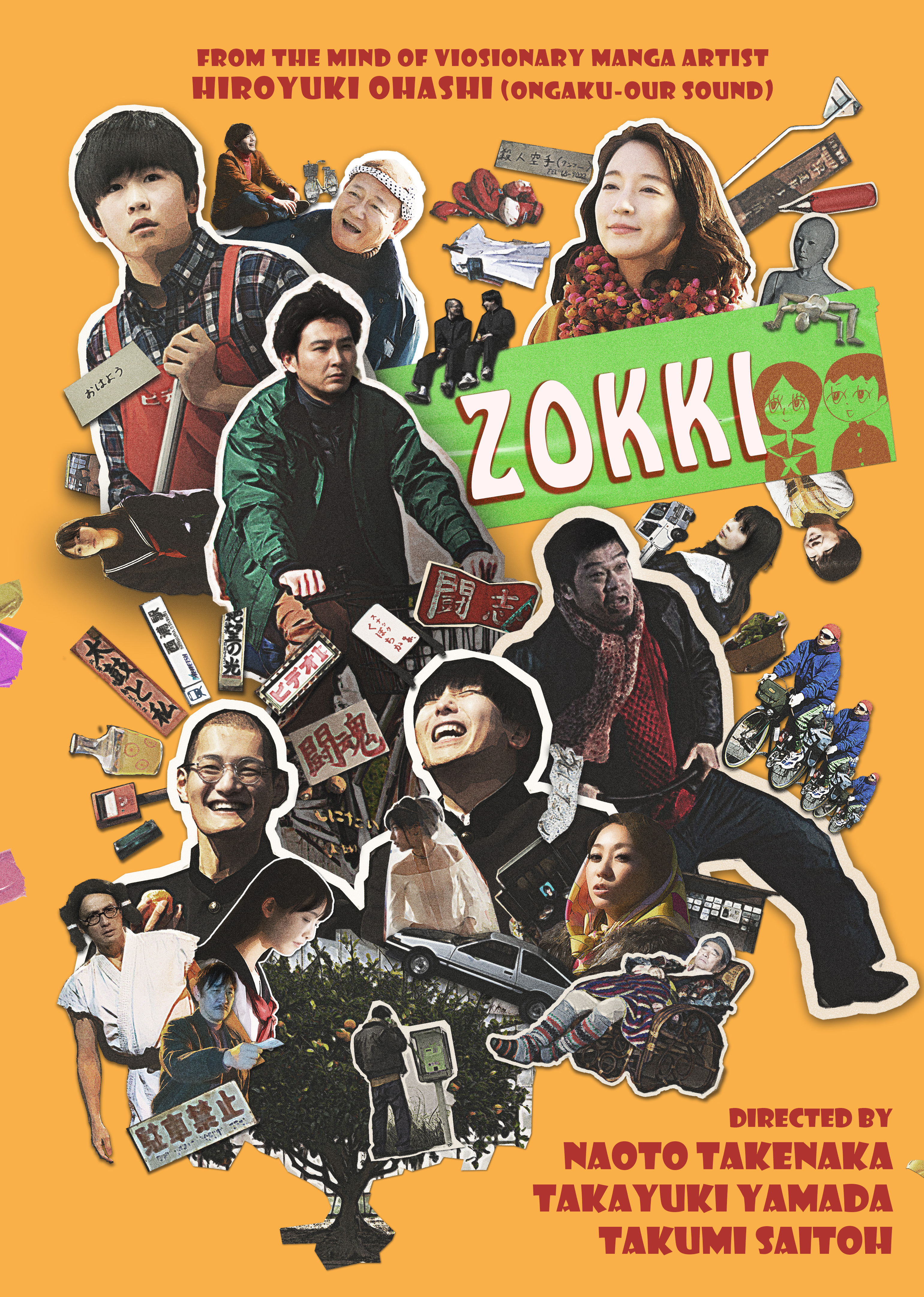
Zokki (2021) [Film Review]

Zokki; or, Too Many Secrets
     Lately, I've been thinking. If a living creature loses what it keeps secret, maybe it can't go on living. Once we finish confessing all our secrets... Or rather... If we confessed all our secrets, would we die, I wonder? So Ryoko, take care of your secrets. Keep as many as you can.
If I were to tell you that there is a Naoto Takenaka, Takayuki Yamada, and Takumi Saitoh movie out there, you would probably wonder who managed to bring together such a mind-blowing cast of excellent actors. In this case, nothing could be further from the truth! The three gentlemen joined forces… as directors(!) and brought to the screen an adaptation of the manga series by Hiroyuki Ohashi called Zokki.
Release Info
Directed by: Naoto Takenaka, Takayuki Yamada, Takumi Saitoh Starring: Riho Yoshioka, Ryuhei Matsuda, Joe Kujo
Language: Japanese Original Title: ゾッキ Runtime: 113 min
Synopsis (issued by the distributor)
There’s an old man who feels the need to impart his knowledge to a grown-up granddaughter; a quiet loner seeking self-discovery on his bike and the fisherman he encounters who invites him to a special meal; a school friendship that turns awkward because of an infatuation with an older sibling; a boy and his father who have very different ideas about how to enjoy themselves; and a friendship between two neighbours that revolves around a series of notes. Scripted by Yutaka Kuramochi, Zokki is less an anthology than a series of snapshots of a strange and quirky world.
Made in Japan
In my opinion, Zokki fits very much into the same narrative stylistics as Survive Style 5+ (2004) and Fish Story (2009). What I mean is that the viewers are presented with a series of vignettes, which gradually cross over into their respective contexts and ultimately constitute one whole. I would not say that Zokki is a wild comedy, but if you have seen Satoshi Miki's flicks, then you will recognise the flavour of distinct quirkiness that could have been manufactured only in Japan.
Although there are five stories featured, the three main ones caught my attention: The first story feels as if it had been penned by Haruki Murakami himself. A guy who clearly has issues with intimate stuff embarks on a bike journey. The second story revolves around two high school students who befriend each other and, consequently, one of them develops an unhealthy obsession. The third one is that of a complex relationship between a father and a son with a touch of horror. To be honest, I think the movie would have been better had the third tale been trimmed a little because it feels prolonged and, in a way, lacks resolution. Still, I very much enjoyed the first two segments, especially the part about high-schoolers.
With regard to performances, unfortunately we are not getting to see Naoto Takenaka, Takayuki Yamada, and Takeru Saitoh in action, but watch out for the leading parts done by Riho Yoshioka, Ryuhei Matsuda, and Joe Kujo. There are also wonderful cameo appearances from Jun Kunimura, Shinnosuke Mitsushima, Yurina Yanagi, Masanobu Ando, and Mai Kiryuu.
Recommendations
If you are in need of yet another set of happy-go-lucky short stories sprinkled with Japanese sensibility, then I recommend Zokki. The movie comes out on Blu-ray from Third Window on the 25th of April. This edition is going to contain such bonus features as interviews with all three directors, a look at behind the scenes, and a theatrical trailer.
Overall score: 7/10
«Enjoyed this post? Never miss out on future posts by following us»
Melancholic (2018) [Film Review]

Melancholic; or, The Bathhouse Job
     Let me ask you this. A Tokyo University graduate has to work at a big company and become happy?
The bathhouse setting appears frequently in Japanese movies. From Departures (2008) to Attamara Sento (2016), the significance of communal bath in Japanese culture is always emphasised. It is not only a place where one can take care of personal hygiene but also can experience physical proximity which, in theory, should influence emotional intimacy. Director Seiji Tanaka turns the symbolism of a bathhouse on its head in his outstanding debut feature called Melancholic (2018).
Release Info
Directed by: Seiji Tanaka Starring: Yoji Minagawa, Yoshitomo Isozaki, Mebuki Yoshida
Language: Japanese Original Title: メランコリック Runtime: 113 min
Synopsis
Kazuhiko Nabeoka (Yoji Minagawa) is a Tokyo University graduate who spends his days at home with parents. One day, he meets a high school colleague, Yuri (Mebuki Yoshida), at a local bathhouse. The girl, eager to see Kazuhiko more often, encourages him to apply for a job at the bathhouse. After an interview with the owner, Azuma (Makoto Hada), Kazuhiko gets the cleaning job together with another newcomer, Matsumoto (Yoshitomo Isozaki). Much to his surprise, Kazuhiko discovers that the bathhouse is used by the yakuza to execute people…
Stand By Me
The title of the film indeed reflects the personality of the main character. Kazuhiko is yet another by-product of the modern educational system, a person who does not know what to do in life. Consequently, director Seiji Tanaka turns Melancholic into a crazy coming-of-age tale in which a young man orientates himself towards a certain activity, yet this “activity” is actually cleaning the bathhouse from corpses.
The professional misadventures of Kazuhiko are yet another ingenious aspect of Melancholic. The dark comedy works extremely well and mixes effortlessly with the classic yakuza-centered thriller vibes. I really do not want to get into any spoilers, so let me say in the simplest terms possible that the film has major plot twists and really goes off the rails in the finale. Interestingly, even secondary characters receive strong character development in the third act!
With regard to performances, in my opinion, Yoji Minagawa did very well in the leading role, but the real star of the picture is Yoshitomo Isozaki as Matsumoto. He portrays his characters in an incredibly comic yet tragic manner. Additional shout out goes to the rest of the cast: Mebuki Yoshida as Kazuhiko’s quirky girlfriend, Makoto Hada as the stressed-out bathhouse owner, Yasuyuki Hamada as the mysterious Koreda, Masanobu Yata as the scary yakuza mobster, and (last but least) Stefanie Arianne as Angela, the mobster’s gaijin girl.
All things considered, I think it’s safe to conclude that the main theme of Melancholic is that of the everlasting generational conflict within Japanese society. Similarly to Masato Harada’s Kamikaze Taxi (1995) and SABU’s Postman Blues (1997), Melancholic also presents the viewers with a group of a young people who want to change their lives for the better, but the grumpy old-timers, who love the status quo, prevent them from doing so.
Recommendations
In spite of winning numerous awards at film festivals, including Best Director at Tokyo Film Festivals and Audience Award at Nippon Connection, I wish this movie could get greater exposure in the West. Thankfully, Third Window Films released Melancholic in dual format (Blu-Ray and DVD). Their region B edition includes a look at behind the scenes, Q&A with director and cast, Melancholic short film, and trailer.
Overall score: 8/10
«Enjoyed this post? Never miss out on future posts by following us»