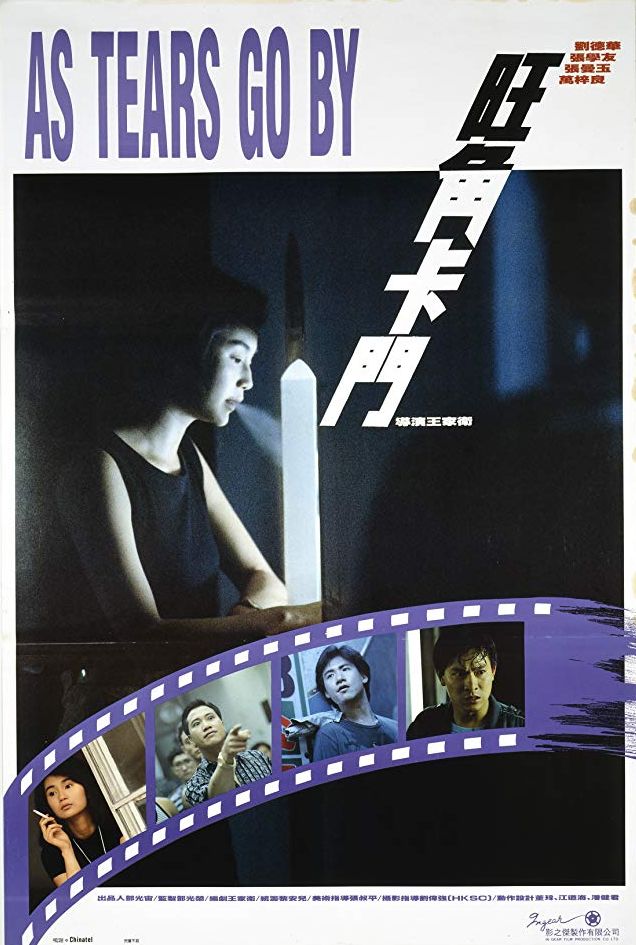
As Tears Go By: or, Stand By Me Older Brother At least you were a hotshot for a while. But what about me? Everyone looks down on me. Does that make you happy? People think I'm nothing, like some stray dog just following you around. Did you know that? I'd rather be a hero for one day than go on being a fly all my life. Charged by Wong Kar Wai's ambience from the previous week, I decided it is high time to watch the director’s film I have not yet seen. That is, his directorial debut, which is often not discussed or mentioned among the critics’ top rundowns of Wong Kar Wai’s filmography. So please, put on your shades, switch on your CRT TV, and let’s take a closer look at As Tears Go By.
Release Info
Directed by: Wong Kar WaiStarring: Andy Lau, Jacky Cheung, Maggie Cheung
Language: CantoneseOriginal Title: 旺角卡门 Runtime: 102 min
Synopsis Wah (Andy Lau) is working for the triad gang as an enforcer. All of a sudden, his distant cousin from Lantau Island called Ngor (Maggie Cheung) comes to Hong Hong to have a medical procedure. Wah hangs out with his best friend Fly (Jacky Cheung), who often gets in trouble with other mobsters because of his hot-headed attitude. When Wah falls for Ngor, Fly has to fight for survival to pay off his debt. Wah rushes to help him.
Glass in the Heart Evidently, As Tears Go By stands out from the rest of Wong Kar Wai’s auteur masterpieces. It is not a bad movie by any means, but it is apparent from the get-go that the young director desperately wanted to break into the cinematic mainstream, and in the process of doing so, he sacrificed his artistic intentions for the purpose of entertaining the audience.
I believe “commercial product” is the best way to describe this motion picture. As Tears Go By really tries to tap into the typical 1980s trend of violent tales about the triads. Wong Kar Wai even borrows from John Woo and Ringo Lam the familiar motives of modern chivalry and overt bromance vibes between the male protagonists. We get blood, gunfights, and Shakespearean drama. Unfortunately, the love subplot is just for the sake of being there, so the audience could have some emotional anchor to root for the hero.
Under many of these commercial layers, it is hard to uncover the Wong Kar Wai we all know and love, but it is not impossible. By means of cinematography and editing, the auteur filmmaker weaves his passion and sensibility into the fabric of As Tears Go By. In the foreground, it is a story about brotherhood and innocent love, but in the background, the core of everything is Wah who becomes an adult and has to come to terms with decisions he makes.
Perhaps the best example of Wong Kar Wai’s visual subtlety is the 6-minute-long sequence in the course of which Wah is reminiscing among Ngor while listening to Sandy Lam’s sensual cover of “Take My Breath Away”. This sequence is a tell-tale foreshadowing of similar scenes involving music and lyrical loneliness as featured in Days of Being Wild, Chungking Express, In the Mood for Love, and beyond. Interestingly, this song was removed in the Mandarin dub of the film and replaced with “You Are The Eternal Pain In My Heart” by Dave Wang and Augustine Yeh.
With regard to performances, Andy Lau is absolutely outstanding as the upright lead with a moral backbone. Maggie Cheung is just as memorable as Ngor, even though her role is very one-dimensional because she plays a kind-hearted love interest. I always found Jacky Cheung to be a very expressive actor, and he cranks up this aspect to the max in his supporting role as Fly.
Recommendations If you think of WKW’s movies as refined dishes, then this one is junk food. It is delicious, but you know it is junk food nonetheless. Yet, this should not prevent you from enjoying it! In fact, I like this film a bit more than Days of Being Wild mainly because the plot itself was more understandable and accessible. The movie was released in 2021 on Blu-ray by the Criterion Collection as part of a special boxset devoted to Wong Kar Wai. I watched my own copy of the film from Mayfly’s double-disc DVD edition, which also contains Days of Being Wild.
Overall score: 8/10
«Enjoyed this post? Never miss out on future posts by following us»
Tiger Cage; or, Between a Rock and a Hard Place We bachelors really envy your true feelings. You're lucky, you're quitting tomorrow. Tiger Cage is a trilogy of films made by Yuen Woo-ping between 1988 and 1991 which focus on the hard life of Hong Kong cops who solve criminal cases. The first movie in the series is a hard-edged thriller with an excellent cast and explosive action.
Release Info
Directed by: Yuen Woo-pingStarring: Jacky Cheung, Simon Yam, Donnie Yen, Carol Cheng
Language: CantoneseOriginal Title: 特警屠龍 Runtime: 92 min
Synopsis Officer Hsiu (Leung Kar-Yan) together with his anti-narcotics team raid the smuggling den. The policeman is chasing a bad guy (Johnny Wang) during the raid. The mobster is presumably shot dead, but he actually survives and takes his revenge on Hsiu by killing him. Shirley (Carol Dodo Cheng) who was about to marry Hsiu finds it hard to get over the loss of her fiancé. She is consoled by Inspector Wong (Simon Yam). In the meantime, two officers, Fan Chun-yau (Jacky Cheung) and Terry (Donnie Yen) discover that their partner, Uncle Tat (Ng Man-Tat) actually cooperates with drug dealers. When they present the evidence to Inspector Wong, they unknowingly put themselves in danger…
Upholding the Law Tiger Cage seems like a prelude to Yuen Woo-ping's other classic action film In the Line of Duty IV (1989). Indeed, action set pieces are exhilarating and Donnie Yen appears as the righteous cop. (Un)surprisingly his character is killed off early on in the picture, mostly due to the fact that Donnie was not then as popular as Jacky Cheung who is the real leading man.
Great cast and excellent fight sequences are indeed the main advantages of Tiger Cage. It is a pleasure to see Donnie Yen facing off against Michael Woods and Jacky Cheung battling the intimidating Simon Yam. Interestingly, Carol Cheng (during pre-Her Fatal Ways days) shines in the film, in spite of having small screen time. Also, Ng Man-Tat has a lot of stuff to do in the movie, contrary to being just a comic relief as in his many other roles from the 1990s.
The only disadvantage of Tiger Cage, I would say, is the film’s tendency to crank up that aspect of uncomfortability to the max in certain scenes. For instance, the death scene of the character played by the graceful Irene Wan is too harrowing and too out of the blue. In contrast, Uncle Tat is the story’s main punching bag, but he survives every ordeal.
A word of caution: if you expect to see traditional sequels, it is best to say out-front that Tiger Cage 2 and Tiger Cage 3 are completely unrelated to the original film, even though some of the cast members (Donnie Yen and Carol Cheng) return in new roles. The follow-ups present completely independent storylines.
Recommendations That being said, I admit that Tiger Cage is a pleasant viewing. If you like the cops vs. bandits spectacles , then I recommend the film. In addition, the 1980s vibes and suave Simon Yam as well as Jacky Cheung on the edge are awesome bonuses. Gotta love classic Hong Kong productions.
Overall score: 8/10
«Enjoyed this post? Never miss out on future posts by following us»
I don't know if you're a fool or just a plain good guy. I
have already written this on MDL, but allow me to repeat it: I’d have
never thought that I will watch a romcom/heist flick with 22-year-old
Kyoko Koizumi playing a criminal mastermind. It is so out of the ordinary
seeing this great actress together with the legendary Hiroyuki Sanada
(28 at that time) on the screen. Well, director Makoto Wada made it
possible and Kaito Ruby is a sweet, fun flick indeed.
Release Info
Directed by: Makoto WadaStarring: Kyoko Koizumi, Hiroyuki Sanada, Kumi Mizuno
Language: JapaneseOriginal Title: 快盗ルビイ Runtime: 96 min
Synopsis Toru
Hayashi (Hiroyuki Sanada) is a nerdy guy who lives with his mom (Kumi
Mizuno) in an apartment complex. One day, he notices that a beautiful
girl known as Ruby (Kyoko Koizumi) moves into a flat two floors above
him. All of a sudden, the girl confesses that is a professional burglar
and enlists Toru to help her out in heist projects. Toru agrees but his
cowardice always gets the better of him in heated situations.
Play it again, Toru During
the first thirty minutes of the film, you get an impression that this
is a standard, run-on-the-mill, romantic comedy in which a clumsy guy
falls for a quirky girl who is way of his league, but the longer the
film lasts, the better it gets.
The jokes and slapstick comedy are
entertaining to watch but the chemistry between Sanada and Koizumi is
off the charts. Kaito Ruby really feels like an homage to American
comedies from the 1950s, especially in terms of static cinematographic
style, dream-like production design, and musical numbers (yes, Kyoko and
Hiroyuki sing together!)
My only complaint is that the film could
have been shorter because some of the sequences feel a bit prolonged
(for instance, the boyfriend subplot). Nevertheless, it is still a great
experience watching the film.
With regard to performances, Hiroyuki
Sanada is obviously too cool for school as the next-door boy with huge
glasses (didn’t recognise him at first!). Kyoko Koizumi also delivers a
radically different performance from her standard drama roles as a
know-it-all girl who is basically a missing member of Ocean’s Eleven.
Additional bonus is the appearance of Kumi Mizuno herself as the sweet
and patient mom.
Recommendations If you are looking for a light
comedy with great leads for Sunday afternoon, then Kaito Ruby is a great
choice. The ending really has the spirit of Koki Mitani movies and
Kyoko Kizumi also sings the main theme. All in all, Kaito Ruby will most
certainly uplift your mood.
Overall score: 8/10
«Enjoyed this post? Never miss out on future posts by following us»
Dominion Tank Police; or, Wind, Forest, Fire, Mountain
Well, I wouldn't mind sending the guys out with atomic bombs
instead of guns. If A-bombs can deter wars, they can deter crimes. Of course,
we'll never completely deter crime in this world. You people gave us the tanks
to fight the bad guys. We've known that the law creating the Tank Police was a
bad one. But a law is a law! The Tank Police must stay on the front lines of
this fight! I'm not asking you to find a cure for society. But if you want law
and order, give us more tanks! Don't you understand?! We're already in the
middle of a war!
Having suffered from the recent lack of Patlabor, I decided
to look for some anime similar in tone and style to the unforgettable mecha
series. Many sites, including MAL, named Dominion Tank Police as the
go-to substitute. Needless to say, I became interested in the recommendation
and ended up watching this old-ish OVA about over-the-top police officers in
tanks. Release Info
Created by: Masamune ShirowVoice actors: Hiromi Tsuru, Rei Sakuma, Yuusaku Yara, Ookura Masaaki, Yuuko Mita, Michie Tomizawa, Shigeru Chiba, Ichiro Nagai, Aya Hisakawa, Nina Kumagaya, Hiroyuki Shibamoto, Satsuki Yukino
Language: JapaneseOriginal Title: ドミニオン No. of eps: 11
Synopsis
Welcome to the futuristic city of Newport. The pollution and
intensification of bacteria in the air has become so severe that people have to
wear gas masks whenever they are going outside. The crime rate also increased
significantly. In order to protect the city, the police department has been
equipped with large, military-style tanks. Leona Ozaki is a young and
determined officer transferred from the motorcycle division. She accidentally
crashes her tank during the first patrol, but she does not give up. From the
collected scrap, she and her partner Al build a mini-tank which she fondly
calls “Bonaparte”. Leona rushes to the streets of Newport in order to face off
against gangs of thieves as well as corporate villains.
Extreme Problems Require Extreme Solutions
At the beginning of this review, it should be noted that the
anime was adapted from a manga, simply entitled Dominion, created by none other
than Masamune Shirow. The manga was serialised and published in 1986. Another
manga called Dominion Conflict One: No More Noise was released in 1995. To be
honest, I was surprised how much Dominion Tank Police has in common with
Patlabor: The Mobile Police, both of which premiered the same year. Apart from
the two shows’ light-hearted feels, the main heroine, Leona Ozaki, has a
very similar attitude to Noa Izumi. What is more, they both give names to
the machines they love. In addition, the great Shigeru Chiba gave his voice to
the supporting characters in both shows.
However, Dominion Tank Police also has a great deal of
differences. It feels like a satirical take on the what-if scenario about the
world that is ruled by extremists. Members of the law enforcement are not
knights in shining armour and they are not bothered by political correctness.
In the first episode, we see the Squad Leader, Charles Benten, reading a guide How
To Kill, and two other officers harassing the suspect by playing golf with
grenades instead of balls. That’s the irreplaceable atmosphere of the 1980s!
The anime, in fact, has three different series that were
made over the course of 20 years. So, if you are keen on checking out the OVAs,
but you don’t know where to start, here’s the quick guide:
Dominion Tank Police (1988): The four-part OVA which serves
as the prequel to the events presented in the manga. We see the beginnings of
Leona and how she chases after the Buaku Gang which is composed of an android
and two Puma Twins, Annapuma and Unipuma. The gang is on the service of a
higher authority and the small time crooks unknowingly contribute to a scheme
that aims to wipe out Newport City.
New Dominion Tank Police (1993-1994). The second OVA which
lasts for six episodes. This time, it takes place after the events from the
manga. Leona and her fellow police officers, together the Mayor of Newport
City, are trying to combat a series of high-tech terrorist attacks. Even though
the police does more damage than the actual progress, Leona uncovers a
conspiracy of business sharks who want to get rich by developing the weapons
industry.
Tank S.W.A.T. 01 (2006): One episode made
entirely in CGI. It feels more like a reboot or an adaptation of the second
manga series. Leona was promoted to the Squad Leader and the Puma Twins are now
members of the police force. They work on rescuing a fellow officer who has
been taken hostage by an unknown android.
In total, the anime has 11 episodes which range in runtime
from 30 to 45 minutes. The three OVAs were produced by different companies so
the style differs from show to show. I safely recommend Dominion Tank Police
(1988) as well as New Dominion Tank Police (1993-1994). Tank S.W.A.T. Police 01
(2006)… not really. The story is interesting and it’s a good comeback after the
years, but the CGI is really off in some places.
I enjoyed Dominion Tank Police for the unusual setting (city
after some sort of ecological disaster), colourful characters (Leona, Al,
Benten, the Puma Twins), and City Pop/Rock soundtrack provided by Yoichiro Yoshikawa (first OVA) and Ayako Udagawa (second OVA). The animation level was
also quite stylish and very 90-ish.
Recommendations
I recommend this anime to anyone who seeks funny,
fast-paced, and action-packed series. 11 episodes will probably fly by quick,
but the experience will certainly be worthwhile. I wish we could get more
Dominion Tank Police nowadays. This franchise together with Appleseed are such
underrated gems from the hands of Masamune Shirow and it is quite a shame that
they were overshadowed by the ever-lasting Ghost in the Shell. Good old stuff.
Patlabor; or, Remembering the Mecha Franchise 30 Years Later
Labor: A robot specifically designed for construction work.
Labor allow dramatic advances in construction but also in crime. To combat
these new Labor crimes, the police created a special unit: The Patrol Labor.
And thus, the birth of Patlabor.
Many anime series come and go, but there are some which
imprint themselves on our memories. I remember clearly when a few years back a
colleague of mine recommended to me “this hilarious anime about cops in giant
robots”. Such a description was enough to get me hooked. I checked out the
original OVA from 1988 and I remained a fan of Patlabor ever since, having
watched every single entry in the series. This is my nostalgic look back at the
under-appreciated (but certainly not forgotten) franchise originally known as Kidō Keisatsu Patlabor.
Release Info
Created by: HeadgearVoice actors: Miina Tominaga, Toshio Furukawa, Ryuusuke Oobayashi
Language: JapaneseOriginal Title: 機動警察パトレイバー No. of eps: 70
Synopsis
Welcome to the near future (approximately somewhere between 1998
and 2002). The world has made a huge development in terms of robotics and
especially in manufactured “Labors” that have revolutionised modern industry.
However, along with their usage, Labor-related crimes have skyrocketed as well.
That’s why the Metro Police created a special Patrol Labor unit called Special
Vehicles Section, the aim of which is to prevent such crimes. The story follows
the members of SV Section 2, Division 2, who are the laughing-stock of the entire
police force. Noa Izumi is an energetic young pilot of the top-of-the-line
Ingram AV-98 Labor. She is aided by her commanding officer, Asuma Shinohara;
second unit Ingram pilot, Isao Ohta; his commanding officer, Kanuka Clancy; two
truck drivers: Mikiyasu Shinshi and Hiromi Yamazaki; as well as the Division’s
chief, Captain Kiichi Goto. Although successfully completing missions, the team
often demolishes everything that stands in their way, thus generating huge
financial losses and destroying the image of the public service.
Condition Green!
After finally finding out some clear info about the release
of The Next Generation: Patlabor(2014) adaptation, I decided to revisit the
whole franchise and provide my thoughts on it, especially in view of the fact
that it is roughly 31 years old. To be honest, I enjoyed every single minute of
every anime episode, even more than when I saw the series for the first time.
However, some introductory information should be presented
first. Patlabor was originally created by Headgear, an independent creative
organisation consisting of Masami Yuki, Yutaka Izubuchi, Kazunori Ito, Akemi
Takada, and Mamoru Oshii. It first appeared in the form of a manga (devised by
Masami Yuki) which was released by Shogakukan in 22 volumes between 1988 and
1994. Subsequently, 7 light novels followed between 1990 and 1994.
In terms of anime, the series spans across 3 theatrical
movies and 70 episodes which are divided into 2 separate timelines, so bear
with me:
The Movie Timeline:
Patlabor: Early Days (1988-1989)- The first 7-episode-long
OVA directed by Mamoru Oshii which focuses on the origins of Tokyo MPD’s SV2
team.
Patlabor: The Movie (1989)- I already wrote about this film
here, but to be clear: SV2 investigates a series of mysterious Labour incidents
during the construction of Babylon Project, an advanced technological attempt
to connect small islands in Tokyo Bay and artificially create new land for the
expanding Tokyo suburbs.
WXII: Patlabor The Movie 3 (2002)- This one is more like a
spin-off than a proper sequel. A year after the events from the first movie,
two Tokyo MPD detectives work on the case involving missing scientists. They
have participated in an experiment, the result of which was a genetically
engineered monster who fled to Tokyo Bay.
Patlabor: The Movie 2 (1993)- SV2’s final adventure. An
unknown group of terrorists initiates a state of emergency across Tokyo. The
only way to stop the threat is SV2 joining forces again, together with Captain
Shinobu Nagumo, the leader of Division 1.
The Next Generation: Patlabor (2014): Taking place 11 years
after the events from the anime, this live action series focuses on a new SV2
team fighting Labor-related crimes.
TV Timeline:
Patlabor: The TV Series (a.k.a. Patlabor on Television)
(1989-1990): A 47-episode-long story taking place in a different continuity.
This series has a structure similar to Ghost in the Shell: Stand Alone Complex
because it features many SV2’s one-off missions, slice-of-life shenanigans, as
well as the whole story arc about battling an evil company known as Schaft
Enterprises.
Patlabor: The New Files (1990-1992): The OVA which consists
of 16 episodes serving as the conclusion to the TV series.
Whew, that was quite an enumeration, nevertheless, an
important one. If you do not know where to start, then I suggest trying
Patlabor: Early Days which serves as a great introduction into the series. If you
get interested, then you can check out the rest of the entries in whichever
order you like (I personally mixed the TV series with the movies).
With regard to each entry, I safely recommend watching all
of them. I always have little issues with Patlabor: The Movie 2 (a bit too
slow-paced and having strong Ghost in the Shell undertones), but it is a great finale in its
own right. In addition, WXIII: Patlabor the Movie 3 functions pretty well as an
independent monster story, but is pretty underwhelming when compared with the
other instalments. My all-time favourites shall remain the TV Series, New Files
follow-up, and the first movie.
Speaking of TV Series, I really do not get why it is so
looked down on contemporarily. To me, this a core of the Patlabor
franchise. Without it, we would not get all these wonderful, hilarious, but
also dark, and dangerous adventures of SV2. It provides a major character
development and, consequently, by Patlabor: The Movie 2, one can really feel the
amount of time spent with the characters.
In terms of the characters themselves, I love how they are a
mixed bunch of unique personalities. Apart from comedy dynamics, each character
has a clear story arc and undergoes a personal development as the story moves
on. As a result, this makes them all even more wonderful and unforgettable as a
team.
The futuristic vision of early 2000s is very light-hearted
for a change rather than being cyberpunk rendition all over again. However,
Headgear cleverly turns the world of Patlabors from harmless fun into a dark
reality involving corrupt governments, espionage, and military coups. That’s
how multilayered this franchise is.
Additionally, the animation itself coupled with beautiful Labor
designs by Yutaka Izubuchi is just awesome. I literally have like 4 Patlabor
posters hanging on my wall right now. On top of that, Patlabor would not have
its distinct tone without the composer Kenji Kawai and his many musical contributions. With his music, one can feel as if living in the mecha world.
In 2014, Mamoru Oshii directed a live action called The Next Generation: Patlabor which was followed a year later by a theatrical film The Next Generation Patlabor: Tokyo War. Unfortunately, this reimagining of the series was not well
received (at least financially). What is more, there is absolutely no legit
English translation of this show. However, I took up the challenge and watched
both the drama and movie raw. While not getting much of the details, I can say
The Next Generation: Parlabor looks very solid, especially in terms of being
faithful to its anime source, and certainly does not deserve the excessive bad rap it
receives.
2016 saw the release of Mobile Police Patlabor Reboot, an
8-minute concept short reintroducing the franchise to a younger audience. The
fate and Japanese reception of the reboot is unknown (I personally liked it).
However, it’s been announced by Headgear that they are developing a new
animated television series called Patlabor: EZY. You can check out the project’s official site here.
Recommendations
All things considered, Patlabor is just so much fun. Quoting
a Youtube user: “Friends + Police Academy + giant robots = Patlabor”. Check it
out if you can. There are some issues with the availability but where there’s a will there’s a way. Patlabor is a great show which needs some love
especially in the CGI age. I am keeping my fingers crossed for the new anime
because more people around the world should know about this cops-and-robots
franchise. As Noa used to say at the end of each episode: Target, Locked On!