Showing posts with label indie. Show all posts

Night Light (2018) [Film Review]

Movies focusing on family issues tend to be either extremely serious in tone or, on the contrary, very light-hearted. It is quite rare to see a motion picture centring on the father-son relationship through the perspective of nature. Night Light directed and written by Kim Moo-young is such a film, and it deals with the difficult theme in an almost oneiric way.
Release Info
Directed byKim Moo Young Starring: Song Jae Ryong, Ji Dae Han, Jung Ah Mi
Language: Korean Original Title: 밤빛 Runtime: 108 min
Synopsis

Hee-tae (Song Jae Ryong) is an herb collector who finds out that he is terminally ill. Suddenly, he receives a letter from his ex-wife. The content of the letter remains unknown, but it definitely has an impact on Hee-tae. We see him living in the mountains, leading a spartanic lifestyle, and collecting herbs. Soon after, his son (Ji Dae Han) arrives for a visit. The estranged father and son try to get to know each other while being surrounded by nature. Each day, they collect herbs and climb the nearby mountain.
Night Light is basically a slow-paced story about the appreciation of life and the acceptance of our fate. In a manner similar to the Japanese New Wave of the 1960s, director Kim Moo Young unhurriedly guides the viewers through a simple story with huge mountains looming in the far background. If you like long shots of walking through a forest, drinking from a frozen pond, or just climbing, then you will definitely enjoy this film.
Cinematography helmed by Kim Bo Wram is simply breathtaking. Some of the mountain shots could be used for a National Geographic documentary. Unfortunately, the music score is virtually non-existent in the movie. Apart from the haunting ending sequence, no music accompanies the scenes, which is a shame because it may have improved the viewing experience.
With regard to performances, Song Jae Ryong as the main lead is the movie's definite highlight. He convincingly portrays a troubled man struggling with an illness. The role of Hee-tae's son was played quite well by young Ji Dae Han. An honourable mention goes to the veteran actress Jung Ah Mi who managed to mark her presence in the story with a small part.
Recommendations

I recommend Night Light to anyone who is interested in great visuals, subtle character interactions, and loose narration. It is simple, yet multi-layered, look at the intimacy between a parent and a child. Let's face it, we are all, sometimes, pondering about life in the middle of the night, just as Hee-tae does at the top of a mountain.
Disclaimer: This review is an edited re-release of a text composed for AMP in 2019.
«Enjoyed this post? Never miss out on future posts by following us»

Hanalei Bay (2018) [Film Review]

Hanalei Bay; or, Silent Grieving
     Being forgetful isn’t the problem. Forgetting is the problem.
At the moment, I am making my way through the movie adaptations of Haruki Murakami’s novels for the purposes of my upcoming editorial. I thought it could be a idea to slow my pace and focus in greater detail on one particular movie, which is Daishi Matsunaga’s Hanalei Bay.
Release Info
Directed by: Daishi Matsunaga Starring: Yo Yoshida, Nijiro Murakami, Reo Sano
Language: Japanese Original Title: ハナレイ・ベイ Runtime: 96 min
Synopsis
Sachi (Yo Yoshida) receives a phone call informing her that her son died in Hawaii due to a shark attack. The woman arrives in Hanalei Bay to take care of formalities and retrieve the ashes of her son. Nevertheless, Sachi continues to come back to Hanalei Bay every year…
By the seaside
One could think that Murakami purposely came up with the theme of a mother losing her son to tell a sappy tale centered on grieving, but the mother figure is an extremely bitter and self-reliant person who helps out two noob teenagers from Japan.
Director Daishi Matsunaga recreates the main plot points a T, but the reserved camerawork, stoic atmosphere, and the striking performance by the legendary Yo Yoshida are the factors that make this particular adaptation stand out to me. The third act is especially captivating as the viewers see a clear difference between the difficult past of the main heroine and the present stillness of the titular bay.
I have to say that the mother in the film is not simply bitter. She processes her feelings towards her unruly late son while becoming the mother figure to two Japanese surfers. Undoubtedly, the most touching scene is the one in a skate park, and it is an original addition not penned by Murakami at all.
With regard to performances, Yo Yoshida undoubtedly carries the weight of the film on her shoulders. Nijiro Murakami does well in the supporting role as one of the young surfers in need. Reo Sano is quite memorable as the son, in spire of the limited screen time. I also appreciate the fact that there is a lot of dialogue in English. Some viewers voiced their concerns about the delivery of lines by Yo Yoshida, but I think she did it very well, definitely better than Satomi Ishihara in Shin Godzilla (2016).
Recommendations
If you are looking for a tranquil feature that will make you reconnect with the lyrical loneliness, then recommend Hanalei Bay. Unfortunately, the film is unavailable on streaming platforms at the moment. However, the movie is making rounds as part of many film festivals (that’s how I watched it originally), and there’s also a Japanese DVD edition out there.
Overall score: 9/10
«Enjoyed this post? Never miss out on future posts by following us»

Beloved (2022) [Film Review]

Beloved; or, Stay With Me
     I have an idea. How about we spend one last day together? Go somewhere, walk around, have dinner…
Director Bishrel Mashbat is no stranger to this blog as I have already reviewed his feature-length debut In the Land of Lost Angels (2018). I was pleasantly surprised when Bishrel Mashbat reached out to me recently with information that he made a new movie called Beloved. Needless to say, I checked it out and was not disappointed.
Release Info
Directed by: Bishrel Mashbat Starring: Iveel Mashbat, Jana Miley, Charletta Rozzell
Language: English, Mongolian Runtime: 92 min
Synopsis
Anar (Iveel Mashbat) and Kassy (Jana Miley) constitute an inter-racial couple living in the United States. They have been married for five years, but things are not going well. In fact, their marriage gradually falls apart and they two behave towards each other more like roommates than husband and wife. Both of them consider divorce, but are they truly willing to give up on their relationship?
Memories of You
First of all, I have to say that Beloved seems to be a conventional story that has been done numerous times before, but the theme of marriage examination is not as important as that of nostalgia and introspective feelings of the main characters.
It is difficult for me to describe it, but the usage of music by Louis Armstrong, Camile Saint-Saëns, Eric Satie, Tchaikovsky, and Chopin, coupled with top-notch production design done by Nimi Lkhagva evokes this distinct feeling of coziness and warmth that can be found in pictures of such auteur filmmakers as Wong Kar-wai or Hirokazu Koreeda.
In other words, I felt as if I wanted to step into the 4:3 frame and experience the setting surrounding the characters on my own. Consequently, it goes without saying that Bishrel Mashbat is an artist who puts extreme emphasis on visuals rather than dialogue. Therefore, Beloved pulls you in with its ontological aspects (characters functioning in spaces and stuck in the past) rather than with expository means (standard breakaway of marriage).
With regard to performances, of course, I immediately spotted Iveel Mashbat whom I have already seen in In the Land of Lost Angels. In my opinion, he gives a more compelling performance in Beloved due to the general subject matter of the film. Obviously, Jana Miley cannot go unnoticed as well. She did a great job playing an emotionally-torn wife. My praise also goes to Charletta Rozzell who played a supporting but extremely vivid part.
Recommendations
If you are in need of a peaceful, yet thoughtful film, then I recommend Beloved. It officially premiered at the Seattle Asian Film Festival and is currently making rounds at other festivals. I sincerely hope that, similarly to In the Land of Lost Angels, Bishrel Mashabat’s latest film will also make its way to Amazon Prime and/or other streaming service.
Overall score: 7/10
«Enjoyed this post? Never miss out on future posts by following us»

Melancholic (2018) [Film Review]

Melancholic; or, The Bathhouse Job
     Let me ask you this. A Tokyo University graduate has to work at a big company and become happy?
The bathhouse setting appears frequently in Japanese movies. From Departures (2008) to Attamara Sento (2016), the significance of communal bath in Japanese culture is always emphasised. It is not only a place where one can take care of personal hygiene but also can experience physical proximity which, in theory, should influence emotional intimacy. Director Seiji Tanaka turns the symbolism of a bathhouse on its head in his outstanding debut feature called Melancholic (2018).
Release Info
Directed by: Seiji Tanaka Starring: Yoji Minagawa, Yoshitomo Isozaki, Mebuki Yoshida
Language: Japanese Original Title: メランコリック Runtime: 113 min
Synopsis
Kazuhiko Nabeoka (Yoji Minagawa) is a Tokyo University graduate who spends his days at home with parents. One day, he meets a high school colleague, Yuri (Mebuki Yoshida), at a local bathhouse. The girl, eager to see Kazuhiko more often, encourages him to apply for a job at the bathhouse. After an interview with the owner, Azuma (Makoto Hada), Kazuhiko gets the cleaning job together with another newcomer, Matsumoto (Yoshitomo Isozaki). Much to his surprise, Kazuhiko discovers that the bathhouse is used by the yakuza to execute people…
Stand By Me
The title of the film indeed reflects the personality of the main character. Kazuhiko is yet another by-product of the modern educational system, a person who does not know what to do in life. Consequently, director Seiji Tanaka turns Melancholic into a crazy coming-of-age tale in which a young man orientates himself towards a certain activity, yet this “activity” is actually cleaning the bathhouse from corpses.
The professional misadventures of Kazuhiko are yet another ingenious aspect of Melancholic. The dark comedy works extremely well and mixes effortlessly with the classic yakuza-centered thriller vibes. I really do not want to get into any spoilers, so let me say in the simplest terms possible that the film has major plot twists and really goes off the rails in the finale. Interestingly, even secondary characters receive strong character development in the third act!
With regard to performances, in my opinion, Yoji Minagawa did very well in the leading role, but the real star of the picture is Yoshitomo Isozaki as Matsumoto. He portrays his characters in an incredibly comic yet tragic manner. Additional shout out goes to the rest of the cast: Mebuki Yoshida as Kazuhiko’s quirky girlfriend, Makoto Hada as the stressed-out bathhouse owner, Yasuyuki Hamada as the mysterious Koreda, Masanobu Yata as the scary yakuza mobster, and (last but least) Stefanie Arianne as Angela, the mobster’s gaijin girl.
All things considered, I think it’s safe to conclude that the main theme of Melancholic is that of the everlasting generational conflict within Japanese society. Similarly to Masato Harada’s Kamikaze Taxi (1995) and SABU’s Postman Blues (1997), Melancholic also presents the viewers with a group of a young people who want to change their lives for the better, but the grumpy old-timers, who love the status quo, prevent them from doing so.
Recommendations
In spite of winning numerous awards at film festivals, including Best Director at Tokyo Film Festivals and Audience Award at Nippon Connection, I wish this movie could get greater exposure in the West. Thankfully, Third Window Films released Melancholic in dual format (Blu-Ray and DVD). Their region B edition includes a look at behind the scenes, Q&A with director and cast, Melancholic short film, and trailer.
Overall score: 8/10
«Enjoyed this post? Never miss out on future posts by following us»

Crazy Thunder Road (1980) [Film Review]

Crazy Thunder Road; or, Falling Down
     I founded the Maboroshi group eight years ago. Now I'm one of its seniors. You should know I'm on your side. I'm right behind you guys who want to raise hell on your bikes. You beat the pseudo grown-ups any day. But listen, Jin... This way you'll end up wasting your energy.
When it comes to punk-charged aesthetics accompanied by outstanding cinematography and a strong critical comment on modern society, Gakuryu Ishii (also known as Sogo Ishii) is the go-to director. In this review, I am taking a look at his university “senior thesis” project called Crazy Thunder Road, a biker-gang classic that is about to be released for the first time in the West by Third Window Films
Release Info
Directed by: Gakuryu (Sogo) Ishii Starring: Tatsuyo Yamada, Koji Nanjo, Michiko Kitahara
Language: Japanese Original Title: 狂い咲きサンダーロード Runtime: 98 min
Synopsis
Ken (Koji Nanjo) is the leader of a Maboroshi biker group. He calls it quits because he wants to have a quiet life with his girlfriend Noriko (Michiko Kitahara). However, Jin (Tatsuyo Yamada) opposes the idea to merge the gang with another organisation, so he takes over the leadership. In order to preserve his individuality, Jin will have to fight against yakuza kingpins and ultra-nationalist militants.
Seize the Day and Set it on Fire
Even though Gakuryu Ishii was already known in Japan for the Panic High School (1978) movie he co-directed, Crazy Thunder Road got him into the showbiz of Japanese Cinema. The Toei executives were so impressed with the young filmmaker’s punk feature, which was made because, allegedly, he wanted to continue using university equipment, they have upscaled the original 16mm negative into a 35mm presentation and gave the movie a nationwide release.
In my opinion, Crazy Thunder Road has to be seen twice in order to be understood. You just don’t know what to expect from Gakuryu Ishii, the visionary who gave us The Crazy Family (1984), Angel Dust (1994), and August in the Water (1995). Crazy Thunder Road is a low-budget introduction into the cyberpunk genre made in Japan. That is to say, we have bosozoku characters but their manic attitude, especially Jin’s, is cranked up to the max. The nihilistic and industrialised atmosphere of the film gives off the feeling as if society is on the brink of destruction. Indeed, Jin himself is torn between chaos and order as we see him meandering between right-wing crazies and yakuza nutjobs. All in all, the only way out for the main hero is to oppose every kind of authority.
In many reviews, you can find Crazy Thunder Road being compared to Mad Max (1979) and The Warriors (1979). I believe that Midnight Eye team was spot on with their own analysis of the film when saying that Ishii’s feature, in terms of its basic yet efficient resourcefulness resembles Sam Raimi’s The Evil Dead (1981): “Both films are dazzling showcases of ostentatious film school experimentation coupled with an undeniably accomplished technical proficiency and razor-sharp editing” (source).
Personally, I would add that if it had not been for Crazy Thunder Road, there would not have been Akira (1988) in its present form. After watching Ishii’s bikes-and-guns epic, it becomes obvious that the film had an influence on Katsuhiro Otomo. The two even collaborated together on the adaptation of Otomo’s manga Run in 1981. What is more, the action-packed finale of Crazy Thunder Road predates the showdown between Deckard and Roy Batty in Blade Runner by two years!
In terms of disadvantages, the erratic pacing has to be addressed. Perhaps this is only my own reflection, but it seems as if a lot of the footage was, in fact, cut out in the editing process. At times, there is a strong prevalence that a certain scene is just missing as we see the characters jump from one location to another. Still, this uncanny feeling is compensated by the exhaustively dynamic performance of the late Tatsuyo Yamada as Jin.
Recommendations
If you seek for an unusual, anti-establishment motion picture from the hallmarks of film history, I recommend Gakuryu Ishii’s Crazy Thunder Road. It’s a 42-year-old university project that keeps on giving to this day. The Third Window Blu-ray release comes out on the 21st of February. Their edition includes a new master of the film approved by Gakuryu Ishii, new interview with the director, audio commentary by Tom Mes, and a video essay by Jasper Sharp on Jishu Eiga.
Overall score: 7/10
«Enjoyed this post? Never miss out on future posts by following us»

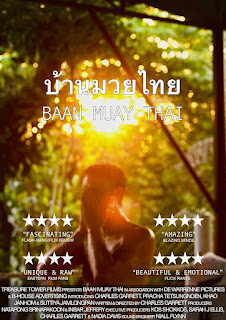
Baan Muay Thai (2021) [Film Review]

Baan Muay Thai; or, The Measure of a Man
     When I was 19, I could do anything. Hurt but no real problem. One or two days and I was fine. Now it is not the same.
It’s time for another indie feature! In this review, I would like to take a look at Baan Muay Thai, a debut production directed and written by Charles Garrett. I heard about the film for the first time a little over a year ago when the Asian Film Fans team was working on a video review. I was lucky enough to interview the director and hear the surprising and extremely detailed backstory of the film.
Release Info
Directed by: Charles Garrett Starring:Charles Garrett, Khao Janhom, Pracha Tetsungnoen, Suttiya Jamlongpan
Language: English, Thai Original Title: Baan Muay Thai
Synopsis
Max (Charles Garrett) is a Londoner who spends his days in a trading business. One day, he is called by a good friend from Thailand. The ailing coach wants Max to help in reinvigorating their training camp and participate in an exhibition match. Max quits his job and goes back to the land where he once trained in order to rediscover the art of Baan Muay Thai.
Honour of the Gym
The first thing which definitely transpires while watching Baan Muay Thai is the naturalistic, guerilla-like filmmaking style. As a viewer, you are really under the impression that what you are seeing is a documentary about a British guy who wants to help out his friends in need and reconnect with his inner self in the process.
In consequence, Baan Muay Thai goes for the feeling rather than the experience. Do not expect this movie to be yet another action-packed rehash of Enter the Dragon (1973) or Ip Man (2008). You will not find Donnie Yen or Angela Mao here. This movie is about real struggles and real characters and it boldly ventures into the kitchen-sink drama territory of the first Rocky (1976) picture.
Be prepared for steady camera work, beautiful overview shots of Thailand, and nuanced but sparse dialogue. The director has recently recut the film, and the updated version certainly has a better pacing and is easier to follow in terms of narration. In addition, the English subtitles are hardcoded which eliminates the problem of translation not displaying properly during the screening.
Recommendations
If you are on the lookout for a calm, poignant drama with great visuals, then I recommend Baan Muay Thai. I sincerely hope that Charles Garrett will keep on making more indie films with the same type of true-to-life ambience. My thanks go to the director for sharing the screener and I am looking forward to part II.
Overall score: 7/10
«Enjoyed this post? Never miss out on future posts by following us»

Immigrant Experience and American Dreams: Interview with Bishrel Mashbat

 
When thinking about Mongolian films and artists, one can realise that such a topic is not extremely popular in mainstream culture. This does not mean; however, that this country does not have passionate filmmakers determined to communicate their voices to international audiences. For this interview, I sit down to talk with Bishrel Mashbat, the director of a 2018 movie In the Land of Lost Angels.
 
 
Is In the Land of Lost Angels your feature film debut? How did your career unfold prior to this movie?
Yes, it is my feature debut. Before this, I have spent many years editing documentaries and tv shows. I was doing various gigs really, anything I could get my hands on while trying to get a film made unsuccessfully.
 
How did the idea of making In the Land of Lost Angels come about?
Mainly I wanted to show Mongolians to the world. When I say I am Mongolian, most people have no clue of who we are. I wanted to show people how we looked, acted, walked, and talked like, albeit in a fiction setting. Furthermore, I wanted to make an Asian American film that is tonally different than what was out there. Lighthearted, comedic, or melodramatic films tend to dominate most Asian American Cinema. I wanted our film to feel different on a granular level. I wanted it to have a different texture.
 
 
The movie evidently deals with a popular theme of kidnapping. Did you draw inspirations from other popular films with similar story patterns, such as High and Low (1963) or Ransom (1996)?
Nope. I am not sure if I watched them before. Although our film deals with the topic of kidnapping, it meant something different to me, at least. One could also approach the kidnapping from an allegorical angle. 
 
I noticed on the cast and crew listing that a couple of actors share your surname. Could you tell us a bit more about the casting process?
My brother, Iveel Mashbat, plays Orgil's character. There are not a lot of Mongolian American actors out there, so pragmaticism might have played a role there. He also was a child actor, so the roots were there. My wife also appears briefly in the film.
 
 
How did you get American actors on board?
Most of them are my personal friends and fellow filmmakers. However, to answer your question directly: it took a lot of beers.
 
Have you been in any way inspired by Mongolian artists while making In the Land of Lost Angels?
Not particularly. Maybe rap artists. I used to drive a lot at night while writing the script, blasting Mongolian rap music in my car.
 
 
What was the reaction of the Mongolian diaspora in America upon seeing the movie?
Mongolian Americans responded very well. They have been championing this project since its inception. If they read this, I would like to thank every one of them.
 
Do you have any piece of advice for aspiring filmmakers from minority communities?
Being someone from a minority community, one might feel like they have a tougher hill to climb, but the flip side is that you bring a unique point-of-view and life experience. That will set you apart. Write what you know. Write a lot.
 
 
What are your future plans? Are you already working on a new motion picture?
Right before this crazy pandemic happened, I was filming my second feature. I was lucky enough to have my footage in the can before the lockdown happened. Consequently, I have spent most of the lockdown working on the post of my second film titled Beloved.
 
If you are interested in Bishrel's work, please refer to his official website. In the Last of Lost Angels can be viewed on Amazon Prime. Thank you for reading!
 
«Enjoyed this post? Never miss out on future posts by following us»