Hello and welcome to today’s update. No review or editorial this week due to work obligations, but I did not want to leave an empty weekly slot on the blog, so I thought that I would share some positive news with enthusiasts of Japanese Cinema out there.
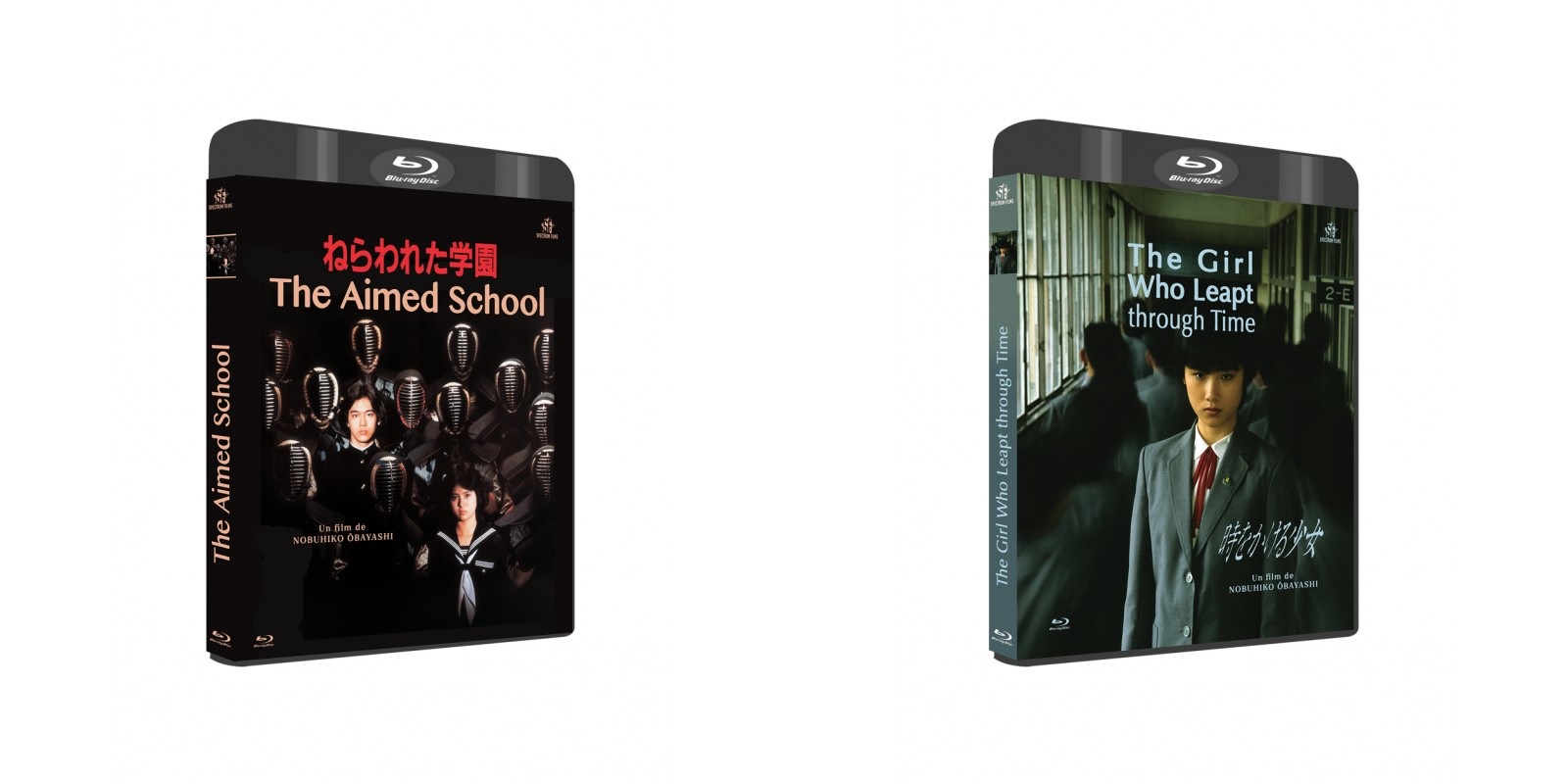
That is to say, Yoan Orszulik- a contributor at Monsieur Bobine and Furyosa- has recently informed me that France-based distributor Spectrum Films is going to release two(!) Nobuhiko Obayashi’s features on Blu-Ray.
The titles in question are School in the Crosshairs (a.k.a The Aimed School) and The Girl Who Leapt Through Time. I have already reviewed both films because these were released in the UK by Third Window as part of a limited release boxset. Consequently, it is a bit sad that we are not going to get new Obayashi’s titles in Europe this year, but if you missed the Third Window collection set, then you still have the chance to get two titles which Obayashi made for the Kadokawa company.
In addition, it should be emphasised that School in the Crosshairs and The Girl Who Leapt Through Time are going to be released separately, not as a dual disc package. Therefore, you need to prepare your wallet for possible extra shipping costs. With regard to releases themselves, you can read the official info on the distributor’s site.
It appears that the movies are going to have classic theatrical covers with English as well as Japanese titles on the front. As for the special features, I am not fluent in French but it is easy to infer from the description that some (if not many) bonus materials are going to be the same as the ones from the Third Window set. Nevertheless, Yoan Orszulik and Aurélien Gouriou-Vales from Monsieur Bobine did manage to prepare two original interviews.
There is no information about English subtitles on these releases, so it is safe to assume that we can only expect French translations. The movies are going to be available on the 19th of October, so basically next week. Below, you can watch the original trailers.
«Enjoyed this post? Never miss out on future posts by following us»
School in the Crosshairs; or, All of Us Are Aliens Stars...you can see so many stars in this universe. Welcome to the concluding part of my journey through Nobuhiko Obayashi’s Kadokawa productions, which were recently released by Third Window Films. I realise that School in the Crosshairs is chronologically the first movie which Obayashi made for the idol-centered studio, but I saved this review for the last course because it is my least favourite one of the bunch. Without further ado, let’s jump into the discussion.
Language: JapaneseOriginal Title: ねらわれた学園 Runtime: 90 min
Synopsis Yuka Mitamura (Hiroko Yakushimaru) is a middle school student who suddenly discovers that has psychic powers. Nevertheless, another girl called Takamizawa (Masami Hasegawa), obviously being under the influence of a mysterious intergalactic being, also displays psychic abilities, and uses them to impose a military regimen at school. Yuka stands in defence of oppressed students, and humanity on the whole. She has to face off against a villainous creature from Venus known as Kyogoku (Toru Minegishi).
The Psychic Club Allow me to clarify right off the bat that I consider School in the Crosshairs to be my least favourite Obayashi movie made for Kadokawa, but it does not mean I dislike it. Given the circumstances, the budget, the idol cast, and the source material (a novel by Taku Mayumura), the director gave his best effort to make a fantasy movie, which touches upon some very important themes.
The problem with School in the Crosshairs is that the pacing is erratic and the themes in question are not entirely fleshed out. The alien invasion, which subsequently results in a radical change of school life, echoes Obayashi’s own childhood during World War II, when he was constantly indoctrinated by imperialist propaganda about the might of the Japanese Empire. Interestingly, Mitamura and her colleagues’ personal struggles at school can serve as a metaphor for the so-called “juken jikoku” phenomenon; that is, “exam hell” in Japan.
Needless to say, Obayashi deeply criticises in his story the herd mentality and favours independent action. This culminates in the bombastic finale filled with outstanding visual extravaganza, in the course of which Mitamura single-handedly fights off against an alien invader who turned her friends into mindless drones. The heroine manifests her objection against not only brainwashing, but also the modern conditioning of students to blindly follow authority and the educational system.
Consequently, I appreciate the messages which Obayashi tried to convey in this motion picture, but these are unfortunately hidden under layers of composite shots and rotoscope animation, which to date make an impression on the Western enthusiasts of Japanese Cinema, but also steal away that antiwar sentiment which Obayashi was so keen on putting in his movies since House (1977).
With regard to performances, School in the Crosshairs marks the first (and the last) time when Obayashi worked with the idol gem of Kadokawa studio: Hiroko Yakushimaru (before her big breakthrough with Sailor Suit and Machine Gun). Hiroko does a great job as the female lead, and I dare to say that she would have been a better fit to play the heroine in The Island Closest to Heaven than Tomoyo Harada. (Interestingly, Harada played Yakushimaru's part in FujiTV's drama adaptation of School in the Crosshairs). Ryoichi Takayanagi’s appearance as the love interest is a given because this is in a Kadokawa movie after all, and the actor is just there, nothing more, nothing less. However, my words of praise go to Masami Hasegawa for playing the villainous student, and the always-wonderful Toru Minegishi for appearing as the boss villain.
Recommendations All things considered, if you want to experience a bizarre mash-up of teenage romance and fantasy, then I recommend School in the Crosshairs. The Third Window release has such bonus features as an original theatrical trailer, selected audio commentary by Aaron Gerrow, and translation notes by Owen Baron.
Overall score: 7/10
«Enjoyed this post? Never miss out on future posts by following us»
Game of Death II; or, The Towers of Silence Dear
Bobby, how are you? I was hoping to see you, but you were out. Sorry I
missed you. I gather you are not studying or training so hard lately. I
guess I don't have to tell you that to become an expert in the art of
Kung Fu, you must practise more. There'll be time for girls later. Take
care of yourself. After the release of Robert Clouse’s Game of Death
in 1978, one could think that producer Raymond Chow was done and dusted
with the phenomenon of Bruceploitation movies, but three year later, he
greenlit yet another Game of Death, this time directed by Ng See-yuen
and distributed solely by Golden Harvest.
Release Info
Directed by: Ng See-yuenStarring: Tong Lung, Hwang Jang-lee, Roy Horan, Roy Chiao
Language: CantoneseOriginal Title: 死亡塔 Runtime: 96 min
Synopsis Billy Lo (Tong
Lung posing as Bruce Lee) leaves his younger brother, Bobby Lo (also
Tong Lung), under the care of his former teacher, Chin Ku (Hwang
Jang-lee). However, it turns out that Chin Ku suddenly dies in
mysterious circumstances. Billy Lo goes to Japan to investigate the
matter, but he gets killed while trying to protect the remains of his
master. Bobby Lo takes up the challenge and goes after the men who led
to the death of his brother.
Down and Out in a Crack Den Allegedly,
there are three cuts of Game of Death II, so after a brief
investigation, I found out that my dilapidated DVD copy contains an
international UK version which clocks in at 96 minutes (there are also
Hong Kong and South Korean cuts out there).
To be honest, I am
pleasantly surprised with this film. From the get go you can clearly see
that it is a vast improvement over the 1978 Game of Death. The
storyline is super easy to follow and the stock footage of Bruce Lee
(taken mainly from Enter the Dragon (1973)) blends in very neatly with
the fight scenes. The filmmakers even included scenes of young Bruce Lee
at the very beginning of his acting career!
That being said, our
Billy Lo/Bruce Lee protagonist works only for the first half of the film
until he is killed off in a debilitating manner (and yeah, the horrific
coffin mug shot returns with a vengeance as well). From this point on,
it is up to Bobby Lo to save the honour of the flick.
Just when you
think that the movie is on the verge of completely falling apart (bad
guy eating raw meat, etc.), it manages to remain an entertaining action
showcase. Obviously, Bruce’s pagoda footage is not reused here, but at
least the concept of it is kept for the finale. We see Bobby entering an
inverted tower buried within an underground compound (it is basically a
villain’s base from Moonraker (1979)) and facing a few imposing
baddies. The final showdown is ridiculous fun!
Basically, Game of
Death II is not so much about exploiting Bruce Lee, but about
replicating the spirit of what made his movies so great. Had Bruce been
alive and well to do this picture, Game of Death II could have been a
classic. Still, it is a fairly enjoyable ride.
Recommendations If
you are in a desperate need for a Bruce Lee film without Bruce, then
Game of Death II is the best choice for you. Ditch the atrocious Robert
Clouse’s movie and play this one instead. Huge respect for the
filmmaking team behind this flick: Ng See- yuen, Yuen woo-ping, Sammo
Hung, and Yuen Biao.
Overall score: 8/10
«Enjoyed this post? Never miss out on future posts by following us»
Samurai
Reincarnation; or, Sonny Chiba vs. Evil Samurai Spirits from Hell!
Master Jubei, if you encounter God, God will be cut. If you encounter an evil spirit then it will be cut. This... this is the greatest sword ever made by Muramasa.
When the leader of a group of slaughtered Japanese Catholics comes back to life as a demon and assembles the team of the most badass dead samurai in order to overthrow the Tokugawa Shogunate and plunge Japan into raging chaos, you know there is nobody else to call than Sonny Chiba himself.
Release Info
Directed by: Kinji FukasakuStarring: Sonny Chiba, Kenji Sawada, Tomisaburo Wakayama, Ken Ogata Language: JapaneseOriginal Title: 魔界転生Runtime: 120 min
Synopsis
The movie starts with the crush of the real Shimabara Rebellion in the 17th century, during the Edo Period. Thirty-seven thousand peasant Catholics rebelled in the name of religious freedom but the Shogunate army quickly besieged and massacred them at Hara Caste. The Christian leader Amakusa Shiro (Kenji Sawada) was beheaded and his severed head was put on public display outside the castle. However, due to evil forces, he comes back to life in order to avenge his people. He renounces God and embraces Satan as his true deity instead; which gives him supernatural powers. In this way, Shiro travels through Japan recruiting the most powerful samurai at their deathbeds, so they could help him kill the shogun Tokugawa Ietsuna (Noboru Matsuhashi). In order to stop the vicious demons, an honourable samurai with an eyepatch, Jubei Yagyu (Sonny Chiba) sets off on a journey to hunt them down and kill once and for all.
Resurrection from Hell
The movie is based on a novel by Futaro Yamada called Makai Tensho and the author devised probably one of the finest pieces of historical fiction. Yes, the story of samurai demons trying to take over Japan sounds interesting in itself (most especially for those who played the game Throne of Darkness fifteen years ago), but the real awesome thing in this movie is that there are only real historical figures in it. The Demonic team consists of: Amakusa Shiro (a Christian leader), Lady Hosokawa (a female samurai), Inshun Hozoin (a priest and a master of spearmanship), Musashi Miyamoto (obviously, the best samurai who ever lived), and Munenori Yagyu (a retainer of the Tokugawa house). Whereas “Team Salvation” includes Jubei Yagyu (son of Munenori and one of the most recognisable samurai in popular culture), Muramasa (a famous swordsmith who was allegedly able to make “wicked swords” that could defeat demons), and Otsu (daughter of Musashi’s wife).
Now that is a lot of characters for one story, but the movie tends to focus predominantly on the demons rather than on the good guys. The whole process of recruiting the fallen samurai and getting to know their back stories consumes the first half of the picture. The second half, on the other hand, centres on the demons' attempts to destroy the Shogunate and Jubei’s preparations to confront them. Nevertheless, it is still highly interesting to watch this film, mostly due to the fact that the only true villain in the story is Amakusa Shiro who deceived the restless souls of fellow samurai. Due to the leader’s sick manipulations we get to know that the rest of the baddies simply want to fulfill their hidden desires which they did not manage to do during their lifetimes.
Needless to say, all of the fights starting from Shiro’s slaughter of the troops and finishing on the final epic confrontation in the burning Edo Castle are awesome and Sonny Chiba definitely displays some kick-ass sword skills. The only disappointing thing may be the score. It is really bland and does not fit into the dark tone of the film. Apart from this issue, the ending seems a bit rushed, as if the makers for some reason decided to cut out the concluding scene. Nevertheless, these things do not really disrupt the reception of the movie.
Recommendations
If you want to enjoy this film, I suggest you watch it with zero expectations. Samurai Reincarnation may not be one of the chanbara classics with Toshiro Mifune and Tatsuya Nakadai, but it is certainly one of the highlights from the period in which this particular genre started losing popularity in Japanese cinema. Plus, if you like Sonny Chiba, the film is definitely worth watching.