Hello and welcome to today’s update. No review or editorial this week due to work obligations, but I did not want to leave an empty weekly slot on the blog, so I thought that I would share some positive news with enthusiasts of Japanese Cinema out there.
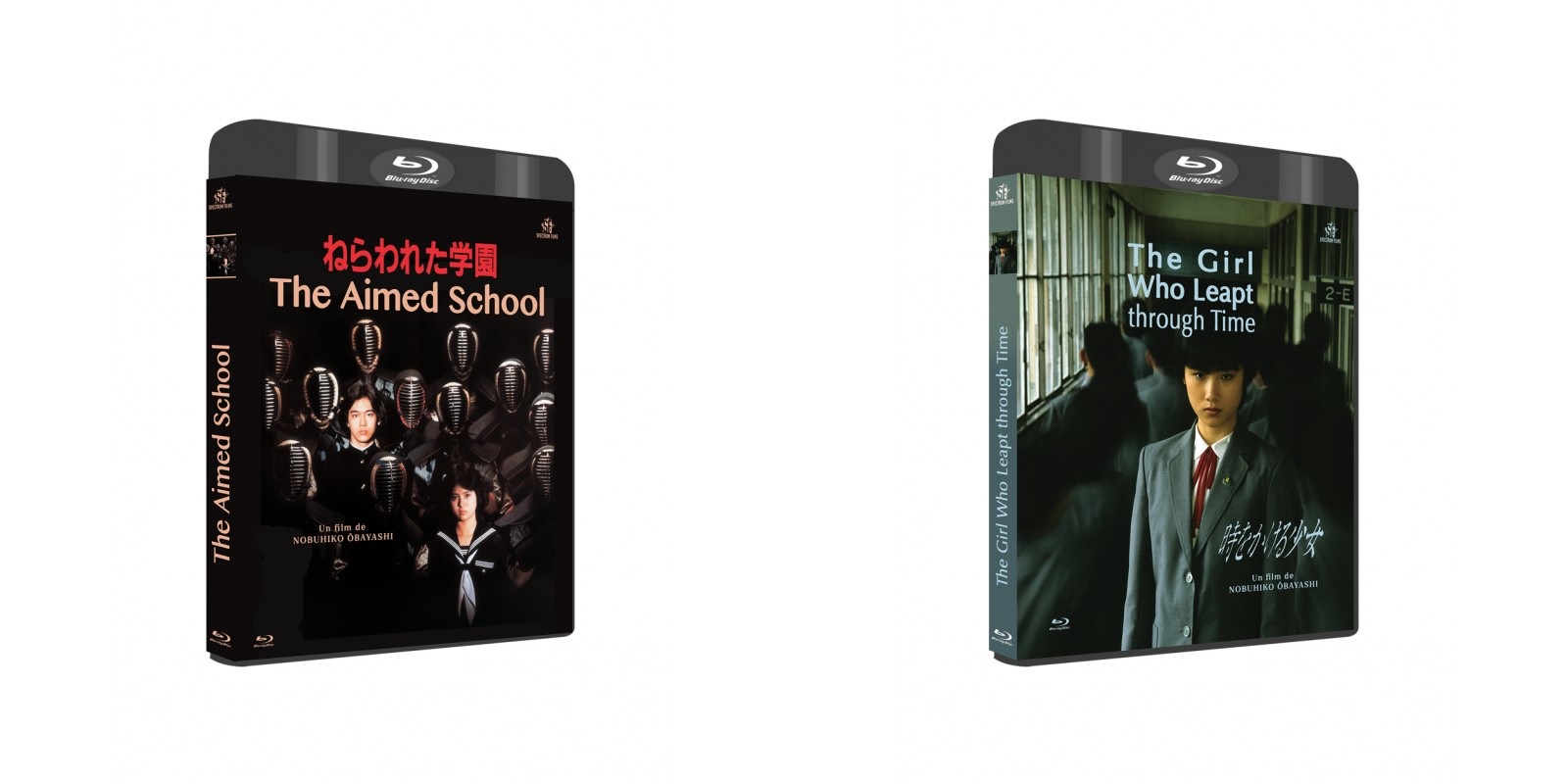
That is to say, Yoan Orszulik- a contributor at Monsieur Bobine and Furyosa- has recently informed me that France-based distributor Spectrum Films is going to release two(!) Nobuhiko Obayashi’s features on Blu-Ray.
The titles in question are School in the Crosshairs (a.k.a The Aimed School) and The Girl Who Leapt Through Time. I have already reviewed both films because these were released in the UK by Third Window as part of a limited release boxset. Consequently, it is a bit sad that we are not going to get new Obayashi’s titles in Europe this year, but if you missed the Third Window collection set, then you still have the chance to get two titles which Obayashi made for the Kadokawa company.
In addition, it should be emphasised that School in the Crosshairs and The Girl Who Leapt Through Time are going to be released separately, not as a dual disc package. Therefore, you need to prepare your wallet for possible extra shipping costs. With regard to releases themselves, you can read the official info on the distributor’s site.
It appears that the movies are going to have classic theatrical covers with English as well as Japanese titles on the front. As for the special features, I am not fluent in French but it is easy to infer from the description that some (if not many) bonus materials are going to be the same as the ones from the Third Window set. Nevertheless, Yoan Orszulik and Aurélien Gouriou-Vales from Monsieur Bobine did manage to prepare two original interviews.
There is no information about English subtitles on these releases, so it is safe to assume that we can only expect French translations. The movies are going to be available on the 19th of October, so basically next week. Below, you can watch the original trailers.
«Enjoyed this post? Never miss out on future posts by following us»
Poisson d’Avril; or, Manic Dinner A long time ago, the new year began on April 1st. On that day, people would play little jokes on each other, known as poisson d'avril. That was how April Fools' Day started. Eventually, a custom developed where people would exchange chocolate fish... This particular week I was in the mood for some kind of light-hearted motion picture, so I decided to follow a MDL recommendation made on the feeds a couple of months ago by @kura2ninja. The original suggestion centered on the 1986 romantic comedy film Poisson d’Avril directed by the late Nobuhiko Obayashi and starring the late Yukihiro Takahashi in the leading role. I admit that I missed out on this movie while preparing my guide devoted to Obayashi last year, but I do not feel disappointed that I finally watched this little gem cooked up by one of my all-time favourite directors.
Language: JapaneseOriginal Title: 四月の魚 Runtime: 109 min
Synopsis Shohei Nemoto (Yukihiro Takahashi) used to be a prolific movie director who unfortunately made a box-office bomb and was unable to get a filmmaking gig since then. He is married to Fujiko Kinugasa (Miyoko Akaza), an extremely popular actress who plays lead parts in dramas alongside handsome idols. All of a sudden, Shohei receives a letter from the South Seas where he shot a commercial. A good friend of his, Chief Panapora (Tetsuro Tanba), is coming to Japan. Shohei sees this as an opportunity to pitch a movie idea to an influential friend, but he remembers that he is obliged to fulfil a controversial promise so as not to offend the Chief. In order to fool the Chief, and protect the dignity of his wife, Shohei hires a young actress Mari (Kyo Kanoko) to “play” Mrs Nemoto for one night…
The Name of the Candy I have to say that I was a bit wary of the movie at first because of its absolutely distasteful theatrical poster, which gives you an idea that this is going to be a kinky and NSFW comedy. However, Nobuhiko Obayashi actually made an enjoyable comedy of mistakes very much in the style of good old French productions, such as Jean Girault’s Pouic-Pouic (1963) and Éduoard Molinaro’s Oscar (1967). Poisson d’Avril is, indeed, a witty farce that ridiculous celebrity lifestyle, but also poignantly examines the value of marriage and happiness between spouses.
The screenplay written by Obayashi, James Miki, and Tadashi Naito obviously provides the viewers with a much-needed dosage of slapstick humour and over-the-top crazy situations. Nevertheless, it is the execution of the whole thing that turns the film into an enjoyable and delightful experience. Even though the locations are mostly indoors, and the aspect ratio is a simple 4:3 full frame presentation, I can’t help but love the cinematography in this film. Shohei’s house is shot so beautifully and with vibrant colours, especially the kitchen and the living room. There is not a single scene in the film where the setting is bland or makes you feel bored.
What is more, Obayashi’s editing really spices up the wacky tone of the film. When there is some heated situation going on, some sense of urgency involving the main character, Obayashi resolves to the usage of not only quick cuts, but also of rudimentary time lapse to make events go even faster! In addition, similarly to House (1977), the director also extensively uses sound effects during slapstick moments, almost as if playfully winking at the audience, reminding them not to treat the plot all too seriously because it is a comedy after all.
Now, we get to the nitty gritty of Poisson d’Avril, the late Yukihiro Takahashi. Enthusiasts of Japanese culture obviously know that this man was a prolific musician, a pioneer of Electronic Pop, and the lead vocalist of Yellow Magic Orchestra. It makes me all the more sad that Yukihiro had not had a blooming acting career after Poisson d’Avril. The man steals every scene he is in, and many of his exaggerated facial expressions (*cue PTSD flashbacks to his South Seas visit*) are so darn funny!
His performance in the film clearly demonstrates that he could do comedy as well as drama. Perhaps he got too worried and shied away from the acting spotlight, because rumour has it that Yukihiro got ulcer and did not participate in the film’s official premiere press conference. Apart from Poisson d’Avril, he appeared in episodic roles in The Island Closest to Heaven (1984), Norwegian Wood (2010), and Labyrinth of Cinema (2020).
What is more, Yukihiro Takahashi also helmed the soundtrack in the film which is a joy to listen to and it truly alleviates the mood of the story, starting from the main theme and finishing on long-ish segments of incidental music. Some bits and pieces of the latter actually reminded me of Ryuichi Sakamoto’s compositions for The Last Emperor (1987). I guess it goes to show that great minds from YMO think alike.The original soundtrack was released in limited edition on vinyl in 2022.
With regard to other performances, Kyo Kanoko appears in her debut role as Mari and she has a wonderful onscreen chemistry with Yukihiro. Obayashi’s regular, Miyoko Akaza, brilliantly plays the egocentric and overbearing wife who, nonetheless, cares deep inside about her marriage. Wakaba Irie has a supporting role as the wife’s assistant, and she provides a lot of comic relief in the middle section of the film. Tetsuro Tanba basically plays himself as the crazy tribal guy who speaks broken Japanese and French. There are also cameo appearances done by James Miki, Toru Minegishi, and Nobuhiko Obayashi himself.
One word about the availability of the film: I was unable to include it in my guide last year because I tried (and still try) to watch Obayashi’s films as legally as possible. Unfortunately, this movie is completely unavailable anywhere, so the only means to watch it are (sadly) present online. I sincerely hope that this gets a proper release someday either on a streaming platform or on physical media. We need to get Obayashi’s movies out of the copyright hellhole of obscurity. Do not get me wrong, I appreciate the struggle of Obayashi’s fans to find his lost movies and translate them to English, but we have to stop illegal streamers who rob fansubbers from their hard work and profit from it.
Recommendations If you want to watch an unconventional comedy with the great Yukihiro Takahashi, awesome music, and a touch of romance, then I recommend Poisson d’Avril. It is definitely a feel-good movie with a heart-warming ending that will leave you uplifted. My thanks go to Nobuhiko Obayashi and his unlimited versatility that allowed him to craft such a nice romcom.
Overall score: 8/10
«Enjoyed this post? Never miss out on future posts by following us»
School in the Crosshairs; or, All of Us Are Aliens Stars...you can see so many stars in this universe. Welcome to the concluding part of my journey through Nobuhiko Obayashi’s Kadokawa productions, which were recently released by Third Window Films. I realise that School in the Crosshairs is chronologically the first movie which Obayashi made for the idol-centered studio, but I saved this review for the last course because it is my least favourite one of the bunch. Without further ado, let’s jump into the discussion.
Language: JapaneseOriginal Title: ねらわれた学園 Runtime: 90 min
Synopsis Yuka Mitamura (Hiroko Yakushimaru) is a middle school student who suddenly discovers that has psychic powers. Nevertheless, another girl called Takamizawa (Masami Hasegawa), obviously being under the influence of a mysterious intergalactic being, also displays psychic abilities, and uses them to impose a military regimen at school. Yuka stands in defence of oppressed students, and humanity on the whole. She has to face off against a villainous creature from Venus known as Kyogoku (Toru Minegishi).
The Psychic Club Allow me to clarify right off the bat that I consider School in the Crosshairs to be my least favourite Obayashi movie made for Kadokawa, but it does not mean I dislike it. Given the circumstances, the budget, the idol cast, and the source material (a novel by Taku Mayumura), the director gave his best effort to make a fantasy movie, which touches upon some very important themes.
The problem with School in the Crosshairs is that the pacing is erratic and the themes in question are not entirely fleshed out. The alien invasion, which subsequently results in a radical change of school life, echoes Obayashi’s own childhood during World War II, when he was constantly indoctrinated by imperialist propaganda about the might of the Japanese Empire. Interestingly, Mitamura and her colleagues’ personal struggles at school can serve as a metaphor for the so-called “juken jikoku” phenomenon; that is, “exam hell” in Japan.
Needless to say, Obayashi deeply criticises in his story the herd mentality and favours independent action. This culminates in the bombastic finale filled with outstanding visual extravaganza, in the course of which Mitamura single-handedly fights off against an alien invader who turned her friends into mindless drones. The heroine manifests her objection against not only brainwashing, but also the modern conditioning of students to blindly follow authority and the educational system.
Consequently, I appreciate the messages which Obayashi tried to convey in this motion picture, but these are unfortunately hidden under layers of composite shots and rotoscope animation, which to date make an impression on the Western enthusiasts of Japanese Cinema, but also steal away that antiwar sentiment which Obayashi was so keen on putting in his movies since House (1977).
With regard to performances, School in the Crosshairs marks the first (and the last) time when Obayashi worked with the idol gem of Kadokawa studio: Hiroko Yakushimaru (before her big breakthrough with Sailor Suit and Machine Gun). Hiroko does a great job as the female lead, and I dare to say that she would have been a better fit to play the heroine in The Island Closest to Heaven than Tomoyo Harada. (Interestingly, Harada played Yakushimaru's part in FujiTV's drama adaptation of School in the Crosshairs). Ryoichi Takayanagi’s appearance as the love interest is a given because this is in a Kadokawa movie after all, and the actor is just there, nothing more, nothing less. However, my words of praise go to Masami Hasegawa for playing the villainous student, and the always-wonderful Toru Minegishi for appearing as the boss villain.
Recommendations All things considered, if you want to experience a bizarre mash-up of teenage romance and fantasy, then I recommend School in the Crosshairs. The Third Window release has such bonus features as an original theatrical trailer, selected audio commentary by Aaron Gerrow, and translation notes by Owen Baron.
Overall score: 7/10
«Enjoyed this post? Never miss out on future posts by following us»
The Island Closest to Heaven; or, Let’s Go to the Beach See this river? If you follow it all the way out, it leads you to the sea. If you keep going, way to the south, all the way to the other side of the world, there’s a small island made of pure white coral. That is the island closest to where God is in heaven. I continue my journey through Obayashi’s Kadokawa productions, this time with The Island Closest to Heaven from 1984, yet another Tomoyo Harada vehicle, based on an autobiographical book authored by Morimura Katsura.
Language: JapaneseOriginal Title: 天国にいちばん近い島 Runtime: 102 min
Synopsis When Mari Katsuragi (Tomoyo Harada) was a little girl, her father told her about an island far to the south where it is always sunny and warm. It was the island closest to heaven, and the father promised Mari that they would visit it together. After the father’s passing, Mari declares to her mother that she is going to search for the island on her own. She goes to New Caledonia where she meets a whole bunch of idiosyncratic natives and Japanese immigrants who will make an impact on her life.
Safe Space I would say that The Island Closest to Heaven is the first unusual filmmaking endeavour for Obayashi because it does not have an avant-garde storyline or fantasy/horror elements. The film is primarily an introspective, soul-searching journey of the main heroine who makes her first steps into adulthood.
I would not call this a Bildungsroman in and of itself, but rather a slice-of-life evaluation of the Japanese immigrant experience within the French territory of New Caledonia. Indeed, Obayashi populates the story with many people deriving from different backgrounds and age groups. Mari finds herself particularly torn in between two men, a young “local” Taro (Ryoichi Takayanagi) and an elderly tour guide Yuichi (Toru Minegishi). She goes through teenage love in the first relationship, but Yuichi’s heartbroken past (which Mari glues back in the finale) teaches her that there is still much more to experience in life.
The juxtaposition between the indigenous people and the Japanese immigrants done by Obayashi is also interesting. Mari, in the course of her journey experiences disappointment after disappointment, failure after failure. The Japanese settlers to whom Taro belongs reject Mari because they perceive her as an outsider: “You shouldn’t fall in love with a tourist. You’ll end up being lonely,” Taro is warned. However, the natives unconditionally rush to the rescue and save Mari suffering from fever. This marks her rite of passage into an adult woman.
In addition, Mari’s relationship with a Japanese widow who visited New Caledonia to pay respects to her deceased husband is also intriguing. One would expect the widow to behave in a restrained and conservative manner, but her character (as expected from Obayashi) is suffused with sentimentality, and she advises Mari that “Life is not long. You need to be unreasonable sometimes.” This stands in stark contrast with the behaviour of Mari’s travel colleague Fukuko (Maiko Ogo) who carelessly consumes alcohol and hunts in the hotel poolside for prospective French boyfriends.
With regard to performances, Tomoyo Harada provides a decent performance as the female lead, but I preferred her more assertive modus operandi as depicted in The Girl Who Leapt Through Time. Ryoichi Takayanagi does a better job this time round as the love interest, but his delivery of lines is still off. Toru Minegishi is outstanding in the supporting part and a true highlight of the motion picture.
Recommendations All things considered, this is one of the Obayashi films to which I fondly come back just to revisit the tranquil ambience. Thanks to the wonderful cinematography helmed by Yoshitaka Sakamoto and the peaceful, orchestral music score composed by Tomoyuki Asakawa, The Island Closest to Heaven feels like a classic Hollywood picture from the 1930s but suffused with vibrant colours and breathtaking locations. The Third Window release of the film contains such bonus features as an original theatrical trailer, an audio commentary by Samm Deighan, and a video essay called “Obayashi - Femininity in Transition” by Robert Edwards. My only complaint is that the theme of the essay would have been more fitting for the potential discussion of The Girl Who Leapt Through Time.
Overall score: 8/10
«Enjoyed this post? Never miss out on future posts by following us»
His Motorbike, Her Island; or, Crazy Thunder Road 2: Love Warrior She was there from one summer to the next. She became my story. I press on with my mini-marathon through Obayashi’s Kadokawa endeavours. This time, I am focusing on his 1986 bosozoku-centered picture called His Motorbike, Her Island, based on a romance novel by Yoshio Kataoka, with Riki Takeuchi and Kiwako Harada in the leading roles.
Language: JapaneseOriginal Title: 彼のオートバイ、彼女の島 Runtime: 90 min
Synopsis Koh Hashimoto (Riki Takeuchi) is a young, rebellious student who after a failed romance goes on a bike ride through a rural town on an island, and meets a carefree girl Miyoko Shiraishi (Kiwako Harada). Gradually, a relationship forms between the two, but Miyoko gets increasingly drawn to the bike…
Speed Our Destination The bosozoku subculture was truly at its peak in Japan of the 1980s, making forays into such domains as literature, manga, anime, television, and of course cinema. Undoubtedly, Sogo Ishii’s Crazy Thunder Road (1980), which was already discussed on this blog, serves as the best example of a film that depicted this phenomenon, but also took it to another level in aesthetic terms. It comes as no surprise that Nobuhiko Obayashi dipped his toes into the popular genre as well.
Although His Motorbike, Her Island is not as wacky as Crazy Thunder Road, I dare to say that Obayashi’s film functions very much like its companion piece. What makes His Motorbike, Her Island stand out from a whole slew of numerous bosozoku flicks is the fact that Obayashi for the first time in his career tells an essentially failed romance story. Koh is a social outcast, whereas Miyoko is just a rural girl. One would expect a passionate romance to catch on fire between the two, but it is only a dream, an illusion Miyoko at one point says to Koh: “In Shinshu… When I saw you on top of that Kawasaki, I was so jealous… I envied that Kawasaki. I wanted to ride it myself. And I wanted to be loved as much as that Kawasaki.”
Obayashi explores the unlikely romance through monochromatic shots as well as vividly colourful ones, blurring the lines between a dream, a memory, and reality. What makes the story more interesting is that it is told through the perspective of now adult Koh, which is an indication that he eventually matured, and we, the viewers, relive the glory days together with him. Nevertheless, the conclusion of the tale is unnerving to say the least. Allow me to refrain from giving away any major spoilers, but let me just say that Obayashi presents us with a seemingly bittersweet ending, but at its core, it is deeply heartbreaking.
With regard to performances, if you had not known that piece trivia, His Motorbike, Her Island is the debut appearance of the legendary actor Riki Takeuchi. Indeed, he has a dominating presence as the male lead, but one should also appreciate the youthful gentleness and vulnerability which he displays in this picture. Kiwako Harada is without a doubt memorable as Miyoko, but I would not call her the most assertive Obayashi heroine out there. Truth be told, her character is independent but lost at the same time. My praise also goes to Noriko Watanabe and Tomokazu Miura for appearing in the supporting parts.
Recommendations I really do not want to use the word “esoteric”. I guess ethereal would be more suitable for His Motorbike, Her Island. Indeed, I appreciate the film for its ethereal ambience and the wonderful riding sequences through urban cityscapes as well as rural landscapes. It is yet another beautifully crafted picture by Nobuhiko Obayashi. The Third Window release of the film contains such bonus features as an archival interview with Nobuhiko Obayashi, an audio commentary by Tom Mes, and an original theatrical trailer.
Overall score: 7/10
«Enjoyed this post? Never miss out on future posts by following us»
The Girl Who Leapt Through Time: or, Lavender Day The fruit of love is at the bottom of the sea. The sky's sigh has turned into stars. It takes millions of years for people to meet. It’s Obayashi time on this blog again. I finally manage to sit down and revisit four films of the late master, which were recently released in a limited boxset by Third Window Films. Allow me to start my revisitation with Toki o Kakeru Shōjo, or, using the English title, The Girl Who Leapt Through Time from 1983 with Tomoyo Harada in the leading role.
Language: Japanese Original Title: 時をかける少女 Runtime: 104 min
Synopsis Meet Kazuko Yoshiyama (Tomoyo Harada). She is an ordinary girl and an average student at a local high school. She is a good friend of Goro Horikawa (Toshinori Omi), whom she has known since childhood, and also of Kazuo Fukamachi (Ryoichi Takayanagi). After a sudden accident while cleaning the science lab, Kazuko discovers that she has the power to travel in time. Little does know that her extraordinary ability is linked to the boy she falls for, Fukamachi.
If I Could Turn Back Time Let me say right off the bat that The Girl Who Leapt Through Time is often unfairly labelled among Western viewers as Obayashi’s take on the Groundhog Day (1993) formula. In my opinion, this is more of a consequence of Yasutaka Tsutsui’s original novel's premise rather than of misinterpretation of the movie adaptation. Indeed, many Obayashi’s films made in the 1980s were based on some kind of external source material, be it a book or a manga series, but regardless of the story constraints, the auteur director always managed to leave his personal imprint on the subject matter, and The Girl Who Leapt Through Time is no exception from this.
To be specific, rather than reliving the same day over and over again, Kazuko finds herself unwittingly jumping between various points of her life. She literally “cuts through time” as the alternative English title suggests. Personally, I regard this approach as quite refreshing because Obayashi does not make “time travel” as the main MacGuffin or the axis that drives the action forward. Kazuko’s ability serves as the lead-in for discovering her love for Fukamachi. Therefore, the movie is first and foremost a teenage romantic drama suffused with sentimentality and otherworldly strangeness (keep an eye out for The Wizard of Oz easter eggs in the film).
If I were to choose another Obayashi film that is stylistically similar to The Girl Who Leapt Through Time, it would have to be The Visitor in the Eye (1977) because the cinematography as well as the thoughtful usage of music goes hand in hand in both pictures. However, in the case of The Girl Who Leapt Through Time, Obayashi manages to employ his full on visual bizarness in the final act. The stop-motion spectacle as Kazuko travels through time and space is a true invasion of the spectator’s senses, in a positive way of course.
With regard to performances, if I am not mistaken, this is the first instance when Obayashi collaborated with the idol actress Tomoyo Harada (She went on to appear later in The Island Closest to Heaven, Kenya Boy, and Samurai Kids). In my opinion, out of all her appearances in Obayashi’s films, Harada gives her best performance in The Girl Who Leapt Through Time. She gives off the vibe of an innocent girl with pure intentions who is not too egotistical or absent-minded. I have to say that she had a great onscreen chemistry with Obayashi’s regular, Toshinori Omi.
The same, unfortunately, cannot be said fot Ryoichi Takayanagi who plays the main love interest. His delivery of lines is wooden and off-putting to say the least. Still, it did not discourage Kadokawa from utilising the young actor in Obayashi’s other productions cooked up for the studio. In terms of supporting parts, it is great to see Ittoku Kishibe and Wakaba Irie.
Recommendations If you are looking for a peaceful and unpredictable coming-of-age drama, then I recommend The Girl Who Leapt Through Time. The Third Window limited release of the film comes with such bonus features as an archival interview with Nobuhiko Obayashi, a featurette devoted to Tomoyo Harada, a music video, and an original theatrical trailer. Out of the many adaptations of the original novel, this is the best one.
Overall score: 8/10
«Enjoyed this post? Never miss out on future posts by following us»
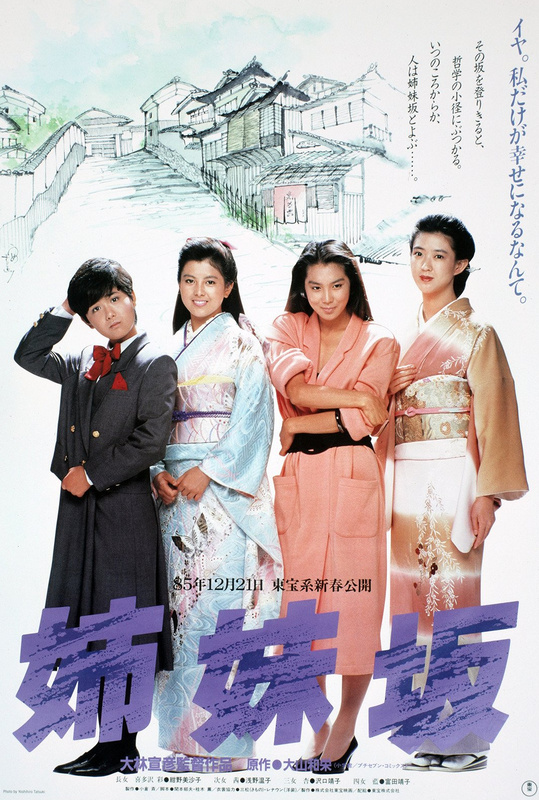
Four Sisters; or, Bildungsroman: The Movie My dear sister. You've done nothing wrong. Not wanting to let her go shows that you've really taken up the role as her mother. The year 2022 is slowly but surely nearing its end. A lot of stuff has happened to me personally, but in terms of movies, the running theme through many months was the filmography of Nobuhiko Obayashi. From Third Window’s Anti-War Trilogy release to their recent Kadokawa Years boxset, I have been fuelled by a desire to discover the idiosyncratic grandeur of this auteur filmmaker. As some of the blog readers already know, the result of my deep dive became An Ultra Fan’s Guide to Obayashi Nobuhiko. However, I believe there is still more to be said about this particular director and his movies. To be specific, I would like to talk about one of his motion pictures which is calm, romantic, and deeply melancholic. That is, Four Sisters, a perfect fit for a windy Autumn evening.
Language: JapaneseOriginal Title: 姉妹坂 Runtime: 101 min
Synopsis Meet the Kitazawa family. Four sisters: Aya (Misako Konno), Akane (Atsuko Asano), Anzu (Yasuko Sawaguchi), and Ai (Yasuko Tomita) live in their parental household in Kyoto. Two high school friends, Ryo (Toshinori Omi) and Togo (Ichirota Miyakawa) compete against each other to win the heart of Anzu, which sets in motion a chain of events in the course of which the sisters discover that they are not related by blood. Each sister will have to cross into adulthood on her own terms, facing hardships and real-life drama along the way.
Shoujo Magic I have to say that Four Sisters does not get a lot of recognition among Obayashi fans because it is not (for lack of a better word) “Obayashi-enough”. There are no vampires, evil children, or pianos that eat people. Four Sisters is what the title suggests: a story about four sisters. The editing itself and Obayashi’s visual stylistics are quite reserved indeed, but it does not mean they are totally absent. Obayashi divides the film into three separate chapters which, thanks to director’s wit and perceptive eye for details, function as memoirs taken straight out of a photo album. In fact, the beginning and end of each section are reminiscent of Polaroid photographs.
There is not a lot of information about the film online, but it seems clear that after Obayashi’s successes at Kadokawa with such movies as School in the Crosshairs (1981), The Girl Who Leapt Through Time (1983), and The Island Closest to Heaven (1984), the Toho Studios wanted to profit from the emerging trend of idol eiga, so they brought the director on board, gave him a shoujo manga called Shimaizaka to adapt, and showered him with their most promising pop stars they had at that time.
Evidently, as usual throughout the 1980s, Obayashi did his magic and put a personal spin on the source material while trying hard to bring out the best performance out of the leading ladies. Consequently, Four Sisters is a compelling coming-of-age drama. It is a story about growing up and finding love as well as inner peace, but certainly not in a conventional way.
Common criticism of the film is that it is too short and some of the subplots concerning the titular four sisters are not greatly elaborated upon. In my opinion, Obayashi was not going for a three-hour epic, but he wanted to create this bildungsroman-like ambience done in the style of the Brontës’ novels. Consequently, the movie is not so much about the exposition but about emotion: motherly love for a child, and longing for a loved one.
This aspect takes me back to the issue of visuals and editing. As I stated previously, Obayashi does not use fast cutting, different frame rates, or a mix of coloured scenes with black-and-white ones. In Four Sisters, when Obayashi wants to convey something intimate, he places a character in front of a camera and uses a really big close up. When he wants to get an unnerving feeling, he plays with the geography of a scene, changing a character’s position in a conversation (see Akane’s medical appointment).
What is more, Obayashi presents us with truly outstanding cinematography. Each and every scene: the framing of characters, their placement within glorious outdoor settings, all of it has meaning! To me, some of the shots like, for example, Akane crying over her mother’s grave, Anzu dancing, or Ryo standing near a stream next to a hospital, are just absolutely breathtaking.
Speaking of the performances, undoubtedly, each and every leading lady gets to shine on the screen, but the true show stealer is Atsuko Asano as Akane. Had the movie been made and released today, I am positive that she would have won an Oscar for her role of a bitter, yet deeply mature and sensitive sister. More words of praise go to Toshinori Omi who, in my opinion, delivered in Four Sisters his best performance out of all Obayashi films he appeared in. Omi no longer plays a sweet schoolboy but a real man who is head over heels in love with Akane.
Yasuko Sawaguchi, known from The Return of Godzilla (1984) does a great job as Anzu. Misako Konno is memorable and graceful as the oldest sister Aya; whereas, Yasuko Tomita is indeed noticeable as the youngest sister Ai. Tomita also played the leading part in Obayashi’s Lonely Heart which was released the same year as Four Sisters. In addition, a whole array of Obayashi’s frequent collaborators such as Yumiko Fujita, Wakaba Irie, Akiko Kitamura, and Toru Minegishi make short appearances as well. Four Sisters was also one of the first major pictures for actor Ichirota Miyakawa who played Anzu’s love interest, Togo.
Recommendations All things considered, I personally think that Four Sisters is Obayashi’s highly underrated masterpiece. In fact, allow me to say (write) a bit more. It is one of the few movies out there that actually made me cry. I am not ashamed to admit it. And I cried again as I rewatched it for the purposes of this review. I can only hope that sometime in the future the Criterion Collection of some other company will strike a deal with Toho and release this outstanding film on physical media in Europe and the US. There are so many Obayashi movies out there apart from House (1977) that people need to see!
Overall score: 10/10
«Enjoyed this post? Never miss out on future posts by following us»