Godzilla vs. Destoroyah; or, Highway to Hell First you come and see me to warn me not to make an Oxygen Destroyer. Now you want me to make one? Citing a popular proverb, all the good things come to an end, and this is also the case with my revisitation of the Godzilla Heisei series. I was a bit reluctant to write this review, especially in view of that fact that I still have conflicting thoughts about the Big G’s 90s swan song that is revered by the fans and considered to be one of the best Godzilla movies out there. Well, here it is, my review of Godzilla vs. Destoroyah.
Language: JapaneseOriginal Title: ゴジラ対デストロイア Runtime: 103 min
Synopsis 40 years after the detonation of the Oxygen Destroyer by Dr Serizawa that led to the annihilation of the original Godzilla in 1954, a species of tiny, prehistoric creatures emerge from the sea depths and wreak havoc in Tokyo. The United Nations Godzilla Countermeasures Center travels to Birth Island to monitor Godzilla and his son. It turns out that Godzilla’s heart is nearing a nuclear meltdown. In the meantime, the devilish creatures morph into an indestructible monster called Destoroyah. Hoping that Destoroyah would kill Godzilla and prevent the meltdown that would contaminate Japan, the authorities lure the Big G and his son to Tokyo for a battle against a hellish nemesis.
Animal I Have Become During the promotion of the film, the producer Shogo Tomiyama stated that Toho wanted to finish with Godzilla while he was still a star. Tomiyama explained that the studio wanted to end the series on a high note while they still had some good ideas. In my opinion, Godzilla vs. Destoroyah is an unnecessary entry in the Heisei series, and was made only as a “publicity stunt” (Ryfle 1998: 312) because Toho wanted to get more money out of the franchise before handing it over to Hollywood (see Ronald Emmerich’s 1998 remake).
Why Godzilla vs. Destoroyah is a publicity stunt? Well, from the get-go the studio marketed the movie with a gargantuan tagline “GODZILLA DIES”. They did not even care about the spoilers or the emotional impact of the story. Even the early teaser trailer harkening back to the original 1954 movie contained this premise.
To ensure decent box office returns, producers Tomoyuki Tanaka and Shogo Tomiyama essentially rehired the creative team behind the financially successful Godzilla vs. Mothra (1992); that is, director Takao Okawara, writer Kazuki Omori, composer Akira Ifukube, and F/X director Koichi Kawakita. As a result, on the technical front, the movie is a bombastic mash-up of kaiju fights and action sequences, but storywise, numerous characters and their erratic behaviour water down the gut-wrenching finale.
My biggest problem centres on the subplot concerning Miki Saegusa in this picture. In Godzilla vs. Destroyah, her story arc is essentially thrown out the window because she consciously agrees to put Godzilla Junior in danger, just so the Big G could get killed off. Of course, the whole plan fails miserably. It boggles my mind that Kazuki Omori came up with such an idea for a character that accompanied Godzilla for the previous five films.
Apart from this issue, the second act of the film is essentially a remixed version of Aliens and Jurassic Park as we see multiple, unformed Destoroyahs terrorising a journalist Yukari Yamane (Yoko Ishino) and going up against the military. In the meantime, the scientists continue to theorise over and over again about the Oxygen Destroyer and Godzilla’s nuclear meltdown.
Still, I have to praise the fact that Kazuki Omori tried to turn this Heisei movie into a direct continuation of Godzilla (1954). What is more, the special effects done by Koichi Kawakita are simply top notch across the board, especially in the film’s epic final battle. What is more, maestro Akira Ifukube goes all out in his final gig as the film composer and creates a truly captivating and enthralling music that accompanies Godzilla’s death.
I have to say that I saw the film for the first time on TV in the early 2000s and when I saw the King’s death I could not help but cry. “I want people to look at the death of Godzilla knowing that he was created by nuclear power and the most selfish existence in the world: mankind,” director Okawara explained, and indeed, he accomplished his intention (Ryfle 1998: 313).
It is without a doubt, a beautifully executed sequence. After the end credits rolled, I was genuinely convinced that I saw the all-time best Godzilla movie ever; however… this is the main problem with Godzilla vs. Destoroyah. The whole weight of wonderful visuals, emotional engagement, and paper-thin plot rests on this one absolutely magnificent sequence. Without it, and the scene that follows immediately after (no spoilers), Godzilla vs. Destoroyah would not have been held in such high regard as it is nowadays.
Recommendations All in all, as a grown-up Godzilla fan, I appreciate Godzilla vs. Destoroyah for what it is, but I think that this conclusion of the Heisei era was a bit forced by Toho. I prefer more optimistic take on the King of the Monsters as presented in Godzilla vs. King Ghidorah, Godzilla vs. Mechagodzilla II, and even Godzilla vs. SpaceGodzilla. Well, please stay tuned for more Toku reviews on the blog soon because I am going to finish my reviews of the Godzilla Millennium series and the Polygon anime trilogy as well.
Overall score: 7/10
«Enjoyed this post? Never miss out on future posts by following us»
Godzilla vs. SpaceGodzilla; or, Neon Genesis Crystals Godzilla, thank you for staying alive for me. After the successful release of Godzilla vs. Mechagodzilla II (1993), it seemed as if the Toho Studios were done and dusted with the franchise, but the troubling pre-production of the planned Hollywood remake resulted in delays, which encouraged producers Tomoyuki Tanaka and Shogo Tomiyama to press on with more Heisei instalments. Consequently, the year 1994 saw the release of the 40th anniversary Godzilla movie. To many fans, this is considered to be the black sheep and the lowest point in the series. Let’s dive deeper in to Godzilla vs. SpaceGodzilla.
Language: Japanese Original Title: ゴジラ対スペースゴジラ Runtime: 108 min
Synopsis After the disastrous battle between Godzilla and Mechagodzilla, the army develops a special combat robot known as Mogera. At the same time, G-Force works on a special T-Project which focuses on the supposed mental control of the Big G. Miki Saegusa (Megumi Odaka) works with Doctor Gondo (Towako Yoshikawa) on the project, but she is suddenly warned by the Cosmos (Sayako Osawa and Keiko Imamura) about the approaching danger from outer space. Suddenly, a giant object crashes on the Birth Island. It turns out to be SpaceGodzilla, a creature born out of Godzilla’s cells which ended up in a black hole after the King’s fight either with Biollante or Mothra. SpaceGodzilla imprisons Baby Godzilla and rushes to Fukuoka. Enraged King of the Monsters follows the alien invader in hot pursuit.
Event Horizon It is clear from the get-go that Godzilla vs. SpaceGodzilla is different in terms of its narrative approach and stylistics than the preceding movies. This stems from the fact that the film was directed by the late Kensho Yamashita and written by Hiroshi Kashiwabara. Both filmmakers were more experienced in teen idol flicks, but evidently, they were also Godzilla enthusiasts, having worked on the set of Terror of Mechagodzilla (1975).
Their approach to the Tokusatsu genre is more light-hearted in tone because they chose to focus not only on monster rumble, but human drama as well. For this reason, Megumi Odaka for the first time in the series becomes the main heroine with a love subplot(!) Indeed, this may seem surprising, but in my opinion, works in favour of the character and enhances her story arc.
Alas, it is not the end of human drama because director Yamashita introduces us to the Han Solo-like character of Major Yuki (played by too-cool-for-school Akira Emoto) who wants to hunt down Godzilla and to avenge the death of his friend Gondo (who died in Godzilla vs. Biollante).
On the monster’s side, the emotional payoff is taken verbatim from Godzilla vs. Mechagodzilla II. In Godzilla vs. SpaceGodzilla, the King again fights to rescue his son, saving humanity is just collateral damage. All in all, the cross-cutting of numerous subplots involving monsters and humans results in an extremely long and exhaustive third act of the film.
That being said, I do not dislike Godzilla vs. SpaceGodzilla. On the contrary, the film is my personal guilty pleasure and I will take it any day over Godzilla vs. Mothra or Godzilla vs. Destoroyah. I totally dig the romantic teen idol vibes with which Kensho Yamashita sprinkled this story. This is the only Godzilla movie in which you will get to see beautiful sunset cinematography by the seaside AND the King furiously obliterating his nemesis with the red radioactive beam.
With regard to special effects, these were once again handled by the series veteran Koichi Kawakita. It seems interesting because the F/X director changed his approach for the purposes of this movie as well. Godzilla vs. SpaceGodzilla has less overview shots, but more close-ups and POV shots, almost as if the filmmakers wanted the viewers to feel dragged in to the monster fight.
As far as the music is concerned, Akira Ifukube allegedly declined to return as the composer after reading the script, so the difficult task was given to Takayuki Hattori. This was the composer’s first Godzilla gig, and I must say I absolutely adore his soundtrack for the film. It is very low key, but so accessible and nostalgic at the same time. Definitely has the spirit of the 1990s.
Speaking about performances, Megumi Odaka is obviously the leading lady here, but I always love seeing her in a Godzilla film. Akira Emoto steals the show as the bitter soldier hellbent on killing Godzilla. Jun Hashizume does well as Miki’s love interest. Towako Yoshikawa’s onscreen beauty as Doctor Gondo cannot go unnoticed. The actress is primarily a model, so her delivery of lines sounds extremely conservative in many scenes.
Recommendations To me, this is a fun Godzilla movie. I understand why many fans avoid it, but I adore the different approach by Kensho Yamashita and the bombastic battle scenes. Honestly, I would not mind if this would have been the conclusion of the Heisei series, but this is yet to be discussed in my review of Godzilla vs. Destoroyah (1995).
Overall score: 8/10
«Enjoyed this post? Never miss out on future posts by following us»
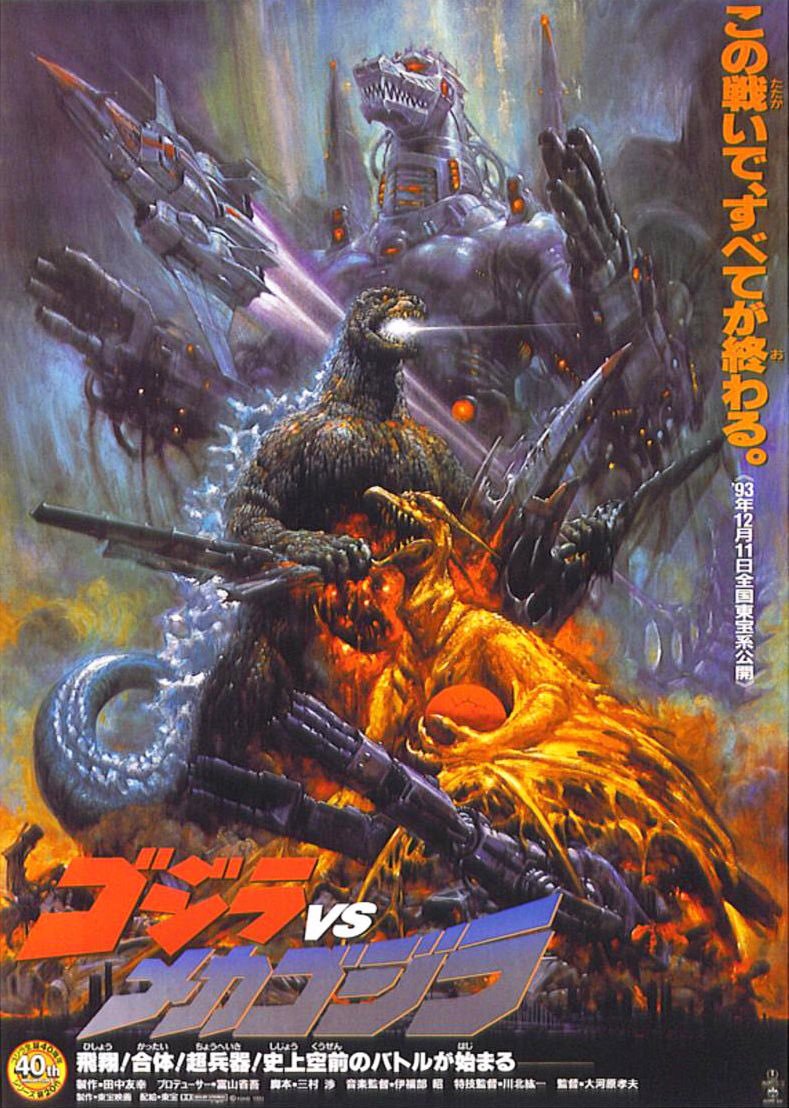
Godzilla vs. Mechagodzilla II; or, Superior Firepower The time has come to finally put our technology to the test. I continue to press on with my journey through the Godzilla Heisei movies. This time, I am focusing on the 5th movie of the series; that is, Takao Okawara’s Godzilla vs. Mechagodzilla from 1993. For clarity’s sake, I will be using the English title Godzilla vs. Mechagodzilla II throughout the review so as to differentiate this movie from the Showa series original made in 1974.
Language: JapaneseOriginal Title: ゴジラ対メカゴジラ Runtime: 107 min
Synopsis The United Nations came to the conclusion that they have to do anything in their power to stop Godzilla. For this reason, a special Godzilla Countermeasures Center was created. Their job was to utilise the futuristic technology from the remains of Mecha-King Ghidorah and create a technologically advanced robot that could surpass Godzilla’s might. The final outcome of this research materialised in the form of Mechagodzilla. In the meantime, the Japanese team of scientists on Adona Island finds an egg which gives off a telepathic signal that attracts Godzilla and Rodan. The two monsters rush to protect the contents of the egg, but the military sends Mechagodzilla to intercept them…
Natural Life vs. Artificial Life Immediately after the overwhelming success of Godzilla vs. Mothra, Toho greenlit another Godzilla picture. Initially, the producers were toying with the idea of bringing back the good old King Kong, but the studio no longer had the rights to the iconic creature. Consequently, the decision was made to pit the Big G against another classic foe, Mechagodzilla.
In contrast to previous films, Godzilla vs. Mechagodzilla II was not penned by director/writer Kazuki Omori. The screenwriting duties were given to a series newcomer, a major sci-fi buff, Wataru Mimura. The writer realised that writing a Godzilla project may be a one-shot deal for him, so he gave it his all in the screenplay by incorporating lots of action and providing the King of the Monsters with the much-needed dosage of pathos and character motivation.
Unlike the erratic shenanigans of Godzilla vs. Mothra, the Big G is no longer just an angry monster. Godzilla vs. Mechagodzilla II marks his progression from a force of nature to a loving parent because the film presents the viewers with Godzilla Junior! Initially, Takao Okawara was against the idea of bringing back Godzilla’s son, but I have to say the director handled all the sequences involving the creature perfectly. In addition, the design of Baby Godzilla is also extremely kawaii. What is more, the presence of the baby in the finale adds additional gravitas to the kaiju confrontation because viewers start to really root for Godzilla.
Speaking about special effects, these were once again helmed by Koichi Kawakita and all the heavy action scenes are top notch across the board. I am actually surprised that there are a lot of “beam fights” in this movie. Undoubtedly, the epic final battle must have served as direct inspiration for the culminating point of Godzilla: King of the Monsters (2019).
Thankfully, Akira Ifukube returned to compose a music score for the film, and his contributions are simply breathtaking. The main theme of Mechagodzilla is sombre and militaristic at the same time. It grabs your attention from the opening scene! The haunting chorus song accompanying Baby Godzilla is also a composition to be cherished.
With regard to performances, this time round Masahiro Takashima plays the male lead. He already had an experience with Tokusatsu flicks because of his appearance in Gunhed (1989). His presence does not have much impact on the story. To be honest, Ryoko Sano steals the spotlight as a scientist who looks after Baby Godzilla (played by suitmation actor Hurricane Ryu). Their scenes are easily the best in the film.
Evidently, the movie also features many Tokusatsu veterans, such as Akira Nakao, Koichi Ueda, Kenji Sahara, and of course Kenpachiro Satsuma as Godzilla. Megumi Odaka reprises her role as Miki Saegusa once again and her character has surprisingly a lot of stuff to do in this picture. Miki initially helps the team of scientists who are with Baby Godzilla, but the military actually forces her to help them neutralise Godzilla. It is quite an intriguing twist in the story arc of this particular heroine. There is even a deleted scene from the film in which Baby is afraid of Miki because of her psychic connection with the King.
When it comes to home media releases, the distribution duties of Godzilla vs. Mechagodzilla II were mainly handled by Columbia TriStar who produced their English dub for the film. Interestingly, Toho commissioned their own international translation in 1994, but this version is considered to be “lost”. Fragments of it were unearthed a few years ago through Hindi releases of the film, and snippets can be watched here.
Recommendations If you enjoy Godzilla’s monster rumble at its purest form, the I recommend Godzilla vs. Mechagodzilla II. Toho initially wanted to end the series with this movie, but they changed their mind in view of the delays concerning the American remake. I must say that Godzilla vs. Mechagodzilla II is a solid, action-packed entry of the Heisei era, but it would not be a strong enough conclusion of the series. What is more important, we would not get Godzilla vs. Spacegodzilla and Godzilla vs. Destoroyah (to be reviewed soon).
Overall score: 9/10
«Enjoyed this post? Never miss out on future posts by following us»
Godzilla vs. Mothra; or, For Mother Earth! There isn't a job that is too tough for me, except, the one time I was married to a real stubborn woman. I am back at my revisitation of Godzilla movies. This time, I would like to focus on the fourth instalment of the Heisei series, Godzilla vs. Mothra from 1992. This text is going to be actually a re-review, but I have already discussed this film on the blog years ago, but I felt that my initial reaction was too crude and too emotional. So here it is: my new thoughts on one of my least favourite Godzilla films.
Language: JapaneseOriginal Title: ゴジラ対モスラ Runtime: 102 min
Synopsis A large meteoroid crashes in the Ogasawara Trench and awakens Godzilla. An explorer Takuya Fujito (Tetsuya Bessho), his ex-wife Masako (Satomi Kobayashi), and a representative of the Marumoto company Ando (Takehiro Murata), go to the Infant Island and discover the hidden egg of Mothra which is guarded by two representatives of an ancient civilisation known as the Cosmos. They explain that thousands of years ago Mothra used to fight Battra, a monster created by the Earth’s ecosystem as a punishment for the Cosmos’ vanity. The team decides to transport the egg to Japan, but Mothra hatches while en route. What is more, it turns out that Battra got reawakened as well. With Godzilla thrown into the mix, all three monsters rush for a showdown in Yokohama.
Mothra Strikes Back As I have already mentioned in my review of Godzilla vs. King Ghidorah (1991), Toho had various plans for a follow-up, including making a direct sequel that would bring back the Big G’s arch-nemesis once again. However, special effects director Koichi Kawakita together with Minoru Yoshida and Marie Terunuma submitted a script called Godzilla vs. Gigamoth, which was inspired by an unmade Mothra vs. Bagan story. In its essence, the basic storyline is very similar to the final film, but the main difference is the fact that Godzilla fights an amalgam of a good Mothra and evil Mothra in the finale. It is unknown whether the series veteran Kazuki Omori read the script for Godzilla vs. Gigamoth or maybe he based his premise on Mothra vs. Bagan, but under the supervision of producer Tomoyuki Tanaka he penned his own screenplay that was ultimately filmed.
It is clear from the get-go that Toho wanted to cater to as many groups of cinema-going audiences as possible. Women constituted the majority of moviegoers in Japan in the mid-1990s, so it goes without saying that bringing back Mothra was a logical decision. However, the film also tries as hard as possible to be family-friendly: we get light action (see the first act being a rehash of Indiana Jones), parental conflicts, twin fairies (who are not actual twins) and an Oblivion NPC child who struggles to be kawaii in every scene.
Well, the strategy worked for Toho because Godzilla vs. Mothra turned out to be a massive box office success, basically financing the rest of the Heisei era movies. Nevertheless, this movie is not by any means decent. The pacing is uneven, the editing is jarring at times, and all the action reaches a standstill in the second act because there has to be room for family-friendly drama (Fujito actually tries to sell the Cosmos, but Mothra rushes to save them).
I believe the main cause of these issues is the direction done by Takao Okawara. Indeed, this man is an experienced director who worked with the best of the best, serving as an associate director on Akira Kurosawa’s and Kihachi Okamoto’s films, but in my opinion, Okawara fundamentally does not understand Tokusatsu action. He finds it hard to tell a compelling story with Kaiju monsters at the helm. All of his Godzilla films have grand finales, but the middle segments are frequently forgettable.
With regard to special effects and cinematography, Godzilla vs. Mothra is the film that has the best looking Heisei Godzilla. I just love all the close ups of the new BattleGoji suit worn by Kenpachiro Satsuma. What is more, Koichi Kawakita did an amazing job with the battles between Godzilla, Battra, and Mothra; however, the moves of the latter two monsters are a bit clunky at times. The underwater sequences are also great to look at.
Speaking about additional advantages, Akira Ifukube obviously delivers yet another brilliant music score as the film’s composer. Of course, he reuses and repurposes Yuji Koseki’s Song of Mothra from the original 1961 film, but this piece of music is so synonymous with the Queen of the Monsters that it is a given it accompanies her all the time.
With regard to performances, all the actors and actresses feel like a wasted opportunity. Tetsuya Bessho has a more commanding presence than Isao Toyohara from the previous film, but most of the time he is forced to play an Indiana Jones/Han Solo type of guy, which does not add anything to the film. The always-wonderful Satomi Kobayashi plays a bitter ex-wife and her character's objective is to either comment on the monster action or carry the Cosmos around in a special basket. Veterans of the series, such as Akira Takarada, Megumi Odaka, Akiji Kobayashi, and Yoshiko Tanaka do not have anything compelling to do apart from standing in front of giant monitors and observing the monster rumble.
Recommendations All things considered, I did not hate Godzilla vs. Mothra as much as I did during the first viewing. Still again, I regard it as a deeply flawed entry in the Godzilla franchise. The Big G deserved better and Mothra deserved better as well. Ultimately, she received better treatment in the Rebirth of Mothra Trilogy, and Millennium entry Godzilla: Tokyo SOS (2003).
Overall score: 6/10
«Enjoyed this post? Never miss out on future posts by following us»
Godzilla vs. King Ghidorah; or, There Can Only Be One I nearly died on Lagos Island, along with my entire Garrison, but the dinosaur saved us all. Now, all of that prosperity I built is now being destroyed by the same dinosaur at this moment, and there’s nothing I can do about it. Very ironic, don't you think? It has been a while since Godzilla, the one and only King of the Monsters, was discussed on this blog. In view of the recent release of Shin Ultraman and the news that Toho is actually making a new Godzilla movie, I am back in the Tokusatsu mode again and decided it would be fitting to finally come round and complete my reviews of all Japanese Godzilla flicks. A daunting task for sure, and some reviewers I follow and respect already undertook this endeavour, but still, I feel I should explore the heart of Godzilla on my own and provide my personal take on the nearly 70-year-old franchise. For this reason, I would like to talk today about my favourite Goji-movie of all time, especially in view of the recent passing of director Kazuki Omori; that is, Godzilla vs. King Ghidorah.
Release Info
Directed by: Kazuki OmoriStarring: Isao Toyohara, Anna Nakagawa, Megumi Odaka
Language: JapaneseOriginal Title: ゴジラ対キングギドラ Runtime: 103 min
Synopsis Tokyo, 1991. An unidentified flying object appears on the Tokyo skyline. The Japanese government is afraid that this may be an alien invasion, but it turns out that the mysterious visitors are people who travelled back in time from the 23rd century. They claim that in their time period Godzilla led to total annihilation of Japan, and the only way to stop the monster is to prevent its origin. A joint research team comprised of Emi Kanno (Anna Nakagawa), an android M-11 (Robert Scott Field), a freelance journalist Terasawa (Isao Toyohara), Dr Masaaki (Katsuhiko Sasaki), and Miki Saegusa (Megumi Odaka) jumps in time to the year 1944 and carries out the difficult task. Godzilla has been wiped out from existence, but his monstrous reign has been taken over by King Ghidorah. Now, humanity's only hope is to bring back the Big G.
Days of Future Past After the release of Godzilla vs. Biollante (1989), the Toho Studios found themselves in a slump with the series. According to Steve Ryfle’s book Japan’s Favorite Mon-star: The Unathorized Biography of Godzilla (1998), Godzilla vs. Biollante was the most expensive production of the franchise at the time of its making, but modest box office performance ultimately made the studio loose 3 million yen on the picture. After two (if counting The Return of Godzilla from 1984) so-so attempts to jumpstart the franchise, producer Tomoyuki Tanaka made a decision to appeal to the fans’ nostalgia. Therefore, Godzilla was to be pitted against his arch-nemesis from the Showa era, King Ghidorah.
Scripting and directorial duties were once again given to Kazuki Omori, the man who cooked up Godzilla vs. Biollante. However, this time Omori put less emphasis on the human drama. Instead, he cranked up the science-fiction aspect to the max, and also added his personal commentary on (or rather critique of) Bubble Era Japan’s international relations.
Godzilla vs. King Ghidorah is often regarded by fans and ordinary movie enthusiasts as the underwhelming entry of the Heisei series, primarily due to its convoluted plot concerning time travel. Steve Ryfle obliterates the movie’s plot in his book in a very shallow and condescending way, repeating many claims from viewers who did not pay attention while watching the film. In fact, if you watch the film while having fresh in mind the events of other Heisei series instalments, the events of Godzilla vs. King Ghidorah do make sense, and the film adds more context to the mythos of the Big G and his arch-nemesis in a very bold and straightforward manner that was only outmatched by the grandeur of the original Gojira (1954) and Shin Gojira (2016).
What I am getting at is that I love in this movie all the elements that are oftentimes perceived by critics of this film as campy: time travel, a Terminator-like android, countdown to a big explosion, Godzilla originating from a dinosaur, King Ghidorah originating from kawaii squishy Gremlin-like creatures called Dorats, Mecha-King Ghidorah. The list goes on! Godzilla vs. King Ghidorah is a wild, escapist fun that takes itself seriously only at certain places.
These places are obviously Omori’s own thoughts about the leading role of Japan on an international stage. The period of the 1980s indeed seemed as the time of Japan’s economic dominance, but this prospect was clearly gone with the wind by the year 1991. Omori not highlights the ever troubling issue of Japan’s resentment of nuclear weapons (Big G actually destroys a nuclear sub to regain his strength), but the director also underlines heavy preoccupation of the Japanese with rampant consumerism and lavish lifestyle, which may ultimately lead to disastrous consequences.
This is perfectly reflected in an emotional confrontation scene between Godzilla on the loose and a war veteran Shindo (now a prosperous businessman who took part in rebuilding Japan). This scene alone is a wonderful stand out in an entire franchise, which not only ties Godzilla to the people of Japan, but turns the monster into a token of warning against authority power and mindless accumulation of wealth (see Godzilla’s destruction of the Tokyo Metropolitan Government Building in the film’s finale).
Speaking about special effects, the practical stuff, miniatures, monster fights, and cell animation helmed by the late Koichi Kawakita are simply outstanding. The production design, especially of the Futurians’ ship, is beautiful to look at as well. One has to appreciate the dedication of the Toho team in the modern age filled with computer-generated images. What is more, Akira Ifukube himself was brought back to the franchise as the film’s composer after 16 years of break. I have already outlined my thoughts on Ifukube’s compositions in my series of blog articles last year, but allow me to say here that I adore the music score for Godzilla vs. King Ghidorah. Indeed, Maestro Ifukube may have reused a lot of old compositions, but these fit so well with this picture, especially the action themes reappropriated from Godzilla vs. King Kong (1962).
With regard to performances, Isao Toyohara does a decent job as the male lead. Megumi Odaka reprises her role of Miki Saegusa from Godzilla vs. Biollante. She already gained experience on the set of the previous film, so she perfectly knew how to react to monster fights that were added later in post-production. The late Anna Nakagawa is also memorable as Emi Kanno, the mysterious lady from the future who ultimately joins the good guys and becomes a pilot of Mecha-King Ghidorah. Robert Scott Field is a joy to watch as an android M-11 in action. The supporting role of Shindo played by Tokusatsu veteran Yoshio Tsuchiya is also a welcomed addition.
Contrary to some misleading info on the net, Godzilla vs. King Ghidorah did become a success at the Japanese box office and managed to reinvigorate an interest in the franchise. For a brief period of time, Toho even considered making a direct sequel to the film titled Counterattack of Ghidorah, but the plans fell through in favour of brining back another familiar monster from Godzilla’s lore (Mothra). Unfortunately, Godzilla vs. King Ghidorah was released on VHS and subsequently on DVD in the West with a crappy English dubbing that really sucked excitement out of the viewing experience. If you want to enjoy the film in its original, unabridged form, then you have to rely either on the Japanese DVD or Blu-Ray release.
Recommendations All things considered, I will never forget the time over 20 years ago when I sat down in front of TV and watched my first Godzilla movie: this movie. Godzilla vs. King Ghidorah may be bonkers to some, but still, it is positively charged with action and science fiction vibes. What is more, it is one of the few movies in the franchise that served as an inspiration for Godzilla: King of the Monsters (2019) blockbuster. The legacy of this Heisei era movie continues to live on. Please refer to an epic fan-made trailer below to experience the visuals on your own.
Overall score: 10/10
«Enjoyed this post? Never miss out on future posts by following us»


_Japanese_theatrical_poster.jpg)