Showing posts with label haruki murakami. Show all posts

Hanalei Bay (2018) [Film Review]

Hanalei Bay; or, Silent Grieving
     Being forgetful isn’t the problem. Forgetting is the problem.
At the moment, I am making my way through the movie adaptations of Haruki Murakami’s novels for the purposes of my upcoming editorial. I thought it could be a idea to slow my pace and focus in greater detail on one particular movie, which is Daishi Matsunaga’s Hanalei Bay.
Release Info
Directed by: Daishi Matsunaga Starring: Yo Yoshida, Nijiro Murakami, Reo Sano
Language: Japanese Original Title: ハナレイ・ベイ Runtime: 96 min
Synopsis
Sachi (Yo Yoshida) receives a phone call informing her that her son died in Hawaii due to a shark attack. The woman arrives in Hanalei Bay to take care of formalities and retrieve the ashes of her son. Nevertheless, Sachi continues to come back to Hanalei Bay every year…
By the seaside
One could think that Murakami purposely came up with the theme of a mother losing her son to tell a sappy tale centered on grieving, but the mother figure is an extremely bitter and self-reliant person who helps out two noob teenagers from Japan.
Director Daishi Matsunaga recreates the main plot points a T, but the reserved camerawork, stoic atmosphere, and the striking performance by the legendary Yo Yoshida are the factors that make this particular adaptation stand out to me. The third act is especially captivating as the viewers see a clear difference between the difficult past of the main heroine and the present stillness of the titular bay.
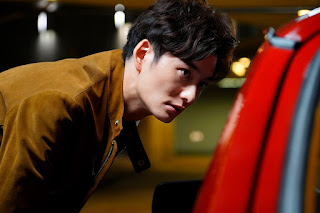
I have to say that the mother in the film is not simply bitter. She processes her feelings towards her unruly late son while becoming the mother figure to two Japanese surfers. Undoubtedly, the most touching scene is the one in a skate park, and it is an original addition not penned by Murakami at all.
With regard to performances, Yo Yoshida undoubtedly carries the weight of the film on her shoulders. Nijiro Murakami does well in the supporting role as one of the young surfers in need. Reo Sano is quite memorable as the son, in spire of the limited screen time. I also appreciate the fact that there is a lot of dialogue in English. Some viewers voiced their concerns about the delivery of lines by Yo Yoshida, but I think she did it very well, definitely better than Satomi Ishihara in Shin Godzilla (2016).
Recommendations
If you are looking for a tranquil feature that will make you reconnect with the lyrical loneliness, then recommend Hanalei Bay. Unfortunately, the film is unavailable on streaming platforms at the moment. However, the movie is making rounds as part of many film festivals (that’s how I watched it originally), and there’s also a Japanese DVD edition out there.
Overall score: 9/10
«Enjoyed this post? Never miss out on future posts by following us»

Drive My Car (2021) [Film Review]

Drive My Car; or, Depression: The Movie
     I like that car. I can tell it’s been treated with care. That’s why I also want to drive it with care. Let’s go.
I heard about Drive My Car movie for the first time when it started gaining awards at the Cannes Film Festival. It would have almost joined the line of “stuff I wanted to check out but forgot about it” had it not been for a summer movie festival in my country. I was lucky enough to check out the film, but it left me with mixed feelings. Consequently, I hesitated for a long time with this review, but well, here it is.
Release Info
Directed by: Ryusuke Hamaguchi Starring: Hidetoshi Nishijima, Toko Miura, Masaki Okada, Reika Kirishima
Language: Japanese Original Title: ドライブ・マイ・カー Runtime: 179 min
Synopsis
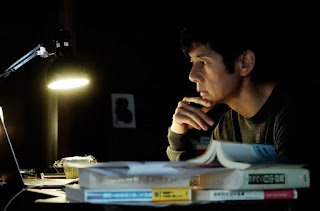
Yusuke Kafuku (Hidetoshi Nishijima) is a stage-actor who collaborates closely with his wife Oto (Reika Kirishima). One day, by complete accident, Yusaka discovers that Oto is cheating on him. He never confronts his wife about it, but the marital status quo is disrupted by her untimely passing. Two years later, Yusuke goes to Hiroshima in order to direct a multilingual adaptation of Chekhov’s play Uncle Vanya. However, the producers’ regulations prevent Yusuke from driving on his own. He gets assigned a special chauffeur called Misaki Watari (Toko Miura). While driving his car, Misaki learns about Yusuke’s ambiguous past.
A man without a woman
I have to be frank and say that my expectations for this film were enormous. Drive My Car gets praised time and time again across film festivals, it is an adaptation of Haruki Murakami’s short story, and on top of that the director of the film is Ryusuke Hamaguchi, the man who co-wrote Wife of a Spy (2020).
I have re-read the original short story before the screening, and the movie follows and greatly expands upon major plot points of Murakami’s work. I was all game during the prologue sequence, but when the opening credits hit at about the 40-minute mark, the storyline started going a bit downhill for me.
Please do not get me wrong, but I felt the prologue was meant to prepare the viewers for a massive catharsis, a grand journey in the course of which Yusuke will rediscover himself. Truth be told, I found the protagonist’s actions to be questionable. He goes to Hiroshima to do this super unconventional theatre play (which in itself adds tons of layers to the film’s storyline), but he hires an actor who slept with his wife (Masaki Okada). What was his motivation? To torment the guy? At least, that’s what Yusuke says in the short story, but it does not become transparent enough in the movie. Actually, Yusuke behaves like a depressed individual who enjoys being tormented by his wife’s lover.
Evidently, there is a big reconciliation scene between the two characters in the third act of the film, but this moment only made me realise how hard it is to adapt Murakami. The author frequently introduces exposition through conversation. In many of his short stories and even novels, we have two characters talking to each other, and in the course of this seemingly casual talk, the readers get to discover some major twist or a whole story. Hamaguchi’s Drive My Car lays out everything chronologically from beginning to the end, leaving little room for this Murakami-specific trope only towards the end of the film. Call me cruel, but I would have appreciated the movie more had the driving scenes looked more like this.
Well, this movie did not click with me, unfortunately. Nevertheless, I have to give justice to the cast and praise nuanced but powerful performances of Hidetoshi Nishijima, Toko Miura, and Masaki Okada. In addition, I have huge respect for production design and the titular car itself, which indeed felt like a separate character.
Recommendations
Out of all Murakami adaptations I have seen so far, I still like Burning (2018) best. Drive My Car deserves your attention in terms of how neatly it manages to handle performance art (a stage play, which makes the characters confront each other). All in all, it’s a film about lost love and an attempt to drive away from traumas of the past. I understand the growing popularity of this adaptation, but it is not a movie for everybody. It certainly was not for me.
Overall score: 6/10 
«Enjoyed this post? Never miss out on future posts by following us»