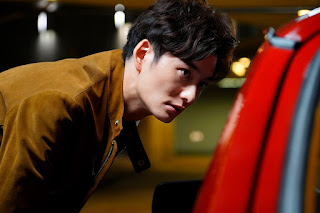
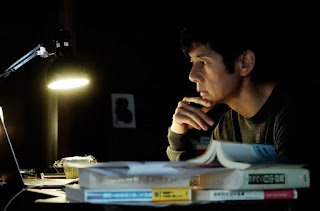
Showing posts with label cars. Show all posts

Shuto Kousoku Trial 3 (1991) [Film Review]

Shuto Kousoku Trial 3; or, Remember Me
     I'll race you anytime as long as it's on the track.
Shuto Kousoku Trial 3 is yet another entry in the popular racing series from Nikkatsu studio. Apart from being a sequel with the shortest runtime (barely 65 minutes), this movie is also known for being the debut flick of Reiko Takashima(!) Without further due, let’s buckle up and drive through the third movie about the legendary Shuto Expressway.
Release Info
Starring: Kazuhiko Nishimura, Reiko Takashima, Ikuo Fukada
Language: Japanese Original Title: 首都高速トライアル 3 Runtime: 65 min
Synopsis
Kyohei (Kazuhiko Nishimura) is a former holder of a record time run at Shuto Express. He retired from illegal racing and now works as a mechanic for Keiichi Tsuchiya’s racing team. Kyohei’s friend, Yusuke (Ikuo Fukada), still hits the street with his Nissan Silvia. One day, while practicing in the mountains, he is challenged by a mysterious driver in a Toyota Supra. Yusuke barely manages to survive the confrontation. Kyohei, on the other hand, witnesses a car accident while practicing in Skyline R32. This event makes him recollect a horrible accident from the past. He tries to persuade Yusuke to give up street racing; however, a friend takes up another challenge from Toyota Supra and dies during the race. Kyohei returns to Shuto Expressway in order to face off against the mysterious driver. It turns out that everything is connected to a tragic incident from the past...
Catch me, darling!
I have to say that Shuto Kousoku Trial 3 is by far the weakest entry in the series, but it is not by any means unwatchable. Evidently, the screenplay is just an excuse to get to car action, but the director interpreted this rule too literally. Consequently, what we have is a film with shoddy editing, only one City Pop song, and (potentially) the best storyline of the series that got lost in translation…
It feels as if well over 30 minutes of footage involving the characters ended up on a cutting room floor, so that there would be more space for decent racing sequences. Honestly, these are the only worthwhile aspects of the film. Interestingly, I could not understand the director’s decision to use only one (great) song: MAHARA’s Crying All Night; and then sync the rest or car action to random incidental music. This creative choice significantly tones down the viewing experience.
Still, I love the appearance of young Reiko Takashima as a journal writing about Keiichi Tsuchiya, and street racing in general. She provides the necessary charm and charisma, but her limited screen time is a big disadvantage. The screenplay constantly revolves around her character, and it is pretty obvious who she really is halfway through the film (no spoilers), yet Reiko is not given the chance to properly shine. All in all, it is a pleasure to see her in a non-drama role.
Additionally, maybe it is only my impression, but Keiichi Tsuchiya appears to be totally disinterested on the screen. He only shows up to repeat the message from the second film, do some cool drifting in R32, and that’s it. Personally, I think that he did much better as “the mentor figure” in Shuto Kousoku Trial 5 & 6.
Recommendations
I recommend Shuto Kousoku Trial 3 only for the cars and Reiko Takashima’s appearance. Subsequent entries in the series have learned a lesson from this sequel and tried to tell more compelling stories about the drivers chasing fortune and glory on the Shuto Expressway.
Overall score: 6/10
«Enjoyed this post? Never miss out on future posts by following us»

Shuto Kousoku Trial 2 (1990) [Film Review]

Shuto Kousoku Trial 2; or, Gas Gas Gas
     It's the best! With GTR nobody will beat me!
After the troubled release of the original Shuto Kousoku Trial movie in 1988, Nikkatsu studio did not back down, and this time, they joined forces with the Drift King himself, Keiichi Tsuchiya, and Toei’s V-Cinema line in order to continue the series in straight-to-video format. Shuto Kousoku Trial may be a production made on a smaller budget and in 4:3 aspect ratio, but it still manages to retain the spirit of the original movie.
Release Info
Directed by: Shuji Kataoka Starring: Daisuke Nagakura, Arthur Kuroda, Naomi Ashizawa
Language: Japanese Original Title: 首都高速トライアル 2 Runtime: 67 min
Synopsis
Takahiro Yamane (Daisuke Nagakura) is a street racer who looks up to Japan’s all-time best driver, Keiichi Tsuchiya. Takahiro’s friend/ex-mentor is Junichi Tashiro (Arthur Kuroda), the proud owner of Skyline R30 who dreams of getting a GT-R. However, he gives up racing in order to marry his girlfriend, Nozomi (Naomi Ashizawa). Sawaki (Minoru Toyoshima) is a hot-headed racer who wants to break records on the Shuto Expressway. As a result, he challenges Takahiro as well as Junichi...
Skyline GT-R
Shuto Kousoku Trial 2 seems to owe its existence purely to Keiichi Tsuchiya and its anti-street racing message. Whereas the original praised the glory of midnight car chases, the sequel puts up a giant warning sign saying that if you want to become a professional driver, then you have to abide by the law and hone your skills on a race track rather than a city street. However, the movie is not all about preaching because it provides the much needed dosage of car action set to the beats of City Pop.
The first film focused primarily on Skyline R30, but Shuto Kousoku Trial 2 presents us with Nissan R32, 300ZX, and Silvia, all battling each other in epic style. For this film, J-singer Saori Sato provided the songs (which were subsequently released on her album called Lady). Apart from her cameo appearance (as herself giving the main protagonist a mixtape with her best hits), we can also see her performances of All Eyes and Naga-denwa no ballad themes intercut with the chase sequences. You really can’t get more 80s than that.
Interesting is also the role of Keiichi Tsuchiya who basically plays himself and always appears in the film’s calmest moments, just to give a word of advice to the main hero. Similarly to Obi-Wan Kenobi, he says that a driver should trust his feelings (and refrain from participating in illegal races).
With regard to performances, I know that you can’t expect a lot from these sequels which had relatively unknown actors, but I particularly liked the performance of Minoru Toyoshima as a girl who is enthusiastic about her boyfriend’s passion for driving. The final scene in which she waves a checkered flag between two speeding GT-Rs is so beautifully done.
Recommendations
If you can’t get enough of speed chills from Initial D, Wangan Midnight, and The Fast and The Furious, then turn to the series that started it all. No racing franchise has yet managed to surpass the class and practical car action of the Shuto Kousoku Trial movies.
Overall score: 7/10
«Enjoyed this post? Never miss out on future posts by following us»

Drive My Car (2021) [Film Review]

Drive My Car; or, Depression: The Movie
     I like that car. I can tell it’s been treated with care. That’s why I also want to drive it with care. Let’s go.
I heard about Drive My Car movie for the first time when it started gaining awards at the Cannes Film Festival. It would have almost joined the line of “stuff I wanted to check out but forgot about it” had it not been for a summer movie festival in my country. I was lucky enough to check out the film, but it left me with mixed feelings. Consequently, I hesitated for a long time with this review, but well, here it is.
Release Info
Directed by: Ryusuke Hamaguchi Starring: Hidetoshi Nishijima, Toko Miura, Masaki Okada, Reika Kirishima
Language: Japanese Original Title: ドライブ・マイ・カー Runtime: 179 min
Synopsis
Yusuke Kafuku (Hidetoshi Nishijima) is a stage-actor who collaborates closely with his wife Oto (Reika Kirishima). One day, by complete accident, Yusaka discovers that Oto is cheating on him. He never confronts his wife about it, but the marital status quo is disrupted by her untimely passing. Two years later, Yusuke goes to Hiroshima in order to direct a multilingual adaptation of Chekhov’s play Uncle Vanya. However, the producers’ regulations prevent Yusuke from driving on his own. He gets assigned a special chauffeur called Misaki Watari (Toko Miura). While driving his car, Misaki learns about Yusuke’s ambiguous past.
A man without a woman
I have to be frank and say that my expectations for this film were enormous. Drive My Car gets praised time and time again across film festivals, it is an adaptation of Haruki Murakami’s short story, and on top of that the director of the film is Ryusuke Hamaguchi, the man who co-wrote Wife of a Spy (2020).
I have re-read the original short story before the screening, and the movie follows and greatly expands upon major plot points of Murakami’s work. I was all game during the prologue sequence, but when the opening credits hit at about the 40-minute mark, the storyline started going a bit downhill for me.
Please do not get me wrong, but I felt the prologue was meant to prepare the viewers for a massive catharsis, a grand journey in the course of which Yusuke will rediscover himself. Truth be told, I found the protagonist’s actions to be questionable. He goes to Hiroshima to do this super unconventional theatre play (which in itself adds tons of layers to the film’s storyline), but he hires an actor who slept with his wife (Masaki Okada). What was his motivation? To torment the guy? At least, that’s what Yusuke says in the short story, but it does not become transparent enough in the movie. Actually, Yusuke behaves like a depressed individual who enjoys being tormented by his wife’s lover.
Evidently, there is a big reconciliation scene between the two characters in the third act of the film, but this moment only made me realise how hard it is to adapt Murakami. The author frequently introduces exposition through conversation. In many of his short stories and even novels, we have two characters talking to each other, and in the course of this seemingly casual talk, the readers get to discover some major twist or a whole story. Hamaguchi’s Drive My Car lays out everything chronologically from beginning to the end, leaving little room for this Murakami-specific trope only towards the end of the film. Call me cruel, but I would have appreciated the movie more had the driving scenes looked more like this.
Well, this movie did not click with me, unfortunately. Nevertheless, I have to give justice to the cast and praise nuanced but powerful performances of Hidetoshi Nishijima, Toko Miura, and Masaki Okada. In addition, I have huge respect for production design and the titular car itself, which indeed felt like a separate character.
Recommendations
Out of all Murakami adaptations I have seen so far, I still like Burning (2018) best. Drive My Car deserves your attention in terms of how neatly it manages to handle performance art (a stage play, which makes the characters confront each other). All in all, it’s a film about lost love and an attempt to drive away from traumas of the past. I understand the growing popularity of this adaptation, but it is not a movie for everybody. It certainly was not for me.
Overall score: 6/10 
«Enjoyed this post? Never miss out on future posts by following us»

Gekisou Sentai Carranger (1996) [Tokusatsu Review]

Gekisou Sentai Carranger; or Forever Traffic Safety!
     Why are you saying something so unheroic and selfish, Dappu?! If you say that… If you say that… I love you guys!
Gekisou Sentai Carranger [Racing Squadron Carranger] marks Toei’s 20th production within the Super Sentai franchise. In addition, this a bit peculiar entry from the 1990s is also connected with one of the biggest urban myths of the series. How does Carranger hold up 24 years after its release? Let’s find out together.
Release Info
Developed by: Yoshio Urasawa Starring: Yuji Kishi, Yoshihiro Masujima, Yoshihiro Fukuda, Yuka Motohashi, Atsuko Kurusu
Language: Japanese Original Title: 激走戦隊カーレンジャー No. of eps.: 48
Synopsis
Dappu (Mari Maruta) is the last survivor of the Hazardian War. A young alien infiltrates the Universal Reckless Driving Tribe Bowzock, a group of savage invaders who run rampant across the cosmos. When the Bowzock gang arrives to blow up Earth, Dappu discovers that Carmagic power (a special force emanating from star constellations) is within the five workers of a car repair shop: Kyosuke (Yuji Kishi), Naoki (Yoshihiro Masujima), Minoru (Yoshihiro Fukuda), Natsumi (Yuka Motohashi), and Youko (Atsuko Kurusu). With the help of Dappu, the five individuals use the mythical power and transform into Carrangers. Their aim is to stop the Bowzock gang from wrecking havoc. However, in the course of their struggle, they have to fight against such formidable villains as President Gynamo (Hiroshi Otake), Instructor Ritchihiker (Nobuo Tanaka), and Reckless Dash Emperor Exhaus (Osamu Kobayashi). Apart from Dappu, the Carrangers are supported by such powerful allies as an intergalactic police officer Signalman (Hochu Otsuka) and the mysterious VRV Master (Kiyoshi Kobayasho).
Safety First
Gekisou Sentai Carranger was developed in 1996 by Yoshio Urasawa. Interestingly, this was the only Super Sentai season helmed by this writer (he went on to contribute a few scripts to Bakuryuu Sentai Abaranger and Kaizoku Sentai Gokaiger). In addition, Carranger was preceded by Chouriki Sentai Ohranger which was plagued by production problems caused by the Kobe Earthquake and the Sarin Gas Attack in 1995.
Due to unsatisfactory ratings, Toei significantly reduced the budget of Carranger which is reflected on the screen. This was the first series not recorded on film but on D-2 cassettes which resulted in heavy quality loss (I mentioned this in my Timeranger review as well). Additionally, the monster-of-the-week designs and the special effects are either hit or miss. So, in view of the significant decline of Super Sentai’s popularity, does it mean that Carranger is a bad season? Not at all.
Carragner was written as a parody of the franchise. To be honest, I appreciate the light-hearted tone of this season as well as zany comedy elements which spur out in every episode. The team is freaking awesome! I like them all as well as their chemistry and insanely catchy transformation sequence. I also love how the special cars morph into two(!) mechas. While initially I was afraid that the presence of Signalman would ruin the show, he actually became a hilarious supporting character.
Speaking of the characters I like, well I have to say that Natsumi Shinohara [YellowRacer] is my favourite yellow ranger of all time. There are only two episodes centering on her, but they are so good! On top of that, there is a love relationship between RedRacer and Zonette (Rika Nanase) (let’s call her a chaotic neutral villainess). Their bantering is fun to watch, and it is still a better love story than Twilight (2008). Furthermore, there’s a (kind of) sixth ranger joining the team for a while who turns out to be a space princess/magician/idol called Radietta Fanbelt (Megumi Hamamatsu/Misaki Sudo)!
Carranger is full of classic Super Sentai tropes, including the shake up, plot twists, and dramatic reveals. What is more, the protagonists have to face not one, not two, but three villains. All of that culminates in an epic two-part finale.
That being said, Carranger unfortunately fell victim to a common urban myth. That is to say, some overzealous fans frequently describe Carranger as the saviour of Super Sentai due to improving the ratings after the low performance of Ohranger. Even I believed in that story, while writing my Super Sentai editorial. The truth is that Carranger’s ratings were better only by 3% in comparison to Ohranger’s. The franchise at that time lived off toy sales, and the ratings started picking up for real during the run of Denji Sentai Megaranger (1997).
It has to be mentioned that Carrangers returned in two crossover episodes, Carranger vs. Ohranger (1997) and Megaranger vs. Carranger (1998). This straight to video specials have much better picture quality than the show itself and they are a joy to watch. In the crossover with Ohranger, the rangers have to cooperate with Chief Miura (Hiroshi Miyauchi) in order to save OhRed, whereas in the Megaranger episode, the teams join forces to save an alien being who can grant wishes. The latter special is especially engaging and action-packed. I still have yet to check out the Megaranger season.
Recommendations
All things considered, Gekisou Sentai Carranger is a fun and amusing Super Sentai entry that (most of the time) does not treat itself seriously. If you are looking for a light Tokusatsu pleaser and you don’t mind cheap special effects, then I recommend it. The show was released by Shout! Factor on DVD in 2017. Carrangers are the only team who bravely fought for traffic safety. Gekisou Accel Changer!
Overall score: 8/10
«Enjoyed this post? Never miss out on future posts by following us»

Hit-and-Run Squad (2019) [Film Review]

Hit-and-Run Squad; or, Top Gear Police Department
     Officer, you lost. G-g-gonna kill me? But you're a cop.
Hit-and-Run Squad is a 2019 police procedural film which managed to generate a huge buzz before its release due to a stellar cast of popular actors. The movie's announcement back in 2018 already got me interested and the official trailer only peaked my expectations. Is Hit-and-Run Squad yet another standard cuff'em-and-book'em actioner? Let's find out together.
Release Info
Directed by: Han Jun Hee Starring: Gong Hyo Jin, Jo Jung Suk, Ryu Jun Yeol
Language: Korean Original Title: 뺑반  Runtime: 138 min
 
Synopsis
The movie tells the story of a police officer, Eun Shi Yeon (Gong Hyo Jin), who is transferred to a hit-and-run team after a failed investigation involving police corruption. Eun Shi Yeon joins forces together with officer Seo Min Jae (Ryu Jun Yeol) and team-leader Woo Sun Young (Jeon Hye Jin) in order to catch Jung Jae Cheol (Jo Jung Suk), a racing maniac who also happens to be a business tycoon. However, catching the culprit proves to be an arduous undertaking.

 
Running in the 2010s
Even though the title of the film clearly implies car action, you have to be aware that the movie is primarily a crime thriller with racing elements rather than the other way round. All in all, not everything car-related has to be Initial D right away. Nevertheless, Hit-and-Run Squad manages to deliver plenty of gripping chase sequences as well as an engaging storyline. On top of that, there is quite a Lethal Weapon-like music score.

 
The secret behind this film’s magic is its amazing cast. Gong Hyo Jin and Ryu Jun Yeol are great as upright police officers determined to catch the baddies and save the day. There are also great supporting parts from veteran actresses Yum Jung Ah and Jeon Hye Jin, who evoke the classic “dirty cop vs. good cop” conflict. However, the ultimate show-stealer is Jo Jung Suk as the main bad guy with a stutter and some serious behavioural issues. He could easily befriend the Joker.
Recommendations
If you are looking for an interesting movie that involves police and cars, then Hit-and-Run Squad is the choice for you. Director Han Jun Hee was so sure that the film is going to be a hit (1 million moviegoers within 6 days since the release) that a mid-credits scene was included, which heavily implies a sequel. Some critics cite weak plot development as the film’s primary disadvantage, but I really did not mind that in view of wonderful performances of the main leads.

Overall score: 7/10

Initial D: The Movie (2005) [Film Review]

Initial D: The Movie; or, It needs Eurobeat!
     You're a really good driver, Takumi. I always get carsick on long rides, but I didn't even need to take my pills today. I had a great time today.
After months of continuous resentment, I finally gave in and watched a live action adaptation of one of my favourite anime shows. The opinions about this film are very polarised, but I approached the matter with an open mind and a lot of optimism. After all, what can go wrong with a movie about racing, right? Let’s just say that Initial D: The Movie left me quite disappointed.
Release Info
Directed by: Andrew Lau, Alan Mak Starring: Jay Chou, Anne Suzuki, Edison Chen, Anthony Wong
Language: Cantonese Original Title: 頭文字 D Runtime: 110 min
 
Plot
The story focuses on Takumi Fujiwara (Jay Chou) a young driver who is helping out his father, Bunta (Anthony Wong), in delivering Tofu down the mountain pass of Akina. Fujiwara has been driving this route for 5 years in Toyota “Hachi-Roku” AE-86 and unknowingly became an expert at downhill racing. He is challenged by fearless, both amateur and professional, drivers who wish to defeat the legend of Mount Akina. The problem is that Takumi never loses in his old 86.
 
Running in the 2000s
Well, after checking this movie out, I can’t blame Initial D fans for their unfavourable opinions about this movie. To be honest, it felt like a fan-film that tried to condense as much references to the anime as possible, while at the same rejecting many of the hallmarks that made it so fun and popular.
 
Most importantly, unfamiliar viewers should know that the original Initial D tells the ultimate underdog story. There is that kid, the son of a legendary racer, who does not even know that he became a racing genius. Heck, he does not even care about racing. Only due to many challenges and adventures along the way, Takumi realises that he wants to go pro and, as a result, proceeds to rage his dream. This 80-episode long series depicts a wonderful coming-of-age journey with a touching message of never giving up, even against all odds.
Initial D: The Movie, on the other hand, struggles to present the same storyline, but shoves it in a very idiotic manner. First of all, the racing culture is depicted not as the environment of young drivers in pursuit of larger-than-life greatness, but rather as a gathering of thugs. Secondly, many supporting characters are either altered or missing (the most painful absence is that of Keisuke Takahashi). Thirdly, there are obvious name changes, unfunny toilet jokes (lots of puking), and… no Eurobeat.
 
Why this movie doesn’t work is partially due to the fact that it tries so hard to cram the first three stages (seasons) of the anime into a 2-hour time span. At the same time, it doesn’t do proper justice to its source material. The most vivid example is the character of Bunta Fujiwara in the movie. From a caring father in the anime, he was turned into a repulsive alcoholic and child abuser. Outrageous is also the filmmakers’ overconfidence in the success of this film. Not getting into any spoilers, there is an open ending which suggests a sequel (that never got made).
 
Don’t even get me started on the lack of Eurobeat, the music score of every self-respecting driver. That’s another reason behind the failure of this picture. Instead of recreating the thrill of gutter run, unexpected overtake, and epic drift, pumped up by the cool vibrations of Dave Rodgers, Mega NRG Man, and Leslie Parrish, the filmmakers went for the hip-hop vibes, because nothing feels better to them than that gangsta atmosphere of ghetto racing (Fast and Furious flashbacks). Guess what: this movie could have been saved in the edit by adding so much needed Eurobeat. Refer below to a fan video of one of the race scenes:
That being said about the disadvantages, I have to be fair and point out some of the good stuff. What was done well? Two things: the usage of classic cars from the anime (Toyota AE-86, Nissan Skyline R32, Mazda RX-7, Mitsubishi Lancer Evolution IV) and the way how the racing scenes were shot. These were done in a very natural style with a camera attached to a vehicle that followed the racing cars. Very little usage of CGI, only a couple of shots, is commendable. In addition, I appreciated the scene in which, just for a moment, 86 turned into an animated version of itself.
 
With regard to performances, many actors seem miscast. Jay Chou tries his best as Takumi, but comes off as tired and bland. Anthony Wong does not do well as Bunta either, but that’s due to a bad script writing. Wong is a great actor and he would probably make a great Bunta if given a proper chance. Chapman To is embarrassing as the playboy amalgam of Itsuki and Iketani. The only actors who understood their parts were Anne Suzuki and Edison Chen as Natsuki Mogi and Ryousuke Takahashi, respectively. Especially Edison Chen did so well that he should reprise his role in a new movie adaptation.
 
Recommendations
If you are an Initial D fan, give this film a pass. It left such a bitter taste in my mouth, that I had to aid myself with a couple of Super Eurobeat albums and Carx Drift Racing. If you need to check it out nonetheless, keep an eye on the racing action, because this is a redeemable aspect of this motion picture. As we all know: Initial D is love, Initial D is life. This movie is related to Initial D by name only.
Overall score: 5/10 (generous points for the cars and racings)

Shuto Kousoku Trial (1988) [Film Review]

Shuto Kousoku Trial; or, Whatever It Takes
     A professional driver must have luck too apart from skill. If you’re lucky, you get sponsors, skill alone won’t get you the chance to race. Luck, skill, and money for racing. I have none of that! If I can’t beat 5’13”, I should just forget it!
Today, I would like to review a movie that was purposely pushed into the abyss of cinematic non-existence, placed at the bottom of the straight-to-video heap by censors who hoped that it will become forgotten in time. I’m talking about Shuto Kousoku Trial (a.k.a. Megalopolis Expressway Trial) from 1988. The first live action movie that focused on the controversial subject of illegal highway racing in Japan, way before the development of The Fast and the Furious franchise.
Release Info
Directed by: Katsuji Kanazawa Starring: Gitan Otsuru, Yumiko Masuzaki, Toru Sakai
Language: Japanese Original Title: 首都高速トライアル Runtime: 95 min
 
Synopsis
Rokuoo (Gitan Otsuru) is a young and ambitious driver who aspires to become a professional F1 racer. In order to achieve his dream, Rokuoo, together with his girlfriend Yoshiko (Yumiko Masuzaki) and mechanic Yuji (Toru Sakai), attempts to break the time records set on national highways by a famous racer Nakajima. With a specially modified Nissan Skyline R-30, Rokuoo quickly starts setting new records one by one. Friends cheer for the rising champion, but there’s one road which he dreads the most: the 13,9 km track on Shuto Expressway which Nakajima beat in 5 minutes and 13 seconds.
 
“To hell with heroes! To hell with Shuto!”
I became aware of the Shuto Kousoku Trial series quite accidentally when I saw a fan music video with Meiko Nakahara’s song superimposed on the awesome racing clips. I started searching for the source of these scenes and that’s how I discovered the series. The first movie was made at the height of the street racing era in Japan and the popularity of Mid Night Club. Although it was intended for a theatrical release, it was ultimately banned by the authorities due to alleged promotion of illegal racing. Nevertheless the movie was successful on home video and Toei Company Ltd. commissioned direct-to-video sequels to be made.
 
The information on the making and history of the series is scarce and mostly outlined by motorisation fans. All I managed to find out was that the sequels were received warmly by the authorities as the pro-illegal racing message was toned down and a professional racer Keiichi Tsuchiya was brought on board in the supporting role. Shuto Kousoku Trial is also considered to be not only the first series about racing, but also the one which has influenced Initial D and Wangan Midnight manga series (and The Fast and the Furious as well!).
 
However, all of this stemmed from the first movie, which can now be perceived as an underrated 80s classic. It has the heart and passion due to its story, interesting characters, and unforgettable racing scenes. In addition, the implementation of rock instrumentals and City Pop soundtrack also significantly adds to the viewing experience. The movie was banned for advocating illegal racing, but, ironically, it is the only one in the whole series to feature a police chase!
 
Honestly, I did not find the movie to be pro-illegal at all. It is an engaging story about a driver coming to terms with his fears and sacrifices he had made. The movie also touches upon the themes of friendship and love for the road while objectively depicting the exclusive circle of street racers. In the end, it’s all about making a successful trial run, overtaking the Ajima bend, and losing the heat. That’s what kept me on the edge of my seat.
 
Gitan Otsuru is excellent as Rokuoo, the first driver of the series, and his performance is backed by a brilliant supporting role of Yumiko Masuzaki. Additionally, Toru Sakai is great as a know-it-all mechanic. Additionally, Ryo Kinomoto comes to notice as crazy police officer, Kawakita, who is determined to put the racer behind bars.
 
Recommendations
If you like racing, you will definitely love Shuto Kousoku Trial. Grab some snacks and relax during the 95-minute long spectacle of incredible speed. I will definitely review the sequels, but I have to think in which form (one review or each separately). As for the first movie, I’m glad that I came across it. I will frequently sit back and enjoy its ride. Feel the force of Skyline R-30, feel the nostalgia for the 1980s and; most importantly, feel the power of Shuto Express!
Overall score: 9/10