Showing posts with label romantic drama. Show all posts

Farewell My Concubine (1993) [Film Review]

Farewell My Concubine; or, The Hegemon-King Bids Farewell to His Concubine
     I am by nature a boy… not a girl.
Today’s review is something really special, dear readers. I have heard about this movie for so many years. Even before the internet era, in special film guidebooks, this particular motion picture was frequently mentioned alongside Akira Kurosawa’s Seven Samurai as one of the all-time best Asian productions. It comes as no surprise that to date this is the only Chinese production movie that won the Palme d'Or at the 1993 Cannes Film Festival. In addition, it was also listed as one of the 100 Best Films in Global History by Time magazine. Let’s take a closer look at Chen Kaige’s Farewell My Concubine.
Release Info
Directed by: Chen Kaige Starring: Leslie Cheung, Zhang Fengyi, Gong Li
Language: Mandarin Original Title: 霸王别姬 Runtime: 171 min (unaltered version)
Synopsis
It is the year 1924, China after the fall of the Qing Dynasty. Dou Zi and Shi Tou are brought up together in an acting troupe under the strict regime of an opera master. Thirteen years later, the two friends become big stars, assume new names: Cheng Dieyi (Leslie Cheung) and Duan Xiaolou (Zhang Fengyi); and they act out together on stage the famous play known as “Farewell My Concubine”. World War II comes and goes, the Republic of China falls, yet in spite of hardships, Dieyi and Xiaolou continue their acting profession. A major blow comes for Dieyi when Xiaolou decides to marry a woman from the House of Blossoms known as Juxian (Gong Li).
Sentimental Haze
I was surprised to learn that Farewell My Concubine is actually based on a novel of the same name written by a Hong Kong novelist Lilian Lee. The book was pitched to director Chen Kaige who felt that the story lacked the emotional impact, so he recruited the services of Lu Wei, a screenwriter who later went on to pen Yimou Zhang’s To Live (1994).
Interestingly, the release of the film was quite a turmoil in itself. After the official Hong Kong premiere, the movie opened in Shanghai but was quickly removed from theatres. Only after heavy censoring, it was re-released mainly because it became a massive success at the Cannes Festival. As a result, there are many different cuts of the film out there. The full, unaltered edition runs at 171 minutes. The version I saw from local TV is 7 minutes shorter. Perhaps that is why I felt as sort of discontinuity between a couple of sequences.
The movie itself is a stunning, visual spectacle. It is one of these rare motion pictures which you can’t help but watch just for the breathtaking cinematography. Farewell My Concubine is undeniably a journey into the heart of Chinese art and culture. As for the story, it is deeply harrowing and tragic, yet incredibly romantic at the same time. This is a movie about faithfulness and forgiveness revolving around two friends and a woman who came between them. Yet, that is not all. The protagonists have to grapple with the consequences of great historical changes that influence them. Dieyi has to rescue Xiaolou from the hands of Japanese soldiers, Xiaolou has to rescue Dieyi from being persecuted by the Kuomintang. The most unsettling section is the third act of the film which depicts the horrors set in motion by the Cultural Revolution.
Many scholars focus in their analyses on the theme of homoerotics between Dieyi and Xiaolou. In my opinion, Farewell My Concubine presents this aspect in a very subtle manner (opting to show NSFW practices between patrons and actors they adore), so it is hard for me to call this film a representative instance of queer cinema. Dieyi is clearly in love with Xiaolou; that is why he opposes his relationship with Juxian, but there is a whole another layer of context between these characters in the form of an opera play itself. Dieyi acts out the part of a concubine who is loyal to her king (portrayed by Xiaolou). This blurring of boundaries between fiction and reality is what makes Farewell My Concubine an utterly enthralling and mesmerising movie.
With regard to performances, I absolutely love the late Leslie Cheung. He stole my heart with this film. I read online that supposedly Jackie Chan and John Lone were considered for the leading part, but I think none of them could channel this idiosyncratic sensibility as much as Leslie did. Zhang Fengyi is a wonderful onscreen partner of Leslie, and this really transpires in many scenes. The most heartbreaking one, in my opinion, was the moment when Xiaolou and Dieyi were forced to put on their make-ups for the shaming session. As for Gong Li, fresh after the success of Raise the Red Lantern (1991), she is drop dead gorgeous in this film. I really felt sorry for the plight of her character.
Recommendations
Farewell My Concubine is an obligatory must-watch from the time when Chinese Cinema was not beating around the bush and really faced the country’s controversial past head on. The performances of the main leads are just brilliant, cinematography unforgettable, and the story heartbreaking. This movie is a one-of-a-kind visual experience.
Overall score: 9/10
«Enjoyed this post? Never miss out on future posts by following us»

100th Review: In the Mood for Love (2000)

In the Mood for Love; or, Secrets of the Flowery Years
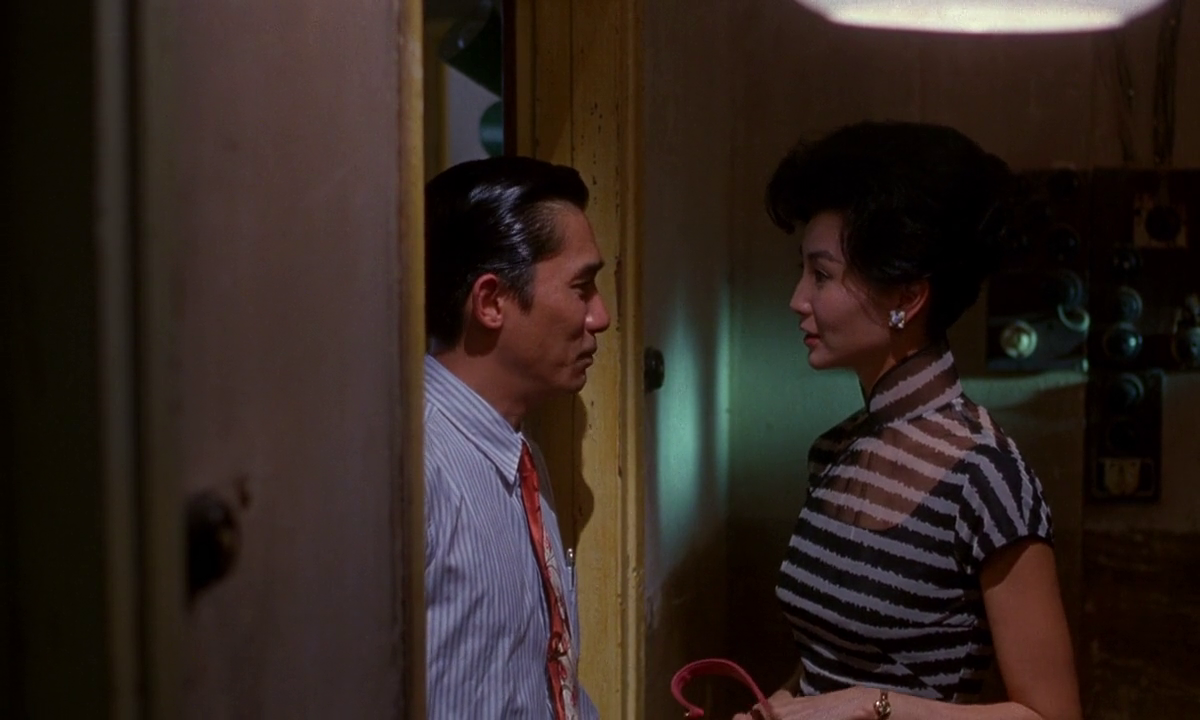
     It is a restless moment. She has kept her head lowered... to give him a chance to come closer. But he could not, for lack of courage. She turns and walks away.
Well, here it is, my 100th blog review. To some bloggers it may not seem to be a great achievement, but I have never expected to come so far when I launched this blog over 3 years ago. Many things have changed since then (which is a subject for another post), but I tried to make the latest reviews as special as they could possibly be. For my 100th film to be discussed, I did not want to write about any random movie, but the one which I regard as one of the most important in the history of moviemaking. Hence, this is my review of Wong Kar-wai’s In the Mood for Love.
Release Info
Directed by: Wong Kar-wai Starring: Tony Leung Chiu-wai, Maggie Cheung, Rebecca Pan
Language: Cantonese Original Title: 花樣年華 Runtime: 98 min
Synopsis
Hong Kong, the 1960s. Mrs Chan (Tony Leung Chiu-wai) and Mr Chow (Maggie Cheung) rent rooms in the adjacent apartments on the same day. They move in with their spouses who are extremely busy as each of them works abroad. Mrs Chan and Mr Chow often spent their lonely days in the neighbouring apartments, accidentally encountering each other from time to time. With the passage of days and weeks, they begin to suspect that their spouses are cheating on them with each other. Mrs Chan and Mr Chow share their suspicions with one another, but they do not dare confront the situation. In fact, the two try to understand how the romance was initiated and they grow closer together in the process, yet Mrs Chan and Mr Chow do not want their relation to transform into a typical love affair...
Tenderness of Devotion
First of all, I was quite shocked to discover the polarity of opinions about In the Mood for Love. I did not expect everyone to unanimously hail the movie as the art-house masterpiece, but for each positive comment there is a negative one, for example: 90 minutes of boredom; Wong Kar-wai is a hack; Why didn’t they just live happily together? Of course, everyone is entitled to their own opinion, but I suspect on the basis of the enumerated statements that some of the viewers did not entirely understood the story that was laid out in this film.
In the Mood for Love is not a standard romance picture focusing on the development of a burning passion between two people. Rather than that, it is about the understanding of love as a feeling. Mr Chow and Mrs Chan’s relationship stems directly from the infidelity of their spouses. Instead of dealing with this issue, they re-enact the moments of temptation. Through this complex series of re-enactments, they gradually start caring for each other. Mrs Chan makes Mr Chow a sesame syrup when he’s sick and Mr Chow asks Mrs Chan for tips when writing a martial arts serial for a newspaper. They build a perfect world around themselves in order to escape from their marital solitude, yet at the same time, they dread to come clean about their feelings.
On the one hand, they do not want to confront their spouses, but on the other, they are afraid of gossip and social ostracism. "We will never be like them," says Mrs Chan at one point. The two protagonists are entrapped in the confinements of their own doubts and insecurities, whereas the viewers become the voyeurs of their daily interactions. Only when Mr Chow confesses his love to Mrs Chan is the existence of their microcosm destroyed completely. "I thought we wouldn’t be like them, but I was wrong," says Mr Chow. However, it is not the end of their story.
What can I say more about this movie? It is visually stunning, but the form does not overshadow the thought-provoking content. 15 months of shooting under the skilled guidance of Wong Kar-Wai and two brilliant cameramen, who provided magnificent cinematography (Christopher Doyle and Mark Lee Ping-bin), resulted in a breathtaking experience that is In the Mood for Love. The enchanting and evocative soundtrack provided by Michael Galasso and Shigeru Umebayashi cannot be forgotten as well. With regard to performances, Tony Leung and Maggie Cheung are at their very best here, outstanding and mesmerising with their unforgettable performances.
Recommendations
Highly recommended to anyone who would like to spend a thoughtful evening immersed in the painting-like world crafted by Wong Kar-wai. To be honest, I enjoyed the movie more during the second viewing after a couple of years. It leaves you thinking about such things as love, longing, nostalgia, and past. I wish that Mr Chow and Mrs Chan could be together, but that’s a happy ending which does not always take place in real life... All things considered, I would really like to visit Angkor and whisper into a hole that I consider In the Mood for Love to be a modern masterpiece of Asian cinema.
     He remembers those vanished years. As though looking through a dusty window pane, the past is something he could see, but not touch. And everything he sees is blurred and indistinct.
Overall score: 10/10