Showing posts with label 2000. Show all posts

Joint Security Area (2000) [Film Review]

Joint Security Area; or, Incident at a Frontier
     Three minutes into the war, both countries would be destroyed.
Joint Security Area is a 2000 mystery thriller based on the novel DMZ by Park Sang Yeon and directed by the awesome Park Chan Wook. The movie became an instant blockbuster at the time of the release and also gained critical acclaim due to its controversial subject matter. The picture provides a striking evaluation of the 50 years of history since the outbreak of the Korean War.
Release Info
Directed by: Park Chan Wook Starring: Lee Byung Hun, Song Kang Ho, Lee Young Ae
Language: Korean Original Title: 공동경비구역 JSA Runtime: 110 min
Synopsis
Major Sophie E. Jean (Lee Young Ae) is a Swiss Army emissary sent by the Neutral Nations Supervisory Commission to investigate a shooting incident in the Demilitarized Zone. Sergeant Lee Soo Hyuk (Lee Byung Hun) claims to have been kidnapped by the North Korean officers, which resulted in a shoot out in a border house. However, North Korean survivor of the incident, Sergeant Oh Kyung Pil (Song Kang Ho) states that Lee singlehandedly attacked their outpost. In the course of her investigation, Major Jean discovers that both men are not telling the truth. What really happened at a small outpost in the middle of the night on the 28th of October remains a mystery…
Enemy at the Gates
To be honest, I was totally blown away by the movie when I saw it for the first time. Joint Security Area is definitely not a standard Korean flick with lots of thrilling action and high doses of melodrama. In fact, director Park Chan Wook crafted a haunting Rashomon-like story which shows that the Korean people can rise above the political boundaries.
I checked out the film while doing my research for the MDL article "Through the Looking Glass: Inter-Korean Relations in South Korean Fiction," co-written with my friend Seonsaeng (I hope that we will finish it someday). Indeed, Joint Security Area is an excellent introduction into the relations between the South Koreans and the North Koreans.
The movie does take sides and it does not demonize the main protagonists. I try to keep my reviews spoiler-free, and in this case, I do not want to reveal the plot twists, but let me just say… OMG. Joint Security Area hits all the right marks. It is that awesome! So many memorable scenes and so many wonderful quotes! It is not surprising that South Korea's President Roh Moo Hyun gave Kim Jong Il a DVD version of the film in 2007.
With regard to performances, the film obviously would not have been so wonderful without excellent casting. Lee Young Ae is great as Major Jean, a heroine with intriguing past who searches for the truth, I definitely need to check out more movies and dramas with this actress. Lee Byung Hun is also amazing as Sgt. Lee (but still, to me, he will always be "the Bad" from The Good, The Bad, The Weird movie). However, Song Kang Ho provides such overload of charisma that he simply steals the show. You will always be the greatest! In addition, Shin Ha Kyun also appears the film in a memorable supporting role as Pvt. Jung Woo Jin.
Recommendations
I recommend Joint Security Area to anyone who would like to discover more information on the complex relations between South Korea and North Korea. This motion picture is an undeniable classic. I hope that someday I will be able to see on my own eyes the crossing at Panmunjom. Last year, Arrow Video released the movie on Blu-Ray in a beautiful edition.
Overall score: 10/10
«Enjoyed this post? Never miss out on future posts by following us»

Mirai Sentai Timeranger (2000) [Tokusatsu Review]

Mirai Sentai Timeranger; or, Back to the Future
     Even if we can’t change our future, we can still change our tomorrow!
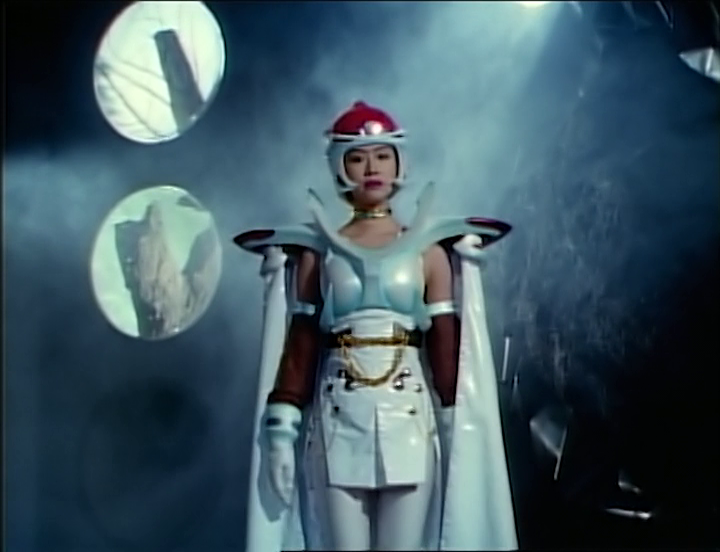
Mirai Sentai Timeranger [Future Squadron Timeranger] is one of the first shows that were recommended to me at the beginning of my Super Sentai journey. With breaks, it took me about a year to check out all 51 episodes of the series. To be honest, I do not regret any minute of this long journey. Timeranger is undoubtedly one of the most gripping Super Sentai seasons out there.
Release Info
Developed by: Yasuko Kobayashi Starring: Masaru Nagai, Mika Katsumura, Yuji Kido, Masahiro Kuranuki, Shuhei Izumi, Shinji Kasahara
Language: Japanese Original Title: 未来戦隊タイムレンジャー No. of eps.: 51
Synopsis
It’s the year 3000. With the boost of technology, time travel has become possible, but due to an increase of crimes which created paradoxes, the Time Protection Agency was developed. Their aim is to prevent time-related crimes and arrest the criminals. However, a group of gangsters known as the Londerz Family: Dolnero (Ryuzaburo Otomo), Gien (Koji Tobe), and Lila (Asami Kuru) escape from the confinement facility together with dozens of other prisoners locked in suspended animation. They jump in time to the year 2000. Four young Time Agency cadets: Yuuri (Mika Katsumura), Ayase (Yuji Kido), Sion (Masahiro Kuranuki), and Domon (Shuhei Izumi) follow in hot pursuit. They barely survive the landing and, after being betrayed, their Chrono Ship self-destructs. Stranded in 2000, the cadets are aided by a local guy Tatsuya (Masaru Nagai) who coincidentally looks like their Captain from the future. With the help of Navigator Robo Tac (Yusuke Numata) and Chrono Changer braces, the team transforms into Timerangers. Their aim is to arrest the Londerz Family and prevent history from being altered.

Time After Time
Mirai Sentai Timeranger was developed by anime/Tokusatsu veteran screenwriter Yasuko Kobayashi (who also helmed Seijuu Sentai Gingaman in 1998). Evidently, Timeranger puts a lot of emphasis on a serious tone and action. Even though things may seem to be light-hearted at certain moments, the story actually has a lot of depth and Timerangers (as well as the villains) have marvellous story arcs throughout the series.
Right from the very first episode, the viewers are kept on the edge of their seats and the show just keeps getting better with each consecutive episode. Thankfully, the idea of “time travel” is not used here as a plot armour (contrary to Avengers: Endgame (2019)). Timerangers can’t just go back in time and undo their failures. In fact, the story of the series is not so much about changing time but changing possible dimensions (which is explained in the finale and ties in to Tatsuya’s saying about changing one's own tomorrow).
The rangers themselves are simply wonderful. I love them all! Throughout the series, each and every one of them faces their own demons, even the Navigator Robot Tac has an entire episode devoted just to him. If I were to pick a favourite ranger, I’d go for Domon (TimeYellow) and Naoto (TimeFire- yes, the sixth ranger joins the team and he is such a badass!) In addition, the villains appear to be painfully predictable at first glance, but their motivations change and they become extremely complex characters (I’m looking at you, Gien!)
Being a kid at primary school, I remember seeing bits and pieces of the American adaptation, Power Rangers: Time Force, on television. Well, I’m glad that I finally managed to check out the original show in its unaltered form. The story is excellent and the pacing just perfect (one can feel that all hell breaks loose onwards episode 42).
Speaking about performances, all the actors playing the rangers were great in their roles. I also enjoyed the voice performances of Koji Tobe, Ryuzaburo Otomo, and Yusuke Numata as Gien, Dolnero, and Tac, respectively. Also, Asami Kuru was hilarious as Lila.
With regard to trivia, there is not much of these about Timeranger. Allegedly, the production was riddled with problems and there was some drama on the set, but I treat these revelations merely as unconfirmed rumours. From other information, this is the first series which used only a female singer for the opening theme song ("JIKŪ ~Mirai Sentai Timeranger~" by Kumi Sasaki). Many fans dislike the intro, but I love it. In addition, the ending theme “Toki No Kanata E” by NAT’S is absolutely outstanding. Interestingly, Timeranger is the last series since Carranger that has been shot with the usage of digital D-2 cassettes, not proper film (hence, the picture has visible quality loss).
Recommendations
I recommend Mirai Sentai Timeranger to anyone who wants to experience a well-made Super Sentai series. If you live in the West, try to grab a Shout! Factory DVD release. This is science fiction at its best. Grasp the Infinite Future!
Overall Score: 10/10
«Enjoyed this post? Never miss out on future posts by following us»

Battle Royale (2000) [Film Review]

Battle Royale; or, The Ultimate Survival Programme
     Life is a game. So fight for survival...and find out if you're worth it.
Battle Royale is the movie that needs no introduction. Based on a novel by Koshun Takami and directed by veteran filmmaker Kinji Fukasaku, the film made its way to the silver screen on December 16, 2000 and it took the popular culture by the storm. Apart from a sequel, there was also a manga adaptation and tie-in books. In addition, lots of video games, visual novels, and anime used the phrase “battle royale” as an umbrella term to describe the new genre (the last man standing challenges). The harrowing story about 42 students forced to fight each other to the death is a modern morality tale that criticises authoritarian regimes and degradation of our society
Release Info
Directed by: Kinji Fukasaku Starring: Tatsuya Fujiwara, Aki Maeda, Taro Yamamoto
Language: Japanese Original Title: バトル・ロワイアル Runtime: 110 min

 
Synopsis
Due to economic recession, Japan has fallen into chaos. As a result, many of the youngsters rebelled against authorities. In order to discipline the unruly youth, the government has passed the Battle Royale Act. Each year, one grade 9 class is selected at random and sent on a remote island. They are given instructions, survival gear, and weapons. They are ordered to kill each other. Any sort of rebellion will be punished by death. Any escape attempt will also be punished by death. The only winner of the game is the one student left alive after the time period of three days. This is the story of Class 3-B and their teacher, Kitano (Takeshi Kitano).
 
The Last Class
Probably, every enthusiast of Japanese cinema has heard about Battle Royale. I was absolutely stunned when I saw this movie for the first time, roughly a decade ago. Of course, this is a top-class action survival horror, but I believe that its shock value was not emphasised merely to satisfy the vanity of some less-than-normal viewers. I believe that the violence of Battle Royale is not meaningless. In fact, it serves to make a point.
 
Kinji Fukasaku signed on to direct the picture because the story reminded him about his own experiences during World War II. Koshun Takami explained in the afterword of the 2009 edition of the novel, that the story is about fear and betrayal (He got an inspiration for the novel after having a hallucinatory dream). In my opinion, Battle Royale is an outcry about how broken our world is. Evidently, we do not kill students for sport, but maniacs do commit horrible crimes and ordinary people are constantly betrayed by authority figures (politicians, parents, teachers). Not all of the students participating in the game are bad by default: some were made crazy, some act out of fear, and some refuse to participate in this madness (but still, all of their actions are monitored by Kitano and the military). The students of Class 3-B reflect different kinds of people and different approaches to life (all within the grasp of mighty government).
 
Thought-provoking script and gruesome action set pieces are not the only advantages of Battle Royale. Powerful visuals are accompanied by a magnificent music score composed by Masamichi Amano. Apart from the usage of classical music, I particularly liked Amano’s “Winner of Sorrow” track.
 
From the making of featurette, one can clearly see that Kinji Fukasaku, while directing on the set, was like a warrior on a battlefield. Getting each shot right was extremely important to him. In addition, it is striking that in his time off, Fukasaku would drink beer and drive Skyline R32 like a totally laid back guy.
Teenagers playing high school kids approached the matter very seriously, even though some of their roles were small. Nevertheless, the chaos of the motion picture was not reflected on the set. Everyone was in good spirits and ready to work, but the boys and the girls tended to stay away from each other. Takeshi Kitano himself seemed very timid during the shooting, but the director managed to bring the badass out of him we all know and love. Interestingly, Kitano drew by himself the famous painting which is featured at the end of the movie and in the sequel.
In fact, there are two versions of Battle Royale available. The theatrical cut runs at 110 minutes and the Special Edition cut which is approximately 10 minutes longer. It features additional scenes that were shot after the original release of the movie, including basketball game flashbacks, Mitsuko Souma’s backstory, and an extended scene between Kitano and Noriko. I personally prefer the theatrical cut because it has better pacing.
 
Speaking about performances, literally everyone gave their best in the movie. Of course performances of the three main leads: Tatsuya Fujiwara, Aki Maeda, and Taro Yamamoto will remain unforgettable. I also enjoyed small parts done by (now legendary) Chiaki Kuriyama and Kou Shibasaki. Takeshi Kitano was great as the teacher. Additionally, we cannot forget about Yuko Miyamura (that crazy awesome voice actress) who played the host of the Battle Royale Video Guide!
 
Recommendations
All things considered, Battle Royale is a movie that does not need any remake in this day and age. There is constant talk about it in Hollywood, but I hope that nothing will come to fruition. (Besides, the Americans made a shameless rip-off already!) Kinji Fukasaku’s Battle Royale is a timeless cult film that will certainly continue to inspire new generations of fans of Japanese pop-culture. In the meantime, all of us run, no matter how far, run for all we're worth!
Overall score: 8/10

Monday (2000) [Film Review]

Monday; or, Don’t Do Alcohol
     The forecast for Chiba calls for sun, with strong southerly winds. Tomorrow will be cloudy, with south-westerly winds. The day after tomorrow will be partly cloudy with winds increasing.
Some of you probably experienced such a situation at least once. There was a hard party, you drank too much and passed out at some point only to wake up having no memory of your last night’s activities. SABU’s 2000 movie Monday takes this premise as its focus point, but also gives it a double spin.
Release Info
Directed by: SABU Starring: Shinichi Tsutsumi, Naomi Nishida, Yasuko Matsuyuki
Language: Japanese Original Title: マンデイ Runtime: 100 min
 
Plot
Koichi Takagi (played by Shinichi Tsutsumi) is a typical salaryman with an uneventful job, quiet life, and one annoying girlfriend (Naomi Nishida). All of a sudden, he wakes up in a hotel room. He does not know what day it is or how he got there. Slowly, Koichi starts regaining memories of the past two days and, one event after another, he recalls his unexpectedly shocking drunk trail.
 
The Worst Day of the Week
Two words got me into checking this movie out. The first, “SABU”, because I have already seen this director’s hilarious Drive (2002) (also with Shinichi Tsutsumi in the lead) and the second, "Monday", because I literally can’t stand this day of the week. Needless to say, the movie hit all the right marks in my book and fulfilled my expectations.
 
However, if you expect an action-packed comedy, then it is better for you to approach this film with patience and zero expectations. Monday is a slow-burning story; in fact, the first act is so slow that Yasujiro Ozu would most certainly issue his seal of approval if he could. Yet, things start to pick up gradually. From a bitter drama the film turns into a dark comedy only to end up being a psychological thriller in the finale. That kind of craziness is what makes Monday so awesome!
 
SABU is very keen on weaving mythological elements into the storylines of his movies and Monday is no exception from that. In order to keep this review spoiler free (even though the movie is almost 20 years old), let me just say that Monday has more than a strong anti-alcohol message and I approve of this (sorry, not a booze fan). Koichi is a good guy and we start to root for him as the film goes on, but even though hot drinks release his inhibitions, they also lead to disastrous consequences.
 
The strongest point of this motion picture is definitely cinematography. Monday has very little dialogue, so the events are told visually. The two outstanding sequences are the yakuza girl (Yasuko Matsuyuki) encounter and Koichi’s sick dance grooves at a night club(!), as seen in the trailer below. In addition to this, the 60s-like upbeat music grealty fits the tone of the picture.
 
With regard to performances, Shinichi Tsutsumi is simply brilliant as a salaryman “on the edge”. This is my favourite performance of his out of all 5 movies he did with SABU. Apart from Tsutsumi, there are many great actors in small yet funny roles, such as Ren Osugi, Akira Yamamoto, Susumu Terajima, Yutaka Matsushige, and aforementioned Yasuko Matsuyuki as well as Naomi Nishida.
 
Recommendations
I recommend Monday to anyone who wants to spend an enjoyable and alcohol-free Sunday evening. I think that the best way to describe this film is by labelling it as something akin to Memento (2000) but way way better, at least in my opinion. I suggest you give it a go because it is a great introduction into SABU’s filmography.
Overall score: 9/10

100th Review: In the Mood for Love (2000)

In the Mood for Love; or, Secrets of the Flowery Years
     It is a restless moment. She has kept her head lowered... to give him a chance to come closer. But he could not, for lack of courage. She turns and walks away.
Well, here it is, my 100th blog review. To some bloggers it may not seem to be a great achievement, but I have never expected to come so far when I launched this blog over 3 years ago. Many things have changed since then (which is a subject for another post), but I tried to make the latest reviews as special as they could possibly be. For my 100th film to be discussed, I did not want to write about any random movie, but the one which I regard as one of the most important in the history of moviemaking. Hence, this is my review of Wong Kar-wai’s In the Mood for Love.
Release Info
Directed by: Wong Kar-wai Starring: Tony Leung Chiu-wai, Maggie Cheung, Rebecca Pan
Language: Cantonese Original Title: 花樣年華 Runtime: 98 min
Synopsis
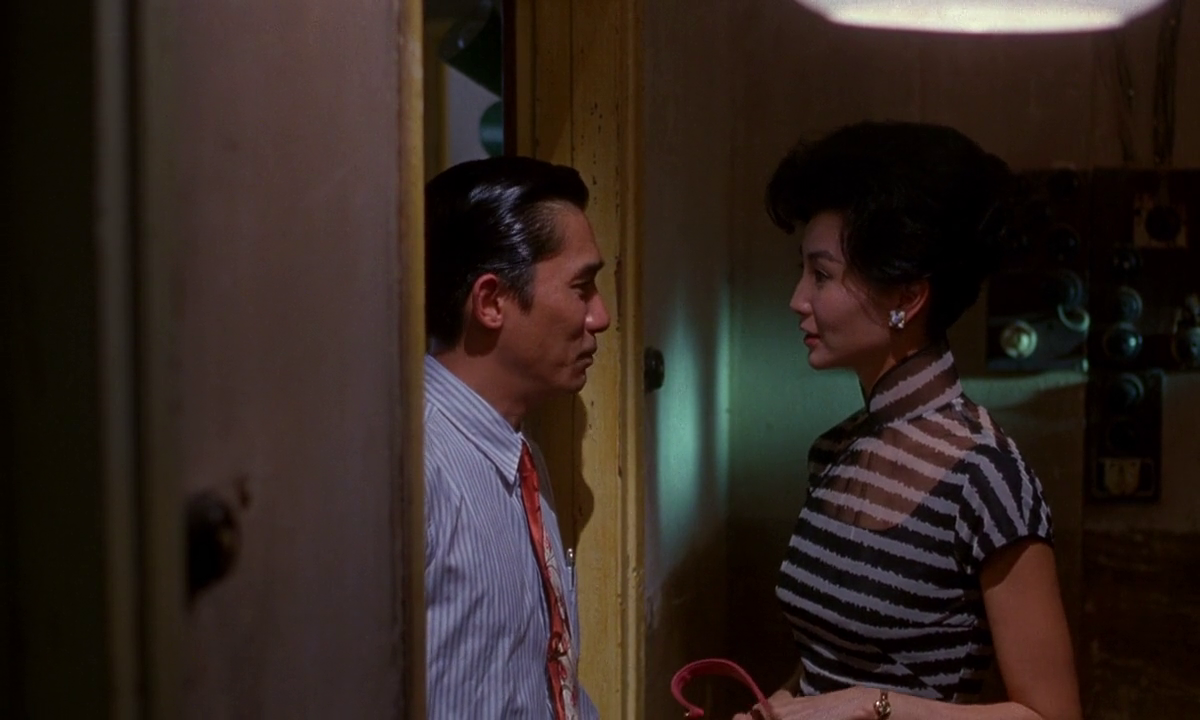
Hong Kong, the 1960s. Mrs Chan (Tony Leung Chiu-wai) and Mr Chow (Maggie Cheung) rent rooms in the adjacent apartments on the same day. They move in with their spouses who are extremely busy as each of them works abroad. Mrs Chan and Mr Chow often spent their lonely days in the neighbouring apartments, accidentally encountering each other from time to time. With the passage of days and weeks, they begin to suspect that their spouses are cheating on them with each other. Mrs Chan and Mr Chow share their suspicions with one another, but they do not dare confront the situation. In fact, the two try to understand how the romance was initiated and they grow closer together in the process, yet Mrs Chan and Mr Chow do not want their relation to transform into a typical love affair...
Tenderness of Devotion
First of all, I was quite shocked to discover the polarity of opinions about In the Mood for Love. I did not expect everyone to unanimously hail the movie as the art-house masterpiece, but for each positive comment there is a negative one, for example: 90 minutes of boredom; Wong Kar-wai is a hack; Why didn’t they just live happily together? Of course, everyone is entitled to their own opinion, but I suspect on the basis of the enumerated statements that some of the viewers did not entirely understood the story that was laid out in this film.
In the Mood for Love is not a standard romance picture focusing on the development of a burning passion between two people. Rather than that, it is about the understanding of love as a feeling. Mr Chow and Mrs Chan’s relationship stems directly from the infidelity of their spouses. Instead of dealing with this issue, they re-enact the moments of temptation. Through this complex series of re-enactments, they gradually start caring for each other. Mrs Chan makes Mr Chow a sesame syrup when he’s sick and Mr Chow asks Mrs Chan for tips when writing a martial arts serial for a newspaper. They build a perfect world around themselves in order to escape from their marital solitude, yet at the same time, they dread to come clean about their feelings.
On the one hand, they do not want to confront their spouses, but on the other, they are afraid of gossip and social ostracism. "We will never be like them," says Mrs Chan at one point. The two protagonists are entrapped in the confinements of their own doubts and insecurities, whereas the viewers become the voyeurs of their daily interactions. Only when Mr Chow confesses his love to Mrs Chan is the existence of their microcosm destroyed completely. "I thought we wouldn’t be like them, but I was wrong," says Mr Chow. However, it is not the end of their story.
What can I say more about this movie? It is visually stunning, but the form does not overshadow the thought-provoking content. 15 months of shooting under the skilled guidance of Wong Kar-Wai and two brilliant cameramen, who provided magnificent cinematography (Christopher Doyle and Mark Lee Ping-bin), resulted in a breathtaking experience that is In the Mood for Love. The enchanting and evocative soundtrack provided by Michael Galasso and Shigeru Umebayashi cannot be forgotten as well. With regard to performances, Tony Leung and Maggie Cheung are at their very best here, outstanding and mesmerising with their unforgettable performances.
Recommendations
Highly recommended to anyone who would like to spend a thoughtful evening immersed in the painting-like world crafted by Wong Kar-wai. To be honest, I enjoyed the movie more during the second viewing after a couple of years. It leaves you thinking about such things as love, longing, nostalgia, and past. I wish that Mr Chow and Mrs Chan could be together, but that’s a happy ending which does not always take place in real life... All things considered, I would really like to visit Angkor and whisper into a hole that I consider In the Mood for Love to be a modern masterpiece of Asian cinema.
     He remembers those vanished years. As though looking through a dusty window pane, the past is something he could see, but not touch. And everything he sees is blurred and indistinct.
Overall score: 10/10