Showing posts with label wong kar-wai. Show all posts

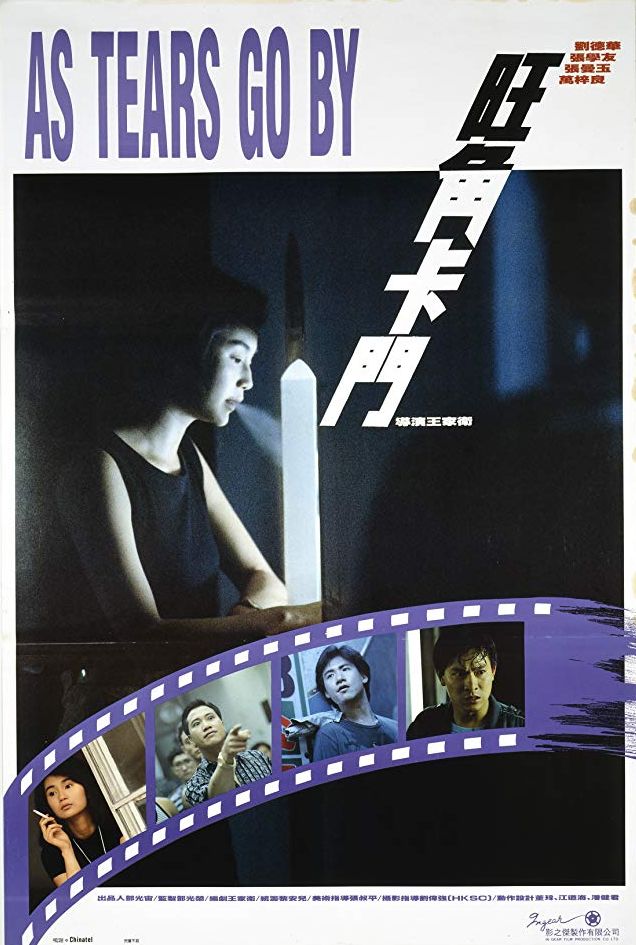
As Tears Go By (1988) [Film Review]

As Tears Go By: or, Stand By Me Older Brother
     At least you were a hotshot for a while. But what about me? Everyone looks down on me. Does that make you happy? People think I'm nothing, like some stray dog just following you around. Did you know that? I'd rather be a hero for one day than go on being a fly all my life.
Charged by Wong Kar Wai's ambience from the previous week, I decided it is high time to watch the director’s film I have not yet seen. That is, his directorial debut, which is often not discussed or mentioned among the critics’ top rundowns of Wong Kar Wai’s filmography. So please, put on your shades, switch on your CRT TV, and let’s take a closer look at As Tears Go By.
Release Info
Directed by: Wong Kar Wai Starring: Andy Lau, Jacky Cheung, Maggie Cheung
Language: Cantonese Original Title: 旺角卡门 Runtime: 102 min
Synopsis
Wah (Andy Lau) is working for the triad gang as an enforcer. All of a sudden, his distant cousin from Lantau Island called Ngor (Maggie Cheung) comes to Hong Hong to have a medical procedure. Wah hangs out with his best friend Fly (Jacky Cheung), who often gets in trouble with other mobsters because of his hot-headed attitude. When Wah falls for Ngor, Fly has to fight for survival to pay off his debt. Wah rushes to help him.
Glass in the Heart
Evidently, As Tears Go By stands out from the rest of Wong Kar Wai’s auteur masterpieces. It is not a bad movie by any means, but it is apparent from the get-go that the young director desperately wanted to break into the cinematic mainstream, and in the process of doing so, he sacrificed his artistic intentions for the purpose of entertaining the audience.
I believe “commercial product” is the best way to describe this motion picture. As Tears Go By really tries to tap into the typical 1980s trend of violent tales about the triads. Wong Kar Wai even borrows from John Woo and Ringo Lam the familiar motives of modern chivalry and overt bromance vibes between the male protagonists. We get blood, gunfights, and Shakespearean drama. Unfortunately, the love subplot is just for the sake of being there, so the audience could have some emotional anchor to root for the hero.
Under many of these commercial layers, it is hard to uncover the Wong Kar Wai we all know and love, but it is not impossible. By means of cinematography and editing, the auteur filmmaker weaves his passion and sensibility into the fabric of As Tears Go By. In the foreground, it is a story about brotherhood and innocent love, but in the background, the core of everything is Wah who becomes an adult and has to come to terms with decisions he makes.
Perhaps the best example of Wong Kar Wai’s visual subtlety is the 6-minute-long sequence in the course of which Wah is reminiscing among Ngor while listening to Sandy Lam’s sensual cover of “Take My Breath Away”. This sequence is a tell-tale foreshadowing of similar scenes involving music and lyrical loneliness as featured in Days of Being Wild, Chungking Express, In the Mood for Love, and beyond. Interestingly, this song was removed in the Mandarin dub of the film and replaced with “You Are The Eternal Pain In My Heart” by Dave Wang and Augustine Yeh.
With regard to performances, Andy Lau is absolutely outstanding as the upright lead with a moral backbone. Maggie Cheung is just as memorable as Ngor, even though her role is very one-dimensional because she plays a kind-hearted love interest. I always found Jacky Cheung to be a very expressive actor, and he cranks up this aspect to the max in his supporting role as Fly.
Recommendations
If you think of WKW’s movies as refined dishes, then this one is junk food. It is delicious, but you know it is junk food nonetheless. Yet, this should not prevent you from enjoying it! In fact, I like this film a bit more than Days of Being Wild mainly because the plot itself was more understandable and accessible. The movie was released in 2021 on Blu-ray by the Criterion Collection as part of a special boxset devoted to Wong Kar Wai. I watched my own copy of the film from Mayfly’s double-disc DVD edition, which also contains Days of Being Wild.
Overall score: 8/10
«Enjoyed this post? Never miss out on future posts by following us»

Days of Being Wild (1990) [Film Review]

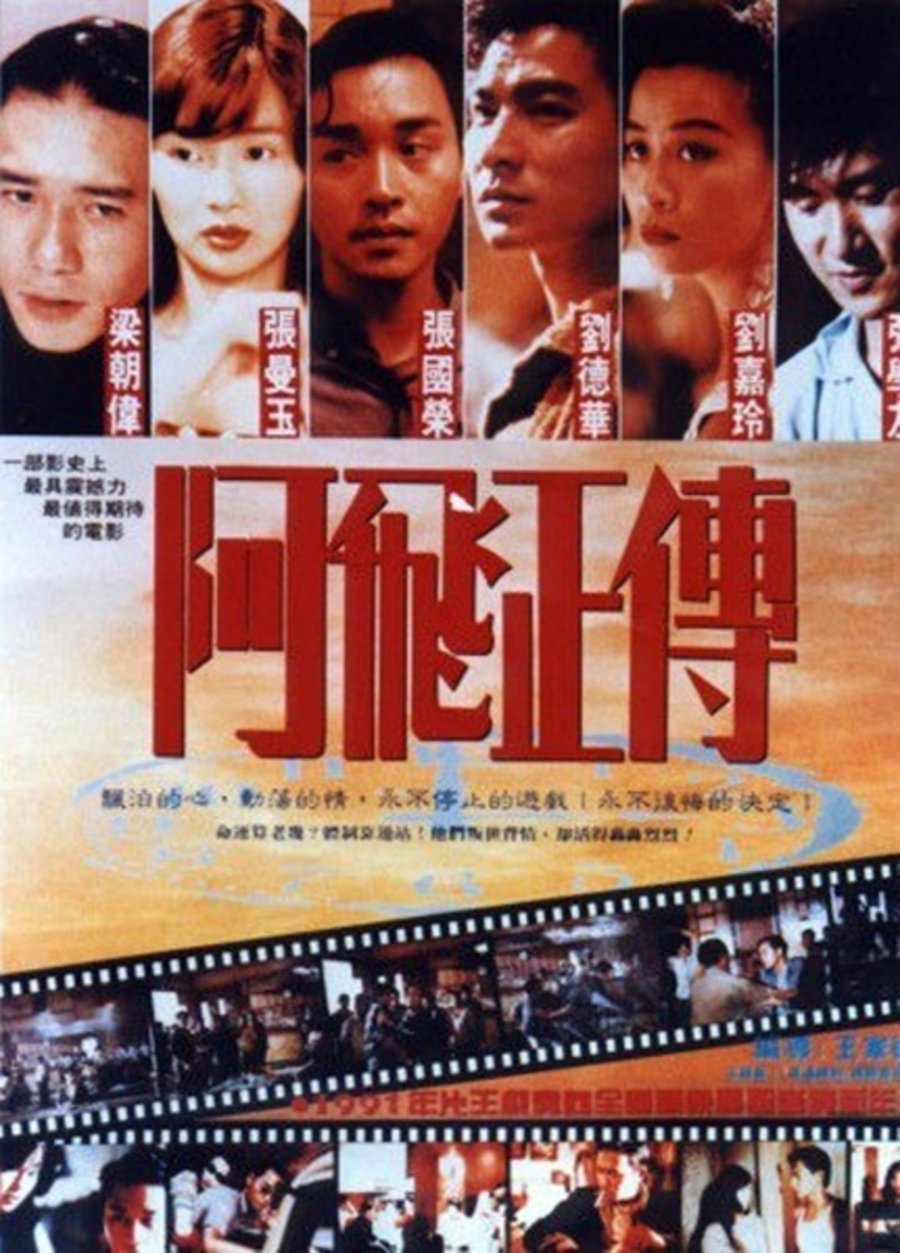
Days of Being Wild; or, As Minutes Go By
     I've heard that there's a kind of bird without legs that can only fly and fly, and sleep in the wind when it is tired. The bird only lands once in its life... that's when it dies.
In the world of today, Wong Kar Wai seems to be one of the most undisciplined artists out there. In the 2010s, a lot of projects helmed by the director were announced but devoted fans still await their completion. Wong Kar Wai certainly does not care about production deals or shooting schedules. Indeed, his main concern is pursuit of inspiration, thanks to which he became a renowned auteur filmmaker. As a way of coping with my personal bout of melancholy, I decided to revisit his earlier movies, and today I would like to discuss Days of Being Wild.
Release Info
Directed by: Wong Kar Wai Starring: Leslie Cheung, Carina Lau, Maggie Cheung, Andy Lau, Jacky Cheung
Language: Cantonese Original Title:  阿飛正傳 Runtime: 94 min
Synopsis
Hong Kong, 1960. Yuddy (Leslie Cheung) seduces Li-zhen (Maggie Cheung) who works at a ticket stall, but he quickly breaks up with her. While standing in defence of his adoptive mother (Rebecca Pan), he meets a cabaret dancer Mimi (Carina Lau) who falls for him. Yuddy desperately wants to know the whereabouts of his biological mother and meet her. In the meantime, police officer Tide (Andy Lau) befriends Li-zhen, and Yuddy’s friend Zeb (Jacky Cheung) develops feelings for Mimi.
2 Lonely 2 Calm
I have been meaning to review Days of Being Wild for a long time; basically, ever since I saw it in 2015, but I was never sure my words would be sufficient enough to describe the film. It was the very first Wong Kar Wai movie I have ever seen, and in my opinion, it was a challenging introduction. It is clearly visible that the director was still playing with the language of cinema, looking for his personal style.
There is little dialogue in the film, and when it is present, it feels deeply poetic yet irrelevant. Wong Kar Wai, rather than telling, is showing to the audience what happens with the story of Yuddy, a young self-destructive nonconformist, a sigma male before being sigma was mainstream, who suffers from attachment issues.
It is really hard to sympathise with the main protagonist because of the way he treats people around him. He does not want to be loved, because he had not experienced motherly love, but it is almost as if he derives pleasure in degrading people and burning bridges behind him. All of the characters who interact with him: Li-zhen, Mimi, Tide, and Zeb are victims of his fatalistic attitude. This longing for love pushes them to question their own sense of identity.
I have to say that I enjoyed this movie more after rewatching it today than eight years ago. Evidently, my sensibilities and attention span have changed, but it does not change the fact that if you want to begin your own journey through Wong Kar Wai’s filmography, Days of Being Wild is not a good place to start. The film has sublime cinematography and top-notch ambience of Hong Kong of the 1960s, but you really have to focus on the story in order to get it.
With regard to performances, Leslie Cheung is (as always) amazing as the leading man. His presence is both charismatic and mesmerising throughout the entire film. The same can be said about Carina Lau who really gave a stand-out performance as an extroverted and emotionally-charged love interest. Maggie Cheung, Andy Lau, and Jacky Cheung are memorable in their supporting roles, even though their screen time is limited.
Last but not least, I have to address the handsome elephant in the room. That is to say, this movie ends with one of the most soothing scenes in the history of cinema. We see Tony Leung Chiu-Wai as an unnamed character who prepares for a gambling night. It is incredibly comforting just watching this man filling his pockets and having a smoke in a dilapidated apartment. Undoubtedly, the scene must have served as a lead-in for In the Mood for Love and we can only wonder how that film would have looked like had it been made immediately after Days of Being Wild.
Recommendations
All things considered, if you are new to Wong Kar Wai, then be wary of this film. However, if you are an old-timer who has already been through such classics as Chungking Express, Fallen Angels, and 2046, then Days of Being Wild is a perfect choice for you. Sometimes watching Wong Kar Wai’s films out of order is more rewarding than doing it chronologically.
Overall score: 7/10
«Enjoyed this post? Never miss out on future posts by following us»
Chungking Express (1994) [Film Review]

Chungking Express; or, Hard-Boiled Wonderland
     Did I leave the tap running, or is the apartment getting more tearful? I always thought it would cope okay. Didn't expect it to cry so much. When people cry, they can dry their eyes with tissues. But when an apartment cries, it takes a lot to mop it up.
Wong Kar-wai, the real auteur whose movies are recognised nowadays as masterpieces. Rather than telling a conventional story, he always presents the viewers with a unique atmosphere, unforgettable visuals, and memorable characters. This is also the case with Chungking Express (1994), a comedy-drama written and directed by him
Release Info
Directed by: Wong Kar-wai Starring: Takeshi Kaneshiro, Brigitte Lin, Tony Leung Chiu-Wai, Faye Wong
Language: Cantonese Original Title: 重慶森林 Runtime:102 min
 
Synopsis
The movie tells two stories. The first one is about a cop no. 223 (Takeshi Kaneshiro) who accidentally meets a woman in a blonde wig (Brigitte Lin). He does not know that the woman is actually a member of a drug-smuggling ring and that she was betrayed by her associates. The second story focuses on a cop no. 663 (Tony Leung Chiu-Wai) who tries to get over the fact that his girlfriend, a flight attendant (Valerie Chow), dumped him. Every day he walks the beat and dines at Midnight Express snack bar. The worker of the snack bar, Faye (Faye Wong), falls for the cop and, by sheer accident, she gets keys to his apartment and the address. Faye proceeds to secretly rearrange the cop’s apartment…
 
Love with an Expiry Date
Chungking Express was made during a three-month break in the post-production of Wong Kar-wai’s wuxia film Ashes of Time (1994). Having been exhausted with extensive shooting on a desert, Wong wanted to make something that was light and quick. Chungking Express was initially conceived as a linear story with the four main characters bumping into each other, but the actors’ tight schedules forced the director to change the film’s formula. Wong based the film on his childhood experiences in Chungking Mansion, a building complex that consists of various lodgings and shops run by people of various nationalities, and in Midnight Express, a bar located in the Central District of Hong Kong.
 
The film is very much a visual experience and that is done due to wonderful cinematography by Andrew Lau and Christopher Doyle. According to critic Tony Rayns, Wong Kar-wai was heavily inspired by the works of Haruki Murakami and this influence can be clearly seen on the screen (cop 223’s obsession with expiry dates and cop 663 talking to objects in his apartment). Chungking Express is not so much a three act piece, but a tale about people passing each other, trying to get noticed. I like the first story, but the second one stole my heart. Now, whenever I hear "California Dreamin" song, I can’t help but think about this movie!
 
Speaking about performances, all the four main actors were brilliant. Interestingly, this was Brigitte Lin’s final movie before her retirement (she did a few cameos later on). At the same time, this was also Faye Wong’s debut picture. Takeshi Kaneshiro provided wonderful narration, whereas Tony Leung did not disappoint as an extraordinarily relaxed cop with existential issues.
 
Recommendations
In the Mood for Love (2000) may be my favourite, but I will always have a special place in my heart for Chungking Express. It is such an enjoyable movie that makes you feel better as soon as the end credits (with Faye Wong’s version of “Dreams” song) roll in. If you have not seen Chungking Express, then please watch it!
Overall score: 10/10

100th Review: In the Mood for Love (2000)

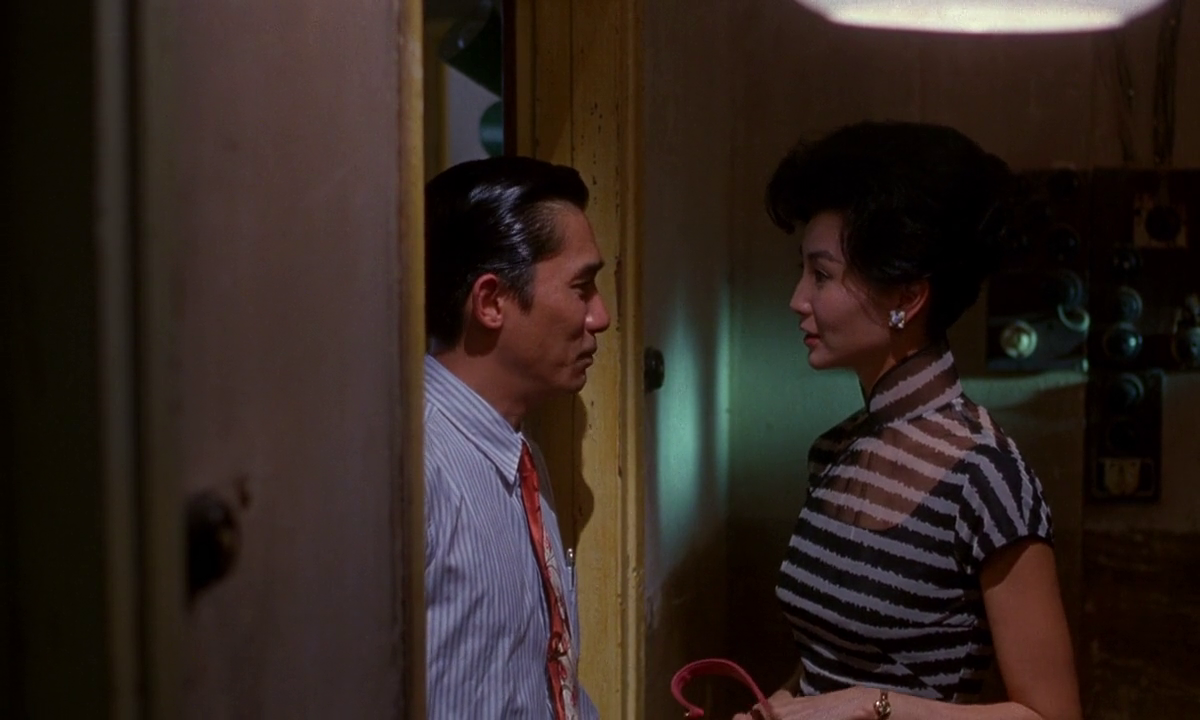
In the Mood for Love; or, Secrets of the Flowery Years
     It is a restless moment. She has kept her head lowered... to give him a chance to come closer. But he could not, for lack of courage. She turns and walks away.
Well, here it is, my 100th blog review. To some bloggers it may not seem to be a great achievement, but I have never expected to come so far when I launched this blog over 3 years ago. Many things have changed since then (which is a subject for another post), but I tried to make the latest reviews as special as they could possibly be. For my 100th film to be discussed, I did not want to write about any random movie, but the one which I regard as one of the most important in the history of moviemaking. Hence, this is my review of Wong Kar-wai’s In the Mood for Love.
Release Info
Directed by: Wong Kar-wai Starring: Tony Leung Chiu-wai, Maggie Cheung, Rebecca Pan
Language: Cantonese Original Title: 花樣年華 Runtime: 98 min
Synopsis
Hong Kong, the 1960s. Mrs Chan (Tony Leung Chiu-wai) and Mr Chow (Maggie Cheung) rent rooms in the adjacent apartments on the same day. They move in with their spouses who are extremely busy as each of them works abroad. Mrs Chan and Mr Chow often spent their lonely days in the neighbouring apartments, accidentally encountering each other from time to time. With the passage of days and weeks, they begin to suspect that their spouses are cheating on them with each other. Mrs Chan and Mr Chow share their suspicions with one another, but they do not dare confront the situation. In fact, the two try to understand how the romance was initiated and they grow closer together in the process, yet Mrs Chan and Mr Chow do not want their relation to transform into a typical love affair...
Tenderness of Devotion
First of all, I was quite shocked to discover the polarity of opinions about In the Mood for Love. I did not expect everyone to unanimously hail the movie as the art-house masterpiece, but for each positive comment there is a negative one, for example: 90 minutes of boredom; Wong Kar-wai is a hack; Why didn’t they just live happily together? Of course, everyone is entitled to their own opinion, but I suspect on the basis of the enumerated statements that some of the viewers did not entirely understood the story that was laid out in this film.
In the Mood for Love is not a standard romance picture focusing on the development of a burning passion between two people. Rather than that, it is about the understanding of love as a feeling. Mr Chow and Mrs Chan’s relationship stems directly from the infidelity of their spouses. Instead of dealing with this issue, they re-enact the moments of temptation. Through this complex series of re-enactments, they gradually start caring for each other. Mrs Chan makes Mr Chow a sesame syrup when he’s sick and Mr Chow asks Mrs Chan for tips when writing a martial arts serial for a newspaper. They build a perfect world around themselves in order to escape from their marital solitude, yet at the same time, they dread to come clean about their feelings.
On the one hand, they do not want to confront their spouses, but on the other, they are afraid of gossip and social ostracism. "We will never be like them," says Mrs Chan at one point. The two protagonists are entrapped in the confinements of their own doubts and insecurities, whereas the viewers become the voyeurs of their daily interactions. Only when Mr Chow confesses his love to Mrs Chan is the existence of their microcosm destroyed completely. "I thought we wouldn’t be like them, but I was wrong," says Mr Chow. However, it is not the end of their story.
What can I say more about this movie? It is visually stunning, but the form does not overshadow the thought-provoking content. 15 months of shooting under the skilled guidance of Wong Kar-Wai and two brilliant cameramen, who provided magnificent cinematography (Christopher Doyle and Mark Lee Ping-bin), resulted in a breathtaking experience that is In the Mood for Love. The enchanting and evocative soundtrack provided by Michael Galasso and Shigeru Umebayashi cannot be forgotten as well. With regard to performances, Tony Leung and Maggie Cheung are at their very best here, outstanding and mesmerising with their unforgettable performances.
Recommendations
Highly recommended to anyone who would like to spend a thoughtful evening immersed in the painting-like world crafted by Wong Kar-wai. To be honest, I enjoyed the movie more during the second viewing after a couple of years. It leaves you thinking about such things as love, longing, nostalgia, and past. I wish that Mr Chow and Mrs Chan could be together, but that’s a happy ending which does not always take place in real life... All things considered, I would really like to visit Angkor and whisper into a hole that I consider In the Mood for Love to be a modern masterpiece of Asian cinema.
     He remembers those vanished years. As though looking through a dusty window pane, the past is something he could see, but not touch. And everything he sees is blurred and indistinct.
Overall score: 10/10