Showing posts with label shiro sano. Show all posts

Godzilla 2000: Millennium (1999) [Tokusatsu Review]

Godzilla 2000: Millennium; or, To the Future and Beyond
     Biologically, Godzilla is a very special existence. It's full of unimaginable mysteries. To study Godzilla will be the key to disclose the secrets of living beings on our planet.
Being fired up by my frenzy regarding Godzilla vs. Kong (2021), I decided to go back and revisit the good old Kaiju flicks with our favourite King of the Monsters. My first choice of revisitation became Godzilla 2000: Millennium, a movie that owes its existence to the abhorrent American remake from 1998.
Release Info
Directed by: Takao Okawara Starring: Takehiro Murata, Naomi Nishida, Shiro Sano, Hiroshi Abe
Language: Japanese Original Title: ゴジラ2000 ミレニアム Runtime: 108 min
Synopsis
Godzilla has become a permanent part of Japan’s geo-cultural landscape. Instead of fighting the monster, the authorities prefer to monitor his whereabouts. As a result, the scientist Yuji Shinoda (Takehiro Murata) and his daughter launch an independent organisation known as The Godzilla Prediction Network. During their observational stake-outs, they are accompanied by Yuki Ichinose (Naomi Nishida), a journalist who wants to get exclusive pictures of the King in action. In the meantime, Crisis Control Intelligence headed by Mitsuo Katagiri (Hiroshi Abe) examines an unidentified object which was found at the bottom of the ocean. Shinoda’s friend, Miyasaka (Shiro Sano), determines that the object is 65 million years old and remained dormant until it was exposed to sunlight. The object flies out of water and scans Godzilla, reaching a conclusion that he is the most powerful being on the planet. The UFO plans to invade Earth by replicating Godzilla’s DNA...

Predestination
After the emotional finale of the Heisei series, Godzilla vs. Destoroyah (1995), Toho wanted to retire the Big G and make way for a (supposed) string of American movies produced by TriStar Pictures. Godzilla producer and the president of Toho, Shogo Tomiyama, was convinced that the American Godzilla series will last up until the year 2005; however, after the disastrous release of the Emmerich’s movie, Toho wanted to protect the legacy of Godzilla, so they greenlit a new Japanese production almost immediately.
Godzilla 2000: Millennium was undoubtedly made in a rush and by a team behind the Heisei movies. Takao Okawara was brought back as the director, Shogo Tomiyama produced, and Hiroshi Kashiwabara (scriptwriter of Godzilla vs Spacegodzilla (1994)) and Wataru Mimura (scriptwriter of Godzilla vs. Mechogodzilla (1993)) wrote the screenplay. What is more, the main lead, Takehiro Murata already appeared in a supporting role in Godzilla vs. Mothra (1992).
This is not to say that the movie is an uneventful, tired leap of the King into the 21st century. The filmmakers clearly wanted to reintroduce as well as update the iconic character. Godzilla was given a new look and a remixed roar. To me, this is my favourite Goji-suit out of all movies. The film also marks the first appearance of the suitmation actor, Tsutomu Kitagawa, as Godzilla.
In terms of special effects, these were helmed by Kenji Suzuki who opted for the usage of digital compositing rather than traditional models. The result is kind of a mixed bag. Some of the sequences look absolutely great, but others are visibly outdated. Still, huge respect goes to the F/X team for trying to push the envelope so early on in the franchise.

As for the screenplay, we get a traditional monster rumble, but in contrast to previous entries of the series, the human drama is fairly enjoyable. I liked the chemistry between Shinoda, his daughter, and Yuki. There’s also the character of Miyasaka who seems to have a bromance attraction to Shinoda, but he restrains himself because he works for villainous Katagiri, a guy hellbent on annihilating Godzilla. Some of the technobabble in the story is barely understandable, but I liked the twist involving an alien race attempting to create their “own Godzilla”.
The music score was composed by Takayuki Hattori (who also scored Godzilla vs. Spacegodzilla). Like I said in my editorial series on Godzilla music, the OST for this particular movie is fine, but I prefer Hattori’s compositions for the anime trilogy.
With regard to performances, all of the main leads do a fine job, but the real show-stealer is the awesome Hiroshi Abe as the baddie. His “Godzilla!!!!!!” moment in the finale has engraved itself into the hall of fame of the most iconic Godzilla scenes. I’m also happy to see Naomi Nishida because she does not normally do tokusatsu flicks at all.

Interestingly, Godzilla 2000: Millennium was re-released in the U.S by Sony. Producer Mike Schlesinger and his team tried the best they could to re-cut and dub the film in a way that will not be disrespectful towards Toho and Godzilla fans. Consequently, the English version is indeed watchable, but I still prefer the original cut. Originally, the English movie ended with a cartoonish “The End?” card, but it was removed from subsequent releases. However, if you happen to own Godzilla 2000 on Spanish VHS, then you can enjoy this piece of lost cinematic trivia.
Recommendations
All things considered, this was my look at Godzilla 2000: Millennium. For many young fans in the early 2000s, this was their first introduction into the franchise (well, this and the Emmerich movie…). I personally have a soft spot for it. It is a decent monster flick that can be enjoyed even by non-kaiju viewers.
Overall score: 8/10
«Enjoyed this post? Never miss out on future posts by following us»

Godzilla and Heroine (2020) [Documentary Review]

Godzilla and Heroine; or, Tokusatsu Mon Amour
     My work with Godzilla has reached an end.
As soon as I heard that NHK television released a new Godzilla documentary in late December, 2020, I knew I had to check it out. This new look at behind the scenes focuses on the theme of female thespians who had the honour of gracing the screen alongside the legendary King of the Monsters.
Release Info
Directed by: Takeshi Yagi Starring: Kumi MIzuno, Yumiko Shaku, Keiko Mari, Megumi Odaka
Language: Japanese Original Title: ゴジラとヒロイン Runtime: 90 min
In spite of my less-than-rudimentary knowledge of Japanese, I was able to grasp the gist of the documentary. The whole thing plays like a variety show, hosted by three people: Shiro Sano (who appeared as a scientist in Godzilla 2000), comedian Tsukaji Muha pretending to be a lab doctor, and actress Megumi Han playing an android. The three hosts begin the show by explaining the concepts of “Tokusatsu” and “Kaiju” and establishing different kinds of heroines.
At this point, the documentary slightly diverges from its title because it covers a wide range of actresses who appeared not only in Godzilla movies but also in other Tokusatsu productions of the Showa era (for example, the hosts show snippets from such films as The Mysterians (1957), The Three Treasures (1959), Matango (1963), Frankenstein Conquers the World (1965), and many more). As a result, the documentary transforms into a love letter to all the actresses who played in Japanese monster movies before these pictures became too-cool-for-school across the globe.
Apart from extensive retrospectives, the documentary also provides a look at previously unknown footage from the making of Tokusatsu films. In addition, the figure of Godzilla producer Tomoyuki Tanaka is outlined in detail.
With regard to special guests, the NHK studio is visited by Kumi Mizuno who reminiscences about her time on Godzilla films, and Yumiko Shaku who shows up in her full Kiryu Squadron uniform from Godzilla Against Mechagodzilla (2002) movie. Interestingly, she is very lively and energetic while interacting with the hosts (but her character in the movies was very serious and pessimistic). In addition, former Godzilla producer/Toho president Shogo Tomiyama also appears and has a conversation with the hosts and other guests.
The documentary also features pre-recorded interviews with two other actresses, Keiko Mari and Megumi Odaka. The first actress discusses her role in Godzilla vs. Hedorah (1971), whereas Megumi Odaka goes over the story arc of her character, as presented in Godzilla vs. SpaceGodzilla (1994) and Godzilla vs. Destoroyah (1995).
Apart from these treats, Shino Sano provides a lecture-like talk about the development of Tokusatsu heroines over the years. To be honest, I would have appreciated these interjections more had it not been for the fact that Godzilla and Heroine does not treat itself seriously, constantly falling into the convention of a variety shows, because the viewers need to be entertained. As a result, we see Shiro Sano is some kind of a bar with loud music (as if he is about to promote Suntory whisky like Bill Murray) and Tsukaji Muha trying to re-enact the famous heroine screams.
I think that the documentary would have worked better if it had been a straightforward retrospective on all of the Godzilla heroines, something similar to Maryam d’Abo’s Bond Girls Are Forever (2002). In this documentary, a former Bond girl tracks down and interviews fellow beauties who appeared alongside Agent 007.

Recommendations
If you are an incurable Godzilla fan, then the documentary is definitely for you. However, you may not get any new information out of this viewing experience. All in all, it’s great that Godzilla’s heroines are still being remembered in the world of today. My respect goes to all the actresses, especially Momoko Kochi (picture above) who had the privilege of playing the first female character in a Godzilla movie.
Overall score: 7/10
«Enjoyed this post? Never miss out on future posts by following us»

Negotiator (2003) [Film Review]

Negotiator; or, Seeking Justice
     Selflessness. Killing the self, is the hardest thing to do.
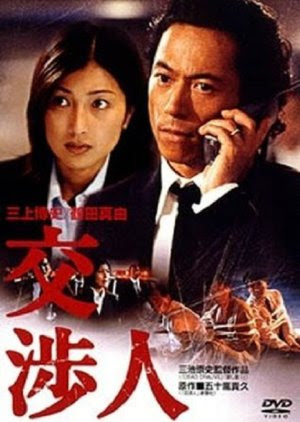
I admit that I am not a massive fan of Takashi Miike, but I don’t mind checking out his earlier works from time to time. In fact, I think that his movies from the 1990s/early 2000s are more interesting than later endeavours (such as Ace Attorney (2012)
Shield of Straw (2013)). As a result, I was pleasantly surprised when I stumbled upon Negotiator from 2003 (not to be mistaken with Negotiator: Mashita Masayoshi (2005) and The Negotiator: The Movie (2010)). This somewhat forgotten entry from Miike’s filmography serves as a proof that the director can craft an engaging drama with a touch of suspense.
Release Info
Directed by: Takashi Miike Starring: Hiroshi Mikami, Mayu Tsuruta, Shiro Sano, Kumi Nakamura
Language: Japanese Original Title: 交渉人 Runtime: 107 min
Synopsis
Inspector Ishida (Hiroshi Mikami) and Captain Tohno (Mayu Tsuruta) are two professional negotiators who handle the most difficult stand-off situations. There are rumours circulating that they might have been in a relationship but nothing is confirmed, especially in view of the fact that Ishida takes care of his ailing wife (Kumi Nakamura). All of a sudden, a group of masked men robs a convenience store, only to leave and barricade themselves in a hospital and take 27 patients as well as 3 doctors hostage. Tohno arrives at the scene and begins the negotiations, but she is relieved from her duties by Ishida who takes over the case. It turns out that Ishida’s wife is one of the captives. Although the negotiations go smoothly and the patients are quickly released, the criminals vanish without a trace, together with the physicians...
In the Line of Duty
One could think on the basis of the title that Negotiator is yet another police procedural endowed with standard cliches and plot twists of the genre. Indeed, this seems to be the first impression at the very beginning when we are presented with Ishida’s inconsequential actions towards the mysterious criminals (who basically have no motive for taking over a hospital). However, as the story progresses, more and more backstory is revealed through extensive flashbacks (the perspectives of Ishida and Tohno are especially essential). Evidently, I am not going to spoil anything (although the film is 17 years old already), so let me just express words of appreciation for Kota Yamada and his thoughtful screenplay.
Apart from focusing on the themes of crime and (in)proper punishment, Negotiator also excels at building a very grim and dark tone. This is what I regard to be the film’s only disadvantage because even though the third act is extremely powerful and provides a social commentary on the modern judiciary system, it is also very harrowing as well as depressing. As a result, the rewatch value of the film is brought down to zero.
With regard to performances, I am not that familiar with other roles of Hiroshi Mikami and Mayu Tsuruta, but they did a great job as the leads. In addition, Kumi Nakamura was excellent as Mrs Ishida. Shiro Sano was also convincing as a police detective who is outwitted in the film’s finale. What is more, such awesome stars as Kenichi Endo, Masato Ibu, and Yoji Tanaka appear in small supporting parts.
Recommendations
If you would like to check out Takashi Miike who does not rely on a wacky screenplay, excessive gore, and special effects, then I recommend Negotiator. It is a very neat crime flick if you are in the mood for reflective dramas. Yet another Koshinin deserves to occupy a place next to Yusuke Santamaria’s film and Ryoko Yonekura’s franchise.
Overall score: 7/10
«Enjoyed this post? Never miss out on future posts by following us»