Showing posts with label 2003. Show all posts

Godzilla: Tokyo SOS (2003) [Tokusatsu Review]

Godzilla: Tokyo SOS; or, Ménage à trois
     Sayonara, Kiryu!
A couple of months ago I posted my review of Godzilla X Mechagodzilla (2002) on the blog, so I relentlessly come back to my revisitation of Godzilla movies, and this time I am taking a look at the film’s direct sequel which came out a year later; that is, Godzilla X Mothra X Mechagodzilla: Tokyo SOS.
Release Info
Directed byMasaaki Tezuka Starring: Noboru Kaneko, Miho Yoshioka, Mitsuki Koga
Language: Japanese Original Title: ゴジラ×モスラ×メカゴジラ 東京SOS Runtime: 91 min
Synopsis
A year after defending Japan from Godzilla’s attack, Kiryu undergoes necessary repairs. However, Mothra appears and warns the authorities that they should dismantle Kiryu and return the remains of the original 1954 Gojira to the sea. Mothra offers to take Kiryu’s place as the Kaiju defender if these terms are fulfilled. Nevertheless, the Big G reawakens and proceeds to initiate a monster rumble in Tokyo. Kiryu is dispatched to the scene and Mothra together with her offspring rush to join the fight.
Kiryu Returns
After the successful release of Godzilla X Mechagodzilla, director Masaaki Tezuka was immediately given a green light to make a new entry in the Millennium series by producer Shogo Tomiyama. The director was allegedly given four potential story treatments, but he rejected all of them, opting to write his own screenplay. The final result became Tokyo SOS, a movie that is a continuation of Godzilla X Mechagodzilla, but most of the time, it throws out the window the style of the previous film and tries to be its own thing.
Perhaps the most disappointing aspect of Tokyo SOS is the fact that it does not continue the storylines of Godzilla X Mechagodzilla. Yumiko Shaku reprises her role as Lt. Akane, but her role is unfortunately marginal, and she is only there to pass the baton to the real heroes of the movie, who are Yoshito Chujo (Noboru Kaneko), Lt. Azusa Kisaragi (Miho Yoshioka), and Kiryu Operator Kyosuke Akiba (Mitsuki Koga). What is more, the characters of Professor Yuhara and his daughter are completely missing in the film, even though Yuhara was the co-constructor of Kiryu and he was in love with Akane.
Therefore, this movie can be regarded as a very loose sequel that strives to be more action-packed and bombastic than its predecessor. In addition, the presence of young cast members and Tokusatsu veterans cannot go unnoticed. Apart from the appearances by Akira Nakao and Koichi Ueda, there is also Hiroshi Koizumi, who reprises his role as Doctor Shinichi Chujo from the original Mothra (1961) movie. He does an excellent job in the film even though his storyline is a bit limited. What is more, Chihiro Otsuka and Masami Nagasawa herself play the new incarnations of the twin fairies who look after Mothra.
Although Tokyo SOS does not attempt to recreate the grandeur of Godzilla X Mechagodzilla. I can’t help but appreciate the film for what it is. Undoubtedly, it is a solid Tokusatsu spectacle with an awesome blend of miniature and CG special effects as well as the magnificent music score by Michiru Oshima. Additionally, the third act is one massive battle between the titular monsters that really leaves you out of breath.
My favourite monster of the Millennium era, Kiryu, gets a bit overshadowed in this film by Mothra, but it is understandable since the picture focuses on three monsters this time. It is a shame though that there is not just more of him in the story. Still, there is a wonderful, touching moment involving Kiryu towards the end that really made me teared up when I watched the film for the first time.
Oddly enough, it seems that I am not the only viewer who underwent such an experience with Tokyo SOS. In an interview, director Tezuka stated that during the screening of the film in the US, some lady came up to him, shook his hand, and said that this was the first Godzilla flick that made her cry (source).
Interestingly, as in the case of other Millennium movies, Tokyo SOS has an intriguing post-credits sequence, which may have possibly served as lead in for a new movie had Tezuka directed it. Unfortunately, this was not the case because Toho decided to go in a new direction for the Big G’s 50th anniversary, but more about this some other time. 
Recommendations
All in all, I greatly like Godzilla X Mothra X Mechagodzilla: Tokyo SOS, but I think the story would benefit more from Kiryu action. I believe that this movie often gets omitted in the fan discussions because it came out in between highly-enjoyable Godzilla X Mechagodzilla and highly-controversial Godzilla: FInal Wars. The movie was originally released on DVD by TriStar in 2004 and it was re-released on Blu-Ray in 2014.
Overall score: 7/10
«Enjoyed this post? Never miss out on future posts by following us»

300th Review: A Tale of Two Sisters (2003)

A Tale of Two Sisters; or, Rose Flower, Red Lotus
     As much as you hate It, I'm the only one in this world you can call mother, got it?
One of my recent visits at a thrift store resulted in obtaining a DVD release of Kim Jee Woon’s A Tale of Two Sisters. Actually, I remember reading about this particular horror film during seminar classes at my university, where a lecturer did a comparison between this film and its Hollywood remake: The Uninvited. So, needless to say, let’s discuss the movie in detail.
Release Info
Directed by: Kim Jee Woon Starring: Im Soo Jung, Moon Geun Young, Yum Jung Ah
Language: Korean Original Title: 장화, 홍련  Runtime:115 min
Synopsis
A teenage girl called Su Mi (Im Soo Jung) was being treated for psychosis in a mental institution. After being discharged, she returns home with her father (Kim Kap Soo), and younger sister Su Yeon (Moon Geun Young). The two sisters have a strong bond and always support each other. However, they refuse to acknowledge Eun Joo (Yum Jung Ah) as their step-mother, which causes friction among family members. Soon after, Su Mi and Su Yeon start seeing supernatural phenomena around the house, even witnessing the ghost of their late mother (Park Mi Hyun).
Past Trauma
I think it is safe to say that Kim Jee Woon is a jack of all trades when it comes to delivering a variety of different genres, from a wacky comedy to an exciting thriller. Evidently, A Tale of Two Sisters is no exception. Having been inspired by a folktale story Janghwa Hongryeon jeon, Kim Jee Woon crafts a dark, slow-paced horror with psychological undertones taken verbatim from the pictures of Kiyoshi Kurosawa.
At its core, A Tale of Two Sisters is the story about the breakdown of a nuclear family. Of course, there are many unexpected plot twists along the way, sprinkled with supernatural elements and jumpscares. Yet, the dramatic reveal in the film’s finale essentially brings the whole thing down to a conflict between a girl and a step-mother, which was set in motion by an ignorant father.
I am not a big fan of a disjointed style of narrative, but in the case of A Tale of Two Sisters, it actually works. There are many sequences throughout the film which make you think whether what you are seeing is real or unreal. In particular, I refer to a chilling scene in which the character of Eun Joo looks for the mother’s ghost under a sink.
With regard to performances, Im Soo Jung and Moon Geun Young did a great job as sisters caught up in a Shakespearean-like tragedy. Nevertheless, they can’t hold a candle to Yum Jung Ah as the devilish step-mom. She really ascended to the heights of Disney villainy in this movie. Kim Kap Soo does well as the emotionless and out-of-touch father.
Recommendations

All things considered, if you want to keep yourselves engaged and put together pieces of a fragmented mystery for two hours, then I recommend A Tale of Two Sisters. To me, it was definitely a more compelling film than The Uninvited remake. The DVD edition I have was issued by IDG company in 2007. Unfortunately, it has no bonus features, but there is a DTS audio track, which improves the viewing experience. Internationally, the film was also issued by Tartan Films in 2005 and by Arrow Video in 2021.
Overall score: 8/10
«Enjoyed this post? Never miss out on future posts by following us»

Heroic Duo (2003) [Film Review]

Heroic Duo; or, Laiception
     There are many doors to the human brain. If you know the code, you can open them and see the secrets inside.
It was a sunny afternoon a few years ago. I was peg hunting at a local bookstore when I suddenly noticed a whole shelf with down-priced DVDs. The store was clearly trying to get rid of the titles, mainly obscure documentaries, but I managed to notice a cover with a title... “Hong Kong Cops”. I was like “What is this?” A quick look at the back revealed that this film is actually Heroic Duo, directed by the late Benny Chan, and starring Ekin Cheng, Leon Lai, and Francis Ng. I thought to myself that half a dollar for a HK flick is a good deal, so I grabbed the disc. Is Heroic Duo really worth 50 cents (or more)? Let’s find out together.
Release Info
Directed by: Benny Chan Starring: Ekin Chen, Leon Lai, Francis Ng
Language: Cantonese Original Title: 雙雄 Runtime: 100 min
Synopsis
Senior Inspector Ken Li (Ekin Chen) investigates the bizarre case of a police officer who was hypnotised to commit a crime. He consults a specialist in the matter, Professor Jack Lai (Leon Lai), who currently serves a sentence in prison. The two men with contrasting personalities have to work together in order to counteract the outrageous diamond heist orchestrated by a dangerous mobster known as Au-Yeung Hoi (Francis Ng).
Hypnotic Affairs
Judging from the synopsis, you would think that Heroic Duo has an interesting premise. Indeed, the first half of the film is quite engaging. It is quite refreshing to see Ekin Chen playing a frustrated and egocentric cop, but who still values order and justice above anything else. He and the laid-back Leon Lai have an awesome onscreen chemistry together, which is a shame to see this potential wasted in the second half of the picture.
That is to say, after an interesting heist sequence, Heroic Duo goes completely bonkers. The police (the same police who were aware of who Jack Lai is) are now convinced that Inspector Li committed the robbery, so they are chasing him. In the meantime, it turns out that Lai actually knows the main baddie, whose actions are also erratic and do not make any sense.
It seems that the scriptwriting team had a great idea for a short film, but they just kept adding layers of plot twists and action scenes, just to make this movie hit the two hour mark. I also believe that the presence of Leon Lai and Francis Ng is not without a reason. All in all, both actors were fresh after the success of the Infernal Affairs trilogy in which they played supporting roles.
Without revealing any spoilers, let me say that the bombastic finale just made me roll my eyes. The scenes are thrown at you without proper explanation, so you find yourself rewinding the film a couple of minutes backwards to make out what the heck is going on. It is almost as if you were hypnotised to misunderstand Heroic Duo… If that was the intention of the filmmakers, then congratulations. Mission accomplished.
Recommendations
All things considered, the cast is great, the beginning interesting, but the storyline gradually falls apart. I would appreciate it if the film was a standard crime thriller with Ekin Chen and Leon Lai working as partners throughout the whole thing. Additional word on the DVD release I have: Actually, the picture format is letterboxed, and for some reason, the distributor chose to convert the film into PAL system, which inevitably resulted in noticeable frame skipping here and there. I would say that Heroic Duo is not really worth half a dollar to watch.
Overall score: 5/10
«Enjoyed this post? Never miss out on future posts by following us»

2LDK (2003) [Film Review]

2LDK; or, Deadly Ambitions
     You know, my room gets more sunlight and has a better view. You really don’t mind?
Whenever I see the name of Yukihiko Tsutsumi in the opening credits, I feel absolutely in the dark. This particular director/screenwriter can come up with some brilliant ideas for gripping mystery thrillers (see Keizoku and Trick), but at times, he has problems with outlining proper character development and giving stories a satisfying conclusion. Let’s see how a low-budget movie 2LDK holds up within the cinematic repertoire of Tsutsumi.
Release info
Directed by: Yukihiko Tsutsumi Starring: Eiko Koike, Maho Nogami
Language: Japanese Original Title: 2ldk Runtime: 70 min
Synopsis
Nozomi (Eiko Koike) and Lana (Maho Nonami) are two actresses on the services of the same talent agency who live in a lavish apartment owned by their manager. The flatmates have their own dreams as well as fears. Lana wants to become a respected movie star, but she can't get out of her mind a nightmarish result of one of her past affairs. Nozomi is determined to hit it big in Tokyo and find a boyfriend, even though she is still a virgin. Initially, the two women follow the harmonious rules of peaceful coexistence, but they soon display passive-aggressive behaviour towards each other. One thing leads to another and suddenly Nozomi and Lana end up in a fight for life and death...
Stand By Me
Allegedly, producer Shinya Kawai challenged directors Yukihiko Tsutsumi and Ryuhei Kitamura to shoot within a timespan of one week a motion picture centering on the theme of a duel with two characters in one setting. Consequently, Kitamura created Aragami (2003), whereas Tsutsumi came up with 2LDK. If you are not a native speaker of English, then allow me to explain that the title stands for an apartment which has two bedrooms and the living/dining space, plus a kitchen.
If you have seen the comedy Airplane (1980), then you must remember a bar scene in which two scout girls go all out against each other. This is essentially the premise of a 70-minute-long 2LDK. To be honest, I greatly enjoyed the first half of the film due to its nuanced exposition and quirky interactions between Nozomi and Lana. Fleshing out the mentality of two heroines and setting up the tension for the next act is top notch; nevertheless, when the fiery battle finally kicks in, it seems a bit of a let down, in my opinion.
The second half of 2LDK definitely goes for the shock value… while keeping it at PG-13 level. Some of the confrontations between the flatmates are interesting (chainsaw duel, grappling with swords), but many are just over the top and remind me of the Looney Tunes’ cartoon (the bathroom electric boogaloo scene, for example). It feels as if the film desperately tries to match the greatness of Audition (1999) and Battle Royale (2000), but instead of focusing on the controversial visuals, it should keep up the ambiguous and dream-like tone from its first act.
Still, I dare to think that 2LDK was ahead of its time due to the subject matter. In the age of widespread (and absolutely despicable) patostreaming, when psychotic scumbags relish performing violence in enclosed spaces for money and viewership stats, Tsutomu’s movie exposes the futility of aggressive relations between people.
With regard to performances, Eiko Koike as well as Maho Nonami provide a class act. I only wish we could get a proper psychological thriller with them rather than a low-key flick with swords, acid, and stuff.
Recommendations
All things considered, 2LDK is a very interesting watch, but has zero rewatch value. The ending itself is indeed predictable and too tongue-in-cheek; nevertheless, Nozomi and Lana’s pointless battle provides some food for thought. If you are in the mood for an arthouse J-Horror, then it’s the choice for you.
Overall score: 6/10
«Enjoyed this post? Never miss out on future posts by following us»

Battle Royale 2: Requiem (2003) [Film Review]

Battle Royale 2: Requiem; or, Extreme Measures
      You may be lonely, but it's time to stop being afraid. To all the abandoned children on earth, Let's rise up together and fight together!
Continuing my adventure with Battle Royale (2000), this week, I take a look at the controversial sequel called Battle Royale: Requiem. Arguably, this movie has just as many haters as admirers. The story was penned single-handedly by Kenta Fukasaku, without any reliance on Koshun Takami’s source material. The end result is, in my opinion, a movie that struggles to distance itself from the father picture while inevitably repeating the tropes which made the original so successful. This is my review of Battle Royale 2: Requiem.
Release Info
Directed by: Kenta Fukasaku, Kinji Fukasaku Starring: Tatsuya Fujiwara, Shugo Oshinari, Ai Maeda, Anna Sakai
Language: Japanese Original Title: バトル・ロワイアルII 鎮魂歌 Runtime: 133 min
Synopsis
Three years after the events from the previous film, we see Shuya Nanahara (Tatsuya Fujiwara) as the leader of the terrorist organisation called Wild Seven. The terrorists declared war against oppressive governments and adults in general. Teenagers from Shikanotoride Junior High School are abducted by Japanese authorities and their teacher (Riki Takeuchi) forces them to participate in a new Battle Royale game. This time, the ultimate goal is to hunt down and kill Nanahara Shuya. They are sent on a deserted island and, after suffering heavy losses, they eventually face the elusive survivor of the previous Battle Royale.
More Battle Less Royale
After the enormous success of Battle Royale in 2000, Toei commissioned a sequel with Kinji Fukasaku returning in the directorial chair. However, the director’s untimely passing at the beginning of the production resulted in Kenta Fukasaku, the director’s son and screenwriter of both Battle Royale films, taking over the project.
The primary disadvantage of Battle Royale 2 are overdone action set pieces. At times, it seems as the movie forgets that it is Battle Royale 2 and turns into Saving Private Ryan 2.
Way too much bombastic action and blood (obvious attempt at pleasing horror fans) really put you off from the viewing experience.
In an attempt to become a meaningful story, the script contains not only strong anti-American sentiments, but also hammers down leftist ideology. This is especially visible in the scene when Shuya enumerates with great respect all the communist-oriented governments across the globe, framing their “revolutions” as the paragon of change that should occur all over the world. This is the moment when the film completely lost my attention. The sequel throws out the window the message from the first film about suffering and oppression, and replaces it with the Marxist manifesto.
I also didn’t like how Shuya Nanahara was basically turned into a Peter Pan in this film. At the end of the previous picture, we see him running away with Noriko (her character appears only towards the end of the sequel) to start a new life. However, now we see him as a terrorist hell-bent on killing adults. Well, he and his comrades will eventually become adults as well, so… Let’s just say that Battle Royale 2 has a lot of plot holes.
This is not to say that there were not things that I liked. In particular, the new class was great. The students felt more vivid and better fleshed out than in the first Battle Royale. I genuinely rooted for them and felt sad when some of the principal characters died in agony. In addition, I loved the subplot involving Kitano’s daughter, Shiori (Ai Maeda). This should have been the main focus of the story, but instead, the filmmakers went with Shuya’s plan to conquer the world. Furthermore, the music score composed by Masamichi Amano was also magnificent.
Wonderful performances of the lead actors: Tatsuya Fujiwara, Ai Maeda, Shugo Oshinari, and Ayana Sakai deserve praise. Nevertheless, Riki Takuechi is a joke as the homeroom teacher. Maybe it is not entirely the actor’s fault. Maybe it is due to directorial instructions, but I could not take his overacting seriously. Sonny Chiba, on the other hand, (who appears in only one flashback scene) would have been better in this role.
Recommendations
The director’s intention was to make a controversial movie and, indeed, he achieved his goal. I recommend Battle Royale 2 only as a passing trivia from the history Japanese cinema. You can check it out for one time, but I doubt that you will find this sequel as a satisfactory conclusion of Battle Royale. Like I said in my previous review, the original movie is so perfect that a remake is unnecessary. Let me just add, that a sequel is unnecessary as well. With such a cult story, the follow-up will always end up being inferior. That does not mean, however, that Battle Royale 2 is riddled only with flaws. There are some positives, but they transpire just occasionally through a politically-charged script.
Overall score: 5/10
«Enjoyed this post? Never miss out on future posts by following us»

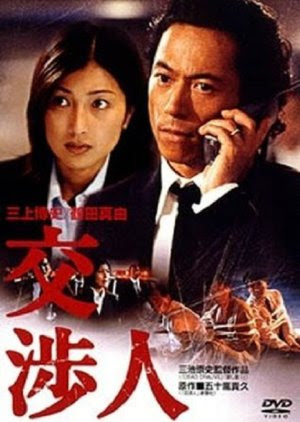
Negotiator (2003) [Film Review]

Negotiator; or, Seeking Justice
     Selflessness. Killing the self, is the hardest thing to do.
I admit that I am not a massive fan of Takashi Miike, but I don’t mind checking out his earlier works from time to time. In fact, I think that his movies from the 1990s/early 2000s are more interesting than later endeavours (such as Ace Attorney (2012)
Shield of Straw (2013)). As a result, I was pleasantly surprised when I stumbled upon Negotiator from 2003 (not to be mistaken with Negotiator: Mashita Masayoshi (2005) and The Negotiator: The Movie (2010)). This somewhat forgotten entry from Miike’s filmography serves as a proof that the director can craft an engaging drama with a touch of suspense.
Release Info
Directed by: Takashi Miike Starring: Hiroshi Mikami, Mayu Tsuruta, Shiro Sano, Kumi Nakamura
Language: Japanese Original Title: 交渉人 Runtime: 107 min
Synopsis
Inspector Ishida (Hiroshi Mikami) and Captain Tohno (Mayu Tsuruta) are two professional negotiators who handle the most difficult stand-off situations. There are rumours circulating that they might have been in a relationship but nothing is confirmed, especially in view of the fact that Ishida takes care of his ailing wife (Kumi Nakamura). All of a sudden, a group of masked men robs a convenience store, only to leave and barricade themselves in a hospital and take 27 patients as well as 3 doctors hostage. Tohno arrives at the scene and begins the negotiations, but she is relieved from her duties by Ishida who takes over the case. It turns out that Ishida’s wife is one of the captives. Although the negotiations go smoothly and the patients are quickly released, the criminals vanish without a trace, together with the physicians...
In the Line of Duty
One could think on the basis of the title that Negotiator is yet another police procedural endowed with standard cliches and plot twists of the genre. Indeed, this seems to be the first impression at the very beginning when we are presented with Ishida’s inconsequential actions towards the mysterious criminals (who basically have no motive for taking over a hospital). However, as the story progresses, more and more backstory is revealed through extensive flashbacks (the perspectives of Ishida and Tohno are especially essential). Evidently, I am not going to spoil anything (although the film is 17 years old already), so let me just express words of appreciation for Kota Yamada and his thoughtful screenplay.
Apart from focusing on the themes of crime and (in)proper punishment, Negotiator also excels at building a very grim and dark tone. This is what I regard to be the film’s only disadvantage because even though the third act is extremely powerful and provides a social commentary on the modern judiciary system, it is also very harrowing as well as depressing. As a result, the rewatch value of the film is brought down to zero.
With regard to performances, I am not that familiar with other roles of Hiroshi Mikami and Mayu Tsuruta, but they did a great job as the leads. In addition, Kumi Nakamura was excellent as Mrs Ishida. Shiro Sano was also convincing as a police detective who is outwitted in the film’s finale. What is more, such awesome stars as Kenichi Endo, Masato Ibu, and Yoji Tanaka appear in small supporting parts.
Recommendations
If you would like to check out Takashi Miike who does not rely on a wacky screenplay, excessive gore, and special effects, then I recommend Negotiator. It is a very neat crime flick if you are in the mood for reflective dramas. Yet another Koshinin deserves to occupy a place next to Yusuke Santamaria’s film and Ryoko Yonekura’s franchise.
Overall score: 7/10
«Enjoyed this post? Never miss out on future posts by following us»

Zatoichi (2003) [Film Review]

Zatoichi; or, Blind Justice
    Even with my eyes wide open, I can’t see a thing.
The character of Zatoichi, a blind swordsman conceived by writer Kan Shimozawa, is deeply engraved in Japanese popular culture and remains a cultural icon similar to Tora-san and Godzilla. Throughout the period between 1962 and 1989 the character was played by an acclaimed actor Shintaro Katsu in 26 theatrical movies and 100 episode-long TV show. The 2003 Shochiku production is both a stand-alone movie and an homage to the classic series.
Release Info
Directed by: Takeshi Kitano Starring: Takeshi Kitano, Yuko Daike, Michiyo Okusu, Akira Emoto
Language: Japanese Original Title: 座頭市 Runtime: 116 min
Synopsis

Zatoichi (Takeshi Kitano) is a blind masseur who roams through the Japanese countryside. He reaches a small town which is torn between rivaling yakuza gangs. The war for influence pushes ordinary citizens into poverty as the gangs take over businesses and demand extraordinary amounts of protection money. Zatoichi joins forces with other people who have enough of this exploitation and takes a stand against the gangsters.
Welcome to Lawless Japan
I have frequently heard about this movie over the years, even more so than about the Shintaro Katsu series. Allegedly, Takeshi Kitano made this movie in order to prove that he can make an entertaining action flick. Indeed, Zatoichi is a radical departure from Takeshi’s slow-paced, existential style. The director/writer/actor/editor created the world of flashing blades, ruthless gangsters, and dancing villagers.
Kitano stated in an exhaustive being-the-scenes documentary that he wanted the movie to be dynamic and look like a computer game. He certainly achieved his intention with many amazing fight sequences and gripping cinematography. The scenes at the inn or at Aunt Oume’s house are simply beautiful.
In addition, even though the movie is connected with the Shintaro Katsu series, it could very well be counted as part of the universe, because the bad guys recognise Zatoichi and the main hero even has a flashback of a spectacular showdown in rain. Still, Kitano provides his personal spin on the Zatoichi mythos, bringing his story arc closer to that of Akira Kurosawa’s Yojimbo (1961). To be honest, my favourite action scene of the movie was Zatoichi’s confrontation with the bodyguard Hattori (played by the great Tadanobu Asano).
What is more, keep an eye out for the final scene. I was totally surprised that Kitano put a Broadway-like number in his movie. It is a ridiculous fun to watch. My respect goes to The Stripes troupe who pulled this off.
With regard to performances, the cast of this movie is outstanding. Takeshi Kitano provides a rougher interpretation of Zatoichi, devoid of happy-go-lucky vibes and musings about morality. Another great performance is that of Yuko Daike as Okinu, a woman who wants to avenge the death of her parents (She looked exactly like Ruriko Asaoka from Goyokin (1969)). There are also great supporting parts done by such veterans as Ittoku Kishibe, Michiyo Okusu, and Akira Emoto.
Recommendations
I highly recommend Zatoichi to chanbara lovers and ordinary viewers. Takeshi Kitano’s take on the blind swordsman story is definitely unique and extremely engaging. Even though I’m a fan of Shintaro Katsu movies, I am a little disappointed that we did not get a sequel to Kitano’s version. At least, there was Ichi (2008), but it is a subject for another review.
Overall score: 8/10
«Enjoyed this post? Never miss out on future posts by following us»