Men always seem to think about their past before they die, as though they were frantically searching for proof that they truly lived. ~ Jet Black
As promised last week, I am back with my blog post about the popular anime series from the late 1990s: Cowboy Bebop. Well, better late than never. Cowboy Bebop was part of my introduction into the realm of anime over 10 years ago, and I have been meaning to write about this show for a long time. However, as in the case of GTO, I avoided doing it because this show is such an all-time classic. To be honest, I regard Cowboy Bebop together with Outlaw Star and Trigun as the Holy Trinity of the animated space western genre. However, all three series exhibit radically idiosyncratic styles. I mentioned in my special review of Outlaw Star that I have some issues with Cowboy Bebop, and today allow me to explain what I meant. Whereas Outlaw Star (and Trigun) seem very modernist and traditional with their approach towards the concept of a hero and his journey (the monomyth), Cowboy Bebop, in contrast, appears to be a deeply postmodernist show. It is, in fact, a disjointed, freewheeling story about a too-cool-for-school bounty hunter who is unable to escape his own past.
First things first, so let’s briefly summarise what the show is about. It was originally conceived by Shinichiro Watanabe and the creative staff led by him in Sunrise animation studio. Bebop presents us with a not-so-distant future, namely the year 2071 in which Earth is almost uninhabitable due to a hyperspace gateway incident. As a result, humanity has colonised the rest of the Solar System, which unfortunately led to skyrocketing crime rates. In consequence, the Inter Solar System Police authorised the profession of bounty hunters (aka Cowboys) who catch criminals alive and return them to law enforcement for financial reward. Spike Spiegel, Jet Black, Faye Valentine, Ed, and Ein accidentally form the bounty hunting crew of a ship called Bebop. It is difficult for me to explain why, but I felt the need recently to revisit Cowboy Bebop. I tried to do this a few years ago (during the pandemic), but I tuned out after a couple of episodes, bitterly labelling the show as dated (that’s how hardwired I am in my unconditional love for Outlaw Star). However, now, as a person who is over 30, I looked at the show in a different light. I really do not want to nitpick Cowboy Bebop, so let me say that after so many years, this anime is still great fun. I nearly forgot how good some of the episodes were, and the light-hearted storylines really brought a smile to my face, such as Stray Dog Strut, Gateway Shuffle, Toys in the Attic, Bohemian Rhapsody, and Wild Horses. This is exactly the type of cheerful, escapist entertainment I needed.
As a result, Cowboy Bebop really excels in the fun department and effortlessly hits the same strides as Outlaw Star and Trigun. However, what makes it truly different is the way in which the show handles the serious stuff. Evidently, we have stand alone episodes about the tragedies of side characters Spike encounters/has to fight, as in the case of Asteroid Blues, Sympathy for the Devil, Heavy Metal Queen, and Waltz for Venus. Spike confronts these characters in the fashion of 1980s action drama heroes (see Magnum PI) and these interactions, and their unfortunate fates, make him grow as a protagonist.
However, the whole seriousness concerning Spike’s personal past is just so stereotypical that it devours the enjoyment of Cowboy Bebop for me. Yes, I get it. Spike is a cool guy, so he was a criminal in the past, and he was in love, but the villain character of Vicious (to my mind) is way too exaggerated. Indeed, he has a cool introduction in the opera house, but it is all there is to his depth: showmanship. The show never made me care about Vicious. I can understand he was a caricature of John Woo’s bromance-charged villains, but things did get lost in translation, which ultimately renders Spike’s story arc flat for me. Nevertheless, Spike’s past is not the only concern of the show. Jet Black faces his own demons in Ganymede Elegy and Black Dog Serenade, and so does Faye Valentine in My Funny Valentine and Speak Like a Child. The way the supporting characters have to deal with their trauma is done perfectly. Time and time again, they try to avoid it, escape it, but the past eventually catches up with them and forces them to evaluate their identity. Jet and Faye really “carry that weight.” Still again, what about Spike? He confronts Vicious head on three times in the show, and this ultimately leads to his death. Perhaps the character truly needed this kind of bleak retribution (he wanted to know if he is alive), but I as an audience member did not. Spike choses death instead of carrying his weight (isn’t it cutting corners?), and this ultimately makes the show a downer, especially if you are a 30/40-something adult dealing with responsibilities of life.
So, here we are. Instead of a typical review, I blurted out my chain of incoherent thoughts about Cowboy Bebop. Thank you for reading, and if you have your own opinions about the series, feel free to share them. Hopefully, next week, I will try to discuss something else. In the meantime, Life is But a Dream and See You Space Cowboys.
«Enjoyed this post? Never miss out on future posts by following us»
A boy has the right to dream. There are endless
possibilities stretched out before him. What awaits him down the path, he will
then have to choose. The boy doesn't always know. At some point, the boy then
becomes an adult and learns what he was able to become. Joy and sadness forever
will accompany this. He is confronted with the choice. When this happens, does
he bid his past farewell in his heart? Once a boy becomes an adult, he can no
longer go back to being a boy. The boy is now a man. Only one thing can be
said: A boy has the right to dream, for those endless possibilities are
stretched out before him. We must remember… All men were once boys.
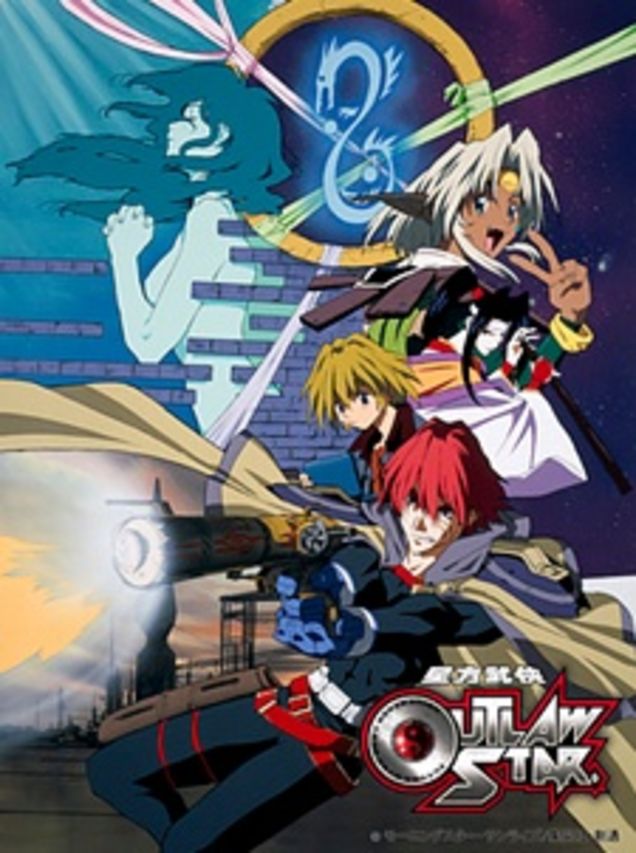
This is the first time when I try to review an anime series.
"Why?" you might ask. Evidently, I don’t want to flow this blog with numerous reviews
of animations, but simply, I decided to write something different this time.
For this occasion, I would like to discuss my favourite anime of all time: Outlaw
Star.
Language: JapaneseOriginal title: 星方武侠アウトロースター No. of eps: 26
Synopsis
Universe in the distant future. Gene Starwind is a young
bounty hunter who lives on a planet called Sentinel III and runs a business
together with an 11-year-old computer expert, Jim Hawking. One day, a
mysterious woman asks them for protection. It turns out that she is Hilda, an outlaw
who is on the run from the Kei pirates. Due to an unexpected chain of events, Gene
and Jim suddenly leave their home planet and end up in the possession of a
top-of-the-line Grappler-class ship which Gene calls Outlaw Star. With the help
of Melfina, the ship’s navigator; Twilight Suzuka, the assassin-for-hire; Aisha
Clan-Clan, the Ctarl-Ctarl Empire emissary; and Gilliam, the ship’s computer,
the newly-formed crew sets out on a quest full of adventures in order to find
the mythical Galactic Leyline.
You Better Get Ready!
I decided to review Outlaw Star, because I recently got my
hands on the beautiful Blu-ray/DVD release from Funmation. Having
revisited the series, I am astonished how entertaining it is after all these
years when I saw it for the first time. All the more reason I can’t stand
modern criticism of Outlaw Star which aims at picturing the series as an
inferior cousin of Cowboy Bebop…
Okay, where should I start? First of all, it should be noted
that Outlaw Star began, in fact, as a manga series created by Takehiko Ito in 1996 and was turned into anime two years later by the famous Sunrise
production company. The series consists of 26 episodes which originally ran
from January 8 to June 25, 1998. To date, the series has not received any sequel,
apart from a spin-off known as Angel Links.
As with every other science-fiction piece, the viewers are
transported into a completely unfamiliar world. We get to discover the wondrous
universe together with the main protagonist, Gene Starwind, a hot-headed, but
well-meaning, adventurer who learns in the first episodes about the three major
powers in the cosmos: the Space Forces, the Pirates, and the Outlaws.
Naturally, Gene chooses to become an outlaw, a drifter (not a criminal) unaffiliated
with any group or authority (either good or bad).
The series begins on a dynamic note and does not slow down,
not even for one moment throughout all the episodes. There is always something
happening and our heroes are faced with overcoming increasingly difficult
challenges. The universe itself is incredibly rich, because apart from the
aforementioned three forces, there is also a mixture of a whole slew of various
races, robots, and baddies, as if Star Trek, Blade Runner, and Indiana Jones
collided together only to create the wild west in space. Oh, did I mention that
there is also room for magic in this show? Yes, we have crazy Kei Pirates
fighting their way through with spells and Gene shooting at the bad guys from
the ancient Caster gun.
This leads me to another aspect which is the characters and
their progress through the story. Believe it or not, but each member of the
crew has a clear story-arc and undergoes a personal change towards the end.
Even though maybe some of the heroes are touched upon rather than fleshed out,
each and every one of them has their own 5 minutes. Gene has to overcome his
fears and doubts, Jim learns the hard way about love, Melfina seeks the true
meaning of her identity, Suzuka desires to avenge her past, and Aisha wants to
prove her worth. Although these heroes are out of this world, they are so
relatable because of their realistic attitudes which can be found in each of
us.
One more thing which I should mention is the animation. Some
critics claim that the show is literally too dark, without any scenes happening
in daylight. Nothing could be further from the truth. Outlaw Star is full of
colours and the picture is crystal clear with balanced contrast. In addition,
the crew does not fly all the time against the background of black space, but
the universe itself is actually lively and colourful with nebulae, orbital
waves, and stars. With regard to the animation itself, the characters and ships
are drawn just beautifully. Their details are especially visible during the thrilling
fight sequences. I can’t take my eyes off them. This is classic cell animation
for you.
Oh! The music score by Kow Otani is a whole another
thing. Not only does it provide the series with appropriate upbeat, sci-fi
mood, but it also has a life of its own. Even today, I can recall my high
school days when I was listening to this awesome music and reminiscing all of
the climatic scenes from the anime. In other words, the auditory part of Outlaw
Star is amazing. Just head over youtube if you need any proof. Additionally,
there were three songs made for the show. The glorious opening theme “Through the Night” written and performed by Masahiko Arimachi (that intro!) and two
ending compositions: “Hiru no Tsuki” and “Tsuki no le”, written and
performed by Akino Arai.
Having said all this, I believe that the following
conclusion should finally be stated: Outlaw Star does not suffer from any
shortcomings. Some anime connoisseurs would like to think otherwise, but their
claims about unevenly paced story, weak animation, and underdeveloped
characters are bogus. In the same way, it’s easy for me to say that Cowboy Bebop
is not paced well, animation could have been better, and some characters could
have been more elaborated upon. Here’s a newsflash: I re-watched Cowboy Bebop and
this show aged greatly in my eyes, but I am not attacking it just because it is
a competing space-western for Outlaw Star. Both of these are classic anime
stories in their own unique ways.
Recommendations
All things considered, Outlaw Star is an underrated
masterpiece. It has everything which a good and escapist story needs plus more.
Wonderful universe, unforgettable characters, excellent voice acting, and the
story full of classic motifs and archetypes that would make Jordan Peterson
envious. Even if you’re not an anime fan, but you like space westerns, such as (indistinct hiss) Firefly or Guardians of the Galaxy, this is a must see. To me, Outlaw
Star’s crew will always be number one in my heart. All systems green!