Showing posts with label anime. Show all posts

City Hunter (1987) [Anime Review]

City Hunter; or, Mokkori Mania
     There’s a chance you will celebrate your next birthday in hell.
Inspired by the Netflix live-action adaptation of City Hunter that came out this year, I decided to finally check out the glorified anime series from the 1980s that ran for four seasons and was followed by theatrical OVAs. My motivation for picking up the anime consisted mainly of action-packed vibes of the previously discussed movie, but also of the opinions of my dear MDL friend, SumiTheCat.
Release Info
Developed by: Toshio Nakatani, Masuo Ueda Voice actors: Akira Kamiya, Kazue Ikura
Language: Japanese Original Title: シティーハンター No of eps.: 51 (season 1)
Synopsis
Ryo Saeba is a sweeper for hire. He basically rushes to action as a detective, bodyguard, or enforcer for hire whenever the police are helpless. Oftentimes, he aids beautiful women simply because… he likes beautiful women. People in need get in contact with Saeba by leaving the XYZ mark on a blackboard at Shinjuku Station. Initially, Saeba operates the business with a friend and former cop Makimura, but when he gets killed by mobsters, his sister Kaori takes over as City Hunter’s partner.
Get Wild
I have to say that as a person struggling with anhedonia, it’s really hard for me these days to find an anime that would satisfy me and hold my disastrous attention span, but City Hunter does the job! I was quite surprised how brisk and freewheeling it felt. Obviously, the manga and the first season of the anime are from the 1980s, so they are products of their times, and it was quite easy to replicate the sense of Bubble Era, City Pop-charged mania of lavish lifestyle that consumed Japan back then.
With regard to the storytelling perspective, I invite you to check out the anime in its original, uncensored form. Yeah, it has a lot of adult jokes (it goes without saying that Ryo Saeba is a perverted man), but these are kept within the safe-for-work confines and not as direct or brutal as in, for instance, the Golden Boy anime.
Jokes aside, I’m a big fan of crime dramas (even to such an extent that once I used to watch Columbo and Detective Conan religiously) and City Hunter very much delivers on that front as well. Of course, the show is not about murder mysteries, but I like the premise of Saeba doing “bare minimum” detecting to uncover the baddies and serve them the comeuppance they deserve.
When it comes to the animation style, I love the bright colours this anime uses. They are vivid, but subtle, not flashy. As a result, the nightly world of City Hunter looks all the more inviting. The action stuff is of course wonderful, and it makes you wonder that the only rival worthy of Saeba’s skill would be Golgo 13.
The music itself is also worth mentioning. It’s not very City Pop (unfortunately), but the incidental bits are quite jazzy and catchy. However, I absolutely adore the opening theme Cool City and the closing theme Get Wild. It’s awesome that the Netflix crew used Get Wild for the closing credits of their adaptation.
Recommendations
All things considered, I am writing this review right after finishing the first season of the anime, but I really want to continue on watching and check out the whole animated domain of City Hunter. Maybe perhaps I will reach out for manga at some point in the future, but this is highly unlikely. Yeah, I definitely recommend this anime if you are looking for something light and fun.
Overall score: 8/10
«Enjoyed this post? Never miss out on future posts by following us»

AD Police Files [OVA Review]

 AD Police Files; or, Stop! An officer will shoot

     At least she died as a woman.
The weather outside is as beautiful as ever this time of the year, so it makes me all the more surprised that I found myself in the mood for some gloomy cyberpunk feels. Needless to say, I decided not to look for the most popular instances of the genre recommended on the internet, but instead I went for something more obscure. As a result, I ended up watching AD Police OVA from the year 1990.
Release Info
Directed by: Akira Nishimori Voice actors: Toshio Furukawa, Youko Matsuoka
Language: Japanese Original Title: ADポリス No. of eps: 3
Synopsis
It’s the year 2027. The advancements in the field of cybernetics allow people to replace their organs with artificial substitutes. There are also fully automated androids known as Boomers. If Boomer goes haywire and commits a crime, they are chased by the special mad criminal investigation unit known as AD Police.
Blade Running

It should be noted that AD Police is a spin-off series of the Bubblegum Crisis franchise. Actually, the title card at the beginning of each of the three OVA episodes says directly “Another Story of Bubblegum Crisis”. The events of the OVA take place before the first series of Bubblegum Crisis and indirectly focus on the cop character of Leon McNichol and his partner Gina Marceau.
With regard to AD Police,I have to say that I really like the traditional animation style because it’s really evocative of its late 80s/early 90s era. In terms of the visuals themselves and storyline themes, however, you can’t help but notice the overwhelming influence of Ridley Scott’s Blade Runner. AD Police grows out of the world crafted by Phillip K. Dick in which the uniqueness of human life is constantly questioned amidst hordes of androids who also have their fair share of desires, fears, and personal introspection.
That being said, I kind of regret watching this OVA primarily because of its NSFW content. With each episode, things get so adult-oriented and explicit that by the end of it, I felt as if I was watching hentai. Sure, the plot of each episode is engaging enough, but the way these are handled leaves a lot to be desired.
Allegedly, there were supposed to be more episodes of the OVA, but the studios responsible for it fell into some sort of dispute. As a result, AD Police had its continuation years later in the form of another short-lived series and a reboot OVA. People responsible for the creation of AD Police were Tony Takezaki and Suzuki Toshimitsu, who also crafted a manga called AD Police: Shuuen Toshi.
Recommendations

All things considered, AD Police Files is a product of its time when there was a huge boom on cyberpunk in the anime industry. Some franchises grew larger than life and lived to tell the tale through decades (see Akira and Ghost in the Shell) but many weren’t so lucky, including AD Police. If you want to get some entertainment value from this, I suggest you watch the whole OVA series at one go in the middle of the night and crank up the volume for the intro song and ending songs. It’s a fairly nice schlock anime experience for one time.
Overall score: 5/10
«Enjoyed this post? Never miss out on future posts by following us»

You are going to carry that weight: Revisiting Cowboy Bebop [Editorial]

 
Men always seem to think about their past before they die, as though they were frantically searching for proof that they truly lived. ~ Jet Black
 
     As promised last week, I am back with my blog post about the popular anime series from the late 1990s: Cowboy Bebop. Well, better late than never. Cowboy Bebop was part of my introduction into the realm of anime over 10 years ago, and I have been meaning to write about this show for a long time. However, as in the case of GTO, I avoided doing it because this show is such an all-time classic.
     To be honest, I regard Cowboy Bebop together with Outlaw Star and Trigun as the Holy Trinity of the animated space western genre. However, all three series exhibit radically idiosyncratic styles. I mentioned in my special review of Outlaw Star that I have some issues with Cowboy Bebop, and today allow me to explain what I meant. Whereas Outlaw Star (and Trigun) seem very modernist and traditional with their approach towards the concept of a hero and his journey (the monomyth), Cowboy Bebop, in contrast, appears to be a deeply postmodernist show. It is, in fact, a disjointed, freewheeling story about a too-cool-for-school bounty hunter who is unable to escape his own past.
     First things first, so let’s briefly summarise what the show is about. It was originally conceived by Shinichiro Watanabe and the creative staff led by him in Sunrise animation studio. Bebop presents us with a not-so-distant future, namely the year 2071 in which Earth is almost uninhabitable due to a hyperspace gateway incident. As a result, humanity has colonised the rest of the Solar System, which unfortunately led to skyrocketing crime rates. In consequence, the Inter Solar System Police authorised the profession of bounty hunters (aka Cowboys) who catch criminals alive and return them to law enforcement for financial reward. Spike Spiegel, Jet Black, Faye Valentine, Ed, and Ein accidentally form the bounty hunting crew of a ship called Bebop.
     It is difficult for me to explain why, but I felt the need recently to revisit Cowboy Bebop. I tried to do this a few years ago (during the pandemic), but I tuned out after a couple of episodes, bitterly labelling the show as dated (that’s how hardwired I am in my unconditional love for Outlaw Star). However, now, as a person who is over 30, I looked at the show in a different light.
     I really do not want to nitpick Cowboy Bebop, so let me say that after so many years, this anime is still great fun. I nearly forgot how good some of the episodes were, and the light-hearted storylines really brought a smile to my face, such as Stray Dog Strut, Gateway Shuffle, Toys in the Attic, Bohemian Rhapsody, and Wild Horses. This is exactly the type of cheerful, escapist entertainment I needed.
     As a result, Cowboy Bebop really excels in the fun department and effortlessly hits the same strides as Outlaw Star and Trigun. However, what makes it truly different is the way in which the show handles the serious stuff.
     Evidently, we have stand alone episodes about the tragedies of side characters Spike encounters/has to fight, as in the case of Asteroid Blues, Sympathy for the Devil, Heavy Metal Queen, and Waltz for Venus. Spike confronts these characters in the fashion of 1980s action drama heroes (see Magnum PI) and these interactions, and their unfortunate fates, make him grow as a protagonist.
 
    However, the whole seriousness concerning Spike’s personal past is just so stereotypical that it devours the enjoyment of Cowboy Bebop for me. Yes, I get it. Spike is a cool guy, so he was a criminal in the past, and he was in love, but the villain character of Vicious (to my mind) is way too exaggerated. Indeed, he has a cool introduction in the opera house, but it is all there is to his depth: showmanship. The show never made me care about Vicious. I can understand he was a caricature of John Woo’s bromance-charged villains, but things did get lost in translation, which ultimately renders Spike’s story arc flat for me.
     Nevertheless, Spike’s past is not the only concern of the show. Jet Black faces his own demons in Ganymede Elegy and Black Dog Serenade, and so does Faye Valentine in My Funny Valentine and Speak Like a Child. The way the supporting characters have to deal with their trauma is done perfectly. Time and time again, they try to avoid it, escape it, but the past eventually catches up with them and forces them to evaluate their identity. Jet and Faye really “carry that weight.”
     Still again, what about Spike? He confronts Vicious head on three times in the show, and this ultimately leads to his death. Perhaps the character truly needed this kind of bleak retribution (he wanted to know if he is alive), but I as an audience member did not. Spike choses death instead of carrying his weight (isn’t it cutting corners?), and this ultimately makes the show a downer, especially if you are a 30/40-something adult dealing with responsibilities of life.
     So, here we are. Instead of a typical review, I blurted out my chain of incoherent thoughts about Cowboy Bebop. Thank you for reading, and if you have your own opinions about the series, feel free to share them. Hopefully, next week, I will try to discuss something else. In the meantime, Life is But a Dream and See You Space Cowboys.
«Enjoyed this post? Never miss out on future posts by following us»

Was Great Teacher Onizuka Right? [A Personal Perspective]

 
We cannot go back to the past, no matter how hard we try. No matter how wonderful it was. The past is nothing but the past. ~ Eikichi Onizuka
 
Hello and welcome to my first blog post of 2024 after a long-ish, six week break. First of all, I feel that I need to explain my absence. Evidently, I wanted to continue writing right after Christmas but a set of personal circumstances forced me to adjust my schedule. In addition, I did not have time (and I was not in the mood) to watch absolutely anything. In fact, throughout January, I managed to see some random stuff on TV and only one(!) movie, which was Amadeus (1984).
     What is more, there is one more important factor responsible for my absence that is connected with the topic of today’s editorial. That is to say, I have made a New Year’s Resolution to become a better teacher for my students. Yes, some of the readers may already know this from the context of my previous reviews and articles. I have been working as a high school teacher for two years now (previously I worked at a university), and it is a very challenging profession at times. Of course, everybody has a different perception of it, depending on their place of birth, but where I live, it is not a line of employment held in high esteem by society (but more on that later).
     The beginning of the current school year was particularly challenging for me. Apart from regular teaching, I got an increase in work hours, I became a homeroom teacher to a class of first graders, and I also had to oversee a team of new teachers in terms of bureaucratic paperwork. The period between September and November was very exhausting for me, and I didn’t feel like a teacher at all, but more like an administrative official who had to mediate his way between students, teachers, and principals.
     Thankfully, things did calm down towards the end of December and I had some time to recharge my batteries and think clearly. It was at that time when I made a firm decision to limit the overbearing paperwork to an absolute minimum and focus primarily on regaining that teaching spark. I even began to re-educate myself, looking for the latest information on classroom management techniques and learning/acquisition strategies other than traditional textbook cramming.
     This is where GTO comes in. For those of you who do not know, Great Teacher Onizuka is a popular Japanese franchise created by manga artist Tooru Fujisawa in 1997. It initially started with a 25-volume manga series that received subsequent continuations and iterations in other media. In 1998, it was turned into a J-Drama. In 1999, there was a theatrical movie as well as a 43-episode anime series. In 2012, GTO was remade again as a J-Drama by Fuji TV. The series tells the story of an ex-bosozoku gang member Eikichi Onizuka who barely finishes studies allowing him to become a teacher. He finds a job at a private middle school in Tokyo, and he is assigned to the most troublesome class. Nevertheless, Onizuka’s unconventional techniques quickly lead to changes in the mentalities of unruly students.
     To be honest, I am a fan of the whole franchise, but the 1998 series with Takashi Sorimachi stole my heart, and to date remains my favourite interpretation of GTO. I have been meaning to write about this drama on the blog for years, but I never felt I had anything innovative to say about this all-time classic. However, in this article, I would like to put it in perspective with regard to my work.
     Consequently, when I was scavenging the abyss of the internet in search of information that might help me on my teaching journey, I stumbled upon a reddit discussion about the validity of techniques used by Onizuka-sensei. This discussion really got me thinking. Evidently, Onizuka is this larger-than-life, too-cool-for-school character with a deep sense of morality overshadowed by typical manga wackiness. However, it is difficult to see him do any actual teaching in the series(!) Yes, sometimes in the drama we see him holding a coursebook for social sciences, so at least we know what subject he is supposed to teach, but that is it!
     Ultimately, Onizuka’s teaching purpose is about conveying life wisdom to his students. He is not teaching them hard theory, but how to live a life. In this manner, Onizuka is yet another fictional teacher in the pantheon of mentor characters like John Keating, Mark Thackeray, and William Hundert who always strived to inspire their students and often treated them like adults. Perhaps this is the most uplifting takeaway from GTO for any struggling teacher: Onizuka persistently broke the stale teacher/student power dynamic, going out of his way to show his students that he does not look down on them.
 
    Still again, “educational” techniques used by Onizuka to achieve his goal leave a lot to be desired. If I were to repeat them, I would certainly end up in jail for jeopardising the health and safety of my students by jumping off a roof, getting into a fight with bikers, busting into a student’s home with a sledgehammer, or playing chicken with a speeding truck. However, I wouldn’t mind wrecking the vice-principal's Toyota Cresta every week.
     Point of the matter is that you will not learn anything about classroom management techniques from GTO (you are better off watching Dragon Zakura instead); however, GTO teaches you about employing a different approach towards your students. Onizuka, in contrast to fellow peers in the teacher’s lounge, understands that teaching is actually a relationship game. Hating your students will not get you anywhere. You should make an effort and familiarise yourself with them, even when they are troublemakers. Remember their names, ask them about their interests. greet them at the beginning of every lesson, and say goodbye when they leave.
     Kindness doesn't cost much, but for many teachers in my country it is an impossible feat. I know from experience that many (not all) teachers here are just in it for the money. They often lack necessary knowledge to conduct a subject, let alone conduct a proper class with beginning, middle, and end. This situation only fuels students’ unwillingness to learn. I know I can’t change the world, but at least I can work on bettering myself.
     All things considered, the past six weeks of teaching were extremely rewarding for me. This is not the time and not the place to get into personal specifics, but my adjusted approach resulted in many unexpected, kind-hearted situations with my students, and I feel really proud because of that. My thanks go to my dear friend @penel from MDL who was willing to patiently hear my stories.
 
    So, coming back to the question of this editorial: Was Great Teacher Onizuka right? Well, he was definitely right about changing your perspective and attitude to your students. And this made me like the character even more. Thank you for sticking by, I did not think this editorial would be so long. Next week, I will try to write something related to Cowboy Bebop (hopefully)!
«Enjoyed this post? Never miss out on future posts by following us»

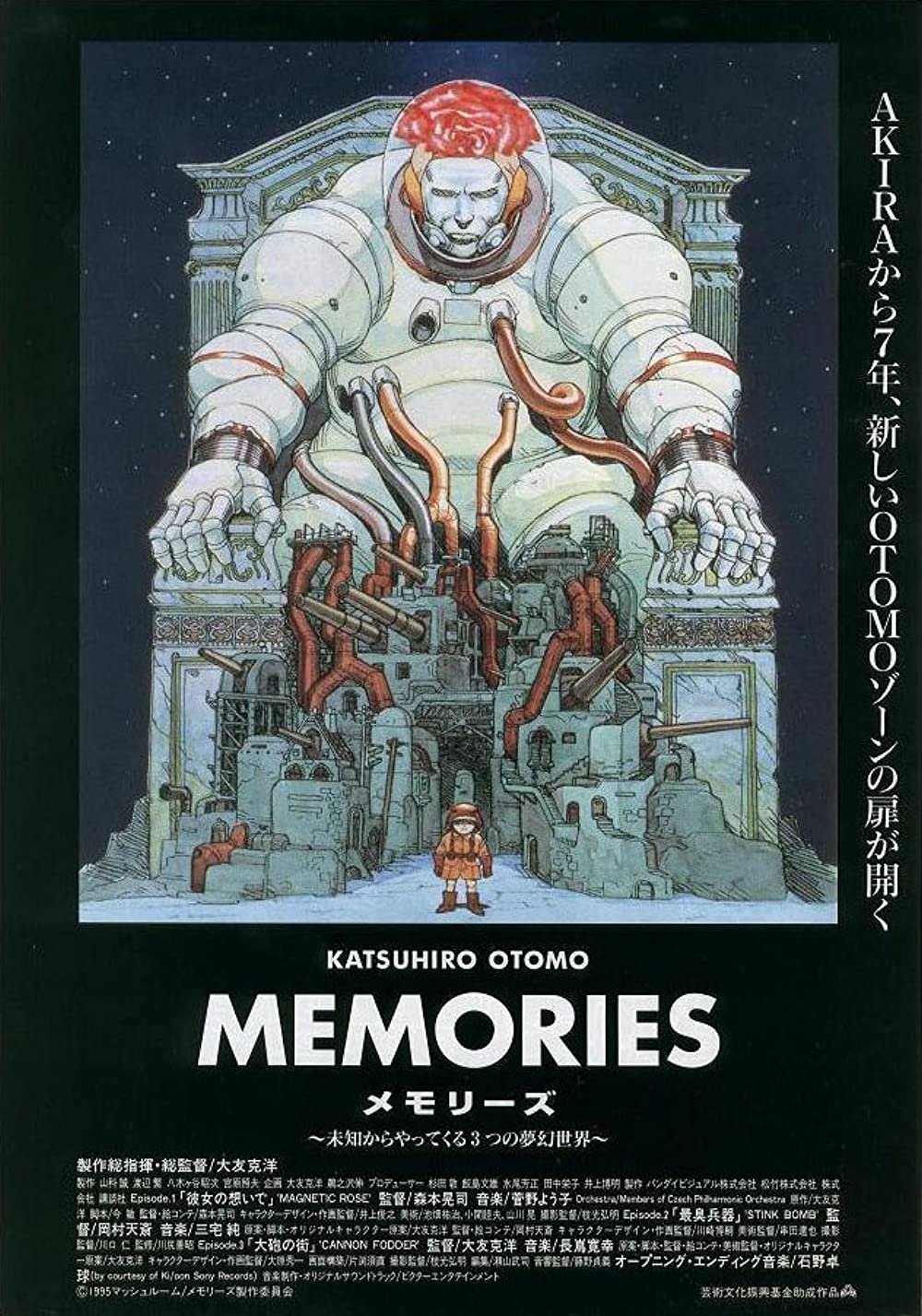
Memories (1995) [Anime Review]

Memories; or, Space Butterfly
     Memories aren't an escape!
I think it would be fitting to begin this review by stating that After Akira there were Memories… How come no distribution label used this as a tagline?! So yes, indeed, Memories is an anime feature, an anthology of science-fiction tales to be exact, adapted from manga stories created by Katsuhiro Otomo.
Release Info
Directed by: Koji Morimoto, Tensai Okamura, Katsuhiro Otomo
Language: Japanese Original Title: メモリーズ Runtime: 113 min
Synopsis
The movie presents us with three stories: Magnetic Rose; Stink Bomb; Cannon Fodder. The first one is basically a rescue mission in deep space which goes totally wrong. The second one presents us with a scientific worker who wakes up from a nap and discovers that all of his colleagues are dead. Whereas the final vignette introduces a bizarre world of a society that is at war with an unknown enemy and their lives constantly revolve around cannons.
In the Realm of Sci-Fi
I do not want to call this movie a spiritual companion to Akira (1988), but it goes without saying that Memories bears a distinct auteur mark of Katsuhiro Otomo in terms of animation style, colours, and motion fluidity. Nevertheless, this is first and foremost a joint-project made by three directors and their distinct visions.
As a result, Koji Morimoto’s Magnetic Rose consumes the majority of the film’s runtime, and rightfully so, because it is a stunning piece of sci-fi storytelling. It obviously takes visual cues from Alien (1979) and 2010: The Year We Make Contact (1984), but this segment also manages to precede with its ingenious storyline Paul W. S. Anderson’s Event Horizon (1997). Magnetic Rose is an enchanting (Madama Butterfly!) yet at the same time demanding viewing experience. I felt so exhausted towards the end that I had to take a break and check out the remaining parts of Memories later on.
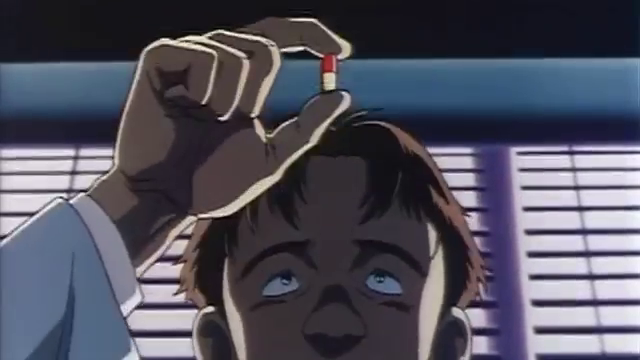
Tensai Okamura’s segment called Stink Bomb is undoubtedly the most light-hearted one in the entire movie. Thanks to bright visuals and kick-ass jazz/funk music score by Jun Miyake, the viewers can have a laugh at the wild misadventures of Nobuo Tanaka, a nerdy scientist who is determined to transport a top-secret drug from Kofu to Tokyo at all costs! This is my personal favourite segment, and allegedly, it was inspired by a real-life incident that took place in the US in 1994.
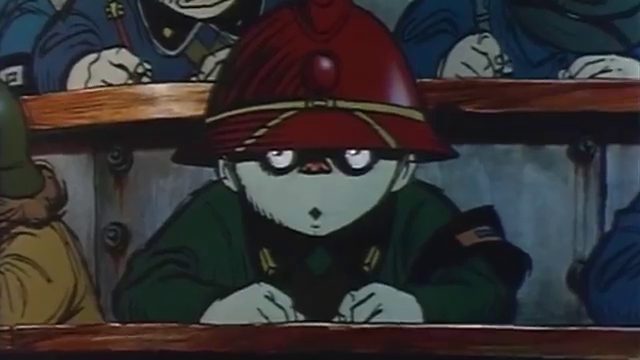
Last but not least, there is Katsuhiro Otomo’s Cannon Fodder. This is, unfortunately, the shortest segment of Memories, yet it does not mean that it is weak or bad. Within 20 minutes, Otomo really grabs you by the heart with his hot take on Fritz Lang’s Metropolis (1927) mixed with a touch of George Orwell’s 1984. Many questions were running through my head with regard to the setting, context, and characters, but Otomo does not provide any answers at all. When a child asks his father about the enemy they are fighting, the father does not provide the details but only replies, “You’ll understand when you get bigger.”
Recommendations
All things considered, I highly recommend Memories if you are in need for a dose of old-school anime science fiction. The movie was released last year on Blu-ray from Discotek Media. I believe it is also available on Tubi, at least according to the letterboxd site.
Overall score: 8/10
«Enjoyed this post? Never miss out on future posts by following us»

Godzilla Singular Point (2021) [Anime Review]

Godzilla Singular Point; or, Kaiju;Gate
     It’s about exploring the structure of the universe. In order to truly understand the world, we must understand that which doesn’t exist within it.
At the height of Godzilla’s popularity due to recent movies, Netflix just can’t let it go at this point, so after the failed anime trilogy, they commissioned a 13-episode anime series, which debuted internationally at the end of June, 2021. My dear readers, please buckle up because this is going to be a wild one. Let’s explore the sci-fi insanity of Godzilla Singular Point.
Release Info
Directed by: Atsushi Takahashi Voice actors: Yume Miyamoto, Shoya Ishige, Taro Kikuchi
Language: Japanese Original Title: ゴジラ S.P <シンギュラポイント> No. of eps.: 13
Synopsis
Michiyuki Ashihara was a genius scientist who witnessed in his youth the destruction of home village by Godzilla. He devoted his life to studying the creature but went missing about 50 years ago. It’s now the year 2030. Yun Arikawa, a handyman working at Otaki Factory, and Mei Kamino, a researcher of imaginary creatures, find themselves on an accidental investigation of a mysterious signal in Ashihara’s abandoned household. The signal turns out to be an old Indian song which supposedly makes Kaiju monsters seep into our reality...
Destination: Predestination
The original trailer for this anime series looked really good but it did not get me hyped up. I guess I am the member of the overwhelming minority that liked the Polygon trilogy of Godzilla films for what they were. Sure, there were no Kaiju fights and a lot of talking, but I appreciated the philosophy behind the story and the attempt to ground the King of the Monsters within the sci-fi convention. Boy, oh boy, nothing prepared for hardcore science-fiction when I watched the first episode of Singular Point.
I guess in order to fully comprehend what is going on in this show, you need to be an enthusiast of mathematics and physics. Perhaps the reason for that is because the main writer himself, Toh EnJoe, has a degree in “mathematical physical study on the natural languages” (I kid you not: source). In Singular Point, you have a dozen of characters, multiple plotlines, and lots of scientific exposition thrown at you. By the middle of the season, you get so overwhelmed that your brain just switches itself off and you stay just to see the monster showdowns.
I am not sure if it is just me, but watching this show made me feel really stupid. All I could understand was that Kaiju monsters are out of this world, they bind the laws of physics, and are able to exist here because of “Red Dust”. On top of that, each monster is like an enclosed universe ready to go into supernova mode, so when they are fighting, they are actually fighting for total dominance on a molecular level, which consequently makes them all “Singular Points”. I think I am way off the mark with this interpretation, but this is coming from a person who thought that figured out all the time travel intricacies of Godzilla vs. King Ghidorah (1991).
The best way to describe this show is to call it a mix between Godzilla, Inception, Lost, and Steins;Gate. It is all about the mystique behind Kaiju monsters, and the series really goes at lengths to rationalise their existence in our world.
That being said, I have to say that there is not a lot of Godzilla in Godzilla Singular Point. The series is mainly about human characters and… Jet Jaguar, who is crazy awesome here! I also liked reinterpretations of other monsters like Rodan and Anguirus. In addition, the fights are simply spectacular. The blending of hand-drawn animation with CGI effects is top notch and very reminiscent of the artstyle from Spiderman: Into the Spider-Verse (2018). In addition, make sure to stay till the end credits of each episode because these are packed with Easter Eggs referring to Godzilla's past.
With regard to human characters, honestly, there are so many of them that I did not feel any emotional attachment to particular individuals. Yun Arikawa and Mei Kamino are at the forefront because they are the protagonists, but the real unsung hero of Singular Point is Pelops II (Mei’s AI programme) who does most of the job and contributes to saving the day in the glorious finale. Huge respect to actress Misaki Kuno for voicing this character.
As for the music, the score was composed by none other than Ken Sawada. He already has enormous experience in the realm of television and anime, so it comes as no surprise that his OST for Singular Point is a solid job from beginning to the end. The score is not as epic as Takayuki Hattori’s composition for the anime trilogy, but I respect Sawada’s nods to Akira Ifukube’s original themes for Godzilla and other monsters.
Recommendations
If you want to experience a unique take on Godzilla, then I recommend Godzilla Singular Point. Just don’t try to understand it, feel it and enjoy the ride. I am positively waiting for the second season (yes, the very last scene of the series implies that there is going to be a continuation).
Overall score: 7/10
«Enjoyed this post? Never miss out on future posts by following us»

Gundress (1999) [Anime Review]

Gundress; or, Mecha Charlie’s Angels
     I lived according to your word. You were everything to me.Your eyes were like those of… a stray dog who had lost a fight. You were scared, and your isolation made you feel that no one loved you. I could understand how the world looked to those eyes. That’s why I was with you. But I misunderstood!
My exploration of good old cyberpunk anime goes on. This time I would like to discuss Gundress, an anime feature from 1999, to which Masamune Shirow contributed as character and mecha designer. Interestingly, the film generated a bit of controversy among anime fans. Well, let’s take a closer look at it.
Release Info
Directed by: Katsuyoshi Yatabe Voice actors: Masako Katsuki, Kumiko Watanabe, Akemi Okamura, Reiko Takagi, Rie Ishizuka, Tomoko Kawakami
Language: Japanese Original Title: ガンドレス Runtime: 85 min
Synopsis
Welcome to the future, it’s the year 2100 in a newly-built Bayside City, an international port. In order to fight off terrorism and smuggling operations, private military organisations step into action. The Angel Arms Company is one of them. It was founded by a former policewoman Takako (Masako Katsuki), and she leads the group composed of six former criminals who now enforce the law in special security suits. The team is ordered to protect an arms-dealer called Hassan (Minoru Inaba) because he might provide some vital information which will enable the authorities to bring down the big crime ring. However, crime lords try to strike back. They send Jean-Luc Skinner (Kenyuu Horiuchi) to kill Hassan. It turns out that the assassin is a former lover of Angel Arms pilot, Alissa (Rie Ishizuka).
At the Edge of Cybernet
I have to say that I checked out Gundress completely without having the knowledge of its troubled production. I think it was for the best. At first glance, Gundress seems to be a small-budget OVA from the late 1980s, similar in production value to Shirow’s other anime project, Black Magic M-66 (1987). However, it appears that Gundress had large financial resources and the backing of a major Japanese studio (Nikkatsu). What is more, it was intended to be a theatrical(!) release. As a result, when comparing Gundress to other sci-fi classics released in cinemas (Akira (1988), Ghost in the Shell (1995)), one can clearly see that something went horribly wrong in the making process.
It cannot confirm this rumour, but (allegedly) moviegoers were given leaflets on the premiere day saying that the film is unfinished and the studio will send them a home video copy later on… I could not find out more about behind-the-scenes drama of Gundress, but undeniably the animation studio could not handle this project properly.
Putting these revelations aside, I have to say that Gundress works well as an OVA played at home on your DVD player. It tries to be as wacky as Dominion Tank Police (1988) and as serious as Ghost in the Shell (1995). In addition, I enjoyed the concept of Charlie’s Angels fighting the bad guys in mechas. Masamune Shirow’s designs are always a pleasure to look at.
What is more, Gundress features an ensemble cast of legendary voice actresses: Masako Katsuki, Kumiko Watanabe, Akemi Okamura, Reiko Takagi, Rie Ishizuka, and the late Tomoko Kawakami. It is worth watching this anime feature, just to listen to their performances.
Recommendations
All things considered, Gundress is harmless fun, but not anything exceptional. If you happen to find it on a cheap DVD, then go ahead and grab it. Certainly, it is not worth the price of a cinema ticket. In my opinion, the storyline would have worked better in the form of a short series rather than a 90-minute picture.
Overall score: 6/10
«Enjoyed this post? Never miss out on future posts by following us»

Black Magic M-66 (1987) [OVA Review]

Black Magic M-66; or, Do Androids Dream of Electric Granddaughters?
     In all honesty, I don't know if any of this really happened. It's kind of hard to imagine that all these soldiers were fighting against two androids.
Having been fired up by Ghost in the Shell S.A.C. 2045, I decided to revisit classic cyberpunk OVAs. Without hesitation, I turned to the visionary himself, Masamune Shirow, and his early creations from the 1980s. My first pick became Black Magic M-66, a 47-minute-long OVA about a military android which went postal. This OVA is based on one of the chapters from Shirow’s first manga series published between 1983 and 1984.
Release Info
Created by: Masamune Shirow Voice actors: Yoshiko Sakakibara, Chisa Yokoyama
Language: Japanese Original Title: ブラックマジック Runtime: 47 min

Synopsis
Due to an accident during an army shipment, two combat androids go haywire and escape their transport pods. As the deadly machines make their way through a forest, Major (Shinji Ogawa) together with his men and the androids’ creator, Professor Matthew (Ichiro Nagai) prepare an ambush. After suffering heavy losses, the army manages to capture and destroy one of the rogue robots. However, the other one is still at large. What is worse, because of the fact that is a Test Programme loaded in its memory, it is determined to track down and execute Matthew’s granddaughter, Ferris (Chisa Yokoyama). A freelance journalist, Sybel (Yoshiko Sakakibara), accidentally learns about the android’s true objective and rushes to save Ferris before it is too late.
Killer in the Shell
To many fans of modern anime out there, Black Magic M-66 may seem to be an outdated and short OVA, but in my opinion, it manages to replicate the thrills and bombastic action sequences from such classic films as The Terminator (1984), Aliens (1986), and Predator (1987). You can clearly notice that Masamune Shirow and co-director Hiroyuki Kitabuko were seeking inspiration in the most popular sci-fi flicks of that time.
The definite assets of this OVA are the storyline and the pacing. There is virtually no exposition, but you immediately feel at ease in this futuristic world that apparently is at some state of Cold War (the character of Major makes a few passing remarks about “spies from the North"). In addition, it is quite poetic to see a female rushing to save another female from a robotic monster (which sort of looks like a female). Oh, and soldiers are finally the good guys! All of this is sprinkled with flying bullets, beaming lasers, and massive explosions which would make Michael Bay feel envy.
The voice acting is also done extremely well. The main character is voiced by none other than Yoshiko Sakakibara herself (a year before she got into the Patlabor franchise) and it is always a pleasure to hear her deep and sensual voice. I also appreciate the input of Shinji Ogawa, Ichiro Nagai (may their souls rest in peace) and Chisa Yokoyama as well as Kyouko Tonguu in the supporting parts. Great music score composed by Joyo Katayanagi and Kengo Kurozumi should not go unnoticed as well.
Recommendations
If you want to check out Masamune Shirow at the beginning of his career, then give Black Magic M-66 a chance. Nothing beats classic cell animation which to date looks great on a TV screen. It is a shame though that this OVA was not turned into a franchise. I see the potential for a 26-episode series and even a live-action film. In the meantime, we all should watch out for androids who are hellbent on killing innocent grandchildren.
Overall score: 8/10
«Enjoyed this post? Never miss out on future posts by following us»