Men always seem to think about their past before they die, as though they were frantically searching for proof that they truly lived. ~ Jet Black
As promised last week, I am back with my blog post about the popular anime series from the late 1990s: Cowboy Bebop. Well, better late than never. Cowboy Bebop was part of my introduction into the realm of anime over 10 years ago, and I have been meaning to write about this show for a long time. However, as in the case of GTO, I avoided doing it because this show is such an all-time classic. To be honest, I regard Cowboy Bebop together with Outlaw Star and Trigun as the Holy Trinity of the animated space western genre. However, all three series exhibit radically idiosyncratic styles. I mentioned in my special review of Outlaw Star that I have some issues with Cowboy Bebop, and today allow me to explain what I meant. Whereas Outlaw Star (and Trigun) seem very modernist and traditional with their approach towards the concept of a hero and his journey (the monomyth), Cowboy Bebop, in contrast, appears to be a deeply postmodernist show. It is, in fact, a disjointed, freewheeling story about a too-cool-for-school bounty hunter who is unable to escape his own past.
First things first, so let’s briefly summarise what the show is about. It was originally conceived by Shinichiro Watanabe and the creative staff led by him in Sunrise animation studio. Bebop presents us with a not-so-distant future, namely the year 2071 in which Earth is almost uninhabitable due to a hyperspace gateway incident. As a result, humanity has colonised the rest of the Solar System, which unfortunately led to skyrocketing crime rates. In consequence, the Inter Solar System Police authorised the profession of bounty hunters (aka Cowboys) who catch criminals alive and return them to law enforcement for financial reward. Spike Spiegel, Jet Black, Faye Valentine, Ed, and Ein accidentally form the bounty hunting crew of a ship called Bebop. It is difficult for me to explain why, but I felt the need recently to revisit Cowboy Bebop. I tried to do this a few years ago (during the pandemic), but I tuned out after a couple of episodes, bitterly labelling the show as dated (that’s how hardwired I am in my unconditional love for Outlaw Star). However, now, as a person who is over 30, I looked at the show in a different light. I really do not want to nitpick Cowboy Bebop, so let me say that after so many years, this anime is still great fun. I nearly forgot how good some of the episodes were, and the light-hearted storylines really brought a smile to my face, such as Stray Dog Strut, Gateway Shuffle, Toys in the Attic, Bohemian Rhapsody, and Wild Horses. This is exactly the type of cheerful, escapist entertainment I needed.
As a result, Cowboy Bebop really excels in the fun department and effortlessly hits the same strides as Outlaw Star and Trigun. However, what makes it truly different is the way in which the show handles the serious stuff. Evidently, we have stand alone episodes about the tragedies of side characters Spike encounters/has to fight, as in the case of Asteroid Blues, Sympathy for the Devil, Heavy Metal Queen, and Waltz for Venus. Spike confronts these characters in the fashion of 1980s action drama heroes (see Magnum PI) and these interactions, and their unfortunate fates, make him grow as a protagonist.
However, the whole seriousness concerning Spike’s personal past is just so stereotypical that it devours the enjoyment of Cowboy Bebop for me. Yes, I get it. Spike is a cool guy, so he was a criminal in the past, and he was in love, but the villain character of Vicious (to my mind) is way too exaggerated. Indeed, he has a cool introduction in the opera house, but it is all there is to his depth: showmanship. The show never made me care about Vicious. I can understand he was a caricature of John Woo’s bromance-charged villains, but things did get lost in translation, which ultimately renders Spike’s story arc flat for me. Nevertheless, Spike’s past is not the only concern of the show. Jet Black faces his own demons in Ganymede Elegy and Black Dog Serenade, and so does Faye Valentine in My Funny Valentine and Speak Like a Child. The way the supporting characters have to deal with their trauma is done perfectly. Time and time again, they try to avoid it, escape it, but the past eventually catches up with them and forces them to evaluate their identity. Jet and Faye really “carry that weight.” Still again, what about Spike? He confronts Vicious head on three times in the show, and this ultimately leads to his death. Perhaps the character truly needed this kind of bleak retribution (he wanted to know if he is alive), but I as an audience member did not. Spike choses death instead of carrying his weight (isn’t it cutting corners?), and this ultimately makes the show a downer, especially if you are a 30/40-something adult dealing with responsibilities of life.
So, here we are. Instead of a typical review, I blurted out my chain of incoherent thoughts about Cowboy Bebop. Thank you for reading, and if you have your own opinions about the series, feel free to share them. Hopefully, next week, I will try to discuss something else. In the meantime, Life is But a Dream and See You Space Cowboys.
«Enjoyed this post? Never miss out on future posts by following us»
The Longest Summer; or, Lost in a Big City I'm disappointed in you! Want me to join the mob? Want me to rob a bank? You think you're cool? I'm disappointed in you! I pity your parents! You understand? The next movie from Fruit Chan’s The Handover Trilogy, The Longest Summer, is one of the few Hong Kong productions which openly addresses the 1997 transfer of power. Unlike Made in Hong Kong, the movie focuses on a group of retired soldiers who try to find a new way of life in post-British Hong Kong.
Release Info
Directed by: Fruit ChanStarring: Tony Ho, Sam Lee, Jo Koo
Language: CantoneseOriginal Title: 去年煙花特別多 Runtime: 128 min
Synopsis The story revolves around five officers of the now disbanded Hong Kong Military Service Corps. Jobless and with no prospects, the retired officers decide to rob a bank, but in such a way that no one will get hurt. Surprisingly, the bank is robbed by another team of bandits just moments before the protagonists were about to enter the building. However, they manage to snatch the stolen cash and hide it. All of that happens during the period of the handover of power. However, there is a growing distrust among the colleagues about the money.
Kick the Habit The Longer Summer is, in my opinion, Fruit Chan’s best motion picture. The director managed to craft a dynamic drama in which the main hero has to give up his entire identity, his own subconscious, in order to be able to embrace the new state of affairs. As a result, it can be inferred that the colonial legacy of Britain as well as the Chinese advent of communism are nothing more but ideological burdens.
The is perhaps most visible in the scene where the main hero, Ga Yin (Tony Ho), is informed by his triad boss that Hong Kong turned into a baby within the span of just one day. Indeed, this change is observable with the singing of Auld Lang Syne in two languages and with the arrival of the People’s Liberation Army.
Interestingly, this movie heavily emphasises Fruit Chan’s fascination with urban space. We get to see lots of scenes with the characters riding through Hong Kong’s downtown or being surrounded by the city’s hustle and bustle. This is arguably the strongest aesthetic advantage of the film.
The plotline itself is quite slow-paced and serves to initiate a discussion about the pros and cons of the handover of power. The scene in which the retired soldiers salute the People’s Liberation Army is, indeed, the most touching, but the grand moment is interrupted by a baffling police chase after a guy running with a melon. Hong Kong has truly become a baby that needs to grow up and stand on its own. The sad ending of the film communicates just that.
Recommendations I recommend The Longest Summer to anyone who would like to see some tidbits from Hong Kong’s history. Unfortunately, the movie is not available on Blu-ray which is a real shame. As a result, we are forced to admire the beauty of Hong Kong cityscape in a SD format. If you are not interested in the story, then watch the film just for the visuals. You won’t be disappointed.
Overall score: 8/10
«Enjoyed this post? Never miss out on future posts by following us»
A; or, In Sonshi We Trust I want you to look at us closely. I want you to record us. We don't have a tradition of recording things. Even if we did, people would see it differently, because we made it. I want ordinary people, people who can understand, to see what they can see, to hear what they can hear. I have to make it clear upfront that I have always been interested in the controversial topic of Aum Shinrikyo and the 1995 Tokyo subway attacks. However, it was not until last year when I could conduct more research on the matter after reading Haruki Murakami’s extremely gripping Underground: The Tokyo Gas Attack and the Japanese Psyche. Going down the rabbit hole of internet search, I stumbled upon a 1998 documentary made by an independent filmmaker Tatsuya Mori. The film simply titled “A” is a behind-the-scenes look into the Japanese cult on the brink of destruction. Release Info
Directed by: Tatsuya MoriLanguage: Japanese
Original Title: A Runtime: 134 min
In contrast to many respected producers and television companies, Tatsuya Mori, a freelance documentarian, was luckily allowed to step into Aum Shinrikyo facilities and record the plight of the cult between 1995 and 1997. In this 134 minutes long feature, we see a shocking image of Aum followers who display unwavering belief in Shoko Asahara, while struggling to acknowledge the atrocity of the sarin incident, which was planned by their beloved master.
The central protagonist of the story is Hiroshi Araki, then deputy spokesman of Aum Shinrikyo. This young introvert in his late 20s has to deal with swarms of news reporters, police officers, civil servants, and ordinary bystanders who postulate for the banning of Aum Shinrikyo group.
At the same time, Mori records everyday activities of other members in now-bankrupt facilities of the cult spread across Japan. They continue to meditate, pray in front of an image of Asahara, and listen to the master’s audio preachings. For non-Japanese viewers, these are truly striking images to look at. The followers themselves frequently provide confessions in front of a camera, shyly trying to put into words their line of reasoning which goes more or less like this: We had no idea what Asahara and his associates were doing. It is hard for us to believe in it, but since they admit this, it probably is true. What happened in the Tokyo subway was horrible, but it does not affect the overall goals of Aum Shinrikyo related to reaching enlightenment.
As Araki travels between different facilities which are either to be demolished or liquidated, Mori records an image of a deeply troubled man who, while thinking about his family, struggles to keep the publicly-hated organisation together. The ambiguity of this documentary raises some moral concerns: Are these people truly brainwashed? Should they be allowed to pursue their concept of utopia even if their leader turned out to be a terrorist? Does the police have any right to harass them? Mori neither acknowledges nor answers these questions. He objectively points the camera at the followers of Asahara and harnesses their complex confessions.
Recommendations Whether we like it or not, Aum Shinrikyo continues to exist in the world of today as two separate organisations: Aleph and The Circle of Light. Hiroshi Araki continues to be the spokesman of Aleph, and recently he was featured in Atsushi Sakahara’s Me and The Cult Leader (2020) documentary. In 2001, Mori released a sequel called A2, which was followed by a novel A3 If you want to learn something more about Aum Shinrikyo, then I highly recommend the original A documentary.
Overall score: 8/10
«Enjoyed this post? Never miss out on future posts by following us»
When I made it into university, Moriyama, my home-room teacher congratulated me, saying "It was a miracle." But if it was a miracle, I want to call it a miracle of love. Encouraged
by numerous recommendations from East Asian Cinema Enthusiastic group, I
decided to check out more works of the awesome director Shunji Iwai.
Needless to say, my journey began with the director’s 1998 feature, under the intriguing title, April Story.
Language: JapaneseOriginal Title: 四月物語 Runtime: 67 min
Synopsis Uzuki
Nireno (Takako Matsu) is a typical countryside girl, living on Hokkaido.
However, she unexpectedly decides to move to Tokyo and begin her
studies there. The family sees her off at the train station and they
send in necessary things via a moving company. Strangely enough, Uzuki
does not get along well with the stuck-up students from Tokyo.
Gradually, Uzuki’s true intentions behind her departure from Hokkaido
are revealed: to find her high-school crush, Yamazaki (Seiichi Tanabe).
Pretty with Red Umbrella I
must say that April Story feels very much like a companion piece to my
favourite Iwai’s film Love Letter (1995). The tone and nostalgic style
are similar and even the school theme is reused to a certain degree.
However, April Story handles it very gently. The movie does not provide
extensive backstories of the characters but emphasises everyday personal
interactions, which we all experience.
One of the MDL users
described the film as Notice me, senpai: The Motion Picture in the
comments section of the film’s profile page. Indeed, that’s the simplest
way of looking at April Story. To me, Iwai’s movie is not so much about
a girl stalking her senpai (that would be a great idea for a horror
film, by the way) but it’s a story about growing up. The main heroine
has to learn how to live independently, become confident, and leave her
safety bubble. This resonantes greatly in Uzuki’s interactions with the
moving guys, the strange neighbour, and some random scientist.
To be
honest, it is worth watching the film just for Shunji Iwai’s amazing
cinematography and the loveable performance of Takako Matsu in the
leading role (Love Generation for life!). In addition to this, the movie
was promoted by a trailer which is a work of art in its own right (see
the clip below).
A word about the availability of the film. Similarly
to Love Letter, it seems that only a Korean DVD release is the only
good option to watch the film with English subtitles. However, HD
versions are also available online.
Recommendations All things
considered, If you want to check out a joyful and innocent story about a
girl finding her way in life, then I recommend April Story. In the age
of movies filled with excessive violence and illogical plotlines, we
need more peaceful films like this one.
Overall score: 7/10
«Enjoyed this post? Never miss out on future posts by following us»
A boy has the right to dream. There are endless
possibilities stretched out before him. What awaits him down the path, he will
then have to choose. The boy doesn't always know. At some point, the boy then
becomes an adult and learns what he was able to become. Joy and sadness forever
will accompany this. He is confronted with the choice. When this happens, does
he bid his past farewell in his heart? Once a boy becomes an adult, he can no
longer go back to being a boy. The boy is now a man. Only one thing can be
said: A boy has the right to dream, for those endless possibilities are
stretched out before him. We must remember… All men were once boys.
This is the first time when I try to review an anime series.
"Why?" you might ask. Evidently, I don’t want to flow this blog with numerous reviews
of animations, but simply, I decided to write something different this time.
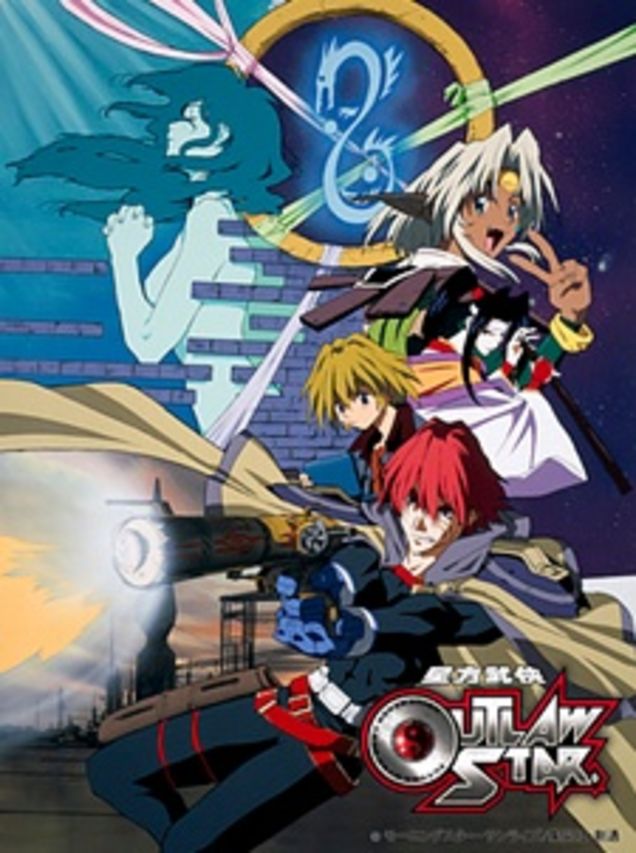
For this occasion, I would like to discuss my favourite anime of all time: Outlaw
Star.
Language: JapaneseOriginal title: 星方武侠アウトロースター No. of eps: 26
Synopsis
Universe in the distant future. Gene Starwind is a young
bounty hunter who lives on a planet called Sentinel III and runs a business
together with an 11-year-old computer expert, Jim Hawking. One day, a
mysterious woman asks them for protection. It turns out that she is Hilda, an outlaw
who is on the run from the Kei pirates. Due to an unexpected chain of events, Gene
and Jim suddenly leave their home planet and end up in the possession of a
top-of-the-line Grappler-class ship which Gene calls Outlaw Star. With the help
of Melfina, the ship’s navigator; Twilight Suzuka, the assassin-for-hire; Aisha
Clan-Clan, the Ctarl-Ctarl Empire emissary; and Gilliam, the ship’s computer,
the newly-formed crew sets out on a quest full of adventures in order to find
the mythical Galactic Leyline.
You Better Get Ready!
I decided to review Outlaw Star, because I recently got my
hands on the beautiful Blu-ray/DVD release from Funmation. Having
revisited the series, I am astonished how entertaining it is after all these
years when I saw it for the first time. All the more reason I can’t stand
modern criticism of Outlaw Star which aims at picturing the series as an
inferior cousin of Cowboy Bebop…
Okay, where should I start? First of all, it should be noted
that Outlaw Star began, in fact, as a manga series created by Takehiko Ito in 1996 and was turned into anime two years later by the famous Sunrise
production company. The series consists of 26 episodes which originally ran
from January 8 to June 25, 1998. To date, the series has not received any sequel,
apart from a spin-off known as Angel Links.
As with every other science-fiction piece, the viewers are
transported into a completely unfamiliar world. We get to discover the wondrous
universe together with the main protagonist, Gene Starwind, a hot-headed, but
well-meaning, adventurer who learns in the first episodes about the three major
powers in the cosmos: the Space Forces, the Pirates, and the Outlaws.
Naturally, Gene chooses to become an outlaw, a drifter (not a criminal) unaffiliated
with any group or authority (either good or bad).
The series begins on a dynamic note and does not slow down,
not even for one moment throughout all the episodes. There is always something
happening and our heroes are faced with overcoming increasingly difficult
challenges. The universe itself is incredibly rich, because apart from the
aforementioned three forces, there is also a mixture of a whole slew of various
races, robots, and baddies, as if Star Trek, Blade Runner, and Indiana Jones
collided together only to create the wild west in space. Oh, did I mention that
there is also room for magic in this show? Yes, we have crazy Kei Pirates
fighting their way through with spells and Gene shooting at the bad guys from
the ancient Caster gun.
This leads me to another aspect which is the characters and
their progress through the story. Believe it or not, but each member of the
crew has a clear story-arc and undergoes a personal change towards the end.
Even though maybe some of the heroes are touched upon rather than fleshed out,
each and every one of them has their own 5 minutes. Gene has to overcome his
fears and doubts, Jim learns the hard way about love, Melfina seeks the true
meaning of her identity, Suzuka desires to avenge her past, and Aisha wants to
prove her worth. Although these heroes are out of this world, they are so
relatable because of their realistic attitudes which can be found in each of
us.
One more thing which I should mention is the animation. Some
critics claim that the show is literally too dark, without any scenes happening
in daylight. Nothing could be further from the truth. Outlaw Star is full of
colours and the picture is crystal clear with balanced contrast. In addition,
the crew does not fly all the time against the background of black space, but
the universe itself is actually lively and colourful with nebulae, orbital
waves, and stars. With regard to the animation itself, the characters and ships
are drawn just beautifully. Their details are especially visible during the thrilling
fight sequences. I can’t take my eyes off them. This is classic cell animation
for you.
Oh! The music score by Kow Otani is a whole another
thing. Not only does it provide the series with appropriate upbeat, sci-fi
mood, but it also has a life of its own. Even today, I can recall my high
school days when I was listening to this awesome music and reminiscing all of
the climatic scenes from the anime. In other words, the auditory part of Outlaw
Star is amazing. Just head over youtube if you need any proof. Additionally,
there were three songs made for the show. The glorious opening theme “Through the Night” written and performed by Masahiko Arimachi (that intro!) and two
ending compositions: “Hiru no Tsuki” and “Tsuki no le”, written and
performed by Akino Arai.
Having said all this, I believe that the following
conclusion should finally be stated: Outlaw Star does not suffer from any
shortcomings. Some anime connoisseurs would like to think otherwise, but their
claims about unevenly paced story, weak animation, and underdeveloped
characters are bogus. In the same way, it’s easy for me to say that Cowboy Bebop
is not paced well, animation could have been better, and some characters could
have been more elaborated upon. Here’s a newsflash: I re-watched Cowboy Bebop and
this show aged greatly in my eyes, but I am not attacking it just because it is
a competing space-western for Outlaw Star. Both of these are classic anime
stories in their own unique ways.
Recommendations
All things considered, Outlaw Star is an underrated
masterpiece. It has everything which a good and escapist story needs plus more.
Wonderful universe, unforgettable characters, excellent voice acting, and the
story full of classic motifs and archetypes that would make Jordan Peterson
envious. Even if you’re not an anime fan, but you like space westerns, such as (indistinct hiss) Firefly or Guardians of the Galaxy, this is a must see. To me, Outlaw
Star’s crew will always be number one in my heart. All systems green!
Bayside Shakedown: The Movie; or, Three Tough Cases
I've got this far, but our promise... I wanted to give the
investigations to the local teams, but I couldn't do it. I can't practise what
I preach.
You can. You of all people. You can do it, Muroi. I believe
in you. I'll wait for it. Let's stick with it, until we get things our way.
After the drama and the TV specials, the time came for Odoru
Daisousasen to hit the big screen. As a result, the first theatrical film
dominated the Japanese box office in 1998 (over 10 billion yen), and today it
occupies the 30th place on the list of the highest grossing films in Japan [see
here]. Let’s talk about Odoru Daisousasen: Zu Mubi.
Release Info
Directed by: Katsuyuki MotohiroStarring: Yuji Oda, Toshiro Yanagiba, Eri Fukatsu
Original Title: 踊る大捜査線 THE MOVIE Language: Japanese Runtime: 119 min
Synopsis
It’s been five months since the events presented in the
drama. Wangan detectives got used to solving petty crimes and the problem
arises when a floating body appears near Bayside. What is more, officers’
private things mysteriously disappear at the station. On top of that, the
Assistant Commissioner has been kidnapped. HQ’s investigative unit steps in to
handle the kidnap, but it is up to Aoshima and his friends to discover that
three cases are strangely connected.
Already the drama and the specials preceding the theatrical
movie were great, but this film only perfected the formula of Odoru Daisousasen.
Sure, at the beginning, it feels like an extra, super-special episode, but big
budget and clever scripting enhance the cinematic feel of the movie. The music
score was mainly retained from the original show, with occasional rearrangements
from the composer Akihiko Matsumoto, but I don’t see the issue about it since I
can listen to this soundtrack all the time.
With regard to performances, Odoru cast does as magnificently
as in the drama. Even though it’s the movie, it remains continuous with the
show’s timeline and carriers on the issues which originated there. Yuji Oda and
Toshiro Yanagiba are brilliant as Aoshima and Muroi respectively. The dynamic
relationship between these characters is just amazing, though they do not share
a lot of screen time in this film. Chosuke Ikariya deserves another praise as
Inspector Waku. I dare to think that he gets more stuff to do in the film than
in the drama (by the way, there is a hilarious reference to Kurosawa's High and Low!). Allegedly,
when receiving a Japan Academy Award for his performance, Ikariya claimed
feeling guilty for it, because he had never taken his role seriously.
In addition, a veteran actor of samurai movies
from the 60s, the late Shigeru Koyama plays the kidnapped Commissioner. It is quite
a minor role, but he reprises it in the following sequel: Bayside Shakedown 2: Close the Rainbow Bridge. Actress Kyoko Koizumi deserves an honourable mention as the
psychopathic killer who terrorises Yukino and later busts into the Wangan
Station with a gun. Her character later returns, and is the focal point, of Bayside
Shakedown 3: Set the Guys Loose.
All things considered, Odoru Daisousasen: Zu Mubi is the same
as Odoru Daisousasen the drama in terms of criticising bureaucracy and internal
hierarchy which governs Japanese institutions. Nevertheless, the movie strays
into a new territory when exploring the topical problems of internet abuse and
growing incitement to commit crime among Japanese youngsters. The heartbreaking
ending of the picture shows that bureaucratic stubbornness can be overcome by
the sacrifice and goodwill of individuals. While Aoshima recovers, Muroi’s
promise remains yet to be fulfilled...
Recommendations
Safely recommended to anyone who saw and enjoyed the
original drama and the specials. However, if you want to see the movie without
seeing the drama, then please at least read some background info about the
characters, because they are not introduced in any way in the motion
picture. Apart from this issue, you’re in for lots of great stuff!