Showing posts with label science fiction. Show all posts

AD Police Files [OVA Review]

 AD Police Files; or, Stop! An officer will shoot

     At least she died as a woman.
The weather outside is as beautiful as ever this time of the year, so it makes me all the more surprised that I found myself in the mood for some gloomy cyberpunk feels. Needless to say, I decided not to look for the most popular instances of the genre recommended on the internet, but instead I went for something more obscure. As a result, I ended up watching AD Police OVA from the year 1990.
Release Info
Directed by: Akira Nishimori Voice actors: Toshio Furukawa, Youko Matsuoka
Language: Japanese Original Title: ADポリス No. of eps: 3
Synopsis
It’s the year 2027. The advancements in the field of cybernetics allow people to replace their organs with artificial substitutes. There are also fully automated androids known as Boomers. If Boomer goes haywire and commits a crime, they are chased by the special mad criminal investigation unit known as AD Police.
Blade Running

It should be noted that AD Police is a spin-off series of the Bubblegum Crisis franchise. Actually, the title card at the beginning of each of the three OVA episodes says directly “Another Story of Bubblegum Crisis”. The events of the OVA take place before the first series of Bubblegum Crisis and indirectly focus on the cop character of Leon McNichol and his partner Gina Marceau.
With regard to AD Police,I have to say that I really like the traditional animation style because it’s really evocative of its late 80s/early 90s era. In terms of the visuals themselves and storyline themes, however, you can’t help but notice the overwhelming influence of Ridley Scott’s Blade Runner. AD Police grows out of the world crafted by Phillip K. Dick in which the uniqueness of human life is constantly questioned amidst hordes of androids who also have their fair share of desires, fears, and personal introspection.
That being said, I kind of regret watching this OVA primarily because of its NSFW content. With each episode, things get so adult-oriented and explicit that by the end of it, I felt as if I was watching hentai. Sure, the plot of each episode is engaging enough, but the way these are handled leaves a lot to be desired.
Allegedly, there were supposed to be more episodes of the OVA, but the studios responsible for it fell into some sort of dispute. As a result, AD Police had its continuation years later in the form of another short-lived series and a reboot OVA. People responsible for the creation of AD Police were Tony Takezaki and Suzuki Toshimitsu, who also crafted a manga called AD Police: Shuuen Toshi.
Recommendations

All things considered, AD Police Files is a product of its time when there was a huge boom on cyberpunk in the anime industry. Some franchises grew larger than life and lived to tell the tale through decades (see Akira and Ghost in the Shell) but many weren’t so lucky, including AD Police. If you want to get some entertainment value from this, I suggest you watch the whole OVA series at one go in the middle of the night and crank up the volume for the intro song and ending songs. It’s a fairly nice schlock anime experience for one time.
Overall score: 5/10
«Enjoyed this post? Never miss out on future posts by following us»

Mechanical Violator Hakaider (1995) [Tokusatsu Review]

Mechanical Violator Hakaider; or, Requiem for a Destroyer
     Do you want to live? Do you want to live and have a free will of your own?
It’s been quite some time since I covered Tokusatsu outside the realm of Godzilla. Actually, while being on the lookout for some Goji clips on YouTube, I spotted some random video in Japanese characters, but the thumbnail caught my attention, so I clicked on it. All I cay is that looking at unknown 90s Toku vintage action sent me on a search to find the original source. This led me to Mechanical Violator Hakaider, directed by none other than the crazy nerd himself Keita Amemiya.
Release Info
Directed by: Keita Amemiya Starring: Yuji Kishimoto, Mai Hosho, Jiro Okamoto, Yasuaki Honda
Language: Japanese Original Title: 人造人間ハカイダー Runtime: 77 min
Synopsis
A group of criminals raid an abandoned prison facility. In one of the sealed chambers, they discover a man in chains (Yuji Kishimoto). The man turns himself into an android known as Hakaider and kills the criminals. He mounts a bike and rushes to a utopian world known as Jesus Town, which was built on the ruins of Jerusalem. Jesus Town is governed by the Parliament and psychotic leader Gurjev (Yasuaki Honda). A group of outlaws led by a girl called Kaoru (Mai Hosho) plan to destroy the Parliament. Hakaider teams up with Kaoru because she believes he is the black knight who saved her in her dreams. When the outlaws are attacked, Hakaider steps into action.
Knockin’ on Heaven’s Door

Having done some research online, it turns out the character of Hakaider is actually the original creation of Shotaro Ishinomori, the mastermind behind Super Sentai and Kamen Rider. The villainous robot was part of 1970s Toku manga and TV show called Android Kikaider; however, Amemiya’s movie is not in continuity with the previous media. Instead, Mechanical Violator Hakaider is a stand-alone sci-fi spin on the side character, turning him into a sympathetic anti-hero much in the vein as Terminator from T2: Judgement Day (1991).
If you are already familiar with Keita Amemiya (see my review of the Zeiram franchise), then you know you are in for a ride filled with old-school fireworks, miniatures, model work, stop motiion, front projection, and early CGI. Amemiya uses every single trick in the book to make a satisfying dark Toku spectacle driven by ridiculously satisfying action, Mad Max-inspired production design, and moments of genuine poignancy.
The story itself is simple enough to keep you engaged. We have the main hero who doesn’t know what exactly he is: a tool of destruction or perhaps misunderstood champion of morality. It is only when Hakaider meets the cheerful Kaoru, he experiences some real happiness.
I know that I am a sucker for love subplots, but I really like the romance between Hakaider and Kaoru because it wasn’t just “love at first sight”. In fact, the majority of the thing was presented through Kaoru’s dreams, which made it extremely poetic.
Now, moving to the baddies. Amemiya does some clever deconstruction of expectations here. Gujrev looks like an angel, and he even has a bunch of fake wings. The soft way he speaks and his affection for flowers makes you think he is a kind person, but nothing could be farther from the truth. The same goes for Gujrev’s henchman, android Michael, who looks all clean and slick, as if he came out of the Timeranger show. The android even claims to be a representative of justice, but he too is driven by twisted misconceptions about life, peace, and obedience.
Oh, and a bit of trivia! Perceptible viewers may spot among the outlaws a familiar face from Zyuranger; that is, Ami Kawai who played Lami in the show. Here, unfortunately, she doesn't have much a screen time, but it's great to see her in another Tokusatsu production. 
With regard to disadvantages, the movie’s runtime is quite short and I watched the director’s cut(!) This version lasts 77 minutes, whereas the theatrical one is 26 minutes shorter. It makes me think what exactly was cut to accommodate the shorter runtime, but I have no desire to watch the original version.
Recommendations
All in all, Mechanical Violator Hakaider is a lot of fun if you’re looking for something vintage, yet without gruesome violence. It took me like a whole week to track this movie down. I’ve searched for it anywhere, until my stupid brain told me to head over to YouTube of all places, and lo and behold there it was. Now I’m so super charged that I want to check out more of Keita Amemiya’s filmography.
Overall score: 7/10
«Enjoyed this post? Never miss out on future posts by following us»

You are going to carry that weight: Revisiting Cowboy Bebop [Editorial]

 
Men always seem to think about their past before they die, as though they were frantically searching for proof that they truly lived. ~ Jet Black
 
     As promised last week, I am back with my blog post about the popular anime series from the late 1990s: Cowboy Bebop. Well, better late than never. Cowboy Bebop was part of my introduction into the realm of anime over 10 years ago, and I have been meaning to write about this show for a long time. However, as in the case of GTO, I avoided doing it because this show is such an all-time classic.
     To be honest, I regard Cowboy Bebop together with Outlaw Star and Trigun as the Holy Trinity of the animated space western genre. However, all three series exhibit radically idiosyncratic styles. I mentioned in my special review of Outlaw Star that I have some issues with Cowboy Bebop, and today allow me to explain what I meant. Whereas Outlaw Star (and Trigun) seem very modernist and traditional with their approach towards the concept of a hero and his journey (the monomyth), Cowboy Bebop, in contrast, appears to be a deeply postmodernist show. It is, in fact, a disjointed, freewheeling story about a too-cool-for-school bounty hunter who is unable to escape his own past.
     First things first, so let’s briefly summarise what the show is about. It was originally conceived by Shinichiro Watanabe and the creative staff led by him in Sunrise animation studio. Bebop presents us with a not-so-distant future, namely the year 2071 in which Earth is almost uninhabitable due to a hyperspace gateway incident. As a result, humanity has colonised the rest of the Solar System, which unfortunately led to skyrocketing crime rates. In consequence, the Inter Solar System Police authorised the profession of bounty hunters (aka Cowboys) who catch criminals alive and return them to law enforcement for financial reward. Spike Spiegel, Jet Black, Faye Valentine, Ed, and Ein accidentally form the bounty hunting crew of a ship called Bebop.
     It is difficult for me to explain why, but I felt the need recently to revisit Cowboy Bebop. I tried to do this a few years ago (during the pandemic), but I tuned out after a couple of episodes, bitterly labelling the show as dated (that’s how hardwired I am in my unconditional love for Outlaw Star). However, now, as a person who is over 30, I looked at the show in a different light.
     I really do not want to nitpick Cowboy Bebop, so let me say that after so many years, this anime is still great fun. I nearly forgot how good some of the episodes were, and the light-hearted storylines really brought a smile to my face, such as Stray Dog Strut, Gateway Shuffle, Toys in the Attic, Bohemian Rhapsody, and Wild Horses. This is exactly the type of cheerful, escapist entertainment I needed.
     As a result, Cowboy Bebop really excels in the fun department and effortlessly hits the same strides as Outlaw Star and Trigun. However, what makes it truly different is the way in which the show handles the serious stuff.
     Evidently, we have stand alone episodes about the tragedies of side characters Spike encounters/has to fight, as in the case of Asteroid Blues, Sympathy for the Devil, Heavy Metal Queen, and Waltz for Venus. Spike confronts these characters in the fashion of 1980s action drama heroes (see Magnum PI) and these interactions, and their unfortunate fates, make him grow as a protagonist.
 
    However, the whole seriousness concerning Spike’s personal past is just so stereotypical that it devours the enjoyment of Cowboy Bebop for me. Yes, I get it. Spike is a cool guy, so he was a criminal in the past, and he was in love, but the villain character of Vicious (to my mind) is way too exaggerated. Indeed, he has a cool introduction in the opera house, but it is all there is to his depth: showmanship. The show never made me care about Vicious. I can understand he was a caricature of John Woo’s bromance-charged villains, but things did get lost in translation, which ultimately renders Spike’s story arc flat for me.
     Nevertheless, Spike’s past is not the only concern of the show. Jet Black faces his own demons in Ganymede Elegy and Black Dog Serenade, and so does Faye Valentine in My Funny Valentine and Speak Like a Child. The way the supporting characters have to deal with their trauma is done perfectly. Time and time again, they try to avoid it, escape it, but the past eventually catches up with them and forces them to evaluate their identity. Jet and Faye really “carry that weight.”
     Still again, what about Spike? He confronts Vicious head on three times in the show, and this ultimately leads to his death. Perhaps the character truly needed this kind of bleak retribution (he wanted to know if he is alive), but I as an audience member did not. Spike choses death instead of carrying his weight (isn’t it cutting corners?), and this ultimately makes the show a downer, especially if you are a 30/40-something adult dealing with responsibilities of life.
     So, here we are. Instead of a typical review, I blurted out my chain of incoherent thoughts about Cowboy Bebop. Thank you for reading, and if you have your own opinions about the series, feel free to share them. Hopefully, next week, I will try to discuss something else. In the meantime, Life is But a Dream and See You Space Cowboys.
«Enjoyed this post? Never miss out on future posts by following us»

Shin Kamen Rider (2023) [Tokusatsu Review]

Shin Kamen Rider; or, Tokusatsu: Far From Home
     Please use your power for the people. Use your power to protect the weak.
A year after the premiere of Shin Ultraman (2022), Tokusatsu fans were presented with the conclusion of the Shin Trilogy of movies cooked up by Hideaki Anno and Shinji Higuchi. The final instalment focuses on one of Toei’s greatest heroes: Kamen Rider, a motorcycle-riding fighter of justice originally created by manga artist and producer Shotaro Ishinomori.
Release Info
Directed by: Hideaki Anno Starring: Sosuke Ikematsu, Minami Hamabe, Tasuku Emoto
Language: Japanese Original Title: シン・仮面ライダー Runtime: 121 min
Synopsis

A mysterious group called the Sustainable Happiness Organization with Computational Knowledge Embedded Remodeling (in short: SHOCKER) kidnaps Takeshi Hongo (Sosuke Ikematsu) and attempts to transform him into a brainwashed synthetic animal hybrid known as Augment. Hongo undergoes a transformation into Grasshopper-Aug 01, but he retains his human willpower and identity. He is rescued by Professor Hiroshi Midorikawa (Shinya Tsukamoto) and his daughter Ruriko (Minami Hamabe). Midorikawa explains that he gave Hongo the superhuman power of prana for the purpose of defeating SHOCKER. Hongo becomes Kamen Rider and starts to fight the evil organization. Soon after, another Kamen Rider, Hayato Ichimonji (Tasuku Emoto), joins Hongo in his quest.
Fanboyism: The Motion Picture
If you go back and read my reviews of Shin Gojira and Neon Genesis Evangelion, you can tell that I have issues with the auteur artist Hideaki Anno. I try to stay open-minded and appreciate his original input into the realm of visual arts, but there are times when he just takes things way too far in order to please himself. Shin Kamen Rider reflects exactly that.
Whereas Shinji Higuchi’s Shin Ultraman was an enjoyable light-hearted ride that paid tribute to the original content, Shin Kamen Rider delivers the same format but in a very washed out manner. The dynamic, nearly break-neck action is there, but it does not feel compelling. The stakes are there, but you do not feel motivated to root for the characters who are stone cold in their expression of emotions and delivery of lines. A comfortable fanboy aura is there also, but you have experienced it already in the previous entry of Shin flicks.
Perhaps Hideaki Anno wanted to play things safe, or he might have been given a tight deadline by Toei. Either way, Shin Kamen Rider is a disjointed mess that desperately attempts to satisfy 50-something fans of the original series who were children back in the 1970s. Unfortunately, fanboyism is not enough to make this movie good. Personally, I would appreciate it more had Anno gone for a traditional remake that would reintroduce the character of Kamen Rider for a new generation of cinemagoers. Show the character’s origin and give us the standard good vs. evil story without analytical breakdown of the villain’s psyche.
That being said, there are a few things that I enjoyed in the film. For example, the 70s vintage production design, the sound effects, basically the whole showdown with Hachi Aug-01 (but mainly because of Nanase Nishino’s sismance-charged performance), and of course numerous small parts done by such actors as Shinya Tsukamoto, Mikako Ichikawa, Takumi Saitoh, and Yutaka Takenouchi. Unfortunately, Masami Nagasawa’s cameo as Scorpion-Aug seems too awkward and too out-of-the-blue for the context of this film.
Recommendations
All things considered, this is definitely the weakest entry of the Shin Trilogy. When the end credits rolled in, I experienced one of the rare moments in my life that I felt as if I wasted time. However, perhaps Hideaki Anno’s fans will react differently. Shin Kamen Rider just did not click with me. I prefer to stick with the original series and explore the franchise further.
Overall score: 5/10
«Enjoyed this post? Never miss out on future posts by following us»

To the Zone and Back Again: Exploring the Sheer Awesomeness of Zeiram [Editorial]

 
     Iria, you're definitely a fine looking woman.
 
Well, I realise I am really late to the party, but as they say, better late than never. Of course, I have been aware of the existence of Zeiram ever since a colleague recommended the film and its sequel after my enthusiastic response to Yukito Kishiro’s Gunnm/Battle Angel Alita. However, I was never in the right mood to sit down and watch (what seemed to be) yet another standard Tokusatsu production of the 1990s.
     Thankfully, I changed my sentiment and decided to give the movies a chance after reading a wonderful set of reviews penned by Rise from Phoenix Talks Pop Culture Japan. It is not my intention to rework the wheel and repeat what she did in the form of movie reviews, so allow me to share my perspective on the Zeiram franchise in this one concise editorial. At the same time, I wholeheartedly invite you to read her blog posts as well.
     Now that we have the introduction part off the agenda, it is time for a brief summary of what the heck Zeiram is about for readers unfamiliar with the series. Basically, the titular Zeiram is a gruesome monster that can be best described as an amalgam of good-old Terminator and tongue-swirling Xenomorph. Don’t let its traditional appearance from the Edo period fool you, because Zeiram is a perfect biological weapon that can clone any organism it comes in contact with. The monster’s bloody trail paved with corpses is cautiously followed by Iria (Yuko Moriyama), an intergalactic bounty hunter. Iria and her cybernetic partner Bob (voiced by Masakazu Handa) await Zeiram’s arrival on Earth. In order to limit potential casualties, Iria creates an artificial dimension known the Zone in which she entraps Zeiram; however, two unsuspecting electricians, Teppei (Kunihiro Ida) and Kamiya (Yukijiro Hotaru), end up getting entangled in the otherworldly showdown, which causes further hassle for Iria.
     On the basis of the provided synopsis, one would think that Zeiram (1991) is an adaptation of pre-existing manga or anime, but the movie is a totally original creation by Tokusatsu enthusiast Keita Amemiya, who honed his filmmaking craft in terms of directing, writing, and designing on the sets of Chojin Sentai Jetman, Kyoryu Sentai Zyuranger, and Kamen Rider. Actually, a six-episode OVA was made on the wave of the film’s popularity, but more on that later.
 
    The first Zeiram movie is like a crossover between survival horror and sci-fi adventure comedy. Many viewers out there describe it as a dark riff on Super Sentai/Power Rangers, but to me Zeiram has more in common with the classic Ultraman as well as the aforementioned Battle Angel Alita. My reasoning behind this stems from the film’s minimalist approach. You have to bear in mind that it was a passion project made on a tight budget; hence, we don’t get over-the-top CGI action done in generic Hollywood style.
     What we get, however, is a classic Toku spectacle with in-camera effects, rotoscope animation, and composite shots. This is a classic fun ride at its finest and a true labour of love made by Amemiya who had a clear vision of what he was going for.
What is more, I also have to praise the director because (unlike Shinya Tsukamoto or Koji Shiraishi) he never went full gore in terms of violent action. Zeiram, in spite of numerous mindblowing transformations of the titular creature, never veers off the P-13 territory, so the most demanding viewers may feel disappointed, but the film compensates that with thrilling stunts and loveable characters.
     Firstly, let’s talk about Iria the bounty hunter, brilliantly played by Yuko Moriyama. She is tough, she has the looks, but she is not kawaii. In fact, Iria is the antithesis of a typical Tokusatsu heroine who is frequently played by an idol and objectified on camera. With her eyes and reserved demeanour Iria oozes such confidence and equanimity that she effortlessly gives Ellen Ripley and Sarah Connor a run for their money. Hideaki Anno and Shinji Huguchi, instead of drooling over Masami Nagasawa’s legs, should start taking notes on how to create a truly strong female character.
     Secondly, we have sidekicks. Again, many modern-day viewers complain that the humour generated by Teppei and Kamiya does not work. Personally, I think that scared-to-death blue collar workers on the run from a walking biological warfare is exactly what the film needed. I can’t help but agree with a letterboxd remark that the two guys give off the vibe of Abbott and Costello meet the Thing. On top of this, they have insane teamwork chemistry with Iria in the film’s bombastic finale.
     Clearly, at this point of the editorial, you can tell that the Zeiram movie stole my heart. It is exactly the type of light entertainment I needed to kick off summertime, and I am very happy I got myself round to check it out. The same, however, cannot be said about the sequel: Zeiram 2 (1994).
     The follow-up flick suffers from the same ailment that plagues many sequels out there. That is to say, it tries to be as awesome as the original, but also twice as loud, twice as explosive, twice as action-packed. Keita Amemiya evidently tried to “up the ante” for lack of a better term, but to me, Zeiram 2 is a major step down. Sure, it has great fights and outstanding special effects, but this time we get more bounty hunters, more jumping in and out of the Zone, more blood, and even animal cruelty, which is a major NO for me in such types of films. In this regard, Zeiram 2 has more in common with Mad Max 2: Road Warrior than with the original Zeiram.
     In addition, I appreciate the fact that all of the main actors reprise their roles in the sequel, but the way they act in the film leaves a lot to be desired. Kamiya collaborates with Bob (Kazuhiko Inoue) for a change, which is a nice touch; Teppei is basically lost in the Zone for the majority of the film, and Iria has to single-handedly save her favourite electricians while looking for an artefact straight out of Indiana Jones movie and being constantly interrupted by a rival bounty hunter Fujikuro (SABU) and (of course) upgraded Zeiram. It is not until the finale when the gang is reunited, but the feels are no longer as breathtaking as in the previous outing.
     Ultimately, Zeiram 2 is an okay movie in my opinion. Amemiya tried to be more inventive this time while trying to repeat what worked in the first part. The sequel has clearly great production value because it was made on a bigger budget, but all the action, production design, and special effects did not make me love it. The overall violence should have been slightly ironed out, and the main heroes should have been given more agency in the story.
     Last but least, we arrive at the OVA, Iria: Zeiram the Animation, which was also released in 1994, but without Amemiya’s creative input. This show is often labelled as a prequel to what is presented in the movies, but I personally believe that OVA should not be regarded in such a way. At best, it is a remake that strives to retell the Zeiram shenanigans in a different medium and for a completely different target audience. The whole franchise has come full circle at this point and we finally see Iria as an anime heroine (who is more than kawaii, rest assured). However, her origin story is inextricably linked to Zeiram, which is fine in the context of the show because the creators wanted to feature the titular creature in every episode, but this kind of prequel-making in the style of Ridley Scott only ruins the awesomeness of live-action Iria who undoubtedly must have had many more bounty-hunting adventure apart from just fighting Zeiram all her life.
 
     Consequently, it is best to treat OVA as a separate entity, and I am very glad that I saved it for the end of my Zeiram marathon because had I watched before the films, it would have ruined my perception of Iria for sure. Well, I suspect that this works the other way round and the movies ruin the OVA for anime enthusiasts, but this is the kind of vicious circle that has to be broken by your own preferences.
     Personally, I like the movies more, and specifically the first movie. Check out Zeiram if you can because it is totally worth it: for the story, for the awesome monster, for the kick-ass girl with a gun. My thanks again go to Rise for her blog posts that encouraged me to embark on this sci-fi journey. Peace out to you all and see you around in the Zone.
«Enjoyed this post? Never miss out on future posts by following us»

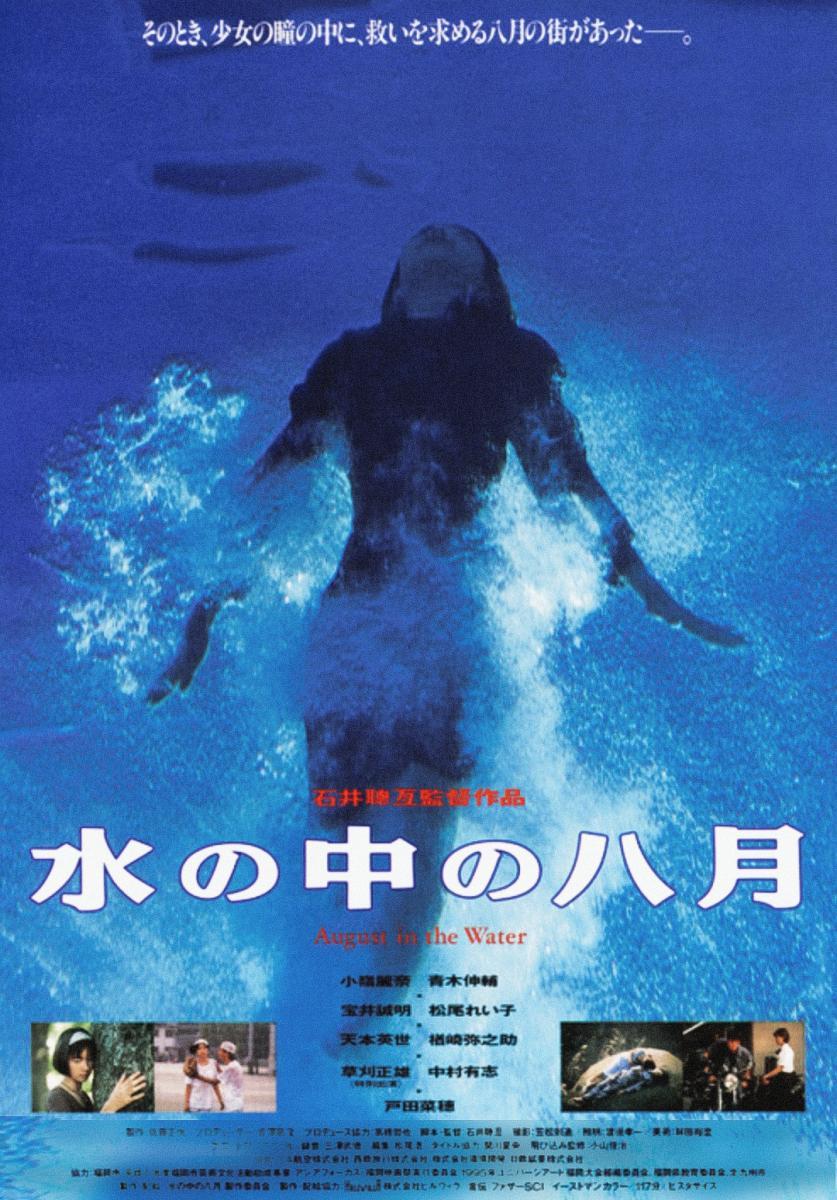
August in the Water (1995) [Film Review]

August in the Water; or, Melancholic Blue
     Sometimes I become uncertain if it was… real, dream or just memories, and whether I'm alive or not.

Allow me to say out-front that I approach this particular review with great trepidation. This is caused by the fact that I have seen Gakuryu (Sogo) Ishii’s August in the Water for the fourth time already in the course of a year and still I do not feel I have digested it fully. On the other hand, I do not want to wait indefinitely, because I am not sure if I will ever be able to fully comprehend this film. In consequence, I apologise if my opinions will not be articulate enough.
Release Info
Directed by: Gakuryu (Sogo) Ishii Starring: Rena Komine, Shinsuke Aoki, Masaaki Takarai
Language: Japanese Original Title: 水の中の八月 Runtime: 127 min
Synopsis
Two high-school students, Mao (Shinsuke Aoki) and Ukiya (Masaaki Takarai) befriend a girl called Izumi (Rena Komine). She practices high diving and participates in competitions organised by the city of Fukuoka. In the meantime, the world is plagued by drought and an unknown outbreak known as the stone disease. The only hope to restore balance is to perform an ancient ritual during a full moon. Izumi suffers an accident while jumping from a pool platform and, in consequence, she gains special powers. She can communicate with dolphins and plants. What is more, she gains an understanding of humanity’s place in the universe.
Water Sensitive
Many people across the internet refer to this movie as a mix between science-fiction and fantasy with a touch of teenage romance. In my opinion, August in the Water is neither of these things. It is most certainly not a narrative-driven picture. In fact, Gakuryu Ishii goes out of his way to enhance the viewing experience by putting emphasis on mesmerising visuals and extremely ethereal music score. As a result, the film very much feels like a dream, an illusive vision that stimulates your senses, yet it is not entirely comprehensible.
The story is there of course but it does not take the center stage. In his own auteur manner, Gakuryu Ishii presents the viewers with glimpses of events, filling in blanks by putting necessary exposition into conversations done by side-characters, TV clips, interviews, or newspaper articles. Therefore, the audience has to assemble the pieces of the puzzle on their own, which is a very challenging task indeed, and opens room to many interpretations of the film.
The way in which I personally understand the film is that the drought and stone disease function as an allegory for a topical problem of modern society, which is lack of empathy. People in the world of today are so dissociated from reality, from contact with another human being that they function as automatons. Hence, their inwards turn to stone. By falling in love with Izumi, Mao understood the value of positive emotions which allowed him to live to the fullest, appreciate nature, and wait decades for the return of the love of his life.
What is more, Ishii can’t help himself but question the organisational order yet again (*Crazy Thunder Road flashbacks*). In spite of drought and disease, the city of Fukuoka organises the high diving competition. Consequently, the country of Japan functions as normally as possible regardless of the immediate threat.
The editing and cinematography of August in the Water deserve a scientific monograph, so I shall limit myself and just say that Ishii really achieved the impossible. Just by camera movement and the marriage of visuals and sound, he creates a one-of-a-kind ambience which covers as well as overshadows the main themes of his picture. Even without the English subtitles, you come to appreciate what is presented on the screen. My favourite sequences, without a doubt, are the opening intro and a water-throwing festival. Had there been a Blu-ray edition of the film in the West, it would have certainly made a great demo disc to test your home cinema setup.
I could devote many more paragraphs to August in the Water, but I feel I would not give justice to the film, so let me end my thoughts here. I know I have to go back and watch it for the fifth time because with each viewing I interpret this film, and Hiroyuki Onogawa’s music, differently. If you wish to read more on the film, then please refer to this informative article at Dazed which has lots of sources.
Unfortunately, the DVD edition of the movie is out of print, so do not get fooled by some preachy sites that refer you to expired offers from Amazon or Yes Asia because most certainly the writers themselves had not seen the film on a physical disc. As of now, the film frequently pops up on YouTube, which is sadly the only way to watch it. I sincerely hope that either Criterion or Eureka! will buy the distribution rights and give August in the Water a proper release it very much deserves. 
Recommendations
I recommend August in the Water if you seek for a magical, other-worldly experience. People need to be more aware of Japanese productions like this one. It is truly idiosyncratic but not by any means pretentious or quirky. It is an emotion rather than a tale.
Overall score: 8/10
«Enjoyed this post? Never miss out on future posts by following us»

The Silent Sea (2021) [Drama Review]

The Silent Sea; or, 2021: A Lunar Odyssey
     Not a damn thing works smoothly in this station.
I have been looking forward to The Silent Sea drama since the first information about the shooting schedule dropped in December, 2020. Still, I had to endure an additional month of waiting after the Netflix premiere at the end of 2021 because of personal stuff and work. Well, as they say, better late than never. This is my review of The Silent Sea.
Release Info
Directed by: Choi Hang Yong Starring: Gong Yoo, Bae Doona, Lee Joon, Kim Sun Young
Language: Korean Original Title: 고요의 바다 No. of eps.: 8
Synopsis

Near future, the world is plagued by shortages of water and food caused by environmental changes. Doctor Song Ji An (Bae Doona) can’t get over the death of her sister who tragically died in a mysterious accident on Balhae Base research station on the moon. The Republic of Korea’s Space and Aeronautics Division asks her to join a team of specialists led by Captain Han Yoon Jae (Gong Yoo). They are sent on a mission to retrieve top-secret samples from the now-abandoned Balhae Base. Upon arriving there, the team realises something is amiss. That is to say, something, or someone, is lurking within the premises of the base.
Fly Me to the Moon
The Silent Sea was based on a 2014 short film The Sea of Tranquillity (I couldn’t track it down) by Choi Hang Yong, who also directed all 8 episodes of the drama. Interestingly, the executive producer of the show was Jung Woo Sung, the star of Steel Rain (2017) and The King (2017). The screenwriting duties were given to Park Eun Kyo who penned in the past Neverending Story (2012) as well as Mother (2009).
This drama is science-fiction at its purest. Fans of the genre will undoubtedly notice that The Silent Sea borrows tropes and concepts left and right from such legendary juggernauts of modern cinema as the Alien franchise (1979-1997), The Abyss (1989), Leviathan (1989), and Ad Astra (2019). There is room for thoughtful critique of modern problems plaguing the social order, but this aspect does not eclipse the willingness of filmmakers to provide the audience with a dose of thrills and chills.
In my opinion, The Silent Sea feels very much like the Lost (2004-2010) TV series, but instead of the island setting we get the moon. The first episode of the drama, albeit visually outstanding, is a bit overwhelming because its main focus is setting up the action and introducing (lots of) characters. Onwards the second episode, it gets easier to dive into the mysteries concerning the Balhae Base as well as the motivations of the main protagonists: Captain Han Yoon Jae and Doctor Song Ji An.
I have read online a lot of criticism about the plotline of the drama, especially the climax and dramatic reveal of (no spoilers) what actually was going on, but I personally found the whole thing enjoyable. I especially appreciated the themes of political corruption, company wars, and unethical research. The only thing that put me off; however, were CGI effects concerning one of the characters. From the visual standpoint, the effects looked good, but there was still some degree of uncanny valley which made these sequences look awkward.
Still, I love the marvellous production design. The Balhae Base looks incredible and the moon’s surface is fantastic, whereas the space suits are awesome. With regard to performances, it is always a pleasure to see Gong Yoo in the heroic role. This time, there is an added bonus because Gong’s character has an epic tattoo on his neck. Bae Doona is always wonderful as the female lead, but I was hoping for more character development in this case. Throughout most of the drama, we see Doctor Song either as bitter or depressed.
As for the supporting cast, I absolutely love Kim Sun Young as Doctor Hong. I have said this already on MDL and I will say it again: To me, she IS the Space Ajumma! In addition, I greatly enjoyed the appearances of Lee Moo Saeng as Chief Gong, head of the security team, and of Lee Joon as Lieutenant Ryoo Tae Seok, the head engineer. In general, the cast members have great chemistry, which also transpires in these sweet promo materials from Netflix, here and here.
Recommendations
After Space Sweepers (2021) and now The Silent Sea, South Korea has proven once again that they can do top-notch entertainment, even in the form of a miniseries. I sincerely hope that there will be a second season; however, we have to bear in mind that the drama came out in-between two other major Netflix players: Squid Game (2021) and All of Us Are Dead (2022). It’s reassuring to see that Netflix cares about the K-Drama audience, but I hope the quality will not be overshadowed by the quantity. The Silent Sea deserves an additional season because there is still the potential to develop the story further, but I would not like to see this drama last as long as Lost, The Walking Dead, or Stranger Things. Sometimes shorter is better.
Overall score: 8/10
«Enjoyed this post? Never miss out on future posts by following us»