Showing posts with label 2019. Show all posts

AMP Short Reviews (2019)

In today's update, allow me to make a jump to the past and highlight for you some of the short film reviews I wrote from AMP back in the year 2019. I am sharing these purely out of sentiment because even though the short film themselves may not be unavailable, it was an interesting experience for me writing these reviews.
1. How Can You Know Where to Go If You Do Not Know Where You Have Been (2018)
World War II is undoubtedly the most tragic global event of the 20th century. Apart from serving as the symbolic warning for future generations, it also became a source of inspiration for various representations in many cultural domains, including cinema. We all are probably familiar with the “war film” genre which encompasses action-adventure stories, anti-war manifestos, and tales of trauma. Mizuki Toriya's animation is none of these. Her short film How Can You Know Where to Go If You Do Not Know Where You Have Been serves as an intimate testimony of her grandmother about the difficult times when Japan engaged into war with the United States and Great Britain.
     The 6-minutes-long film is a recorded conversation between Toriya and her grandmother that is accompanied by paintings animated in a stop-motion fashion. The grandmother recounts from her personal perspective the beginning of the war, how she lived with her family in the city of Kobe, the subsequent destruction of Kobe, the family's life in the suburbs, and the arrival of the American forces after the war's official end.
     How Can You Know Where to Go If You Do Not Know Where You Have Been appears to be a deeply personal and delicate recounting of World War II experiences. Although the viewers may initially long for a more standard visual component (the video recording of the conversation), the animation actually enhances the viewing experience. The grandmother's tender voice combined with simple, yet eye-pleasing, paintings by Dean Aizawa are enough to get the viewers' attention.
     The message of the short film is quite clear: ordinary people do not make wars, but governments do. The grandmother rightfully remarks that peace is the best and no country should ever go to war. We, on the other hand, should learn from these rare testimonies of people who experienced the atrocities at first hand.
     Try to find some spare 6 minutes in your busy schedule and check out How Can You Know Where to Go If You Do Not Know Where You Have Been if you can. It is a peaceful story that will certainly leave you thinking about the past. Its importance is even heightened by the recently commemorated 80th anniversary of World War II's outbreak.
2. 15.7 KM (2018)
Getting to school is usually such a trivial activity that most parents and children do not pay major attention to it. However, there are some remote areas in the world where a child has to travel a significant amount of distance in order to receive the desired education. Rian Apriansyah's short film called 15.7 KM tackles this issues in an original way.
     The 15-minute-long story presents us with a young boy named Budi from Banka Isle in Indonesia. We observe how he prepares himself in the morning and eventually sets out on a long journey to school. In order not to damage his socks and shoes, he walks barefoot through forests and plains. After crossing a lake in a small boat, there is a slight chance that he may hitchhike. Ultimately, the boy arrives at his destination, puts on the socks and shoes, and begins his school day.
     The most striking aspect of the film is an almost complete lack of any dialogue, apart from occasional interjections uttered by the passers-by on Budi's route. In the style resembling that of Yasujirō Ozu, the film exposes the stillness and beauty of Indonesian nature which serves as the setting for Budi's repetitive journey. In order not to confuse the viewers about the compression of space within the 15-minute time span, a distance counter pops out once in a while.
     Even though there is not a lot of stuff happening in the film, director Rian Apriansyah provides a sensitive portrayal of an (in)visible problem, not only prevalent in Asia, which should be resolved in some way. Until then, Budi and many other children are forced to travel the way they do so that they could properly educate themselves.
     Towards the end of the film, one feels as if the story could have been continued. I strongly hope that there is a possibility for a full documentary feature. Maybe then the message about building standard education facilities for children would resonate more. To conclude, 15.7 KM is a very informative and eye-pleasing little film. We need more dialogue-free pictures in modern cinema.
«Enjoyed this post? Never miss out on future posts by following us»

Godzilla MonsterVerse Movies: Memories from Cinema and Sofa [Editorial]

For a very long time, I was thinking if I should take up discussion on the MonsterVerse movies. Obviously, these are American productions, so I did not want to trash my blog with separate reviews of these, even though they are technically part of the Godzilla franchise. For a moment, I considered posting my thoughts on Letterboxd, but I think the best solution is to talk about the films and my memories of them in the form of a concise editorial.

     So here we are. The MonsterVerse movies. The frenzy that started back in 2014 with the release of Gareth Edwards’s Godzilla. However, the slow built-up for the film started already before the premiere of Godzilla: Final Wars. That is to say, the Godzilla vs. Hedorah (1971) director, the late Yoshimitsu Banno, secured the rights from Toho to make a Godzilla short film using 3D technology. Banno started assembling the creative team for the project in the United States, and the idea evolved into making a 3D feature. Ultimately, Legendary Studios teamed up with Banno, and after securing a licence from Toho, they geared up for an official Godzilla live-action remake.
     Being a Godzilla fan in the 2010s, I relentlessly followed the news about the upcoming movie. I still remember the excitement when I saw a 2012 conceptual teaser video, then a leaked 2014 teaser trailer with J. Robert Oppenheimer’s voiceover and a promo photo of Gareth Edwards and Akira Takadara (the actor had a cameo in the film, which unfortunately ended up on the cutting room floor).
     Come May 2014 and I was ready for action. After a whole day at a university, I went to cinema with a colleague who was also a Godzilla enthusiast. We got tickets for late afternoon screening and barely any people were in the audience. When the lights went dark and the opening credits by Kyle Cooper rolled in, I knew I was in for a special viewing experience.
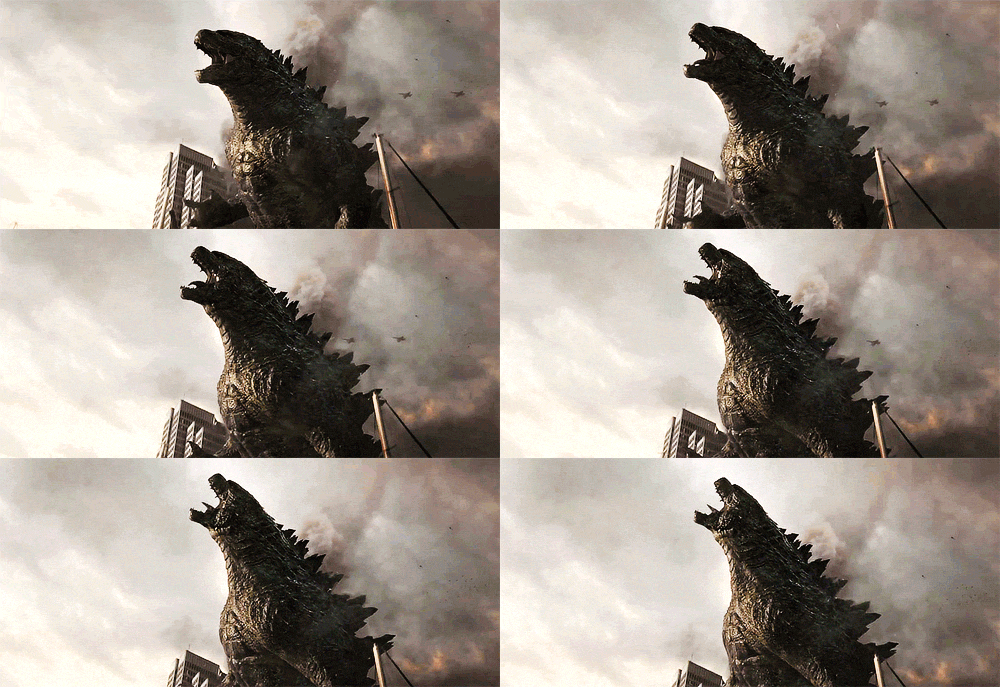
     Needless to say, I greatly enjoyed the film. Nowadays, moviegoers complain that the film does not have enough of Godzilla in it and the monster fights are scarce, but I believe Edwards’ restrained approach compensated for that lack. Godzilla (2014) is more about Kaiju ambience than the King himself. It is a film about the looming, larger-than-life danger that is beyond human comprehension. To my mind, this is the first American monster movie that actually strived to show the psychological side of dealing with monster rumble in the same vein as Spielberg dealt with fear of the unknown in Close Encounters of the Third Kind (1977).
     When the movie ended, I was the only guy at a movie theatre that was clapping. To date, I remember that some parents with children looked at me like some sort of weirdo. My colleague, on the other hand, had teary eyes because he was so moved by the final shot of Godzilla roaring and disappearing in the sea depths. I said to him, “Now, I have to wait four years for a sequel!”
     Little did I know I had to wait five years instead of four. Godzilla: King of the Monsters was plagued by production delays. Even though Gareth Edwards was slated to return as a director, he was eventually replaced by Michael Dougherty who brought the whole project home. In the meantime, I was dealing with sickness on my own, so I was unable to see Kong: Skull Island (2017) on the big screen, which (in fact) is the film that ushered in the MonsterVerse concept; that is, giant monsters having crossovers and fighting each other. For Hollywood, it sounded like a novelty in view of Marvel movies, but Toho started doing this as early as the 1960s.
     I eventually caught a copy of Skull Island on DVD and greatly enjoyed it, although I’m not a massive King Kong fan. The action and bright colours were definitely a stand-out, but some of the sequences involving the military felt dragged out to me.
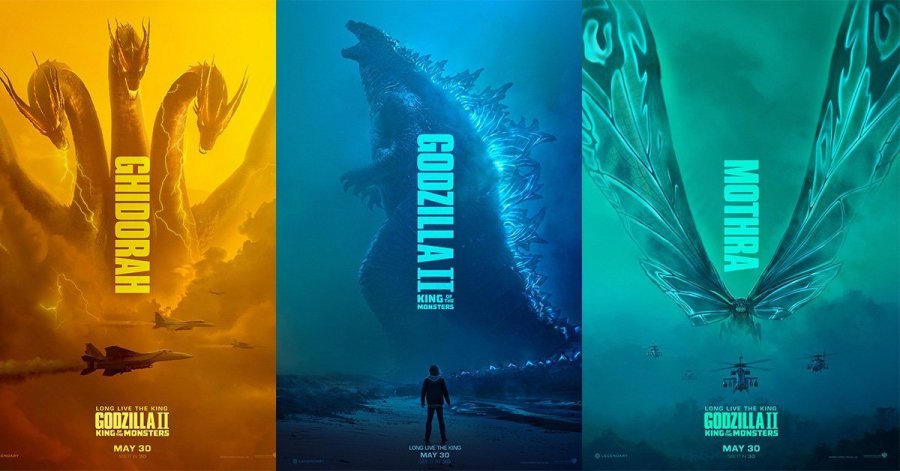
     By 2018, I managed to get better, so I was ready for the premiere of King of the Monsters in June 2019. To be honest, this movie was everything I wanted it to be. The action set pieces and the monster fights were outstanding, in my opinion. In addition, some of the sequences were just really beautiful like the release of King Ghidorah from his ice imprisonment, the airplane getaway from Rodan, or Mothra’s transformation. The last moment in particular made me cry at the cinema because it was so well done. The rearrangement of Yuji Koseki’s original theme gave me incredible chills.
     All the more, it is hard for me to comprehend the hate this film gets. Evidently, it had a lot of human characters, human drama, and cheesy one-liners, but on the whole it was light-hearted fun. The creative team knew what kind of film they wanted to make, and they delivered on that front. Still, it does not change the fact that the film basically failed at the box office, barely recouping its box-office and marketing costs.
 
    It comes as no surprise that Legendary took to heart the complaints of cinemagoers and, after many delays, they re-edited the living crap out of Godzilla vs. Kong before releasing it worldwide in Spring 2021. Back then, my country was still dealing with the pandemic, so I was unable to see it in the cinema, but I watched the film on streaming, and bought a disc later on.
     Well, Adam Wingard’s Godzilla vs. Kong certainly has a briskier pace than King of the Monsters and it is definitely more colourful. Basically, it is a movie in which a giant lizard and an ape go boom boom, so I can’t complain. However, in terms of overall tone, it stands out from the previous MonsterVerse entries. In fact, I believe it can be said that each MonsterVerse Godzilla flick is actually a love letter to Toho’s classic glory days of the franchise. Godzilla (2014) pays homage to the Heisei era by reusing the theme of an old warrior showing up for one more battle, King of the Monsters to the Showa era with the multiple monster/people shenagings, and Godzilla vs. Kong to the Millennium era with its neon aesthetics and bombastic inclusion of Mechagodzilla.
     All things considered, I like MonsterVerse movies for what they are, but it is nice to live in the fourth era of the Big G’s renaissance. The question remains: How long will it last? Legendary already develops the fourth film and a TV series, but Toho also works on their 70th anniversary film Godzilla Zero (2024), and they also churn out remakes of other popular properties: Shin Ultraman (2022), Shin Kamen Rider (2023), etc. It goes without saying that sooner or later Toho will reintroduce the King yet again for a new generation of cinemagoers.
«Enjoyed this post? Never miss out on future posts by following us»

Extreme Job (2019) [Film Review]

Extreme Job; or, Fry Hard
     What’s the point of working so hard if we can’t even eat properly?
This time, I decided to watch an action comedy flick Extreme Job, directed by Lee Byeong Hun. As of 2019, the movie holds the record of the second most viewed production in the history of South Korean cinema. It was inspired by a Chinese production Lobster Cop from 2018.
Release Info
Directed by: Lee Byung Hun Starring: Ryu Seung Ryong, Lee Ha Nee, Jin Seon Kyu
Language: Korean Original Title: 극한직업 Runtime: 110 min
Synopsis
Captain Ko (Ryu Seung Ryong) is the leader of a narcotics team composed of skilled, yet hot-headed police officers. After committing a major blunder during the arrest, the team is given the last chance to save their faces by conducting an undercover surveillance of an international drug gang. For their stakeout base, they choose a chicken restaurant that is on the verge of bankruptcy. Convinced that there won’t be lots of customers, the policemen buy the restaurant. Unexpectedly, their recipe for a rib marinade becomes a hit and hungry customers begin to storm the restaurant...
Cook up the Police
Well, Extreme Job is a pleasant, happy-go-lucky comedy of mistakes that thrives on character chemistry and situational gags. The best way to describe the film is to call it a mix between John Badham’s Stakeout (1987) and Michael Hui’s Chicken and Duck Talk (1988). I am pleasantly surprised that South Korean filmmakers are warming up to such classic styles of comedy.
In my opinion, the only disadvantage of the film is the confusing second act which directs the heroes by mere coincidence onto the bad guys and their schemes. Apart from that, it is hilarious to watch Captain Ko and his men struggling to do their job while keeping the crowds of customers happy.
As expected from a Korean production, the action aspect does not disappoint as welll because we get some great fight sequences, especially in the film’s great finale. (I got that A Better Tomorrow reference!)
With regard to performances, Ryu Seung Ryong does a great job as the team’s leader. I think that he could easily play Golgo 13 in the live-action adaptation (he looks totally like this comic book character). My praise also goes to Lee Hanee as Detective Jang. She kicked ass the female member of the team. In addition, it was great to see Shin Ha Kyun as the villain yet again (*The Villainess flashbacks*).
Recommendations
I highly recommend Extreme Job if you want to lighten up your mood. It is a decent comedy with action elements. As of 2022, apart from a Region A Blu-ray, the movie is also available on Amazon Prime. I thought that it is on Netflix as well, but I could not track it down there.
Overall score: 8/10
«Enjoyed this post? Never miss out on future posts by following us»

The Naked Director (2019-2021) [Drama Review]

The Naked Director; or, The World is Yours
     People have seen my asshole, but I’m not embarrassed. To be human is to live as who you really are. In other words, adult videos show humanity itself.
This week’s review is going to be a bit different. First off, I have to explain that I am not a fervent fan of pornography. Obviously, beauty is in the eye of the beholder, so I am not going to shun anyone who is into that type of stuff, but to me, this is not a form of “entertainment” at all. Still, I could not resist the temptation to check out The Naked Director as soon as I heard about Netflix’s release of the second season at the end of June, 2021. The aspect which attracted me so much to this drama is not the NSFW content, but rather the historical outline of a forbidden branch of Japanese cinema. This is my review of The Naked Director.
Release Info
Directed by: Masaharu Take, Eiji Uchida, Hayato Kawai Starring: Takayuki Yamada, Shinnosuke Mitsushima
Language: Japanese Original Title: 全裸監督 No. of eps.: 16 (two seasons)
Synopsis
Hokkaido, 1980. Toru Muranishi (Takayuki Yamada) is a typical salaryman who lives in an ordinary home together with his mother, wife, and two children. In order to avoid being fired by his company, he learns from the best co-worker the art of salesmanship. When things finally start going in the right direction for Toru, he discovers that his wife is cheating on him. On top of that, his company went bust. Frustrated and depressed, Toru accidentally gets himself entangled in the adult industry. From illegal audio tapes through uncensored magazines to feature-length movies, Toru embarks on a journey to break the conservative boundaries and become the Showa era’s “King of Porn”.
Nice Desu Ne!!!
The very first piece of information which you get from Netflix trailers is that this drama is actually based on real events. Yes, Toru Muranishi is a real guy and what you see on the screen happened in reality. The writers team mainly relied on the non-fiction book Zenra Kantoku Muranishi Toru Den by Nobuhiro Motohashi, and I have to say that the attention to detail in this drama is impressive. We get interview/reality show clips recreated to a t, and you can cross-check that with YouTube. This emphasis on truthfulness makes the story of Toru Muranishi all the more insane for the viewers.
I think the best way to describe this drama is to call it a crossover between Scarface (1983) and Boogie Nights (1997). Obviously, Toru is not Tony Montana and NSFW scenes are not included just for the sake of explicitness. Instead, the drama essentially shows us the rise and fall of one man within a society which is so secretive about its approach towards sexuality.
Season 1 presents us with Toru’s ascension to stardom as he battles a JAV industry mogul (Ryo Ishibashi), yakuza mobster (Jun Kunimura), and a corrupt police officer (Lily Franky). Yet, this season also focuses on another character: a shy girl Megumi (Misato Morita) who eventually becomes Kaoru Kuroki, the undisputable legend of adult movies who cements Toru’s reputation as a naked director.
Interestingly, season 2 tones down the explicit sequences but ramps up the action aspect (chases, shootouts, yakuza confrontations, etc.). Toru becomes obsessed with the idea of satellite television which eventually becomes his undoing. In this series, he is a sort of a douchebag, a Don Quixote-like character with delusions of grandeur. Yet, the supporting characters come into the spotlight with their gripping arcs: Toshi (Shinnosuke Mitsushima) falls in love with a yakuza lady, Kawada (Tetsuji Tamayama) regains faith in himself, whereas Kaoru Kuroki (Misato Morita) finally discovers her true identity.
To be honest, apart from the wonderful narrative, I have to praise the crazy awesome production design which is filled with late 80s/early 90s aesthetics. In addition, the music score composed by Taisei Iwasaki is absolutely epic. From the main theme through incidental music to the usage of popular English songs, I couldn’t help but feel constantly excited. The editing is yet another thing not to be forgotten. At times, the drama has the production quality of a big budget motion picture.
With regard to performances, the cast is just top notch across the board. Takayuki Yamada steals the show as Toru Muranishi. Misato Morita is brilliant as Kaoru Kuroki, and Shinnosuke Mitsushima heartbreakingly awesome as Toshi. My personal favourite character is Junko the make-up artist, wonderfully played by Sairi Ito. I also appreciate that veteran actors and actresses appear in supporting roles.
Recommendations
Evidently, The Naked Director is a drama for mature audiences. If the adult theme does not put you off, then give this show a chance. Its ultimate message is that no matter how many times you lose, there’s always hope for a better tomorrow. Toru Muranishi himself reiterates this in an excellent interview he gave recently. I know it is wishful thinking, but I would love to see the third season exploring Toru’s misadventures with the DVD market in the 2000s.
Overall score: 8/10
«Enjoyed this post? Never miss out on future posts by following us»

Tezuka's Barbara (2020) [Film Review]

Tezuka’s Barbara; or, Deadly Temptation
     A woman like the city's excrement from the millions of people that it consumed and digested. That was Barbara.
As the title of the film suggests, Tezuka's Barbara is a live-action adaptation of a manga created by the legendary artist Osamu Tezuka. The movie was conceived by his son, Macoto Tezuka, in order to celebrate the mangaka's 90th anniversary of birth. Barbara remains one of Tezuka's most serious works, exploring the themes of creativity, infatuation, occultism, violence, and obsession.
Release Info
Directed by: Macoto Tezuka Starring: Fumi Nikado, Goro Inagaki, Kiyohiko Shibukawa, Eri Watanabe, Minami
Language: Japanese Original Title: ばるぼら Runtime: 100 min
Synopsis
While leaving the Tokyo subway, a famous novelist Yosuke Mikura (Goro Inagaki) notices a drunk woman lying on the ground and citing poetry. Her name is Barbara (Fumi Nikado). Mikura takes in a vagrant woman, but they do not get along with each other. However, Mikura is repeatedly saved by Barbara whenever something strange and dangerous happens to him. The woman becomes his muse. As he is writing a novel about Barbara, Mikura distances himself from his friends and colleagues. He intends to marry mysterious Barbara but supernatural forces get in the way...
Manga Femme Fatale
I admit that I had not read the original manga prior to seeing the film, so I am unable to provide a comparative analysis between the source material and its adaptation. However, from what I have found out on sites devoted to Osamu Tezuka, it becomes apparent that the movie encapsulates the essence of the manga in a very effective way.
We see an insecure writer slowly sliding into madness because of the titular Barbara. Just who exactly is she? An angel or a demon? A real woman or a figment of imagination? She saves the writer from falling prey to jealousy, egoism, and greed, but at what cost? Yosuke loses his grip on reality as he engages in a passionate relationship with a woman who changed the course of his life.
Indeed, the movie has a distinct arthouse feeling thanks to top notch production design, jazz-like music score, and drop dead gorgeous cinematography provided by none other than Christopher Doyle (the director of photography who worked on such amazing films as Chungking Express (1994), In the Mood for Love (2000), and Hero (2002)). Needless to say, the technical aspects are the primary advantages of Tezuka’s Barbara.
With regard to the screenplay by Hisako Kurosawa, the story is very ambiguous and open to multiple interpretations. Evidently, due to its strong focus on adult themes, the movie is not for everybody. At times, it strives to match the explicit edginess of Park Chan Wook’s The Handmaiden (2016), but the final result is not that spectacular as in the case of the Korean picture.
In terms of performances, Goro Inagaki and Fumi Nikado are amazing in the leading roles. They made me feel really immersed in the surreal reality of Tezuka’s Barbara. In addition, the viewers can also notice Kiyohiko Shibukawa and Eri Watanabe in supporting roles.
Recommendations
If you want to experience a sensual, arthouse spectacle, then shut the blinds, turn on dim lights, and play Tezuka’s Barbara. Make sure to grab the Third Window Films release which comes out at the end of June! It’s an All Region release in dual format (DVD as well as Blu-Ray) that contains the following bonus features: a look at behind the scenes, interviews with Macoto Tezuka and Christopher Doyle, interviews with Goro Inagaki and Fumi Nikado, deleted scenes, alternative ending. My thanks go to the distributor for sharing the screener.
Overall score: 7/10
«Enjoyed this post? Never miss out on future posts by following us»

The Confidence Man JP: The Movie (2019) [Film Review]

The Confidence Man JP: The Movie; To Live and Die in Hong Kong
     What you see may not be reality. What is real and what is fake? Did Adam and Eve really love each other? Are celebrity couples in the entertainment industry putting up a show for business? Only love knows the truth. Welcome to the world of confidence men!
Freshly after finishing the drama, I jumped onto The Confidence Man JP movies. The first theatrical picture, directed by Ryo Tanaka and written by Ryota Kosawa, sees the return of the original cast members as well as many familiar faces in supporting roles. The storyline itself, however, is not entirely breathtaking.
Release Info
Directed by: Ryo Tanaka Starring: Masama Nagasawa, Masahiro Higashide, Fumiyo Kohinata, Shinya Kote
Language: Japanese Original Title: コンフィデンスマンJP the movie Runtime: 116 min
Synopsis
Taking place between the drama and the special episode, the movie presents us with the team on the lookout for their new target. Dako (Masami Nagasawa), Boku-chan (Masahiro Higashide), and Richard (Fumiyo Kohinata) are joined by a newcomer known as Monako (Lisa Oda). Together with Igarashi (Shinya Kote), they decide to con a powerful leader of the triads known as Ran Riu (Yuko Takeuchi) who is said to own a large diamond. The gang goes to Hong Kong in order to carry out their plan, but it turns out that Ran Riu has already become a prey of Dako’s supposedly old flame, Jessie (Haruma Miura). Will Dako and Jessie join forces for the con? Things get complicated when gangster Akaboshi Eisuke (Yosuke Eguchi) tries to get his revenge on Dako, Boku, and Richard.
Diamonds are Forever
Frequently, popular drama franchises kick into higher gear when transitioning from television to cinema. Be it Bayside Shakedown (1998), GTO (1999), or Hero (2007), theatrical movies always pump out the excitement factor by using a bigger budget to its fullest. Unfortunately, I cannot say that this is the case with The Confidence Man JP: The Movie. The particular film feels like just another SP in terms of script and overall execution.

Apart from a few fancy overview shots of Hong Kong, the movie does not make use of the exotic location at all. A lot of scenes happen indoors, so it is easy to forget that the characters are actually in the financial center of the world. What is more, a romantic adventure about men of confidence that always thrives on intertextual references could have placed an Easter Egg here or there to such popular movies about hustlers like God of Gamblers (1989) and From Vegas to Macau (2014), but it did not. In order words, sending our beloved characters outside Japan may have made this theatrical outing a worthwhile experience, but it ultimately became a wasted opportunity.
Once you get over the fact that the film treats itself like just another drama episode, it becomes pretty enjoyable. I liked the story focusing on courting a female triad leader and the motif involving Dako’s mysterious past. The third act is definitely the best part of the entire story. The showdown at an airport is so epic! Evidently, there is always a trick within a trick, so be prepared that Dako, Boku, and Richard will get out of a heated situation once again.
I also enjoyed small appearances from the villain characters featured in the drama. At first I thought that this is just blatant fanservice, but they actually contribute to the modus operandi of the main villain, Akaboshi, who is a total badass.
With regard to performances, Masami Nagasawa, Masahiro Higashide, and Fumiyo Kohinata are as awesome as in the drama. Lisa Oda is a great addition to the cast as Monako. The movie also features outstanding appearances of Haruma Miura and Yuko Takeuchi, both of whom tragically passed away in 2020… It is a real shame that such talented artists are no longer with us.
Recommendations
If you love the drama, then you will certainly enjoy The Confidence Man JP: The Movie. However, do not have high expectations while checking it out. It is an okay entry in the series, but I can’t help but feel it could have been more epic. By the way, stay for the post-credits scene and you will be rewarded! All in all, I hope that The Confidence Man JP: Princess (2020) will not disappoint me.
Overall score: 7/10
«Enjoyed this post? Never miss out on future posts by following us»

Miss & Mrs. Cops (2019) [Film Review]

Miss & Mrs. Cops; or, Ra Mi Ran to the Rescue
     The first round's always a blank, 5 chambers, giving you 5 to 1 odds. But you're a criminal, so 5 to 2. I'll shoot twice. If I hit a live one, you can say adios to this life. If I don't… Who knows.
Being in the mood for a buddy cop adventure flick, I grabbed Jung Da Won’s Miss & Mrs. Cops (original title: Girl Cops) primarily because it promised just that and also had the glorious Ra Mi Ran in the leading role. The movie is an interesting mix between action and comedy, with a touch of girl power vibes.
Release Info
Directed by: Jung Da Won Starring: Ra Mi Ran, Lee Sung Kyung, Choi Soo Young, Yoon Sang Hyun
Language: Korean Original Title: 걸캅스 Runtime: 107 min
Synopsis
Mi Yeong (Ra Mi Ran) for years used to be a top police officer at the Major Crimes Unit, but after having a baby, she was forced to perform a desk job, handling civil complaints. Her sister-in-law, Ji Hye (Lee Sung Kyung), is also a detective, but due to her hot-headed attitude, she was transferred to Mi Yeong’s squad. The two women obviously can’t stand each other, but they eventually join forces in order to solve a strange case. Namely, someone drugs and rapes innocent women, only to threaten them later with “spy cam adult” videos. Mi Yeong and Ji Hye take matters into their own hands and discover a gangster ring which runs a drug-dealing business.
Lethal Runners
Miss & Mrs. Cops is a straightforward action flick with a simple plot and colorful characters. The movie carefully ticks the main bullet points from other unforgettable cop films, such as Lethal Weapon (1989) and Midnight Runners (2017). However, there is also room for some witty dialogue and a little bit of slapstick as well (the tattoo scene!). In other words, you are going to laugh a lot. The sismance between Ra Mi Ran and Lee Sung Kyung is the driving force of this picture.
I totally did not expect that, but I am pleased to see that Ra Mi Ran actually engages into a lot of fist fights. The role of a kickass police officer is quite a departure from her other cinematic characters, but I’m glad that the actress went for this challenge.
The supporting characters did extremely well, too. I liked Yoon Sang Hyun as the useless husband and Wi Ha Joon as the main villain. Even Hu Jung Woo has a small but hilarious cameo as the hotel receptionist!
In addition, the production design as well cinematography was top notch. All the sets, especially the gangster’s hideout felt very lavish, and quick shots in action scenes only enhanced the gravity of the scenes. However, in my opinion, the music score (composer not specified on IMDb) is a bit of a letdown. The OST feels monotonous at times and does not pump up the most important sequences. This is my only problem with the film
Recommendations
If you are on the lookout for an enjoyable picture to spend an afternoon with family or friends, then I recommend Miss & Mrs. Cops. You can never go wrong with Ra Mi Ran, and I strongly hope that she will return to this genre in the future. We definitely need more Asian movies about female detectives.
Overall score: 7/10
«Enjoyed this post? Never miss out on future posts by following us»

Godzilla’s on the Loose: 65 Years of Kaiju Rampage (Re-edited) [Editorial]

Disclaimer: This is a re-edited version of the original article posted on MyDramaList.com on the 5th of May, 2019. This version includes corrected linguistic errors, updated links, changed pictures, and a new passage on Godzilla: King of the Monsters (2019).

[Note: For clarity’s sake, I mostly use the English transliterated form Godzilla throughout this article, but I also refer to original Gojira when the context requires it.]

Gojira [ゴジラ], also known as the Big G, the God of Destruction, and the King of the Monsters, is a radioactive creature of biblical proportions who stomped his way into the Japanese cinema and became a worldwide pop-cultural icon. Many viewers love him, but also many regard him as campy. However, undeniable is the fact that, over the course of 65 years, there have been 32 feature films (including 3 Hollywood productions), an animated trilogy, two cartoon shows, and countless novels, comic books as well as video games. Godzilla is nowadays both a kaiju superstar in his own right and a profitable commodity for his owner, the Toho Studios. My attempt is to outline the history behind the cinematic monster and his impressively rich legacy.
     My first introduction to Godzilla was back in 1998. Don’t worry, it was not like the Emmerich version became the first Godzilla flick I have ever seen. There was a lot of marketing buzz about this Hollywood blockbuster, but I was completely uninterested in it. All of a sudden, a Polish movie magazine fell into my 6-year-old hands which contained even more hype urging readers to see the American remake. However, there was also an article which provided an overview of the original 22 movies from the Showa and the Heisei series in form of chronologically organized titles with brief descriptions, posters, and monsters. That text became my guide list to Godzilla movies in the pre-internet era. After reading it, I was determined to see every single film listed there and I eventually fulfilled my resolution. The very first Godzilla movie I had the pleasure to see was Godzilla vs. King Ghidorah and to date, it remains my all-time favourite. So, without further delay, let’s get into the nitty-gritty of Japan’s favourite monster.
Character Overview

  • Age: Unknown
  • Height: 50 to 118 meters/164 to 387 feet (depending on a movie)
  • Special powers: Atomic heat beam, extreme resistance to firepower
  • Species: Prehistoric amphibious reptile (Predecessor: Godzillasaurus)
  • Offspring: Minilla (Showa), Godzilla Junior (Heisei)


Origins
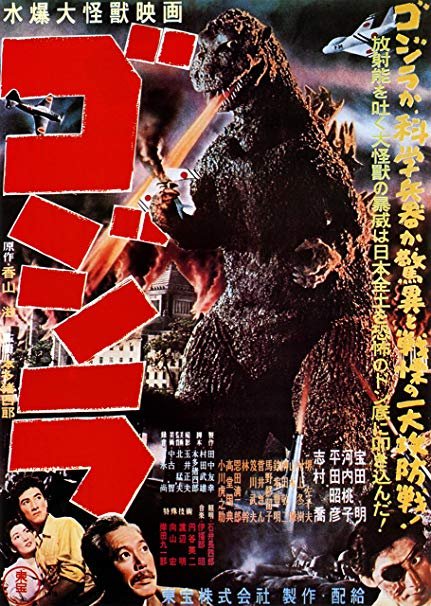
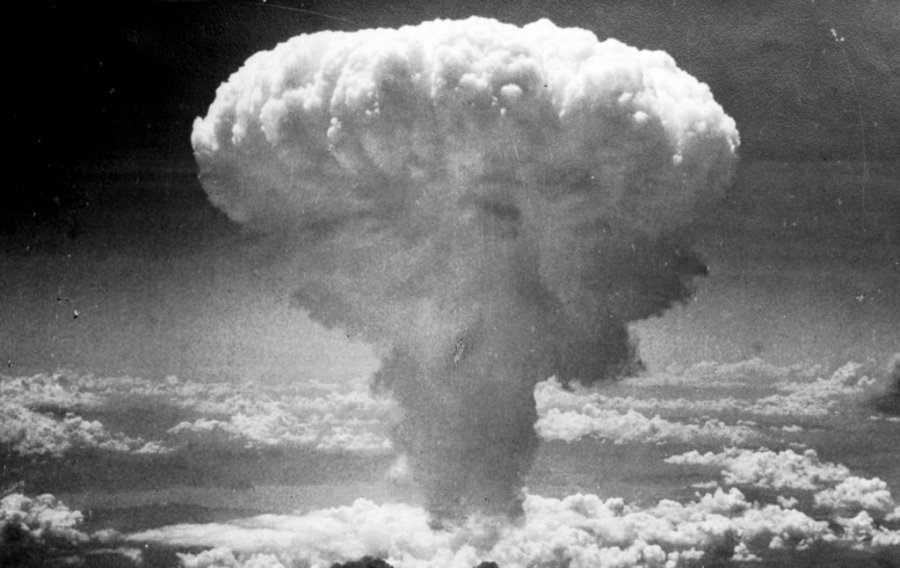
Contrary to many misconceptions, Godzilla had a very meaningful beginning. He started off as an allegory of nuclear holocaust and World War II trauma. Japan was brought onto its knees after the bombing of Hiroshima and Nagasaki in 1945. Then, the American occupation ensued which lasted up until 1952. Throughout this period, Japanese filmmakers were forbidden from acknowledging in any way the war and its atrocities. Nevertheless, the public controversy was ignited in 1954 when, as a result of a hydrogen bomb test performed at Bikini Atoll, 23 Japanese fishermen of Daigo Fukuryu Maru tuna fishing boat were exposed to radioactive ash. The event reminded Japan that the atomic weapon was still a tangible threat, but it also inspired producer Tomoyuki Tanaka to make a movie about a monster emerging from the sea depths as a side effect of nuclear testing.
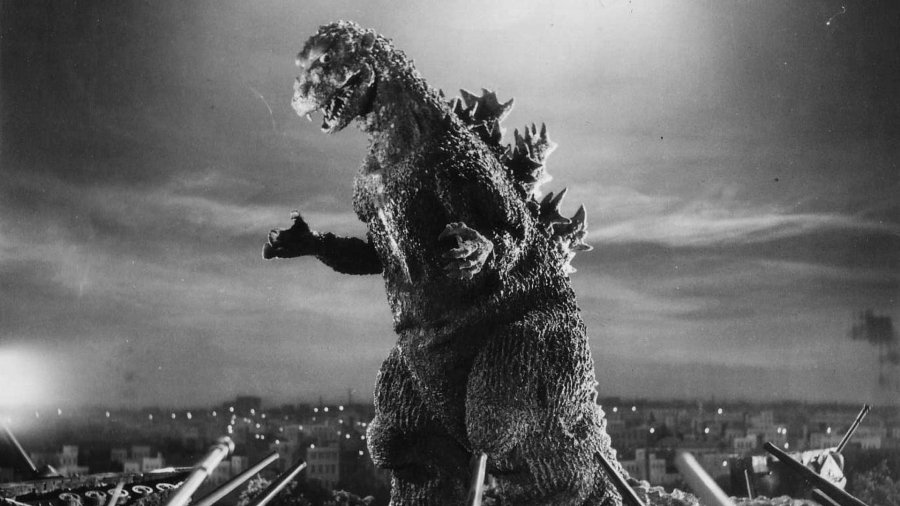
     However, the nuclear test was not the only influence. With the 1952 re-release of King Kong (1933) and the 1953 premiere of The Beast from 20,000 Fathoms, Tanaka saw the potential for a monster film made in Japan. Having obtained a green light from Toho, he brought on board director Ishiro Honda, former Akira Kurosawa’s collaborator, and Eiji Tsuburaya, the mastermind of Japanese special effects. The three created the story and its destructive creature: Gojira, a combination of words gorira [ゴリラ, gorilla] and kujira [クジラ, whale] serving to indicate the monster’s power and might. His appearance was devised by art director Akira Watanabe who blended attributes of various dinosaurs and combined them with scaly, charcoal skin, anthropomorphic torso, dorsal fins on the back, and a long tail. Godzilla’s famous roar, in turn, was invented by legendary Akira Ifukube (the official composer of 11 Godzilla movies) who rubbed the strings of the double bass with a coarse leather glove and played the recording back at a reduced speed. Talk about ingenuity in the 1950s!
The First Movie
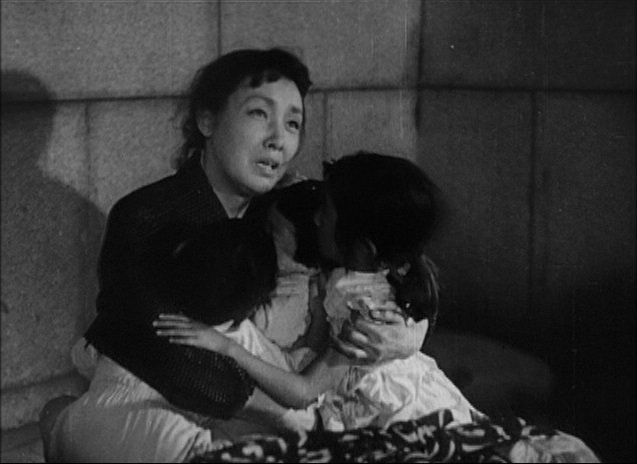
The original Gojira movie hit the screens on November 3, 1954. It was the most expensive Japanese production at that time (even surpassing the oversized budget of Kurosawa’s Seven Samurai from the same year) and it became an instant box office success. It has to be noted, however, that the first film did not establish the conventional formula of spectacular monster fights, army counterattacks, and invasions from outer space. The original movie provides a very bleak and harrowing cinematic experience. Images of utter destruction: Tokyo in flames, people suffering from radiation, and dead bodies made the Japanese recall their wartime trauma. Perhaps the most gutting image in the whole picture is that of a crying mother who, while clutching her children in the midst of explosions, says that they will soon join their father.

     What is more interesting, Godzilla is presented neither as an enemy nor as a symbol of hate. As the story progresses, human characters perceive him as a force of destiny, a metaphorical incarnation of Japanese arrogance who takes revenge on civilization. In accordance with Ishiro Honda’s vision, Godzilla was to behave like a living nuclear bomb, radiating as well as torching everything and everyone on his way. As Tomoyuki Tanaka stated: “Mankind had created the Bomb, and now nature was going to take revenge on mankind” (source).
     Surprisingly, the American audiences were not able to see the full, uncut version of the movie until 2004. Gojira was re-released in 1956 under the title Godzilla, King of the Monsters! (yes, the same name as the 2019 production). Most of the footage was reshot in order to incorporate journalist Steve Martin (played by Raymond Burr) as the lead character. While visibly weaker in comparison to the original, I find this version very watchable as well and it is worth checking out as a trivia.
Special Effects
Of course, the impact of Gojira would not be possible if it had not been for the special effects department. Originally, Godzilla was supposed to be shot using the stop motion approach as in the case of King Kong, but time constraints (only two months to make the picture) forced Eiji Tsuburaya to come up with the suitmation technique. It involves a man in a monster suit placed within a carefully crafted miniature set and shot at an appropriate frame rate (sometimes quicker or slower depending on the shot). Many modern “critics” look upon this approach as outdated and embarrassing, but they need to realize how ingenious and efficient it was. Without it, we would not get 28 Godzilla movies.
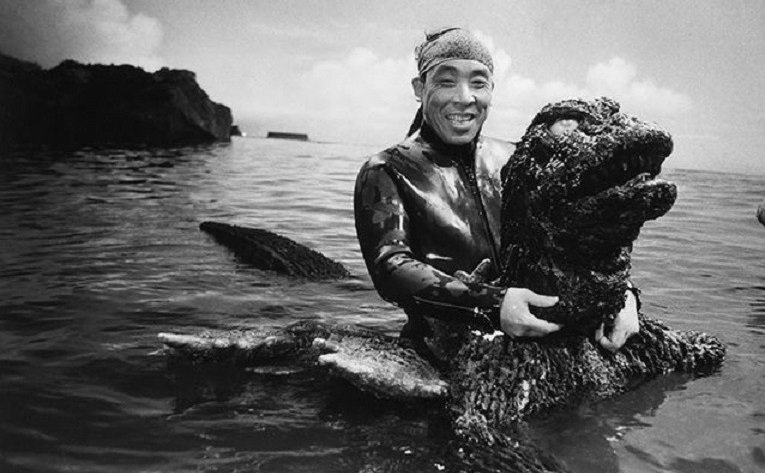
     Nevertheless, if you think that suitmation was a piece of cake, then you could not be more wrong. Haruo Nakajima, Kenpachiro Satsuma, and Tsutomu Kitagawa are the most prominent actors who “played” Godzilla throughout the Showa, Heisei, and Millennium series respectively and they all suffered through a fair share of discomfort and pain. The suits were extremely heavy (up to 100 kg/220 lb) and hot. The actors experienced such things as oxygen deprivation, near-drowning, concussions, lacerations, and electric shocks. In addition, each suit had to be made from scratch for a new movie. As with regard to the sets, the miniatures had to be destroyed on cue, which not always happened and resulted in the crew relentlessly “rebuilding” the miniatures after hours.
     Special effects changed and improved as time went by, but Tsuburaya’s technique remained largely unchanged. In fact, it was utilized on television in many Tokusatsu shows (Ultraman, Kamen Rider, Super Sentai). In the 1990s, the Heisei movies combined miniatures with cell compositing effects and digital graphics, whereas the Millennium era, in the 2000s, began blending CGI into the fights. Forgive me this subsection, but I felt I had to mention and give justice to people who made Godzilla seem real on film. Just check out their devotion even in recent years.
Actors
Evidently, Godzilla would be nothing without thespians whom he can trample on. A variety of actors and actresses graced the screen alongside Godzilla including such veterans as Akira Takarada, Momoko Kochi, Akihiko Hirata, Takashi Shimura, Kumi Mizuno, Yoshio Tsuchiya, Koichi Ueda, Masato Ibu, and Akira Nakao. All of them appeared in more than one movie, having played various roles, but an absolute record-breaker is Megumi Odaka who played the character of Miki Saegusa in six Godzilla movies. (Please, Toho/Warner Bros. give her a guest role in new films already!)
 
Showa Series
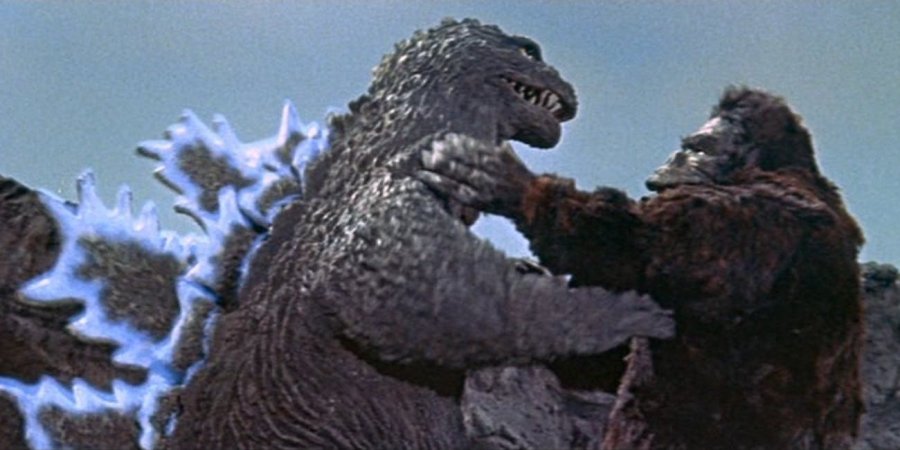
The success of the first movie immediately led to the production of a sequel, Godzilla Raids Again, in which he was pitted against the first antagonist, Anguirus. Though commercially successful, Toho did not pitch another follow-up idea for seven years. The year 1962 saw the release of King Kong vs. Godzilla which became an even greater success and set the tone for the rest of the Showa Series. With the advent of colour film, the style was no longer depressing, references to the war were scrapped, and the socio-political commentary got replaced by a light-hearted plot and monster battles. In the fourth movie, Godzilla had to fight against another Toho star, Mothra; and by the fifth picture, Ghidorah, the Three-Headed Monster, the Big G was presented as a friendly anti-hero who had to defeat a new badass in town.
     Godzilla’s transformation into a positive superhero was laid out in three subsequent productions: Invasion of the Astro-Monster, Ebirah, Horror of the Deep, and Son of Godzilla. In spite of turning Godzilla into a children’s hero, the films did manage to provide some social commentary. For example, Godzilla vs. Hedorah raises the issue of Earth’s pollution, whereas Godzilla vs. Mechagodzilla expresses clearly anti-American undertones. Yet, Godzilla also did such crazy stuff as wrestling jumps, talking or even flying… In the mid-1970s, the economic situation started to change in Japan. Godzilla was present on the silver screen for 20 years already and the demand for new adventures simply began trickling away. After 14 sequels, the series ended with Terror of Mechagodzilla in 1975.
Heisei Series
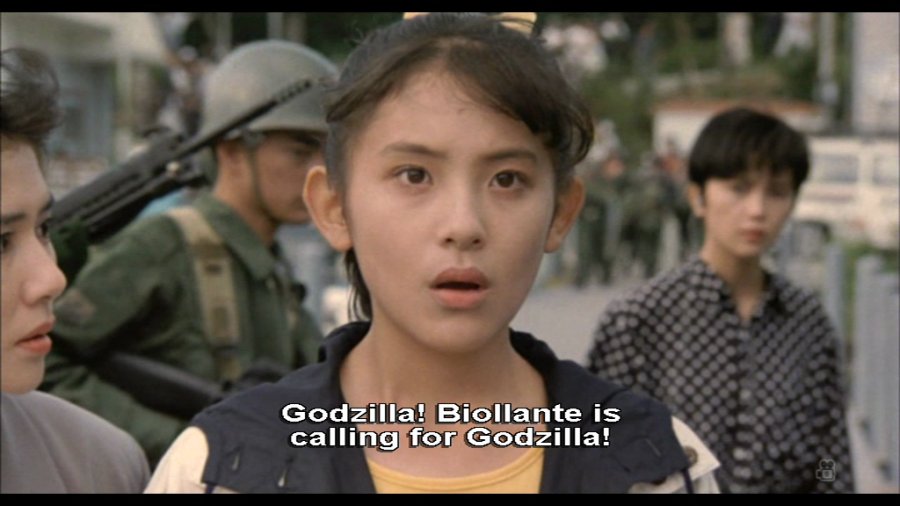
Toho was very keen on bringing back the King of the Monsters and they eventually achieved that in 1984 with The Return of Godzilla (original title: Gojira (1984)). The movie rebooted the franchise by ignoring all of the Showa films apart from the original Gojira. The monster grew to 80 meters and became more menacing in its appearance. Although The Return turned into a welcomed success, Toho had no idea how to carry the story further. Thus, they held a public contest and selected a script which became the basis of Godzilla vs. Biollante. This installment turned into a fans’ favourite over the years, but it was not as successful as anticipated.
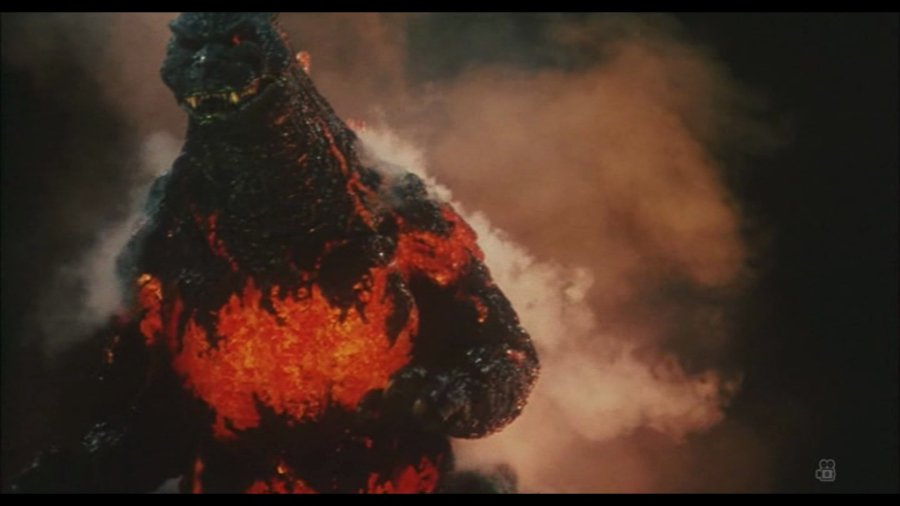
     Toho’s 60th anniversary in 1992 provided the opportunity for another entry in the series. Godzilla vs. King Ghidorah brought back the Big G’s archenemy after two decades of absence. In addition, the movie gave us Godzilla’s background story as well as Mecha-King Ghidorah(!) Consequently, King of the Monsters was pitted against good old foes in Godzilla vs. Mothra and Godzilla vs. Mechagodzilla II. Toho intended to end the franchise at this point but delays with the announced American version allowed them to produce two more pictures: Godzilla vs. SpaceGodzilla (40th-anniversary film) and Godzilla vs. Destoroyah.
     Personally, this is my favourite Godzilla series and I find it to be secretly genius. It has awesome monsters, great special effects, and brilliant music scores. The movies are closely knit together, showing a clear progression of Godzilla from a misunderstood monster to a ruthless destroyer to a loving father. Additionally, the ending of this series made me cry as much as I cried while watching The Lion King all over again (but ten times more heartbreaking!: *spoiler clip*).
Millennium Series
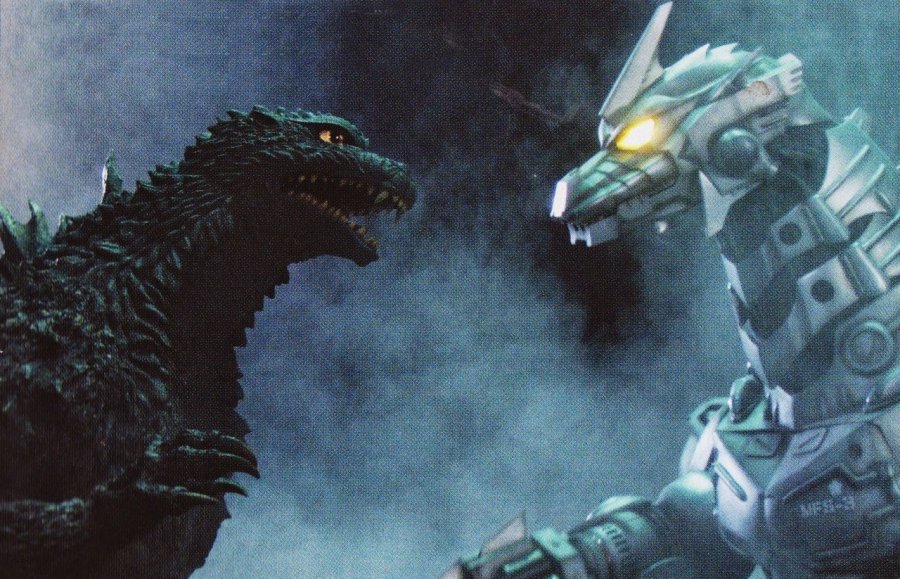
After the premiere of the abysmal Hollywood reimagining of Godzilla in 1998 (“That’s a lot of fish”), the fans raged across the globe and Toho management gave the green light to a new film that was supposed to save the King’s reputation. The result of this was Godzilla 2000: Millennium which, similarly to The Return of Godzilla, ignored everything but the original Gojira. The producers must have taken a liking to this approach because almost every entry of the Millennium Series is a reboot happening in an alternate timeline and ignoring everything that occurred earlier. The notable exception is Godzilla X Mechagodzilla and Godzilla X Mothra X Mechagodzilla: Tokyo S.O.S which constitute a two-part story that references the Showa era. These two are definite highlights and my favourite entries of this series. Though, many fans point to Godzilla, Mothra and King Ghidorah: Giant Monsters All-Out Attack as the best picture of this era. The 50th-anniversary film, Godzilla: Final Wars, came out in 2004 to a mixed reception (I only liked parts of it).
Legendary Series (a.k.a. MonsterVerse)
Ten long years have gone by since Godzilla’s retirement, but he gloriously returned yet again in another Hollywood’s reinterpretation. Godzilla (2014) directed by Gareth Edwards pays a lot more focus and respect to the source material than the 1998 flick. The King is Japanese, its 1954 origins are referenced, and there are monster fights. I enjoyed every minute of this film when I saw it on the big screen, so it is really hard for me to comprehend all the bad rap this movie gets for not having enough of Godzilla in it. This was a very good introduction into a larger story that Legendary Entertainment is currently developing.
     Speaking of which, Godzilla: King of the Monsters (2019) won me over! It was a breathtaking experience seeing this film in cinema. Indeed, it may have a generic human drama and a couple of cheesy one-liners, but the action, pathos, and the monsters are amazing! Hollywood is finally going down the right path laid out by Toho decades ago. Godzilla vs. Kong (2021), you’d better be good!
Shin Series
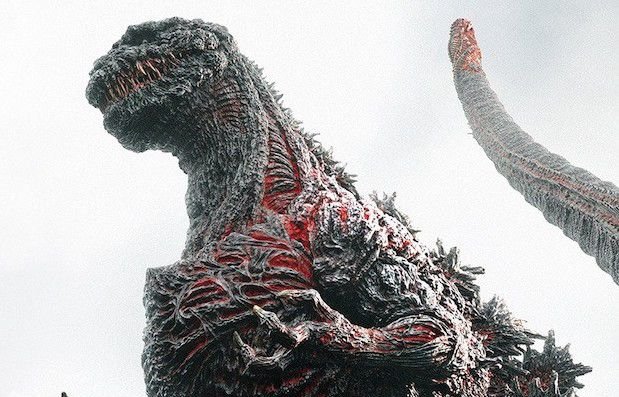
Following the enormous success of Godzilla (2014), it became evident that Toho also wanted a piece of the action. Being bound by the deal with Legendary, Toho cannot release a Godzilla flick in the same year as Legendary’s prospective productions. Hence, they gave director Hideaki Anno a very narrow time window (summer 2016) to make a new movie. The result of this expensive and hasty production is Shin Gojira (a.k.a. Godzilla Resurgence), a new take on Godzilla’s monstrosity that ignores even the 1954 picture.
     The movie became a huge hit at the Japanese box office and received wide critical acclaim. Godzilla’s unique appearance and powers might have been the main visual advantages, but the movie is unconventional in other ways as well. Steve Ryfle describes it in the following manner: “It’s not truly a monster or disaster movie at all, but a faux-documentary look at politicians and bureaucrats responding to a doomsday scenario, with all of the deadlocked meeting, endless discussion, conference calls and staring at computer screens […] What the film eschews in personal emotion, however, it replaces with a sense of national pride, embodied not by the bumbling, indecisive, pass-the-buck, old-school politicians […] but by younger, patriotic and clear-headed generation that leads the country out of the mess” (source). In other words, Shin Gojira turns into an ideological manifesto in the wake of post-Fukushima Japan. While I appreciated the risks the film took and a new direction of the story, it did not make a lasting impression on me. Call me an old-fashioned viewer, but I go with J-Taro Sugisaku’s claim that the primary reason behind Shin Gojira’s popularity was the presence of Satomi Ishihara as the female lead…
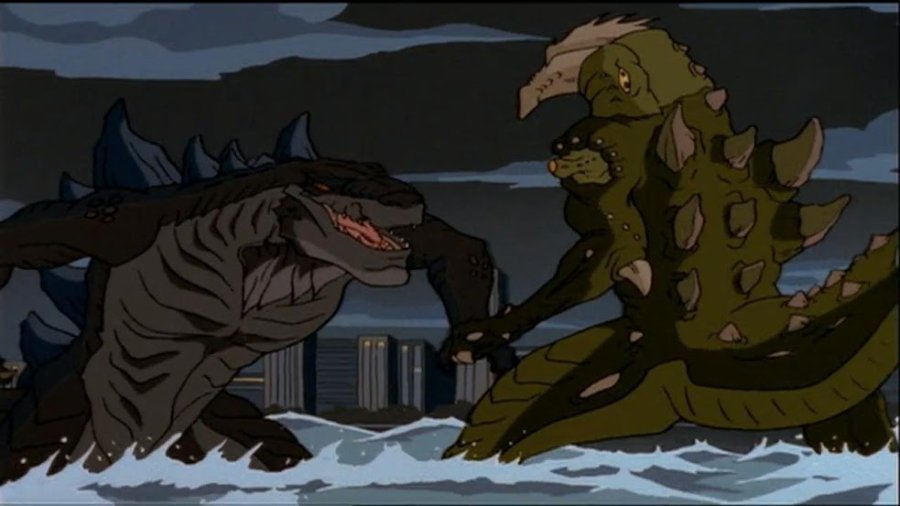
     In between 2017 and 2018, Toho released together with Polygon Pictures a trilogy of animated Godzilla films: Godzilla: Planet of the Monsters, Godzilla: City on the Edge of Battle, Godzilla: The Planet Eater. Although the fandom generally disliked the trilogy for not including monster fights, I think that the anime provides a very interesting what-if scenario for Godzilla, grounding it deeper within the sci-fi convention. In addition, this series gave us, arguably, the most hellish reimagining of King Ghidorah since his first appearance in 1964.
Knock-offs and Imitations
As with every other major phenomenon, Godzilla became the source of many copycats. The most prominent of these is Gamera, Godzilla’s rival from Daiei company, who appeared in 12 movies to date. Other Godzilla-influenced monsters include Repticulus, Gorgo, Yonggary, and Pulgasari. The last one is known more than anything else for the unusual story behind its making. The glorious leader of the North Korean nation, Kim Jong-Il was so desperate to produce a hit that he kidnapped a South Korean actress and director, as well as tricked the Heisei Godzilla crew, in order to create Pulgasari. For more information about this crazy story, please refer here.
 
In Other Media
Apart from the cinema, Godzilla also appeared on television. He was given his own animated toy show called Godzilla Island (1997-1998) as well as a series of animated shorts called Godzilland co-produced by an educational company Gakken (children were supposed to learn writing and maths with the King). In the late 1970s, Hanna-Barbera Productions made their own Godzilla cartoon, whereas 20 years later Sony Pictures produced Godzilla: The Series, a cartoon sequel to the 1998 movie. The King received a string of video games as well (the most prominent one being Godzilla: Destroy All Monsters Melee on Gamecube). Also, Godzilla did manage to battle the Avengers (yes!) in a series of Marvel comics between 1977 and 1979. Unfortunately, the only thing we are missing today is a full-blown J-drama set in the aftermath of the Kaiju apocalypse… (You can do this FujiTV!)
Selected Trivia
  • In 1985, New World Pictures released the U.S. cut of The Return of Godzilla. Similarly to Godzilla, King of the Monsters! from 1956, Raymond Burr was included into the film, reprising the role of American journalist Steve Martin.
  • The second best screenplay of 1986’s public contest involved Godzilla fighting against a supercomputer. It later served as the basis for a science-fiction production called Gunhed.
  • After the release of Godzilla vs. King Ghidorah, Toho wanted an immediate follow-up titled Counterattack of Ghidorah, but they opted instead for Godzilla vs. Mothra because the latter monster was very popular among female fans.
  • A 1992 Nike Ad featured Godzilla playing basketball against Charles Barkley.
  • Japanese baseball star Hideki Matsui was nicknamed “Godzilla” for his achievements and he even made a cameo in Godzilla X Mechagodzilla.
  • In 1992, one of the monster’s costumes (worth $39,000) was stolen from a Toho garage, only to be found washed up on the shore near Tokyo, where it unexpectedly terrified a lady who had gone out for a stroll.
  • Patrick Stewart presented Godzilla with an MTV Lifetime Achievement Award in 1996.
  • In Japanese, Godzilla is referred to with the gender-neutral pronoun “it”, while in English as “he”. In Polish, Godzilla’s gender form is “she” (sorry, our inflectional language is pretty messed up). Toho officially confirmed that the King’s gender is male.
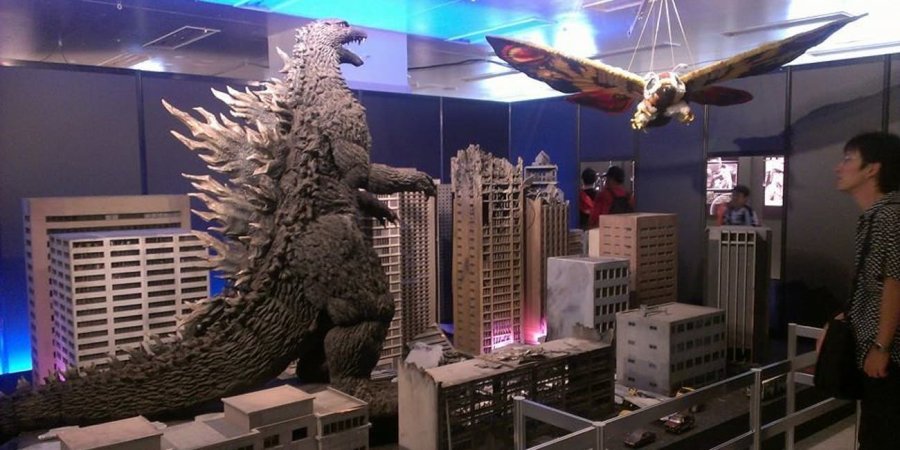
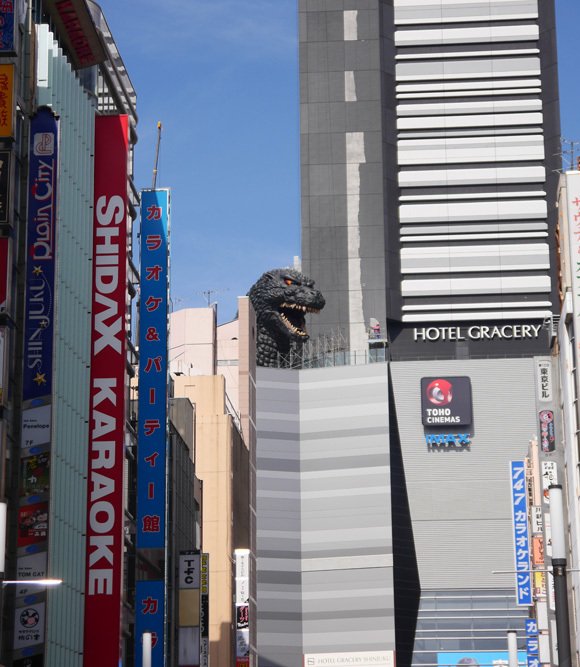
  • Since 2015, Godzilla has been peering down at bystanders from one of the buildings at Shinjuku (as presented by photo at the top of the section). He was also nominated by Shinjuku ward of Tokyo to be an official cultural ambassador.
Personal Movie Recommendations
  • Gojira (1954): The movie that started it all. If you are not interested in the monster theme, it is still worth checking this film out for human drama and social commentary.
  • Ghidorah, The Three-Headed Monster (1964): The first appearance of King Ghidorah and the combined fight between Godzilla, Mothra, and Rodan. Best to check out before the 2019 movie.
  • Invasion of the Astro-Monster (1965): An exemplary instance of the Showa era's greatness. Godzilla duels King Ghidorah once again, but this time there is a lot of science-fiction stuff going on.
  • Godzilla vs. Biollante (1989): The King's triumphant step into the 1990s where he fights a biologically engineered creature.
  • Godzilla vs. King Ghidorah (1991): One of the best sequels out there. Evil time travelers, altering the past, an android, and two incarnations of King Ghidorah.
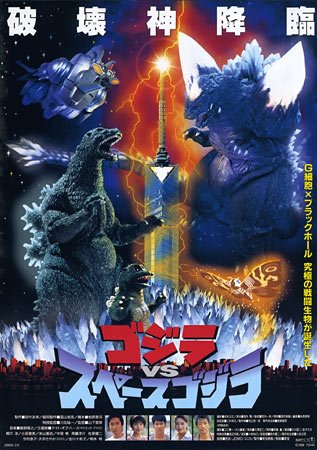
  • Godzilla vs. SpaceGodzilla (1994): Considered by many as the weakest Godzilla film of all time, but it really grew on me over the years, so I give this story my recommendation. Spacegodzilla is awesome!
  • Godzilla vs. Destoroyah (1995): The only movie in the whole franchise which provides some sense of closure. The main antagonist is truly terrifying.
  • Godzilla X Mechagodzilla (2002): I recommend this mainly because of Kiryu who is the best incarnation of Mechagodzilla. Very good special effects and the fights.
  • Godzilla X Mothra X Mechagodzilla: Tokyo S.O.S. (2003): A follow-up to the previous film. This time Mothra joins the party as well. I wish the filmmakers could carry on this story arc. There is a post-credits scene which went to a complete waste because it was not referenced anywhere later on.
 
Well, I guess this is the end of my lengthy retrospective look at the King of the Monsters and his extensive legacy. As of May 2018, Toho announced that there will not be a follow-up to Shin Gojira. However, there are plans for a shared cinematic universe between Godzilla and other Toho monsters after 2021. Saddening is that fact that none of the original crew members will be working on new movies anymore, because they either passed away or retired. Nevertheless, this is the way our world works. Times change, people move on, but Godzilla always stays the same, regardless of whether or not he is a hero, destroyer, or a force of nature. He will be with us for the next 65 years to come.
Make sure to check out Easter eggs in the hyperlinks as well as my sources below. Although I tried to contain as much as info as possible, this task proved to be a fool’s errand: EW.com, Reuters.com, JapanTimes.co.jp, BBC.co.uk, Salon.com, InTheseTimes.com, Motherboard.vice.com, Mangauk.com, SFcrowsnest.info, FactFiend.com, Metro.co.uk, GeeksandSundry.com, Britannica.com, IGN.com, Inverse.com, MentalFloss.com, TokyoCreative.com, HistoryVortex.org, ScifiJapan.com, ScreenRant.com, TohoKingdom.com, Kenpachiro Satsuma Interview, Megumi Odaka Interview, and Bringing Godzilla Down to Size (a documentary).

If you still can’t get enough of reading about Godzilla, then I also recommend two books: Japan’s Favourite Mon-Star: An Unauthorized Biography of the Big G by Steve Ryfle and Millennial Monsters: Japanese Toys and the Global Imagination by Anne Allison.

I hope that you enjoyed the article as much as I did writing it. Have you seen any Godzilla movies? Would you like to check out some of the mentioned ones? Please write in the comments. Thank you for reading.
«Enjoyed this post? Never miss out on future posts by following us»