Showing posts with label 1995. Show all posts

Mechanical Violator Hakaider (1995) [Tokusatsu Review]

Mechanical Violator Hakaider; or, Requiem for a Destroyer
     Do you want to live? Do you want to live and have a free will of your own?
It’s been quite some time since I covered Tokusatsu outside the realm of Godzilla. Actually, while being on the lookout for some Goji clips on YouTube, I spotted some random video in Japanese characters, but the thumbnail caught my attention, so I clicked on it. All I cay is that looking at unknown 90s Toku vintage action sent me on a search to find the original source. This led me to Mechanical Violator Hakaider, directed by none other than the crazy nerd himself Keita Amemiya.
Release Info
Directed by: Keita Amemiya Starring: Yuji Kishimoto, Mai Hosho, Jiro Okamoto, Yasuaki Honda
Language: Japanese Original Title: 人造人間ハカイダー Runtime: 77 min
Synopsis
A group of criminals raid an abandoned prison facility. In one of the sealed chambers, they discover a man in chains (Yuji Kishimoto). The man turns himself into an android known as Hakaider and kills the criminals. He mounts a bike and rushes to a utopian world known as Jesus Town, which was built on the ruins of Jerusalem. Jesus Town is governed by the Parliament and psychotic leader Gurjev (Yasuaki Honda). A group of outlaws led by a girl called Kaoru (Mai Hosho) plan to destroy the Parliament. Hakaider teams up with Kaoru because she believes he is the black knight who saved her in her dreams. When the outlaws are attacked, Hakaider steps into action.
Knockin’ on Heaven’s Door

Having done some research online, it turns out the character of Hakaider is actually the original creation of Shotaro Ishinomori, the mastermind behind Super Sentai and Kamen Rider. The villainous robot was part of 1970s Toku manga and TV show called Android Kikaider; however, Amemiya’s movie is not in continuity with the previous media. Instead, Mechanical Violator Hakaider is a stand-alone sci-fi spin on the side character, turning him into a sympathetic anti-hero much in the vein as Terminator from T2: Judgement Day (1991).
If you are already familiar with Keita Amemiya (see my review of the Zeiram franchise), then you know you are in for a ride filled with old-school fireworks, miniatures, model work, stop motiion, front projection, and early CGI. Amemiya uses every single trick in the book to make a satisfying dark Toku spectacle driven by ridiculously satisfying action, Mad Max-inspired production design, and moments of genuine poignancy.
The story itself is simple enough to keep you engaged. We have the main hero who doesn’t know what exactly he is: a tool of destruction or perhaps misunderstood champion of morality. It is only when Hakaider meets the cheerful Kaoru, he experiences some real happiness.
I know that I am a sucker for love subplots, but I really like the romance between Hakaider and Kaoru because it wasn’t just “love at first sight”. In fact, the majority of the thing was presented through Kaoru’s dreams, which made it extremely poetic.
Now, moving to the baddies. Amemiya does some clever deconstruction of expectations here. Gujrev looks like an angel, and he even has a bunch of fake wings. The soft way he speaks and his affection for flowers makes you think he is a kind person, but nothing could be farther from the truth. The same goes for Gujrev’s henchman, android Michael, who looks all clean and slick, as if he came out of the Timeranger show. The android even claims to be a representative of justice, but he too is driven by twisted misconceptions about life, peace, and obedience.
Oh, and a bit of trivia! Perceptible viewers may spot among the outlaws a familiar face from Zyuranger; that is, Ami Kawai who played Lami in the show. Here, unfortunately, she doesn't have much a screen time, but it's great to see her in another Tokusatsu production. 
With regard to disadvantages, the movie’s runtime is quite short and I watched the director’s cut(!) This version lasts 77 minutes, whereas the theatrical one is 26 minutes shorter. It makes me think what exactly was cut to accommodate the shorter runtime, but I have no desire to watch the original version.
Recommendations
All in all, Mechanical Violator Hakaider is a lot of fun if you’re looking for something vintage, yet without gruesome violence. It took me like a whole week to track this movie down. I’ve searched for it anywhere, until my stupid brain told me to head over to YouTube of all places, and lo and behold there it was. Now I’m so super charged that I want to check out more of Keita Amemiya’s filmography.
Overall score: 7/10
«Enjoyed this post? Never miss out on future posts by following us»

Godzilla vs. Destoroyah (1995) [Tokusatsu Review]

Godzilla vs. Destoroyah; or, Highway to Hell
     First you come and see me to warn me not to make an Oxygen Destroyer. Now you want me to make one?
Citing a popular proverb, all the good things come to an end, and this is also the case with my revisitation of the Godzilla Heisei series. I was a bit reluctant to write this review, especially in view of that fact that I still have conflicting thoughts about the Big G’s 90s swan song that is revered by the fans and considered to be one of the best Godzilla movies out there. Well, here it is, my review of Godzilla vs. Destoroyah.
Release Info
Directed by: Takao Okawara Starring: Megumi Odaka, Yasufumi Hayashi, Sayaka Osawa, Yoko Oshino
Language: Japanese Original Title: ゴジラ対デストロイア Runtime: 103 min
Synopsis

40 years after the detonation of the Oxygen Destroyer by Dr Serizawa that led to the annihilation of the original Godzilla in 1954, a species of tiny, prehistoric creatures emerge from the sea depths and wreak havoc in Tokyo. The United Nations Godzilla Countermeasures Center travels to Birth Island to monitor Godzilla and his son. It turns out that Godzilla’s heart is nearing a nuclear meltdown. In the meantime, the devilish creatures morph into an indestructible monster called Destoroyah. Hoping that Destoroyah would kill Godzilla and prevent the meltdown that would contaminate Japan, the authorities lure the Big G and his son to Tokyo for a battle against a hellish nemesis.
Animal I Have Become
During the promotion of the film, the producer Shogo Tomiyama stated that Toho wanted to finish with Godzilla while he was still a star. Tomiyama explained that the studio wanted to end the series on a high note while they still had some good ideas. In my opinion, Godzilla vs. Destoroyah is an unnecessary entry in the Heisei series, and was made only as a “publicity stunt” (Ryfle 1998: 312) because Toho wanted to get more money out of the franchise before handing it over to Hollywood (see Ronald Emmerich’s 1998 remake).
Why Godzilla vs. Destoroyah is a publicity stunt? Well, from the get-go the studio marketed the movie with a gargantuan tagline “GODZILLA DIES”. They did not even care about the spoilers or the emotional impact of the story. Even the early teaser trailer harkening back to the original 1954 movie contained this premise.
To ensure decent box office returns, producers Tomoyuki Tanaka and Shogo Tomiyama essentially rehired the creative team behind the financially successful Godzilla vs. Mothra (1992); that is, director Takao Okawara, writer Kazuki Omori, composer Akira Ifukube, and F/X director Koichi Kawakita. As a result, on the technical front, the movie is a bombastic mash-up of kaiju fights and action sequences, but storywise, numerous characters and their erratic behaviour water down the gut-wrenching finale.
My biggest problem centres on the subplot concerning Miki Saegusa in this picture. In Godzilla vs. Destroyah, her story arc is essentially thrown out the window because she consciously agrees to put Godzilla Junior in danger, just so the Big G could get killed off. Of course, the whole plan fails miserably. It boggles my mind that Kazuki Omori came up with such an idea for a character that accompanied Godzilla for the previous five films.
Apart from this issue, the second act of the film is essentially a remixed version of Aliens and Jurassic Park as we see multiple, unformed Destoroyahs terrorising a journalist Yukari Yamane (Yoko Ishino) and going up against the military. In the meantime, the scientists continue to theorise over and over again about the Oxygen Destroyer and Godzilla’s nuclear meltdown.
Still, I have to praise the fact that Kazuki Omori tried to turn this Heisei movie into a direct continuation of Godzilla (1954). What is more, the special effects done by Koichi Kawakita are simply top notch across the board, especially in the film’s epic final battle. What is more, maestro Akira Ifukube goes all out in his final gig as the film composer and creates a truly captivating and enthralling music that accompanies Godzilla’s death.
I have to say that I saw the film for the first time on TV in the early 2000s and when I saw the King’s death I could not help but cry. “I want people to look at the death of Godzilla knowing that he was created by nuclear power and the most selfish existence in the world: mankind,” director Okawara explained, and indeed, he accomplished his intention (Ryfle 1998: 313).
It is without a doubt, a beautifully executed sequence. After the end credits rolled, I was genuinely convinced that I saw the all-time best Godzilla movie ever; however… this is the main problem with Godzilla vs. Destoroyah. The whole weight of wonderful visuals, emotional engagement, and paper-thin plot rests on this one absolutely magnificent sequence. Without it, and the scene that follows immediately after (no spoilers), Godzilla vs. Destoroyah would not have been held in such high regard as it is nowadays.
Recommendations
All in all, as a grown-up Godzilla fan, I appreciate Godzilla vs. Destoroyah for what it is, but I think that this conclusion of the Heisei era was a bit forced by Toho. I prefer more optimistic take on the King of the Monsters as presented in Godzilla vs. King Ghidorah, Godzilla vs. Mechagodzilla II, and even Godzilla vs. SpaceGodzilla. Well, please stay tuned for more Toku reviews on the blog soon because I am going to finish my reviews of the Godzilla Millennium series and the Polygon anime trilogy as well.
Overall score: 7/10
«Enjoyed this post? Never miss out on future posts by following us»

High Risk (1995) [Film Review]

High Risk; or, Die Hard, Jackie!
     A man should rely on himself.
I think I should acknowledge this right off the bat. I would not have penned this review had it not been for a great video essay by Accented Cinema called Someone Made a Movie to Diss Jackie Chan. Evidently, the subject of the analysis is Wong Jing’s 1995 action flick High Risk with none other than Jet Li in the leading role. I remember seeing this film like 8-9 years ago, not thinking much about it then, but in view of the YouTube video, I decided to rewatch it and provide my thoughts on it.
Release Info
Directed by: Wong Jing Starring: Jet Li, Jacky Cheung, Chingmy Yau, Valerie Chow
Language: Cantonese Original Title: 鼠膽龍威 Runtime: 100 min
Synopsis
Kit Li (Jet Li) was a cop working for the Hong Kong bomb squad a couple of years ago. While trying to prevent a terrorist attack, he lost his wife and a child in a school bus explosion. Nowadays, Kit works as a bodyguard for a famous movie star, Frankie Lone (Jacky Cheung). When Frankie attends a jewellery exhibition, Kit discovers that a man at a party, calling himself the Doctor (Kelvin Wong), is the same guy behind the school bus incident. Kit rushes to action to stop the bad guys.
Stunt Meltdown
I really do not want to repeat the main points of the Accented Cinema video, so I simply encourage you to watch it. Let me just say that, in my opinion, Wong Jing wanted to make High Risk not just to diss Jackie, but out of the general bitterness over working on City Hunter (1993). The director really wanted to make a faithful anime adaptation, but production problems forced him to change the script on a daily basis. What is more, Jackie’s unfavourable comments about the project and about Wong Jing himself certainly did not alleviate the situation.
Consequently, Wong Jing was determined to make a proper action flick from start to finish, but without Jackie as the main lead. That’s why we get High Risk. It is a very entertaining movie indeed, especially in view of the fact that the plot was heavily inspired by the classic Die Hard (1988) film with Bruce Willis.
Die Hard influences are indeed visible in many sequences and exposition scenes (for instance, helicopter crash or bad guy using high-tech to get the booty), but Wong Jing manages to put his personal spin on the entire thing by throwing a whole array of toilet jokes (which do take place in toilets) and, of course, the aforementioned parody of Jackie Chan played by Jacky Cheung.
In his video, Accented Cinema states the following: “First, how do we know he's supposed to be Jackie Chan? The film seems to have trouble deciding if he's Jackie Chan or Bruce Lee. So it makes fun of both” (source). I beg to disagree on this matter. I believe Wong Jing knew perfectly what he was doing from the start. He wanted to parody Jackie, but a) the director wanted to avoid probable lawsuit for spreading bad PR about the actor, and b) Bruce Lee reference is in itself an additional diss on Jackie! One has to remember that at the very beginning of his career, Jackie used to work as a stuntman on the set of Bruce Lee movies (for instance, please refer to this short clip). Interestingly, after the untimely passing of Bruce, Jackie himself jumped on the Bruceploitation bandwagon by starring in New Fists of Fury (1976) directed by Lo Wei.
All in all, I think it is quite funny actually that Wong Jing decided to throw shade at Jackie Chan and gently highlight the fact that even such an action legend resorts to using stunt doubles. Jacky Cheung pulls off this comedic role really well, and I can’t help but express my words of appreciation for the final fight between him and Billy Chow.
Obviously, we cannot forget about the leading man, Jet Li himself. It is always so good to see this man in action, especially when the film blends kung fu showdowns with bullet ballet spectacle. His commanding presence is enough to make even a weak motion picture watchable. As of today, Jet Li is not battling onscreen baddies but health issues. I wish him all the best and I hope he is feeling better.
Last but not least, I have to compliment Wong Jing for one more thing. He may have done many schlock productions, but he always had an eye for casting beauties. In High Risk, we get to see the director’s regular- the always-great Chingmy Yau (this time playing a pesky TV reporter), the wonderful Valerie Chow as the hot-headed villainess, and Charlie Yeung as a damsel in distress. What is more, I have to give a big shout out to supporting actors: Wu Ma as the witty dad of Jacky Cheung and the late Kelvin Wong as the suave bad guy.
Recommendations
If you want to see a remix of Die Hard and have a few laughs, then I recommend High Risk. The movie is available on Amazon, Vudu, and Tubi. I hope that in the future either Eureka! or 88 Films will give this movie a proper Blu-Ray release.
Overall score: 7/10
«Enjoyed this post? Never miss out on future posts by following us»

Dr. Mack (1995) [Film Review]

Dr. Mack; or, Community Values
     There is no completely rational and unselfish doctor because we are all human. Let me show you the way.
Little do some cinema connoisseurs know Tony Leung Chiu-wai is such a versatile actor that he could even do stupid comedies back in the day. Dr. Mack (also released under alternative title Mack the Knife) is an excellent example of such a flick. Let’s explore together Tony’s personal take on House M.D. type of persona, inspired by a comic book series made by Sho Fumimura and Takumi Nagayasu.
Release Info
Directed by: Lee Chi Ngai Starring: Tony Leung Chiu-wai, Alex To, Andy Hui, Christy Chung
Language: Cantonese Original Title: 流氓醫生 Runtime: 98 min
Synopsis
Lau Mack (Tony Leung Chiu-wai) is a doctor who runs his practice in a working-class neighbourhood in Hong Kong, treating prostitutes, the elderly, and underprivileged. However he has a brilliant mind and exceptional medical skills. Because he obtained his licence in Africa, he is unable to work at a proper hospital, but still he always helps out his colleague Roger Law (Alex To) whenever there is a tough medical case. Nevertheless, Law secretly despises Lau and goes out of his way to revoke his licence…
Tony Leung in the House
If you expect to see a bitter, nihilistic Tony limping away and high on Vicodin, then better hold your horses. Tony’s Dr. Mack character is as genius and outspoken as House M.D. but this is where the similarities end. Mack remains devoted to his profession, even to such an extent that he rushes into action when clearly someone else (see Law) is at fault and unable to treat a patient in need.
In spite of this running theme, it is hard to call Mack a central character of the story. The movie rather focuses on the people Mack interacts with and how he inspires them to better themselves in their lives. If anything, the film’s proper title ought to be “Community” because Mack’s neighbourhood friends: a rookie doctor (Andy Hui), a high-school student (Gigi Leung), a clumsy cop (Sean Lau), an ailing prostitute (Eileen Tung) take the center stage.
Still, it is a darn fun seeing Tony in a light-hearted mode cracking jokes, charming an elegant lady (Christy Chung), and doing the right thing at the same time. Alex To is a great addition as Law, but I would not call his character a total baddie. The supporting actor who really shines on the screen is Andy Hui as Dr. So, his subplot could be the basis for a separate hardcore drama movie. I also appreciate a small but funny part done by the legendary Richard Ng.
An additional word on the official theatrical poster: Don’t let the cover artwork fool you. On the basis of the image alone, you may think that Dr. Mack is a kinky CAT-III flick, but it is not. The only scene that comes closest to the NSFW label is the opening sequence. The rest of the film is very mild, even to such an extent that details of hospital operations are not shown at all.
Recommendations
If you are looking for not-so-serious endeavours from Tony Leung Chiu-wai, then I recommend Dr. Mack. The only disadvantage is a dated English translation from Laserdisc times, which is most certainly not 100% accurate and puts you out of context at times.
Overall score: 7/10
«Enjoyed this post? Never miss out on future posts by following us»

August in the Water (1995) [Film Review]

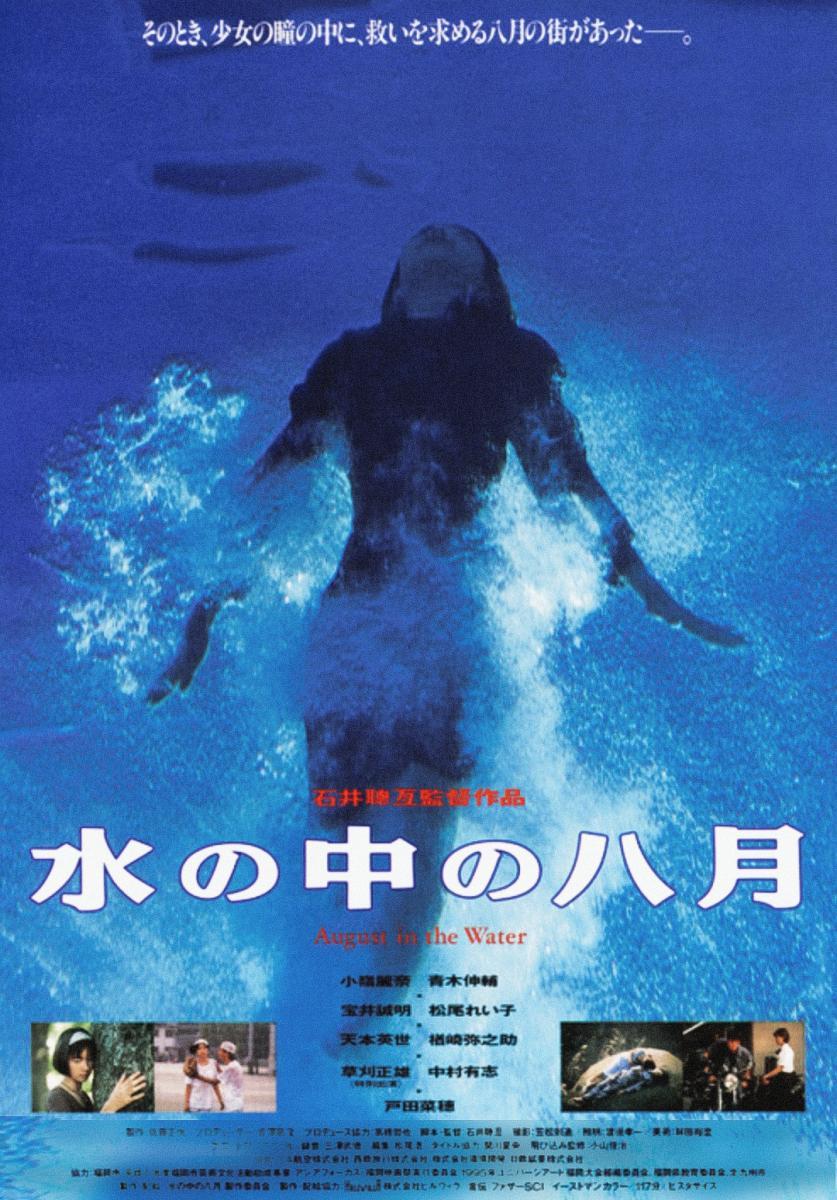
August in the Water; or, Melancholic Blue
     Sometimes I become uncertain if it was… real, dream or just memories, and whether I'm alive or not.

Allow me to say out-front that I approach this particular review with great trepidation. This is caused by the fact that I have seen Gakuryu (Sogo) Ishii’s August in the Water for the fourth time already in the course of a year and still I do not feel I have digested it fully. On the other hand, I do not want to wait indefinitely, because I am not sure if I will ever be able to fully comprehend this film. In consequence, I apologise if my opinions will not be articulate enough.
Release Info
Directed by: Gakuryu (Sogo) Ishii Starring: Rena Komine, Shinsuke Aoki, Masaaki Takarai
Language: Japanese Original Title: 水の中の八月 Runtime: 127 min
Synopsis
Two high-school students, Mao (Shinsuke Aoki) and Ukiya (Masaaki Takarai) befriend a girl called Izumi (Rena Komine). She practices high diving and participates in competitions organised by the city of Fukuoka. In the meantime, the world is plagued by drought and an unknown outbreak known as the stone disease. The only hope to restore balance is to perform an ancient ritual during a full moon. Izumi suffers an accident while jumping from a pool platform and, in consequence, she gains special powers. She can communicate with dolphins and plants. What is more, she gains an understanding of humanity’s place in the universe.
Water Sensitive
Many people across the internet refer to this movie as a mix between science-fiction and fantasy with a touch of teenage romance. In my opinion, August in the Water is neither of these things. It is most certainly not a narrative-driven picture. In fact, Gakuryu Ishii goes out of his way to enhance the viewing experience by putting emphasis on mesmerising visuals and extremely ethereal music score. As a result, the film very much feels like a dream, an illusive vision that stimulates your senses, yet it is not entirely comprehensible.
The story is there of course but it does not take the center stage. In his own auteur manner, Gakuryu Ishii presents the viewers with glimpses of events, filling in blanks by putting necessary exposition into conversations done by side-characters, TV clips, interviews, or newspaper articles. Therefore, the audience has to assemble the pieces of the puzzle on their own, which is a very challenging task indeed, and opens room to many interpretations of the film.
The way in which I personally understand the film is that the drought and stone disease function as an allegory for a topical problem of modern society, which is lack of empathy. People in the world of today are so dissociated from reality, from contact with another human being that they function as automatons. Hence, their inwards turn to stone. By falling in love with Izumi, Mao understood the value of positive emotions which allowed him to live to the fullest, appreciate nature, and wait decades for the return of the love of his life.
What is more, Ishii can’t help himself but question the organisational order yet again (*Crazy Thunder Road flashbacks*). In spite of drought and disease, the city of Fukuoka organises the high diving competition. Consequently, the country of Japan functions as normally as possible regardless of the immediate threat.
The editing and cinematography of August in the Water deserve a scientific monograph, so I shall limit myself and just say that Ishii really achieved the impossible. Just by camera movement and the marriage of visuals and sound, he creates a one-of-a-kind ambience which covers as well as overshadows the main themes of his picture. Even without the English subtitles, you come to appreciate what is presented on the screen. My favourite sequences, without a doubt, are the opening intro and a water-throwing festival. Had there been a Blu-ray edition of the film in the West, it would have certainly made a great demo disc to test your home cinema setup.
I could devote many more paragraphs to August in the Water, but I feel I would not give justice to the film, so let me end my thoughts here. I know I have to go back and watch it for the fifth time because with each viewing I interpret this film, and Hiroyuki Onogawa’s music, differently. If you wish to read more on the film, then please refer to this informative article at Dazed which has lots of sources.
Unfortunately, the DVD edition of the movie is out of print, so do not get fooled by some preachy sites that refer you to expired offers from Amazon or Yes Asia because most certainly the writers themselves had not seen the film on a physical disc. As of now, the film frequently pops up on YouTube, which is sadly the only way to watch it. I sincerely hope that either Criterion or Eureka! will buy the distribution rights and give August in the Water a proper release it very much deserves. 
Recommendations
I recommend August in the Water if you seek for a magical, other-worldly experience. People need to be more aware of Japanese productions like this one. It is truly idiosyncratic but not by any means pretentious or quirky. It is an emotion rather than a tale.
Overall score: 8/10
«Enjoyed this post? Never miss out on future posts by following us»

Rumble in the Bronx (1995) [Film Review]

Rumble in the Bronx; or, A Fish Out of Water
     That’s my uncle’s car!
Fresh after the success of Police Story 3: SuperCop (1992) and Project S (1993), the duo composed of director Stanley Tong and action star Jackie Chan continued their fruitful cooperation in yet another bombastic project called Rumble in the Bronx. This movie would go on to prove itself especially important for Jackie’s career because it is often cited as one of the 90s flicks that made the Hong Kong actor recognisable in the United States.
Release Info
Directed by: Stanley Tong Starring: Jackie Chan, Françoise Yip, Anita Mui
Language: Cantonese, English Original Title: 紅番區 Runtime: 90 min
Synopsis
Keung (Jackie Chan) arrives in New York to visit his uncle (Bill Tung) who is going to remarry soon. Uncle Bill sells his grocery shop to a businesswoman called Elaine (Anita Mui). Nevertheless, problems arise when local thugs raid the shop. Keung helps out Elaine, but for his heroic action, he is assaulted and wounded by the bandits. He is looked after by his neighbour Danny (Morgan Lam), a physically-disabled boy, and his sister Nancy (Françoise Yip). In the meantime, a crime syndicate is looking for stolen diamonds in the neighbourhood. In order to fight the syndicate and protect his friends, Keung will have to join forces with the thugs.
Street Fighter
Rumble in the Bronx was made in-between Jackie’s popular Police Story movies, so it comes as no surprise that the team behind this franchise (director Stanley Tong, producer Raymond Chow, and screenwriter Edward Tang) crafted this particular motion picture. What is more, the movie was shot primarily on location in Vancouver, Canada, so the crew had to make sure that the setting would resemble NYC cityscapes.
The narrative premise as well as the fact that the film was shot outside of Hong Kong are reminiscent of Bruce Lee’s The Way of the Dragon (1972). In that film, Bruce plays a well-meaning newcomer from Hong Kong who finds it difficult to operate within Western culture, but who tries his best to protect his friends from baddies. This is exactly what Jackie channels in Rumble in the Bronx and he does that very well indeed. The movie is packed with breathtaking action stunts, meticulously choreographed fight sequences, and a light-hearted humour (mostly coming from Anita Mui’s character).
When it comes to US releases of Jackie’s films, as always there are differences in various cuts. The most popular edition of the Rumble in the Bronx from New Line Cinema runs at 90 minutes and is very much watchable; however, the Hong Kong release actually provides different contexts for the characters through the Cantonese dubbing. For instance, in the original cut, it is said that Keung is actually a cop and he has a girlfriend back in Hong Kong. In the American cut, there’s absolutely no mention of such a thing.
With regard to performances, Jackie as always shines on the screen as the happy-go-lucky everyman who never wants to cause any trouble. For some of his 90s productions, Jackie had this great skill of choosing pretty wooden actors, especially Western ones, but this is not the case with Rumble in the Bronx. Françoise Yip does well as the friend/love interest character, and (that’s only my observation), she reminds me a lot about young Cherie Cheung. It is always great to see the late Anita Mui alongside Jackie, especially in a comedic role. The actors playing thugs, such as the late Marc Akerstream, and Gavin Cross also did quite well, and it is clear that they must have had a lot of fun on the set.
Unsurprisingly, the only person who did not have fun on the set was Jackie himself who badly injured his leg. In the making-of footage during the end credits, you can see that he filmed some of his stunts with a leg in a cast that had a sock coloured to resemble a shoe!
Recommendations
Needless to say, Rumble in the Bronx marks Jackie’s epic entry into the Hollywood showbiz. 27 years after its original release, the movie is still an enjoyable ride. I saw it for the first time on a promo-VHS copy from Imperial Entertainment Home Video and the memories of the hovercraft chase stayed on with me throughout childhood.The DVD edition I have contains the standard Miramax cut and no bonus features, but there is a DTS audio track.
Overall score: 8/10
«Enjoyed this post? Never miss out on future posts by following us»