Showing posts with label family. Show all posts

Always: Sunset on Third Street 3 (2012) [Film Review]

Always: Sunset on Third Street 3; or, In the Shadow of the Olympics
     Today’s the first day of your new family. But remember… You will always be a part of your family, too.
It took ma a while, but here it is: my review of the third and final instalment of the Always series directed and written by Takashi Yamazaki. Is it a satisfactory conclusion of the trilogy? Let’s jump into the discussion.
Release Info
Directed by: Takashi Yamazaki Starring: Hidetaka Yoshioka, Shinichi Tsutsumi, Koyuki, Maki Horikita
Language: Japanese Original Title: ALWAYS 三丁目の夕日'64 Runtime: 144 min
Synopsis

Tokyo, 1964. The city gears up for the famous Olympics that reintroduced Japan to international consciousness. The citizens of the third street also prepare to celebrate the sports event, but they also struggle with their personal affairs. Chagawa (Hidetaka Yoshioka) has to compete against a young writer who takes over his reading audience, whereas Roku (Maki Horikita) falls for a surgeon from the local hospital.
Always 64
Honestly, Always: Sunset on Third Street 3 did not sit well with me. When compared to the previous two entries, the third movie is riddled with pacing issues, episodic structure, and some odd storytelling decisions.
First of all, the beginning lets you think that the Olympics are going to function as a major overarching theme in the film, but that’s not the case (these are important only in two scenes). Secondly, humour bits are thrown all the time to lighten up the mood, but these feel forced, even to such an extent that the same music cue signals their appearance. Finally, as a viewer who fell in love with the characters, I do not agree with their send off. Again, I avoid the spoilers territory, but the third film primarily focuses on the conflicts of Roku and Chagawa. While the first character was given a bitter-sweet ending, Chagawa was given closure against his warm, deeply kind character. To me, it’s unforgivable.
With regard to production aspects, there are the same as in the case of the previous Always movies. Takashi Yamazaki really has an eye for visual, and likes to freestyle with special effects to achieve a comedic effect. The music score Naoki Sato feels repetitive in the third film, but it hits you in the feels nonetheless.
Speaking about performances, Hidetaka Yoshioka and Shinichi Tsutsumi rock as always. True stars of the third film are Maki Horikita and Kenta Suga who really stand out with their interpretations of the characters.
Recommendations
All things considered, Always: Sunset on Third Street 3 was a bit of a disappointment for me, but I knew I had to see it because of Takashi Yamazaki. I recommend it only for the hardcore viewers who greatly enjoyed the previous two movies. I don’t think there’s any creative potential for the fourth movie at this point, but I wouldn’t mind seeing the new adventures of the third street inhabitants.
Overall score: 6/10
«Enjoyed this post? Never miss out on future posts by following us»

Always: Sunset on Third Street 2 (2007) [Film Review]

Always: Sunset on Third Street 2; or, All Folks Here
     Those of us who survived should be as happy as possible.
As promised, I return to the world of Always: Sunset on Third Street with my review of the second part of the live-action trilogy made by director Takashi Yamazaki. Again, as I explained last week, please accept my apologies for the delay. Without further ado, let’s dive in.
Release Info
Directed by: Takashi Yamazaki Starring: Hidetaka Yoshioka, Shinichi Tsutsumi, Koyuki
Language: Japanese Original Title: ALWAYS 続・三丁目の夕日 Runtime: 146 min
Synopsis
We reunite with the heroes of the first movie two years later. Mr Suzuki’s (Shinichi Tsutsumi) auto repair business thrives, whereas Chagawa (Hidetaka Yoshioka) does his best to raise Junnosuke (Kenta Suga). However, Junnosuke’s biological father (Fumiyo Kohinata) is unwilling to let go, so he pesters Chagawa about giving up the child, pointing out the writer’s poor living conditions. In order to prove that he can provide for Junnosuke, Chagawa decides to take part in the literary contest to win the prestigious Akutagawa Prize. At the same time, Chagawa struggles to meet with Hiromi (Koyuki) and disclose his feelings for her.
The Power of Word
Allow me to say that if you enjoyed the original Always: Sunset on Third Street, then you get the same package with the sequel, in which all the conflicts and touching moments are repeated. This sequel is not a bad film by any means, but it really feels like a washed down version of the first movie.
Nevertheless, Takashi Yamazaki threw some wonderful additions into the mix. For example, we get the traditional opening zoom out from a radio in Suzuki’s house only to reveal that Tokyo is being invaded by the King of the Monsters himself! This is the section of the film over which Godzilla fans relentlessly glow over in the internet, and it is indeed a real treat to watch. It is almost as if back in 2007 Yamazaki made this as a trump card for Toho, trying to say, “Here I am guys. Give me a chance to direct a Godzilla flick!”
Of course, glory of the intro does not constitute an entire movie. I liked Chagawa’s struggle to raise Junnosuke, but we have seen that already. The Suzuki family houses a newcomer in form of a distant cousin, and she feels like a fish out of the water exactly like Mutsuko in the first film. Mutsuko’s romance in the sequel also feels a bit forced. Sill, a breath of fresh air was Mr Suzuki’s nostalgia for the war buddies, a subplot taken straight from Nobuhiko Obayashi flicks.
With regard to performances, evidently, Hidetaka Yoshioka and Shinichi Tsutsumi are the showstealers, but Koyuki, Tomokazu Miura, and Fumiyo Kohinata have a lot more to do this time round.
Recommendations
All things considered, Always: Sunset on Third Street is a decent continuation, but it does on build upon the first movie. Instead, it kind of resets the characters and starts over to achieve the same happy ending outcome. Still, I don’t regret watching it.
Overall score: 7/10
«Enjoyed this post? Never miss out on future posts by following us»

Always: Sunset on Third Street (2005) [Film Review]

Always: Sunset on Third Street; or, The Virtue of Selflessness
     Think of it logically… You and I aren’t related in the slightest. We are completely strangers.
Continuing my obsession with Takashi Yamazaki, initiated by Godzilla Minus One, I decided to set aside some free time and check out the director’s previous cinematic endeavours. As a result, I am sharing my herein review of his 2005 movie Always: Sunset on Third Street.
Release Info
Directed by: Takashi Yamazaki Starring: Hidetaka Yoshioka, Shinichi Tsutsumi, Koyuki
Language: Japanese Original Title: オールウェイズ 三丁目の夕 Runtime: 133 min
Synopsis
Tokyo, 1958. Japan is on the brink of technological advancements as TV broadcasts are becoming a nationwide thing, and the construction of Tokyo Tower is about to be completed. We follow the lives of inhabitants who live in a fictional neighbourhood called “Sunset on Third Street”. Mutsuko (Maki Horikita) is a young employee who arrives from the countryside to work in a car repair factory. Little does she know, the factory she is supposed to work at is actually a small repair shop owned by Norifumi Suzuki (Shinichi Tsutsumi), a bad-tempered head of a lovable family. Their neighbour is a good-for-nothing writer Ryunosuke Chagawa (Hidetaka Yoshioka). He devoted his life to the craft of writing, but now he runs a shop selling toys and sweets. Suddenly, a local bar owner Hiromi (Koyuki) asks Chagawa to look after an abandoned boy Junnosuke (Kenta Soga).
A Tiny Bit of Hope
It should be explained at the beginning that Always: Sunset of Third Street is actually an adaptation of a popular manga series created by Ryohei Saigan in 1974, and it is still in publication today. There was also a short-lived anime show in 1990, but I couldn’t find any information about it, and the MAL profile has no fan discussion whatsoever.
Given the fact that Takashi Yamazaki operated on the basis of a pre-existing source material, it makes me wonder if the director was hired to do the job for the studio, or was he really passionate about the subject. Still, it goes without saying that (as in the majority of his other projects) he wrote the screenplay and supervised special effects.
The movie itself, in my opinion, feels like a heart-warming blanket for cinema enthusiasts who seek visual consolation after a day of hard work. This is exactly the type of uplifting, positive, and incredibly touching period piece that I needed at this point of my life. Some critics may claim that the film is too sentimental and utilises cheap tricks straight out of a TV drama, but I beg to disagree. Always: Sunset on Third Street presents a family-friendly tale about love and emotional connections set in the idiosyncratic period of the 1950s. This may have been a difficult period for Japan, but for some who lived back then, it is a sentimental time of old days long gone.
Apart from the story aspects, I have to praise the reserved cinematography by Kozo Shibasaki and top-notch production design that really captures that stylish post-war look of Japan. Evidently, some special effects had to be used for overview shots (and even comic gags, such as Mr Suzuki obliterating the entrance to his shop), but these are used sparingly and do not look dated. In addition, the music score composed by Naoki Sato is absolutely captivating.
With regard to performances, it is great to see Shinichi Tsutsumi in a non-serious comedic role as the father figure who discovers all the technological commodities like a TV set and a fridge. Hiroko Yakushimaru, Kazuki Koshimizu, and Maki Horikita are also wonderful as members of the Suzuki family. However, the real heart of the film is the outstanding performance of Hidetaka Yoshioka as Chagawa. His character’s tear-jerking story art is a must-see, and it is amplified by supporting parts done by Koyuki and Kazuki Koshimizu. Also, Tomokazu Miura has a small but heartbreaking part in the film, and the legendary Fumiyo Kohinata appears for one scene as well.
Recommendations
All things considered, I greatly enjoyed Always - Sunset on Third Street and I do not regret giving this movie a try. I have heard a lot about this film for a long time, but never actually knew what it is about. Well, now I really want to check out the remaining two parts of the movie trilogy, also done by Takashi Yamazaki. Certainly, this movie is for keeps. Like, please Criterion wake up and give this film a proper physical media treatment.
Overall score: 10/10
«Enjoyed this post? Never miss out on future posts by following us»

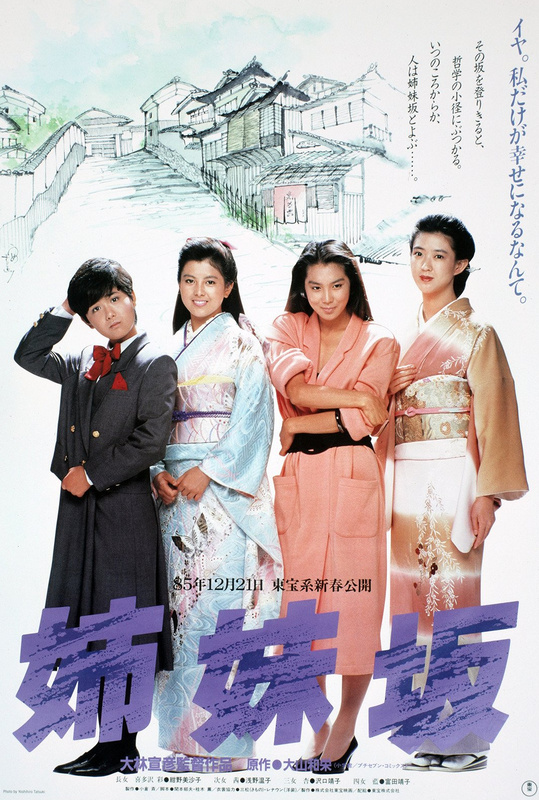
Four Sisters (1985) [Film Review]

Four Sisters; or, Bildungsroman: The Movie
     My dear sister. You've done nothing wrong. Not wanting to let her go shows that you've really taken up the role as her mother.
The year 2022 is slowly but surely nearing its end. A lot of stuff has happened to me personally, but in terms of movies, the running theme through many months was the filmography of Nobuhiko Obayashi. From Third Window’s Anti-War Trilogy release to their recent Kadokawa Years boxset, I have been fuelled by a desire to discover the idiosyncratic grandeur of this auteur filmmaker. As some of the blog readers already know, the result of my deep dive became An Ultra Fan’s Guide to Obayashi Nobuhiko. However, I believe there is still more to be said about this particular director and his movies. To be specific, I would like to talk about one of his motion pictures which is calm, romantic, and deeply melancholic. That is, Four Sisters, a perfect fit for a windy Autumn evening.
Release Info
Directed by: Nobuhiko Obayashi Starring: Atsuko Asano, Yasuko Sawaguchi, Misako Konno, Yasuko Tomita
Language: Japanese Original Title:  姉妹坂 Runtime: 101 min
Synopsis
Meet the Kitazawa family. Four sisters: Aya (Misako Konno), Akane (Atsuko Asano), Anzu (Yasuko Sawaguchi), and Ai (Yasuko Tomita) live in their parental household in Kyoto. Two high school friends, Ryo (Toshinori Omi) and Togo (Ichirota Miyakawa) compete against each other to win the heart of Anzu, which sets in motion a chain of events in the course of which the sisters discover that they are not related by blood. Each sister will have to cross into adulthood on her own terms, facing hardships and real-life drama along the way.
Shoujo Magic
I have to say that Four Sisters does not get a lot of recognition among Obayashi fans because it is not (for lack of a better word) “Obayashi-enough”. There are no vampires, evil children, or pianos that eat people. Four Sisters is what the title suggests: a story about four sisters. The editing itself and Obayashi’s visual stylistics are quite reserved indeed, but it does not mean they are totally absent. Obayashi divides the film into three separate chapters which, thanks to director’s wit and perceptive eye for details, function as memoirs taken straight out of a photo album. In fact, the beginning and end of each section are reminiscent of Polaroid photographs.
There is not a lot of information about the film online, but it seems clear that after Obayashi’s successes at Kadokawa with such movies as School in the Crosshairs (1981), The Girl Who Leapt Through Time (1983), and The Island Closest to Heaven (1984), the Toho Studios wanted to profit from the emerging trend of idol eiga, so they brought the director on board, gave him a shoujo manga called Shimaizaka to adapt, and showered him with their most promising pop stars they had at that time.
Evidently, as usual throughout the 1980s, Obayashi did his magic and put a personal spin on the source material while trying hard to bring out the best performance out of the leading ladies. Consequently, Four Sisters is a compelling coming-of-age drama. It is a story about growing up and finding love as well as inner peace, but certainly not in a conventional way.
Common criticism of the film is that it is too short and some of the subplots concerning the titular four sisters are not greatly elaborated upon. In my opinion, Obayashi was not going for a three-hour epic, but he wanted to create this bildungsroman-like ambience done in the style of the Brontës’ novels. Consequently, the movie is not so much about the exposition but about emotion: motherly love for a child, and longing for a loved one.
This aspect takes me back to the issue of visuals and editing. As I stated previously, Obayashi does not use fast cutting, different frame rates, or a mix of coloured scenes with black-and-white ones. In Four Sisters, when Obayashi wants to convey something intimate, he places a character in front of a camera and uses a really big close up. When he wants to get an unnerving feeling, he plays with the geography of a scene, changing a character’s position in a conversation (see Akane’s medical appointment).
What is more, Obayashi presents us with truly outstanding cinematography. Each and every scene: the framing of characters, their placement within glorious outdoor settings, all of it has meaning! To me, some of the shots like, for example, Akane crying over her mother’s grave, Anzu dancing, or Ryo standing near a stream next to a hospital, are just absolutely breathtaking.
Speaking of the performances, undoubtedly, each and every leading lady gets to shine on the screen, but the true show stealer is Atsuko Asano as Akane. Had the movie been made and released today, I am positive that she would have won an Oscar for her role of a bitter, yet deeply mature and sensitive sister. More words of praise go to Toshinori Omi who, in my opinion, delivered in Four Sisters his best performance out of all Obayashi films he appeared in. Omi no longer plays a sweet schoolboy but a real man who is head over heels in love with Akane.
Yasuko Sawaguchi, known from The Return of Godzilla (1984) does a great job as Anzu. Misako Konno is memorable and graceful as the oldest sister Aya; whereas, Yasuko Tomita is indeed noticeable as the youngest sister Ai. Tomita also played the leading part in Obayashi’s Lonely Heart which was released the same year as Four Sisters. In addition, a whole array of Obayashi’s frequent collaborators such as Yumiko Fujita, Wakaba Irie, Akiko Kitamura, and Toru Minegishi make short appearances as well. Four Sisters was also one of the first major pictures for actor Ichirota Miyakawa who played Anzu’s love interest, Togo.
Recommendations
All things considered, I personally think that Four Sisters is Obayashi’s highly underrated masterpiece. In fact, allow me to say (write) a bit more. It is one of the few movies out there that actually made me cry. I am not ashamed to admit it. And I cried again as I rewatched it for the purposes of this review. I can only hope that sometime in the future the Criterion Collection of some other company will strike a deal with Toho and release this outstanding film on physical media in Europe and the US. There are so many Obayashi movies out there apart from House (1977) that people need to see!
Overall score: 10/10
«Enjoyed this post? Never miss out on future posts by following us»

Mama wa Idol (1987) [Drama Review]

Mama wa Idol; or, Woman of the House
     It’s tough being a mother!
Well, I guess we could say that Miho Nakayama went meta way before John Malkovich or Nicolas Cage! From the times when she was primarily an idol rather than an established actress, comes a heartwarming drama in which Miho plays a fictionalised version of herself, a popular TBS star and singer who tries to divide her time between career in showbiz and… being a mom! Let’s take a closer look at Mama wa Idol.
Release Info
Developed by: Yoshimoto Masahiro Starring: Miho Nakayama, Kunihiko Mitamura, Kumiko Goto
Language: Japanese Original Title: ママはアイドル! No. of eps.: 10 + SP
Synopsis
Mr Shuichi Mizusawa (Kunihiko Mitamura) is a school teacher and a widower who single-handedly looks after his three children. One day, when the children come back home, they discover Miho Nakayama cooking in the kitchen. Miho greets them and explains that from this moment on she is going to act as their mother. This situation infuriates the daughter, Akira Mizusawa (Kumiko Goto), who refuses to accept Miho as a new family member. What is more, Shuichi and Miho actually married in secret and try to hide this fact from the public spotlight so as not to burden the children with paparazzi and unnecessary scandal. Will the secret remain under wraps? Is Akira going to warm up to Miho?
Being Miporin
Watching the first episode was definitely a weird experience. It made me wonder how much crack the screenwriters smoked to come up with an idea of a 17-year-old(!) idol marrying her former homeroom teacher and becoming a mom to kids who are barely younger than her. This may be too much to sink in for certain viewers, but the drama is by no means NSFW. On the contrary, it's a feel-good Miho Nakayama vehicle similar in spirit to an old Disney family comedy called Man of the House (1995).
Once you get over the initial shock triggered by the premise, the show becomes very enjoyable. There are lots of funny as well as touching moments when Miho desperately tries to be a mother while hiding her idol identity in front of the Mizusawa’s pesky neighbour, Ms Tokita (hilariously played by Jun Fubuki). In addition, the drama also provides an insight into the everyday challenges of an idol such as rehearsals, photo sessions, location shooting, and concerts. A lot of real TBS crewmembers and even other idols (Risa Tachibana, Aiko Morishita, Naoko Amihama) have either guest or cameo appearances as well.
Nevertheless, the real heart of the show is the complicated relationship between Miho and Akira. The daughter has her own romantic life which serves as a nice subplot throughout the series. In my opinion, the best episode of the drama is the ninth one, where Akira actually tries to become an idol herself and Miho is cheering for her.
Needless to say, the finale of episode 10 is extremely touching and idealistic. It really makes you wonder if an idol is capable of having a family and being active as a star. The obvious answer is that it’s not possible. Consequently, the SP episode very much underlines this message in its own finale.
Apart from the brilliant performances of Miho Nakayama and Kumiko Goto, I have also enjoyed seeing Kunihiko Mitamura as the dad and Masatoshi Nagase as one of the sons. Apart from Jun Fubuki, also Shigeru Muroi has a hilarious supporting part as Miho’s co-worker. Last but not least, I have to stress that I totally dig the main theme Hade!, which is sung by Miho in the opening credits.
 
Recommendations
All things considered, Mama wa Idol is a neat, good ol’ JDrama which strikes the right chord. It comes as no surprise that it had influenced Hoshikuzu Paradise (1991) anime and Papadol! movie from 2006. Definitely worth checking out, if not for Miho herself, then at least 80s vibes of bubble era Japan.
Overall score: 8/10
«Enjoyed this post? Never miss out on future posts by following us»

Funuke Show Some Love, You Losers! (2007) [Film Review]

Funuke Show Some Love, You Losers!; or, National Lampoon’s Countryside
     Greetings, I would like to introduce myself first. I'm Wago Sumika, age 22. I'm an actress. But the truth is, I haven't done anything remarkable as of yet thanks to the lack of competence by the agency I was with. I want to become an actress that makes people say "there is no replacement for Wago Sumika" as soon as possible. I am prepared to endure through any hardship to make that happen.
When thinking about family dramas made in Japan, people frequently enumerate such skilled filmmakers as Yasujiro Ozu, Hirokazu Koreeda, Miwa Nishikawa, or even Kiyoshi Kurosawa. Personally, I believe that director Daihachi Yoshida also deserves an honorable mention mainly because of his awesome debut feature from 2007 called Funuke Show Some Love, You Losers! based on the novel by Yukiko Motoya.
Release Info
Directed by: Daihachi Yoshida Starring: Eriko Sato, Masatoshi Nagase, Aimi Satsukawa, Hiromi Nagasaku
Language: Japanese Original Title: 腑抜けども、悲しみの愛を見せろ Runtime: 112 min
Synopsis
An elderly couple living in the countryside, Mr and Mrs Wago, tragically die in a road accident while trying to save a cat. The funeral ceremony leads to the reunification of three siblings: Shinji (Masatoshi Nagase) who now takes care of family business, 18-year-old Kiyomi (Aimi Satsukawa) who aspires to become a mangaka, and Sumika (Eriko Sato) who is determined to make it big as an actress in Tokyo. However, Sumika’s dream and her quest to its fulfillment unfortunately influences the family in a negative way. She bullies Shinji into supporting her financially and tortures Kiyomi for what she did to her in the past. Having been recently fired from her talent agency, Sumika does not let go and writes a letter to an acclaimed movie director Tetsuo Komori (Nobumichi Tosa). Surprisingly, she receives a reply...
All in the Family
While sitting down to watch Funuke Show Some Love, You Losers! I had no idea what to expect because I knew nothing about director Daihachi Yoshida and the main cast. The movie begins in quite a grim way only to kick into comedy gear a few minutes later. The central figure of the storyline is Sumika as we see her wreaking havoc across her home town just so she could prove that she is a true actress.
The movie certainly takes advantage of Yasujiro Ozu’s and Mikio Naruse’s filmmaking styles in certain scenes but it is not a straightforward parody of Tokyo Story (1953) or When a Woman Ascends the Stairs (1960). Funuke tries to be its own thing with the usage of slapstick, innovative flashbacks, and situational comedy. As a result, it becomes not only an entertaining spectacle but also an engrossing drama in which you can’t help but care for the characters. In consequence, the film feels like a baby conceived by SABU and Quentin Tarantino.
With regard to performances, Eriko Sato is undeniably too cool for school as unstoppable Sumika. From the arrival scene to the “climactic” battle in the fields, she gives her best in the leading role. My praise also goes to Aimi Satsukawa and Masatoshi Nagase who played the siblings. Another mention goes to Hiromi Nagasaku for her hilarious appearance as Shinji’s wife, Machiko. It comes as no surprise that Nagasaku won Best Supporting Actress award twice for her performance of extremely agreeable yet sexually-frustrated housewife.
Recommendations
If you are looking for an exemplary black comedy from Japan, then give a chance to Funuke Show Some Love, You Losers! I guarantee that crazy confrontations will leave you laughing, whereas outrageous plot twists will make you feel gobsmacked. This movie is for keeps. Please try to grab a Blu-Ray copy of the film from Third Window, which also contains making-of featurette as well as deleted and extended scenes.
Overall score: 8/10
«Enjoyed this post? Never miss out on future posts by following us»

After the Storm (2016) [Film Review]

After the Storm; or, One Step at a Time
     The lottery isn't gambling. It's a dream. A dream you buy for 300 yen.
The theme of family seems to be the most important one for director Hirokazu Koreeda. During his career spanning three decades, he made lots of films focusing on (and examining) family. However, it cannot be said that once you have seen one Koreeda film, you have seen them all. After the Storm is the perfect example proving how different Koreeda’s family stories can be each time.
Release Info
Directed by: Hirokazu Koreeda Starring: Hiroshi Abe, Yoko Maki, Kirin Kiki, Taiyo Yoshizawa
Language: Japanese Original Title: 海よりもまだ深く Runtime: 118 min
 
Synopsis
Ryota Shinoda (Hiroshi Abe) is an acclaimed novelist who does research for his latest novel by working at a detective agency. He wastes money on gambling and can barely make ends meet. What is more, he has to pay child support to his ex-wife, Kyoko (Yoko Maki), or he won’t be able to meet up with their son, Shingo (Taiyo Yoshizawa), each month. Ryota tries to get additional money by offering shady detective work to the clients, but he mostly passes time on gambling and stalking Kyoko. He frequently visits his widowed mother, Yoshiko (Kirin Kiki), who moves on with her life after the death of Ryota’s father. There, he clashes with the sister, Chinatsu (Satomi Kobayashi) as both siblings suspect each other of taking advantage of their mother. Eventually, Ryota makes an attempt to win back his family.
 
“You always win at least 300 yen”
After the Storm was allegedly conceived by Koreeda after the passing of his own father in 2001, when he visited his mother coping with grief. However, the shooting did not start until 2014. At that time, the movie was filmed in the middle of Koreeda’s other production, Our Little Sister (2015).
 
Another striking aspect is Hiroshi Abe in the leading role playing the character called Ryota. Fans speculated that Hiroshi actually reprises his role from Koreeda’s earlier film Still Walking (2008), but the director himself explained that After the Storm is more of a companion piece than an actual sequel to that movie.
 
What After the Storm is actually about? The film focuses on the intimate portrayal of complex relationships within a family. It is quite funny, yet saddening at the same time, watching Hiroshi Abe as a beat-down novelist who does not know what he wants from life. He is not a Hank Moody-type though. It is more than entertaining to see Ryota following cheating couples or harassing high-school kids. He is a loser, but we cannot help rooting for him. Nevertheless, in a very psychological manner, Ryota becomes the very thing which he despised, his own (now deceased) father who was always broke due to gambling.
 
In a slow-paced fashion, Koreeda unravels how Ryota attempts to rebuild his family. The most instrumental figure in this endeavour is the character of grandma (brilliantly played by the late Kirin Kiki) who shares her warmth with the whole family. Not getting into any spoilers, the attempt of “rekindling” a bond between his ex-wife and the son during the storm allows Ryota to make a fresh start in life.
 
With regard to performances, Hiroshi Abe is awesome as always. I was quite surprised to see Yoko Maki (yes, the same Yoko Maki from Saikou no Rikon (2013)) in the role of the ex-wife, but she did great as well. Kirin Kiki obviously steals the show as the grandmother. Sosuke Ikematsu and Lily Franky provide decent supporting parts.
 
Recommendations
If there is a storm raging outside of your house. Then, the best way to wait it over is by watching After the Storm. As with most of Koreeda’s films, it is an engaging slice-of-life story which gives you some food for thought. I personally enjoyed this heart-warming film more than Shoplifters (2018).
Overall score: 8/10