Showing posts with label love. Show all posts

Four Sisters (1985) [Film Review]

Four Sisters; or, Bildungsroman: The Movie
     My dear sister. You've done nothing wrong. Not wanting to let her go shows that you've really taken up the role as her mother.
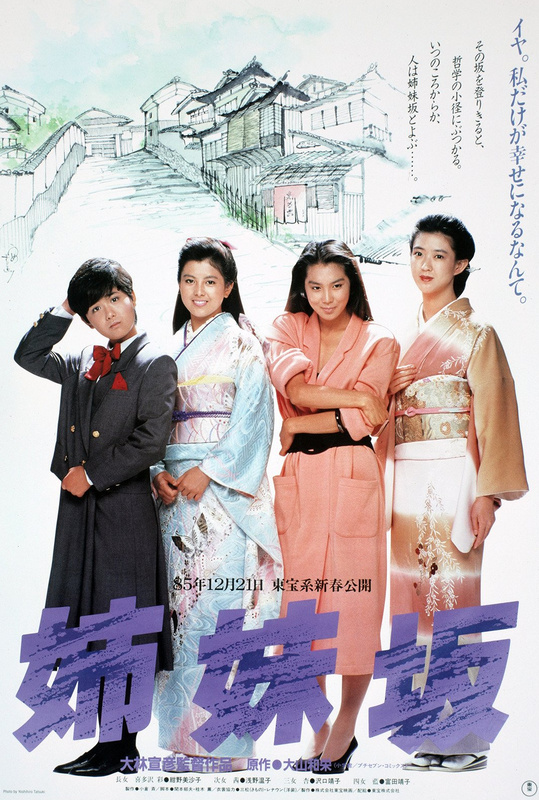
The year 2022 is slowly but surely nearing its end. A lot of stuff has happened to me personally, but in terms of movies, the running theme through many months was the filmography of Nobuhiko Obayashi. From Third Window’s Anti-War Trilogy release to their recent Kadokawa Years boxset, I have been fuelled by a desire to discover the idiosyncratic grandeur of this auteur filmmaker. As some of the blog readers already know, the result of my deep dive became An Ultra Fan’s Guide to Obayashi Nobuhiko. However, I believe there is still more to be said about this particular director and his movies. To be specific, I would like to talk about one of his motion pictures which is calm, romantic, and deeply melancholic. That is, Four Sisters, a perfect fit for a windy Autumn evening.
Release Info
Directed by: Nobuhiko Obayashi Starring: Atsuko Asano, Yasuko Sawaguchi, Misako Konno, Yasuko Tomita
Language: Japanese Original Title:  姉妹坂 Runtime: 101 min
Synopsis
Meet the Kitazawa family. Four sisters: Aya (Misako Konno), Akane (Atsuko Asano), Anzu (Yasuko Sawaguchi), and Ai (Yasuko Tomita) live in their parental household in Kyoto. Two high school friends, Ryo (Toshinori Omi) and Togo (Ichirota Miyakawa) compete against each other to win the heart of Anzu, which sets in motion a chain of events in the course of which the sisters discover that they are not related by blood. Each sister will have to cross into adulthood on her own terms, facing hardships and real-life drama along the way.
Shoujo Magic
I have to say that Four Sisters does not get a lot of recognition among Obayashi fans because it is not (for lack of a better word) “Obayashi-enough”. There are no vampires, evil children, or pianos that eat people. Four Sisters is what the title suggests: a story about four sisters. The editing itself and Obayashi’s visual stylistics are quite reserved indeed, but it does not mean they are totally absent. Obayashi divides the film into three separate chapters which, thanks to director’s wit and perceptive eye for details, function as memoirs taken straight out of a photo album. In fact, the beginning and end of each section are reminiscent of Polaroid photographs.
There is not a lot of information about the film online, but it seems clear that after Obayashi’s successes at Kadokawa with such movies as School in the Crosshairs (1981), The Girl Who Leapt Through Time (1983), and The Island Closest to Heaven (1984), the Toho Studios wanted to profit from the emerging trend of idol eiga, so they brought the director on board, gave him a shoujo manga called Shimaizaka to adapt, and showered him with their most promising pop stars they had at that time.
Evidently, as usual throughout the 1980s, Obayashi did his magic and put a personal spin on the source material while trying hard to bring out the best performance out of the leading ladies. Consequently, Four Sisters is a compelling coming-of-age drama. It is a story about growing up and finding love as well as inner peace, but certainly not in a conventional way.
Common criticism of the film is that it is too short and some of the subplots concerning the titular four sisters are not greatly elaborated upon. In my opinion, Obayashi was not going for a three-hour epic, but he wanted to create this bildungsroman-like ambience done in the style of the Brontës’ novels. Consequently, the movie is not so much about the exposition but about emotion: motherly love for a child, and longing for a loved one.
This aspect takes me back to the issue of visuals and editing. As I stated previously, Obayashi does not use fast cutting, different frame rates, or a mix of coloured scenes with black-and-white ones. In Four Sisters, when Obayashi wants to convey something intimate, he places a character in front of a camera and uses a really big close up. When he wants to get an unnerving feeling, he plays with the geography of a scene, changing a character’s position in a conversation (see Akane’s medical appointment).
What is more, Obayashi presents us with truly outstanding cinematography. Each and every scene: the framing of characters, their placement within glorious outdoor settings, all of it has meaning! To me, some of the shots like, for example, Akane crying over her mother’s grave, Anzu dancing, or Ryo standing near a stream next to a hospital, are just absolutely breathtaking.
Speaking of the performances, undoubtedly, each and every leading lady gets to shine on the screen, but the true show stealer is Atsuko Asano as Akane. Had the movie been made and released today, I am positive that she would have won an Oscar for her role of a bitter, yet deeply mature and sensitive sister. More words of praise go to Toshinori Omi who, in my opinion, delivered in Four Sisters his best performance out of all Obayashi films he appeared in. Omi no longer plays a sweet schoolboy but a real man who is head over heels in love with Akane.
Yasuko Sawaguchi, known from The Return of Godzilla (1984) does a great job as Anzu. Misako Konno is memorable and graceful as the oldest sister Aya; whereas, Yasuko Tomita is indeed noticeable as the youngest sister Ai. Tomita also played the leading part in Obayashi’s Lonely Heart which was released the same year as Four Sisters. In addition, a whole array of Obayashi’s frequent collaborators such as Yumiko Fujita, Wakaba Irie, Akiko Kitamura, and Toru Minegishi make short appearances as well. Four Sisters was also one of the first major pictures for actor Ichirota Miyakawa who played Anzu’s love interest, Togo.
Recommendations
All things considered, I personally think that Four Sisters is Obayashi’s highly underrated masterpiece. In fact, allow me to say (write) a bit more. It is one of the few movies out there that actually made me cry. I am not ashamed to admit it. And I cried again as I rewatched it for the purposes of this review. I can only hope that sometime in the future the Criterion Collection of some other company will strike a deal with Toho and release this outstanding film on physical media in Europe and the US. There are so many Obayashi movies out there apart from House (1977) that people need to see!
Overall score: 10/10
«Enjoyed this post? Never miss out on future posts by following us»

My Teacher (2017) [Film Review]

My Teacher; or, The First Love
     Every hour of lost time now is a chance for future regret.
As soon as I saw the poster and trailer for Sensei!... Am I allowed to love you?, I knew that I had to check it out. I was expecting it be a rehash of Great Teacher Onizuka format, but I was pleasantly surprised. My Teacher is a little sweet film about innocent affection that should never have happened between a student and her teacher.
Release Info
Directed by: Takahiro Miki Starring: Toma Ikuta, Suzu Hirose, Aoi Morikawa, Ryo Ryusei
Language: Japanese Original Title: 先生!、、、好きになってもいいですか? Runtime: 112 min
 
Synopsis
Hibiki Shimada (Suzu Hirose) is an ordinary, 17-year-old, high school student. She has never been in a romantic relationship, but she spends time with her two best friends: Chigusa (Aoi Morikawa) and Kosuke (Ryo Ryusei) who are busy chasing after teachers they fell in love with. Touched by his acts of kindness, Shimada also develops such feelings for her history teacher, Mr Ito (Toma Ikuta). He takes her to a hospital, gives her a ride home a couple of times, and even helps in solving after-class assignments. However, Mr Ito perceives such tasks to be part of his job, nothing beyond that. Shimada eventually confesses her feelings to Ito, but he tells her that cannot reciprocate. As a result, she makes a deal with him: if she scores over 90 points in the test, he will allow her to love him. Discouraged along the way, Shimada does not give up in cultivating her feelings to Mr Ito.
 
Love Knows No Limits
I was afraid I won’t, but I really did enjoy My Teacher. I was worried that halfway through the picture (after the big scene revealed in the trailer) the story will turn into a preachy drama about how some relationships are forbidden, but nothing like that happened. The movie was evenly paced and had this peaceful, believable aura which made events unfolding on the screen seem plausible in real life. Even though there was a part of me knowing that something like this would never happened, I found myself cheering for Hibiki’s quest to win the unwinnable heart.
 
The rooftop scene is the most recognisable hallmark of the picture, but I have also enjoyed the subtle moments in Mr Ito’s office as well as the interactions between Shimada and Chigusa. Even the scenes with Fujioka (Kentaro Matsuo) did not seem forced at all. The school setting feels very much like another character in the film. Thankfully, the “outrage” component in the story is significantly toned down, because it is not the main focus of the picture.
With regard to performances, everyone is praising Toma Ikuta’s performance as Mr Ito. I thought it was convincing and okay, considering the fact that most of the time he plays a grumpy teacher who’s slacking during work hours. In my opinion, Suzu Hirose really carried the picture with her performance as a naive (yet decent and honest) student. The supporting actors did great jobs, especially Aoi Morikawa and Ryo Ryusei as Hibiki’s close friends. The only odd-actress out seemed Manami Higa as Ms. Nakajima. I have nothing against her, but she did not seem to fit the role of a teacher who is standing in-between of Ito and Shimada.
 
Recommendations
Go ahead and check it out if you are into Japanese school stories (or if you have your own secret teacher crush). Some manga enthusiasts may be interested in the fact that the movie is actually based on Sensei! comic book series by Kazune Kawahara. In my personal opinion, it’s best to watch the film at the beginning of a school year, as it has this inextricable Autumn-feel. All things considered, My Teacher is a very subtle romantic movie which leaves you wanting for more.
Overall score: 8/10

The Lunchbox (2013) [Film Review]

The Lunchbox; or, A Stroke of Luck
     Somewhere I read that the wrong train can lead you to the right station...
Has it ever happened to you that you opened your lunchbox and were surprised by its content? This week’s review will cover the troubling topics of depression, letters, unexpected friendship, refuel of faith, and pursuit of happiness. Obviously, I want to discuss the 2013 international hit film The Lunchbox with Irrfan Khan and Nimrat Kaur in the leading roles.
Release Info
Directed by: Ritesh Batra Starring: Irrfan Khan, Nimrat Kaur, Nawazuddin Siddiqui
Language: English, Hindi Runtime: 100 min
Synopsis
Mr Saajan Fernandes (Irrfan) is a widower who is trying to get by at his accounting job. Illa (Nimrat Kaur) is a housewife who is hopelessly attempting to get the attention of her busy husband. The wife even prepares a special meal which she sends via the food delivery system of Mumbai’s “dabbawalas”. Unfortunately, some kind of a mix-up happens en route and the lunchbox ends up on Mr Fernandes’ desk. Illa discovers that the meals are not reaching her husband and writes a letter to the unknown receiver of her dishes. Saajan responds and, in consequence, a long-lasting correspondence ensues. The unexpected communication through the lunchbox irreversibly changes the two strangers.
The way to a man's heart is through his stomach
The first thing I would like to say about this movie is that I deeply regret not seeing it at the cinema. I picked it up on DVD a week ago (Indian food and Irrfan Khan on the cover did the trick) and, after watching it, I complained to myself: How could I miss such a gem on the big screen?! (Release date: February, 2014 in my country). Indeed, The Lunchbox is a shining gem polished with an enormous amount of noticeable love and patience from the cast and crew. What initially appears to be yet another romantic flick pleasantly surprises its viewers by becoming a warm-hearted story about regaining self-confidence and living life to the fullest.
The core of the film is transgressing cultural differences. The eponymous lunchbox is the inanimate facilitator that establishes a connection between people from totally different backgrounds. Mr Fernandes is a Scrooge-like character (living in painful solitude after the loss of his wife) who wants to be left alone. Illa, on the other hand, is a young housewife and a mother who seeks to renew the relationship with her husband. As the two start to exchange recipes, pieces of advice, daily anecdotes, and personal confessions, they get closer to each than they would ever be in reality. This shift in attitude is especially visible in Saajan who transforms from a recluse into a dreamer. He even befriends an outgoing office apprentice Shaikh (played by Nawazuddin Siddiqui) and eventually becomes an important part of his life as well. This is the paradox that the director Ritesh Batra draws before us. Mumbai is the cultural melting pot of people always in a rush. Serendipity in the form of the lunchbox makes two of those people: a Christian (Fernandes) and a Hindu (Illa) stop and think for a moment.
However, there is still one more issue to be mentioned and it is the one of love. Namely, Saajan changes not just because of the excellent food he receives, but because of Illa herself. This is an impossible love story: a 52-year-old Christian falling for a married Hindu. Yet, the two try to find each other. Illa sets up a meeting in a cafe, but Saajan never approaches her, because he is aware of the social gap between them. Still, Illa eventually tracks down his office address, but he has already retired.
This leads us to the real villain of the piece, and no, it’s not Illa’s husband (though it is implied that the man is cheating on her). The true enemy of our characters is time. The Lunchbox touches upon a very universal problem of busy lifestyle in a metropolis. Mumbai workers need to be on time at work, but they prefer home-cooked meals for lunch. Thus, the “dabbawalas” came to existence in order to save the time (of housewives and workers). Yet, time is an obstacle for Saajan and Illa to be together, not only in terms of age difference, but also quite literally.
In the ending scene (which I liked very much, though it sparked many negative comments on the web) we see Saajan travelling with “dabbawalas” on a train. By doing so, Mr Fernandes hopes to find Illa during the process of returning the lunchbox (in the afternoon). However, on the same day, Illa decided to sell her jewellery and escape from her husband as soon as her daughter gets back from school. Will Saajan find her before she leaves? This is the question to which the viewers have to answer on their own. Personally, I believe that even the wrong train can lead you to the right station...
Irrfan Khan gives a superb performance and, out of his cinematic creations, the character of Mr Fernandes instantly became my second favourite (right after Ashoke Ganguli from The Namesake (2006)). Nimrat Kaur is convincing as Illa and handles the character with confidence. Nawazuddin Siddiqui is a wonderful addition to the film as Shaikh. The subplot about this sympathetic extrovert is another advantage of the movie.
Recommendations
If you’re not into romantic films, that’s okay. If you’re not into colourful Bollywood love flicks, it’s also fine. The Lunchbox is neither of these and does not pretend to be. It takes an accident that may well occur in real life and turns it into a wonderful tale about the meaning of life. It’s been quite a while since a movie managed to set me in a positive mood. Maybe I’m being slightly too subjective about this film, but I can’t help to look at it from my personal experience of having a pen friend. Nevertheless, The Lunchbox is a moving and memorable story, which makes you root for its protagonists. I’ll certainly be revisiting it every now and then.

Overall score: 10/10 (Deservedly Earned)

Rouge (1988) [Film Review]

Rouge; or, Chinese (Anti-)Love Story 
This week’s review will be about a classic Hong Kong production from 1988, starring Anita Mui and Leslie Cheung in the leading roles. Rouge, excluding Hong Kong's 3rd category flicks, probably the most bizarre and stylistically extraordinary movie that came out of that particular Asian film industry.
Release Info
Directed by: Stanley Kwan Starring: Anita Mui, Leslie Cheung, Alex Man, Emily Chu
Language: Cantonese Original Title: Yan zhi kou Movie Industry: Hong Kong Runtime: 96 min

Plot 
We follow the story of a high-class courtesan called Fleur (Anita Mui) and her passionate relationship with a rich gentleman known as “12th Young Master” (Leslie Cheung). Initially, it is only a sexual relation, but 12th Young Master becomes so infatuated with Fleur that he develops deeper feelings for her and vice versa. Unfortunately, due to the objection from the Master’s family, the couple is unable to get married. Therefore, not willing to live separately, they decide to commit suicide and search for themselves in another life.
 
Then, the story cuts to a newspaper journalist in Hong Kong of 1987 who sees Fleur walking up to his front desk. The woman came back as a ghost from the afterlife over 50 years after her death in order to find her beloved one. Troubled journalist and his girlfriend resort to help the courtesan before she completely fades away.

Ghosts, courtesans, and a modern cityscape 
Now that’s what I call a crazy ghost story. I have no idea why, but Hong Kong filmmakers had this strange affinity for ghosts and incorporated them in every possible genre (maybe they were profitable trope?). Anyways, as I said previously, the perfect word to sum up this film is the adjective bizarre, however not in a negative sense. What I mean is that the director Stanley Kwan simply plays with his audience as the story goes on. Initially, it seems that the film’s going to be a historical drama (set in 1934, with great scenography and costumes), but then it shifts to a stereotypical love affair, only to shift once more to a comedy/ghost story. During the first 20 minutes of the film, there’s a careful set up of the plot and the characters when completely out of the blue Hong Kong of the 1980s shows up (which is quite confusing, because the whole stuff with suicide and soul-searching is explained way later in the film through Fleur’s flashbacks), but this unexpected transfer of the setting is a good thing, for it keeps the viewers engaged. In addition, there’s also a factor of entertainment.
 
It’s quite hilarious to see an ordinary modern guy like Yuen (Alex Man) to interact with ghostly Fleur who manifests her paranormal presence pretty straightforwardly, but it still takes a lot of time for the journalist to get the picture. Interesting is also the quest of Fleur. She’s been through hell and back (quite literally) and still hasn't found the 12th Young Master yet. She has only three days left to find him, before disintegrating on the anniversary of their death. Yuen and Chor (Emily Chu) got at lengths in searching for the missing lover, which in turn pushes them to re-evaluate their own relationship. All in all, the whole thing is about trying to understand the meaning of true love (but not in soap-opera style).
 
Needless to say, the movie is engaging, entertaining, and surprising with a big twist at the end and the heartbreaking reunion between Fleur and the 12th Young Master that left me gobsmacked. Not only Stanley Kwan did a splendid directorial job, but also Anita Mui and Leslie Cheung who were absolutely perfect in their roles. On a side note, Rouge is said to be a cursed film, because its both leads died in 2003 (Anita suffered from cancer, whereas Leslie committed suicide). Whether it is true or not, I’m not going to be the judge of that. It is a great shame that such great actors passed away so early and won’t make any worthwhile pictures as this one.
Recommendations
Yes, I consider Rouge a worthwhile film. I had a great fun watching it and unlike other flicks about love-from-the-afterlife such as Truly Madly Deeply or Dragonfly you’re not required to suspend your disbelief and the story doesn’t leave you with a bitterness at heart. All things considered, Rouge is a solid motion picture and I recommend it to anyone who’s on the lookout for some interesting film.
Overall score: 8/10