Showing posts with label yasuko tomita. Show all posts

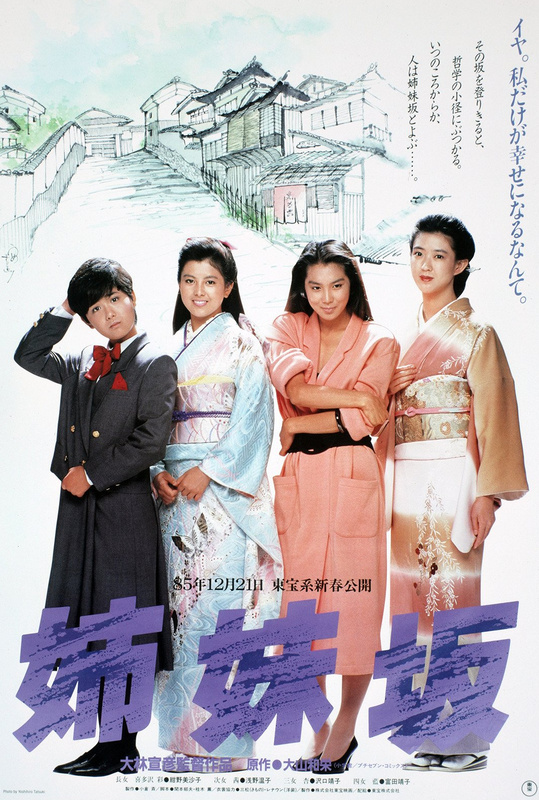
Four Sisters (1985) [Film Review]

Four Sisters; or, Bildungsroman: The Movie
     My dear sister. You've done nothing wrong. Not wanting to let her go shows that you've really taken up the role as her mother.
The year 2022 is slowly but surely nearing its end. A lot of stuff has happened to me personally, but in terms of movies, the running theme through many months was the filmography of Nobuhiko Obayashi. From Third Window’s Anti-War Trilogy release to their recent Kadokawa Years boxset, I have been fuelled by a desire to discover the idiosyncratic grandeur of this auteur filmmaker. As some of the blog readers already know, the result of my deep dive became An Ultra Fan’s Guide to Obayashi Nobuhiko. However, I believe there is still more to be said about this particular director and his movies. To be specific, I would like to talk about one of his motion pictures which is calm, romantic, and deeply melancholic. That is, Four Sisters, a perfect fit for a windy Autumn evening.
Release Info
Directed by: Nobuhiko Obayashi Starring: Atsuko Asano, Yasuko Sawaguchi, Misako Konno, Yasuko Tomita
Language: Japanese Original Title:  姉妹坂 Runtime: 101 min
Synopsis
Meet the Kitazawa family. Four sisters: Aya (Misako Konno), Akane (Atsuko Asano), Anzu (Yasuko Sawaguchi), and Ai (Yasuko Tomita) live in their parental household in Kyoto. Two high school friends, Ryo (Toshinori Omi) and Togo (Ichirota Miyakawa) compete against each other to win the heart of Anzu, which sets in motion a chain of events in the course of which the sisters discover that they are not related by blood. Each sister will have to cross into adulthood on her own terms, facing hardships and real-life drama along the way.
Shoujo Magic
I have to say that Four Sisters does not get a lot of recognition among Obayashi fans because it is not (for lack of a better word) “Obayashi-enough”. There are no vampires, evil children, or pianos that eat people. Four Sisters is what the title suggests: a story about four sisters. The editing itself and Obayashi’s visual stylistics are quite reserved indeed, but it does not mean they are totally absent. Obayashi divides the film into three separate chapters which, thanks to director’s wit and perceptive eye for details, function as memoirs taken straight out of a photo album. In fact, the beginning and end of each section are reminiscent of Polaroid photographs.
There is not a lot of information about the film online, but it seems clear that after Obayashi’s successes at Kadokawa with such movies as School in the Crosshairs (1981), The Girl Who Leapt Through Time (1983), and The Island Closest to Heaven (1984), the Toho Studios wanted to profit from the emerging trend of idol eiga, so they brought the director on board, gave him a shoujo manga called Shimaizaka to adapt, and showered him with their most promising pop stars they had at that time.
Evidently, as usual throughout the 1980s, Obayashi did his magic and put a personal spin on the source material while trying hard to bring out the best performance out of the leading ladies. Consequently, Four Sisters is a compelling coming-of-age drama. It is a story about growing up and finding love as well as inner peace, but certainly not in a conventional way.
Common criticism of the film is that it is too short and some of the subplots concerning the titular four sisters are not greatly elaborated upon. In my opinion, Obayashi was not going for a three-hour epic, but he wanted to create this bildungsroman-like ambience done in the style of the Brontës’ novels. Consequently, the movie is not so much about the exposition but about emotion: motherly love for a child, and longing for a loved one.
This aspect takes me back to the issue of visuals and editing. As I stated previously, Obayashi does not use fast cutting, different frame rates, or a mix of coloured scenes with black-and-white ones. In Four Sisters, when Obayashi wants to convey something intimate, he places a character in front of a camera and uses a really big close up. When he wants to get an unnerving feeling, he plays with the geography of a scene, changing a character’s position in a conversation (see Akane’s medical appointment).
What is more, Obayashi presents us with truly outstanding cinematography. Each and every scene: the framing of characters, their placement within glorious outdoor settings, all of it has meaning! To me, some of the shots like, for example, Akane crying over her mother’s grave, Anzu dancing, or Ryo standing near a stream next to a hospital, are just absolutely breathtaking.
Speaking of the performances, undoubtedly, each and every leading lady gets to shine on the screen, but the true show stealer is Atsuko Asano as Akane. Had the movie been made and released today, I am positive that she would have won an Oscar for her role of a bitter, yet deeply mature and sensitive sister. More words of praise go to Toshinori Omi who, in my opinion, delivered in Four Sisters his best performance out of all Obayashi films he appeared in. Omi no longer plays a sweet schoolboy but a real man who is head over heels in love with Akane.
Yasuko Sawaguchi, known from The Return of Godzilla (1984) does a great job as Anzu. Misako Konno is memorable and graceful as the oldest sister Aya; whereas, Yasuko Tomita is indeed noticeable as the youngest sister Ai. Tomita also played the leading part in Obayashi’s Lonely Heart which was released the same year as Four Sisters. In addition, a whole array of Obayashi’s frequent collaborators such as Yumiko Fujita, Wakaba Irie, Akiko Kitamura, and Toru Minegishi make short appearances as well. Four Sisters was also one of the first major pictures for actor Ichirota Miyakawa who played Anzu’s love interest, Togo.
Recommendations
All things considered, I personally think that Four Sisters is Obayashi’s highly underrated masterpiece. In fact, allow me to say (write) a bit more. It is one of the few movies out there that actually made me cry. I am not ashamed to admit it. And I cried again as I rewatched it for the purposes of this review. I can only hope that sometime in the future the Criterion Collection of some other company will strike a deal with Toho and release this outstanding film on physical media in Europe and the US. There are so many Obayashi movies out there apart from House (1977) that people need to see!
Overall score: 10/10
«Enjoyed this post? Never miss out on future posts by following us»

BU SU (1987) [Film Review]

BU・SU; or, The Days of Our Lives
     Do your best at school!
Rarely do I stumble across a movie which can be easily labelled as a "weird drama". At the beginning, you suspect that the film will be a standard school romance similar to Shunji Iwai's April Story (1988). Later on, you are convinced that the plot will take a darker turn and veer into the territory of Hideo Gosha's geisha thrillers.
BU・SU is none of these things. Jun Ichikawa's debut feature from 1987 is, indeed, an unconventional story about a young girl trying to get over personal trauma.
Release Info
Directed by: Jun Ichikawa Starring: Yasuko Tomita, Michiyo Okusu, Masahiro Takashima, Yuriko Hirooka
Language: Japanese Original Title: ブス Runtime: 95 min
Synopsis
Mugiko (Yasuko Tomita) leaves her home island of Izu and arrives in Tokyo to live together with her aunt (Michiyo Okusu) who runs a geisha house. Mugiko experienced some kind of tragedy back in Izu (which is confirmed by her school file), so that's why she decided to move away from her mother (who, apparently, was a respected geisha performer back in the day). The girl attends a new school, but she is withdrawn from the hustle and bustle of class-life. She is not even doing great during geisha training supervised by her aunt. Most of the time, Mugiko roams aimlessly through the streets of Tokyo with a vivid expression of bitterness on her face. It is only when classmates force her to participate in a school festival that Mugiko gets a hold of herself and decides to perform the traditional Yaoya Oshichi dance...
The Ugly Duckling
The film's enigmatic title can be roughly translated into English as "an unattractive woman" or simply "ugly". Interestingly, the main heroine (played by then up-and-coming actress Yasuko Tomita) is not by any means ugly. Having been petrified by past experiences (which are shown merely as quick and disjointed flashbacks), she is unable to seize the day and enjoy normal life. Mugiko is sad and withdrawn all the time. As a result, being BU・SU refers to the state of her mental seclusion from other people.
Jun Ichikawa plays out the story of Mugiko in an intriguing manner. The heroine does not experience some Murakami-like quirky adventure or process her trauma. Instead, little by little, she learns that the world is not entirely rotten and chaotic. At school, she becomes friends with a bullied student (Yuriko Hirooka) and an aspiring boxer, Tsuda (Masahiro Takashima). In addition, through her dance training, Mugiko also gains the acceptance of her aunt. Consequently, Ichikawa attempts to communicate a message that no matter how bad things are, there is more to life than just staying bitter.
On the whole, the film unexpectedly becomes a poignant and peaceful slice-of-life flick. The sequences that really stole my heart were the ones of Mugiko roaming through Tokyo of the Bubble Era. We get to see Ginza as well as the famous Shibuya Crossing, accompanied by catchy City Pop songs.
With regard to performances, I have known Yasuko Tomita mostly from her supporting roles in dramas, but she absolutely shines in BU・SU. In a lot of ways, she reminds of Kimiko Ikegami and her dramatic performances. I definitely need to check out more of Tomita's early movies. Honourable mention goes to Michiyo Okusu as the aunt. With her reservation and tranquillity, the actress really makes this character stand out.
Recommendations
If you are in the mood for non-violent/peaceful drama, then BU・SU is the film for you. I was pleasantly surprised by the film's warmth and subtlety when the end credits rolled in. Definitely give it a try during a quiet, wintery night.
Overall score: 8/10
«Enjoyed this post? Never miss out on future posts by following us»