Showing posts with label france. Show all posts

Onoda - 10,000 Nights in the Jungle (2021) [Film Review]

Onoda: 10,000 Nights in the Jungle; or, Lonely Warrior
     They’d said, “We’ll come back for you.”
I have been aware of the real life story concerning Hiroo Onoda for quite some time, but I have never known all the details. If you have not heard about it, the phenomenon of the so-called Japanese holdouts refers to soldiers who were either uninformed or refused to believe that World War II had ended. Arthur Harari’s Onoda: 10,000 Nights in the Jungle tells the story of a man who kept on fighting until 1974 on a remote island.
Release Info
Directed by: Arthur Harari Starring: Yuya Endo, Yuya Matsuura, Kanji Tsuda, Tetsuya Chiba, Issey Ogata
Language: Japanese Original Title: ONODA 一万夜を越えて Runtime: 166 min
Synopsis
Young Hiroo Ononda (Yuya Endo) is an intelligence officer training at a special facility under the guidance of Major Taniguchi (Issey Ogata). In 1944, he was sent to Luband Island in the Philippines with a mission of limiting the impact of enemy attacks. Nevertheless, the Allied Forces liberated the island in 1945. While the rest of Japanese troops either died or surrendered, Onoda and three other soldiers continued to carry out their guerilla activities, waiting for the arrival of Imperial forces.
Left Behind
In my opinion, Onoda: 10,000 Nights in the Jungle is a gripping adventure drama which provides an insight into the life of a soldier who is perceived by many as the paragon of discipline and devotion to homeland. Still, it has to be acknowledged that the movie was not based on Onoda’s official autobiography but rather other historical accounts, such as Bernard Cendron and Gérard Chenu's Onoda, seul en guerre dans la jungle; hence, it is difficult to label the film as a biographical motion picture. The director himself was heavily influenced by the novels of Joseph Conrad and Robert Louis Stevenson (source: press book).
Nevertheless, the movie closely follows the major events from Onoda’s stay on the island. It is fascinating to see how he rejects the tell-tale signs that the war is over and proceeds to blindly believe that Japan will team up with China in order to “liberate” the Asian continent. This is a story of false presuppositions and delusions, but also of incredible sacrifice, especially in view of the fact that Onoda was not alone at the beginning of his crusade.
Although the movie lasts nearly three hours, you do not feel bored at all. I think it’s best to say that Onoda: 10,000 Nights in the Jungle is divided into two parts: the first one focuses primarily on young Onoda (Yuya Endo) and young Kinshichi Kozuka (Yuya Matsuura) trying to survive during the 1950s. In 1969, we see aged characters (played by Kanji Tsuda and Tetsuya Chiba respectively) as they try to stay in hiding, away from the local villagers. I appreciated this unconventional measure of double performance, but I believe that the movie would have worked better if there were two actors playing the characters consistently from beginning to the end.
That being said, I appreciate the onscreen performances as well as the supporting parts done by veteran actors like Issey Ogata and Kyusaku Shimada. Beautiful on-location cinematography by Tom Harari also cannot go unnoticed.
Recommendations
I suggest you watch the film back-to-back with Kazuo Hara’s unforgettable documentary The Emperor's Naked Army Marches On (1987) in order to get a full picture of what was going on in the Philippines towards the end of the war. Onoda: 10,000 Nights in the Jungle is going to be released in UK cinemas by Third Windows Films on the 15th of April. VOD/Blu-ray edition will follow appropriately on the 16th of May. The disc is going to include interviews with actor Kanji Tsuda, director Arthur Harari, DOP Tom Harari, and assistant director Benjamin Papin.
Overall score: 8/10
«Enjoyed this post? Never miss out on future posts by following us»

Citizen Kitano (2020) [Documentary Review]

Citizen Kitano; or, A Tribute to the Auteur!
     I intentionally shoot action to make the audience feel real pain. I have never and I will never shoot violence as if it’s some kind of action video game.
It goes without saying that Takeshi Kitano gained widespread international attention in the 1990s, but French occupation with the Japanese director should be categorised as a separate phenomenon. Apart from releasing Kitano’s productions on the European market, France would also translate his books and collections of essays. Yves Montmayeur’s 2020 documentary called Citizen Kitano is yet another proof of how much the Japanese legend is revered there. Let’s see together how it holds up.
Release Info
Directed by: Yves Montmayeur Starring: Takeshi Kitano, Katsumi Yanagijima, Kayoko Kishimoto
Language: French, Japanese Runtime: 52 min
From Street Kid to TV Star
I was lucky enough to catch the documentary on the Canal+ channel in my country. The documentary lasts slightly over 50 minutes, so it is not a lot of time to cover Kitano’s rich cinematic legacy, but Citizen Kitano manages to get through the major points in a succinct way.

We start off with Kitano’s childhood. Where he came from and what his background was. These memoirs are accompanied by animation clips as well as old photos. Then, we move on to his stage endeavours as ‘Beat’ Takeshi and a career on Television in the 1980s. This part of the documentary includes a lot of previously unknown archive footage from Kitano’s reality shows. What is more, the narration is accompanied by insightful interviews from Kitano himself as well as actress Kayoko Kishimoto, director of photography Katsumi Yanagijima, and journalist Michel Temman.
The interviews are undoubtedly the best part of the documentary as they present the fans with new information on the elusive figure of Kitano; however, the director’s “pretentious” (for lack of a better word) narration is unforgivable. It seems as if Yves Montmayeur relentlessly tries to frame Takeshi, with the usage of inventive adjectives and comparisons, as a kind of an underdog battling the disbelievers who fail to recognise his creative talent. Indeed, Kitano had a hard time transitioning from the realm of TV to cinema, and his movies did not sell well in Japan, but it does not mean by default that the whole public perceived him as an misunderstood outcast.
The part of the documentary which covers Kitano’s movies also leaves a bit to be desired. Montmayeur focuses primarily on Kitano’s popular yakuza flicks, such as Violent Cop (1989), Sonatine (1993), and Hana Bi (1997) as well as the director’s intertextual pieces like Takeshis (2005) and Glory to the Filmmaker! (2007). However, Kitano’s sensitive side reflected in A Scene at a Sea (1991), Kikujiro (1999), Dolls (2002), and Achilles and a Tortoise (2008) is barely scratched.
Still, I admire that the documentary shows off Kitano’s activity as a painter and modern commentator on the political and social issues in Japan. We even get a short interview with the Governor of Tokyo, Yuriko Koike, who describes her encounter with Kitano dressed up as Donald Trump.
Arguably, the most interesting and heart-warming statements come from Kayoko Kishimoto who has collaborated with Kitano since the 1980s. The actress really manages to capture the multifaceted image of the director who is either hated or loved by cinemagoers.
Recommendations
All things considered, if you are a die-hard fan of Takeshi Kitano, you probably will not get a lot of new info out of this documentary. Still, it is worth checking it out for the interviews and archive footage. Dear Netflix, I am still waiting for the live-action movie inspired by Kitano’s life. Don’t disappoint me!
Overall score: 7/10
«Enjoyed this post? Never miss out on future posts by following us»

The Burden of Suffering: Comparing La Femme Nikita (1990) and The Villainess (2017) [Editorial]

Disclaimer: The following editorial is filled with spoilers of both movies. Read it only if you have seen the films.

     Don’t forget… There are two things that have no limit: femininity and the means of taking advantage of it.~ La Femme Nikita

     Let me show you… what you made me into.~ The Villainess

Every self-respecting moviegoer is most probably aware of the fact that strong heroines have been present on the silver screen for decades, not several years. The 1970s as well as the 1980s gave us a whole slew of tough and badass female characters, from the West as well as from the East. Interestingly, European Cinema never quite engaged into “Girls with Guns” craze, and perhaps its only worthwhile interjection into the matter is Luc Besson’s La Femme Nikita from 1990.
     The young and confident director was at the top of his game in the 1980s, effectively changing the face of French cinema which was suffused with art-house style and theatricality at that time. By emphasising the visuals and style rather than proper narrative (see Cinema du look movement), Besson created such modern classics as Subway (1985), The Big Blue (1988), and, of course, La Femme Nikita (1990).
     Somewhat forgotten today, the movie about a young woman turned spy became an important cultural phenomenon. If you ask anybody today about “Nikita”, they will most certainly associate the title with one of the American TV shows or even a John Badham movie. Indeed, Besson gave Europeans their own “girl with a gun” but she was immediately snatched by Hollywood and incorporated into the American mainstream. Nevertheless, the archetypal figure of a non-conforming woman forced to serve the state, and who tries to find happiness, proved to be pervasive in culture. While Hollywood was busy with the remakes, Hong Kong already made their own version of Nikita in 1991. Black Cat with Jade Leung ticks all the major plot points from the original film while also adding tropes of an exploitation flick and underlining the anti-authority message (Black Cat is actually controlled by the CIA via microchip).
     Yet, the incarnations of Nikita with Bridget Fonda, Jade Leung, Peta Wilson, and Maggie Q, do not mark the end of fascination with this character. A 2017 South Korean production The Villainess was openly advertised as a movie inspired by La Femme Nikita; however, I believe that the movie is not so much a remake but a companion piece to Nikita.
     The fans have spotted references to Kill Bill (2003), The Raid (2011), and Hardcore Henry (2015), but director Jung Byung-gil acknowledged that The Villainess is first and foremost an homage to La Femme Nikita. Having watched the two movies back-to-back, I was surprised by the fact that The Villainess does not simply retell the events of Nikita but also comments on them and builds on the character of the original heroine.
     Firstly, let’s take a closer look at La Femme Nikita: The movie starts with a bunch of hoodlums who rob a pharmacy. It turns out that our soon-to-be heroine is a drug addict who is on such an acid trip that she actually shots a police officer point blank in the head. Nikita is rightfully sentenced in the court of law, and two men approach her in a cell with an injection. Nikita breaks down because she is convinced that she is about to be euthanized. Actually, she’s only sedated and wakes up in a white room where she is greeted by a man called Bob. He explicitly tells her that the government fakes the deaths of worthless criminals and turns them into spies. Evidently, Nikita is very reluctant about the whole concept and tries to break away, but Bob eventually manages to mould her into a professional agent. Nikita is given a new identity and she is allowed to lead a normal life, on condition that she will always perform secret assignments.
     According to researcher Jeanne Deslandes, La Femme Nikita is a film about going back to the state of normality. We see the main heroine as a social wreck at the very beginning, but she is salvaged by Bob (a representative of the French secret police, we could say) who offers her a second chance in life. Ironically, Nikita gets more than she bargains for. That is to say, whenever something pleasant happens to her, bad things immediately strike as well. For instance, on her 23rd birthday, Bob takes Nikita to a restaurant only to give her a gun and target details. In addition, when Nikita spends a honeymoon with her beloved husband Marco, she is ordered to take down yet another target. In consequence, the heroine is unable to have a happy life because of the very same authorities who gave her a fresh start. When a mission concerning economic espionage goes terribly wrong (not out of Nikita’s fault), she is completely burnt out and, with the blessing of her husband, she runs away (hopefully, trying to regain her normality).
     Now proceeding to The Villainess: The movie has a similar structure and premise of Nikita, but the main character is quite different. Sook Hee is arrested and subsequently turned into a spy by the Korean secret police not because she is a lowlife, but because of her extraordinary abilities. At the very beginning, we see her slashing her way through hordes of expendable baddies and surviving the bombastic ordeal simply because she’s driven by the desire to avenge the death of her father. In a series of flashbacks, it is revealed that Sook Hee’s father was killed because of a stolen diamond. His friend betrayed him but the real killer remains unidentified. Sook Hee was sold to human traffickers, but she was unexpectedly saved by a professional hitman. Cue to present day, Sook Hee is trained by the authorities and given the identity of Chae Yeon Soo. Together with her little daughter, she moves into an apartment and eventually marries a goofy but kind neighbour, Jung Hyun Soo. In the course of her assignments, she comes face to face once again with the hitman who saved her years ago.
     I admit that it is a fool’s errand to correctly summarise The Villainess from beginning to the end because there are tons of subplots happening in this movie. Nevertheless, here are the interesting contextual parallels between the two films:
     For example, Nikita and Sook Hee (amazing Anne Parillaud and Kim Ok Bin, respectively) are so feisty and spirited that they unsuccessfully attempt to escape the containment facility. This is of course a mutual plot point, but each character also sheds their old identity in a unique way. On the one hand, Bob takes away Nikita’s hoodlum clothing as if to symbolically distance her from the old days of being reckless. On the other hand, Sook Hee undergoes a plastic surgery and receives the new name of Chae Yeon Soo and a vocation: an actress. Both tricks seem to work as the heroines proceed with their training.
     Additionally, the mentor figures are also quite interesting (brilliantly played by Tcheky Karyo and Kim Seo Hyung, respectively). Bob is very friendly towards Nikita and he even pretends to be an uncle in front of her husband. Nevertheless, the most appropriate way to describe Bob is to call him a demon, simply because he owns Nikita’s soul. After Nikita’s attempt to free herself from his grasp, Bob’s smile towards the end of the film is more than unnerving. In turn, Kwon Sook in The Villainess performs exactly the same function (Sook Hee/Chae Yeon Soo is an investment that needs to follow orders), though she never becomes a friend.
     Furthermore, it is also intriguing how the characters of husbands (wonderful Jean-Hugues Anglade and Sung Joon, respectively) were handled. Marco in Nikita is a perfect Mr Nice Guy (quiet, caring, understanding). Although he seems to be oblivious to Nikita’s activities, it is revealed at the end that he figured it all out. As for Jung Hyun Soo in The Villainess, he is a government officer who genuinely falls for Chae Yeon Soo. Even though Jung dies while protecting her daughter, I think that Marco’s character has a stronger impact on the story. He is an average guy on whom the viewers can fall back (the bathroom scene is so powerful just because of his presence), whereas the presence of Jung Hyun Soo serves to elicit a melodramatic effect (boosting Chae Yeon Soo’s need for vendetta).
     Speaking about melodrama, The Villainess attempts to emotionally invest the viewer into the story with the usage of overt plot twists and stunning action set pieces. The plot twists about a lover who turned out to be the killer of Hee’s father makes the film venture into the territory of Luc Besson's other popular film, Leon (1994), but does not quite manage to bring the story of an assassin good at heart together with that of a female spy.
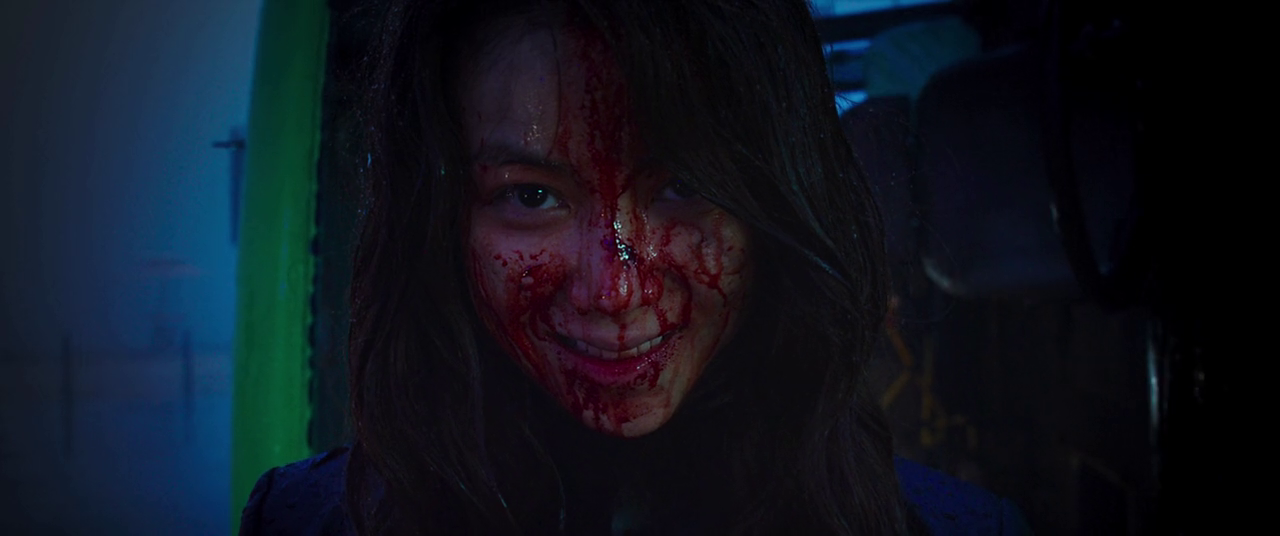
     Nevertheless, The Villainess is an extension of Nikita. What I mean by this is the fact that we get to know everything about Chae Yeon Soo through extensive flashbacks, whereas we know nothing about Nikita (apart from that she was named after a song). Nikita might as well have had exactly the same painful past as Chae Yeon Soo, but it did not haunt her afterwards. The most important bit about the two heroines are their attempts to regain normality. In the case of Nikita, she runs away because she has enough of killing (in fact, her last mission failed because another hitman wanted to solve everything with brute force). In the case of Chae Yeon Soo, she loses her husband and a child simply because she could not leave the past behind. As a result, she becomes an indestructible angel of vengeance (similar to the character played by Meiko Kaji in Lady Snowblood) in the epic finale. After killing the man who ruined her entire life, she turns into an antithesis of herself, she loses her normality (the state that Nikita wants to avoid). Chae Yeon Soo’s malevolent smile at the very end marks her transformation into the villainess…
     All things considered, The Villainess serves not so much as a remake but a companion piece to Nikita, showing what could happen to the archetypal lost woman if she had not run away. Evidently, both movies are about fallen heroines with guns who only wanted to lead a happy life. Actually, I am surprised that we have not been given proper sequels to these films. Perhaps it is best to leave the two heroines as they are.
     I very much recommend watching both movies. I personally like La Femme Nikita a tiny bit better, because it manages to achieve more with its subtlety. I hope that this extensive editorial was not an exhaustive read. I simply wanted to provide food for thought for viewers who also enjoy girls with guns flicks. Please share your thoughts in the comments. My thanks go to Seonsaeng from MyDramaList who kindly read the article and provided his feedback before the publication.
Sources: They Programmed Her to Kill: Black Cat, a Hong Kong remake of Nikita (2002) by Jeanne Deslandes * (Young) Sisters in Arms.Youthification and Femininization in Contemporary Action and Sci-Fi TV Series by Elisa Giomi * THE VILLAINESS Interview: Director Jung Byung-gil on the Stunts and Stars
«Enjoyed this post? Never miss out on future posts by following us»