Showing posts with label 1990. Show all posts

AD Police Files [OVA Review]

 AD Police Files; or, Stop! An officer will shoot

     At least she died as a woman.
The weather outside is as beautiful as ever this time of the year, so it makes me all the more surprised that I found myself in the mood for some gloomy cyberpunk feels. Needless to say, I decided not to look for the most popular instances of the genre recommended on the internet, but instead I went for something more obscure. As a result, I ended up watching AD Police OVA from the year 1990.
Release Info
Directed by: Akira Nishimori Voice actors: Toshio Furukawa, Youko Matsuoka
Language: Japanese Original Title: ADポリス No. of eps: 3
Synopsis
It’s the year 2027. The advancements in the field of cybernetics allow people to replace their organs with artificial substitutes. There are also fully automated androids known as Boomers. If Boomer goes haywire and commits a crime, they are chased by the special mad criminal investigation unit known as AD Police.
Blade Running

It should be noted that AD Police is a spin-off series of the Bubblegum Crisis franchise. Actually, the title card at the beginning of each of the three OVA episodes says directly “Another Story of Bubblegum Crisis”. The events of the OVA take place before the first series of Bubblegum Crisis and indirectly focus on the cop character of Leon McNichol and his partner Gina Marceau.
With regard to AD Police,I have to say that I really like the traditional animation style because it’s really evocative of its late 80s/early 90s era. In terms of the visuals themselves and storyline themes, however, you can’t help but notice the overwhelming influence of Ridley Scott’s Blade Runner. AD Police grows out of the world crafted by Phillip K. Dick in which the uniqueness of human life is constantly questioned amidst hordes of androids who also have their fair share of desires, fears, and personal introspection.
That being said, I kind of regret watching this OVA primarily because of its NSFW content. With each episode, things get so adult-oriented and explicit that by the end of it, I felt as if I was watching hentai. Sure, the plot of each episode is engaging enough, but the way these are handled leaves a lot to be desired.
Allegedly, there were supposed to be more episodes of the OVA, but the studios responsible for it fell into some sort of dispute. As a result, AD Police had its continuation years later in the form of another short-lived series and a reboot OVA. People responsible for the creation of AD Police were Tony Takezaki and Suzuki Toshimitsu, who also crafted a manga called AD Police: Shuuen Toshi.
Recommendations

All things considered, AD Police Files is a product of its time when there was a huge boom on cyberpunk in the anime industry. Some franchises grew larger than life and lived to tell the tale through decades (see Akira and Ghost in the Shell) but many weren’t so lucky, including AD Police. If you want to get some entertainment value from this, I suggest you watch the whole OVA series at one go in the middle of the night and crank up the volume for the intro song and ending songs. It’s a fairly nice schlock anime experience for one time.
Overall score: 5/10
«Enjoyed this post? Never miss out on future posts by following us»

Days of Being Wild (1990) [Film Review]

Days of Being Wild; or, As Minutes Go By
     I've heard that there's a kind of bird without legs that can only fly and fly, and sleep in the wind when it is tired. The bird only lands once in its life... that's when it dies.
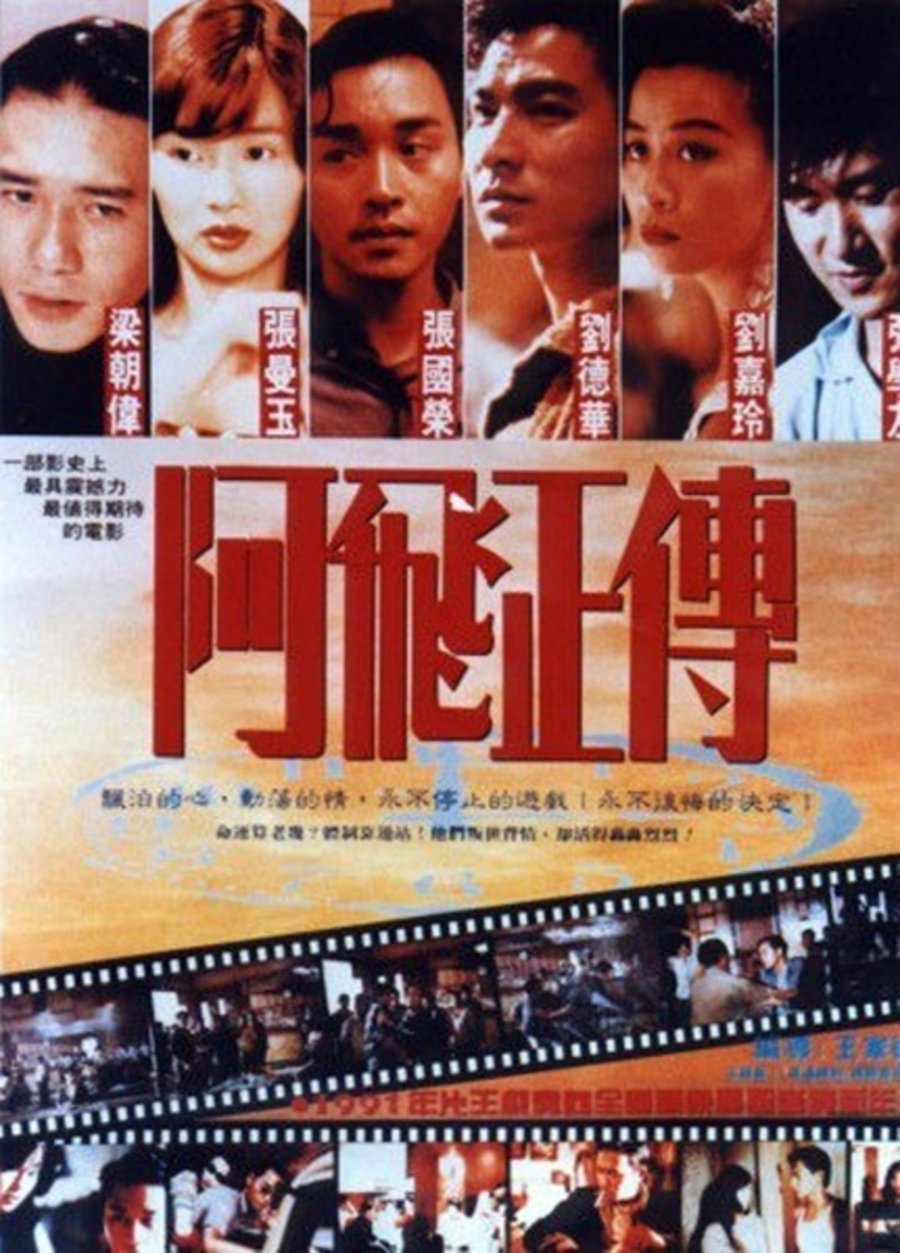
In the world of today, Wong Kar Wai seems to be one of the most undisciplined artists out there. In the 2010s, a lot of projects helmed by the director were announced but devoted fans still await their completion. Wong Kar Wai certainly does not care about production deals or shooting schedules. Indeed, his main concern is pursuit of inspiration, thanks to which he became a renowned auteur filmmaker. As a way of coping with my personal bout of melancholy, I decided to revisit his earlier movies, and today I would like to discuss Days of Being Wild.
Release Info
Directed by: Wong Kar Wai Starring: Leslie Cheung, Carina Lau, Maggie Cheung, Andy Lau, Jacky Cheung
Language: Cantonese Original Title:  阿飛正傳 Runtime: 94 min
Synopsis
Hong Kong, 1960. Yuddy (Leslie Cheung) seduces Li-zhen (Maggie Cheung) who works at a ticket stall, but he quickly breaks up with her. While standing in defence of his adoptive mother (Rebecca Pan), he meets a cabaret dancer Mimi (Carina Lau) who falls for him. Yuddy desperately wants to know the whereabouts of his biological mother and meet her. In the meantime, police officer Tide (Andy Lau) befriends Li-zhen, and Yuddy’s friend Zeb (Jacky Cheung) develops feelings for Mimi.
2 Lonely 2 Calm
I have been meaning to review Days of Being Wild for a long time; basically, ever since I saw it in 2015, but I was never sure my words would be sufficient enough to describe the film. It was the very first Wong Kar Wai movie I have ever seen, and in my opinion, it was a challenging introduction. It is clearly visible that the director was still playing with the language of cinema, looking for his personal style.
There is little dialogue in the film, and when it is present, it feels deeply poetic yet irrelevant. Wong Kar Wai, rather than telling, is showing to the audience what happens with the story of Yuddy, a young self-destructive nonconformist, a sigma male before being sigma was mainstream, who suffers from attachment issues.
It is really hard to sympathise with the main protagonist because of the way he treats people around him. He does not want to be loved, because he had not experienced motherly love, but it is almost as if he derives pleasure in degrading people and burning bridges behind him. All of the characters who interact with him: Li-zhen, Mimi, Tide, and Zeb are victims of his fatalistic attitude. This longing for love pushes them to question their own sense of identity.
I have to say that I enjoyed this movie more after rewatching it today than eight years ago. Evidently, my sensibilities and attention span have changed, but it does not change the fact that if you want to begin your own journey through Wong Kar Wai’s filmography, Days of Being Wild is not a good place to start. The film has sublime cinematography and top-notch ambience of Hong Kong of the 1960s, but you really have to focus on the story in order to get it.
With regard to performances, Leslie Cheung is (as always) amazing as the leading man. His presence is both charismatic and mesmerising throughout the entire film. The same can be said about Carina Lau who really gave a stand-out performance as an extroverted and emotionally-charged love interest. Maggie Cheung, Andy Lau, and Jacky Cheung are memorable in their supporting roles, even though their screen time is limited.
Last but not least, I have to address the handsome elephant in the room. That is to say, this movie ends with one of the most soothing scenes in the history of cinema. We see Tony Leung Chiu-Wai as an unnamed character who prepares for a gambling night. It is incredibly comforting just watching this man filling his pockets and having a smoke in a dilapidated apartment. Undoubtedly, the scene must have served as a lead-in for In the Mood for Love and we can only wonder how that film would have looked like had it been made immediately after Days of Being Wild.
Recommendations
All things considered, if you are new to Wong Kar Wai, then be wary of this film. However, if you are an old-timer who has already been through such classics as Chungking Express, Fallen Angels, and 2046, then Days of Being Wild is a perfect choice for you. Sometimes watching Wong Kar Wai’s films out of order is more rewarding than doing it chronologically.
Overall score: 7/10
«Enjoyed this post? Never miss out on future posts by following us»
Shuto Kousoku Trial 2 (1990) [Film Review]

Shuto Kousoku Trial 2; or, Gas Gas Gas
     It's the best! With GTR nobody will beat me!
After the troubled release of the original Shuto Kousoku Trial movie in 1988, Nikkatsu studio did not back down, and this time, they joined forces with the Drift King himself, Keiichi Tsuchiya, and Toei’s V-Cinema line in order to continue the series in straight-to-video format. Shuto Kousoku Trial may be a production made on a smaller budget and in 4:3 aspect ratio, but it still manages to retain the spirit of the original movie.
Release Info
Directed by: Shuji Kataoka Starring: Daisuke Nagakura, Arthur Kuroda, Naomi Ashizawa
Language: Japanese Original Title: 首都高速トライアル 2 Runtime: 67 min
Synopsis
Takahiro Yamane (Daisuke Nagakura) is a street racer who looks up to Japan’s all-time best driver, Keiichi Tsuchiya. Takahiro’s friend/ex-mentor is Junichi Tashiro (Arthur Kuroda), the proud owner of Skyline R30 who dreams of getting a GT-R. However, he gives up racing in order to marry his girlfriend, Nozomi (Naomi Ashizawa). Sawaki (Minoru Toyoshima) is a hot-headed racer who wants to break records on the Shuto Expressway. As a result, he challenges Takahiro as well as Junichi...
Skyline GT-R
Shuto Kousoku Trial 2 seems to owe its existence purely to Keiichi Tsuchiya and its anti-street racing message. Whereas the original praised the glory of midnight car chases, the sequel puts up a giant warning sign saying that if you want to become a professional driver, then you have to abide by the law and hone your skills on a race track rather than a city street. However, the movie is not all about preaching because it provides the much needed dosage of car action set to the beats of City Pop.
The first film focused primarily on Skyline R30, but Shuto Kousoku Trial 2 presents us with Nissan R32, 300ZX, and Silvia, all battling each other in epic style. For this film, J-singer Saori Sato provided the songs (which were subsequently released on her album called Lady). Apart from her cameo appearance (as herself giving the main protagonist a mixtape with her best hits), we can also see her performances of All Eyes and Naga-denwa no ballad themes intercut with the chase sequences. You really can’t get more 80s than that.
Interesting is also the role of Keiichi Tsuchiya who basically plays himself and always appears in the film’s calmest moments, just to give a word of advice to the main hero. Similarly to Obi-Wan Kenobi, he says that a driver should trust his feelings (and refrain from participating in illegal races).
With regard to performances, I know that you can’t expect a lot from these sequels which had relatively unknown actors, but I particularly liked the performance of Minoru Toyoshima as a girl who is enthusiastic about her boyfriend’s passion for driving. The final scene in which she waves a checkered flag between two speeding GT-Rs is so beautifully done.
Recommendations
If you can’t get enough of speed chills from Initial D, Wangan Midnight, and The Fast and The Furious, then turn to the series that started it all. No racing franchise has yet managed to surpass the class and practical car action of the Shuto Kousoku Trial movies.
Overall score: 7/10
«Enjoyed this post? Never miss out on future posts by following us»

Tiger Cage 2 (1990) [Film Review]

Tiger Cage 2: or, Midnight Run
     Do you even know where is the Caribbean Sea?
Director Yuen Woo-ping continues his series of dynamic thrillers about police officers with Tiger Cage 2, the movie that has absolutely nothing in common with the original Tiger Cage apart from the title and a couple of returning actors. This “sequel in name only” is considered by many fans of Hong Kong cinema as the cult classic due to relentlessly electrifying action set pieces and the presence of Doonie Yen as the male lead.
Release Info
Directed by: Yuen Woo-ping Starring: Donnie Yen, Rosamund Kwan, David Wu
Language: Cantonese Original Title: 洗黑錢 Runtime: 102 min
Synopsis
Mandy (Rosamund Kwan) is a lawyer at a prestigious company; however, she witnesses a brutal murder in the parking lot in the course of which a suitcase filled with money laundered by mobsters goes missing. The mobsters presume that Mandy may be in the possession of the money, so they go after her. Due to unexpected circumstances, the lawyer bumps into a hot-headed cop called Dragon (Donnie Yen). The two are framed for killing Mandy’s friend, Petty (Carol Dodo Cheng). As a result, Mandy and Dragon are on the run from the gangsters and the police. With the help of a fellow worker from the company, David (David Wu), the trio decides to find the money and clear their names.
Yes, Madam Goes Places
Tiger Cage 2 is a film produced by the famous D&B company and basically made by the same team of filmmakers who cooked up In the Line of Duty 4 (1989). Donnie Yen finally takes over the wheel as a leading man in this film and we see him battle such popular “bad guys” as Michael Woods and John Salvitti. Even Cynthia Khan herself makes a small appearance as Inspector Yeung. Apart from one nice chase scene, she does not have much to do in this film, but one has to appreciate her wardrobe (this casual white outfit is so slick!)
Yet, Cynthia Khan is not the only cutie who appears in Tiger Cage 2. Carol Cheng makes a surprise appearance as the love interest of the main villain, but she only has two scenes to play in. The real heroine of this picture is the beautiful Rosamund Kwan who portrays a standard damsel in distress with a baggage of foreseeable clichés. Nevertheless, it is a joy to see Donnie save her skin time and time again.
With regard to action, Yuen Woo-ping really tried to push the envelope with this project. In comparison with the original film, the fights are much bolder and bigger in scope. The sequences that stood out the most for me was the double-decker bus chase, Cynthia Khan vs. Leung Lam-Ling confrontation, and the epic sword fight between Donnie and John Salvitti. All of that coupled with synthwave-like music score by Richard Yuen amounts to a great viewing experience.
The only disadvantage of Tiger Cage 2 I can think of is a mediocre villain. Robin Shou is a very good actor but he is no match for the charismatic Simon Yam who dominated the first movie. I think someone like Andy Lau or Tony Leyng Ka-fai would have been a better choice.
Recommendations
If you like straightforward beat-em-ups, then I recommend Tiger Cage 2. In the Line of Duty 4 is a better cop film in my opinion, but this also a fine endeavour from director Yuen Woo-ping. Now, I’m off to check out Tiger Cage 3.
Overall score: 8/10
«Enjoyed this post? Never miss out on future posts by following us»

Boiling Point (1990) [Film Review]

Boiling Point; or, It’s not a Home Run
     Playing in such a dusty place… What a bunch of idiots!
Boiling Point marks Takeshi Kitano’s second directorial feature. Although Violence Cop (1989) and Sonatine (1993) gained popularity in the West, Boiling Point somehow drifted through unnoticed by the public. Nevertheless, it is still Kitano’s movie with all the recognisable trademarks of the director.
Release Info
Directed by: Takeshi Kitano Starring: Yurei Yanagi, Dankan, Takeshi Kitano, Yuriko Ishida, Eri Fuse
Language: Japanese Original Title: 3-4x10月 Runtime: 97 min
Synopsis
Masaki (Yurei Yanagi) is a player at a local baseball team. The boy is phlegmatic and inattentive but he stays out of trouble. However, he is attacked at a gas station by a yakuza member. Masaki seeks help at his baseball coach/former gangster, Iguchi. However the mentor’s intervention only brings further retaliation. Iguchi is badly beaten up by the yakuza. In an act of revenge, Masaki and his fellow teammate, Kazuo (Dankan) go to Okinawa to buy weapons with which they will kill the gangsters. While on Okinawa, they encounter Uehara (Takeshi Kitano) who turns out to be a sociopath desiring to settle the score with his local superiors.
Play Ball!
The original title of Boiling Point is actually 3 to 4x October which refers to the team’s score in the movie. Similarly to Kitano’s other productions from the 1990s, Boiling Point is also packed with black humour and unconventional narrative style.
To be honest, the movie feels like a collection of WTF moments. While watching it, you will learn how to (repeatedly) knock someone unconscious, how to kill a military officer in broad daylight, and how to smuggle weapons through airport service. Boiling Point seems to be lighter in its mood than Violent Cop, but it still contains nihilistic undertones about the cycle of violence and fragility of life.
That’s Takeshi Kitano for you. You know you should not be laughing at certain drastic moments, but you just can’t help yourself. I guess my favourite scene is the one in which Masaki tries to get a handgun to work, but he accidentally fires a bullet through a car windshield.
With regard to performances, Yurei Yanagai and Dankan really carry the film with their performances. Takeshi Kitano is, as always, too cool for school but I believe he did much better in Sonatine (1993) and Hana-bi (1997). If you are a fan of Satoshi Miki’s movies, then you will spot his wife, Eri Fuse in a supporting role. In addition, this film marked the debut of the wonderful Yuriko Ishida. She was only 20 years old!
Recommendations
If you are looking for low-key Kitano without too much blood, but a high level of black comedy, then Boiling Point is the movie for you. If you enjoy yakuza vibes, then give it a try. I’m surprised that the yakuza did not go after Kitano for the unfavourable portrayal of gangster life in Boiling Point. I guess they only hate Juzo Itami’s Minbo (1992).
Overall score: 7/10
«Enjoyed this post? Never miss out on future posts by following us»

A Chinese Ghost Story II (1990) [Film Review]

A Chinese Ghost Story II; or, To Hell and Back Again
     Mortals are forgetful. Good deeds fade like the wind. No matter what you've done, it's soon forgotten.
Needless to say, the enormous success of the first film inevitably led to the creation of the sequel. The year 1990 saw the release of A Chinese Ghost Story II. Apart from the return of the principal cast members, such stars as Jackie Cheung, Waise Lee, and Michelle Reis also appeared in the supporting roles.
Release Info
Directed by: Ching Siu-Ting Starring: Leslie Cheung, Joey Wong, Wu Ma, Jackie Cheung
Language: Cantonese Original Title: 倩女幽魂 II:人間道 Runtime: 104 min
Synopsis
After successfully freeing the soul of Nip Siu-sin, Ning Choi-san (Leslie Cheung) returns to his home village, but he is mistakenly taken to be a bandit and arrested by the local police. While in prison, he meets a scholar called Elder Chu (Ku Feng) who helps him escape. Due to a concurrence of many events, Choi-san encounters a Taoist monk, Autumn (Jackie Cheung), and a group of rebels led by Windy (Joey Wong). The woman bears a strong resemblance to Nip Siu-sin, so Choi-san thinks that she may be a reincarnation of his dearly beloved. The rebels attempt to free Windy’s father who was sentenced to death by the Emperor. Nevertheless, in the course of their struggle, the heroes have to face a demonic villain known as the High Priest (Lau Shun).
The Ethereal Spirit of a Beauty Returns
A Chinese Ghost Story II can be labelled as a mix between The Naked Gun (1988) and Van Helsing (2004). In order to be more family-friendly, the picture done away with the erotic NSFW sequences from the first film and significantly toned down the gore factor. As a result, the story relies a lot on comic relief (slapstick, characters making false assumptions on one another, etc.) This does not mean; however, that A Chinese Ghost Story II is a bad sequel.
While being noticeably inferior to the first one, it is still an entertaining and action-packed story with many breathtaking scenes (for example, the arrival of the High Priest, possession of Windy, or explosive showdown at the monastery). In addition to this, the special effects are just top notch across the board: from elaborate prosthetics through wire work to visual compositing. What is more important, the character of Ning Choi-san was finally given a happy ending.
As surprising as it may seem, the main theme song of the second picture was pulled from Apple Music and Weibo services in China due to (allegedly) containing vague references in its lyrics to the Tiananmen Square Massacre.
Recommendations
If you enjoyed the original film, then A Chinese Ghost Story II will not disappoint you. Check it out for great cinematography and the amazing Leslie Cheung/Joey Wong chemistry. Now, I'm off to A Chinese Ghost Story III.
Overall score: 8/10
«Enjoyed this post? Never miss out on future posts by following us»

The Burden of Suffering: Comparing La Femme Nikita (1990) and The Villainess (2017) [Editorial]

Disclaimer: The following editorial is filled with spoilers of both movies. Read it only if you have seen the films.

     Don’t forget… There are two things that have no limit: femininity and the means of taking advantage of it.~ La Femme Nikita

     Let me show you… what you made me into.~ The Villainess

Every self-respecting moviegoer is most probably aware of the fact that strong heroines have been present on the silver screen for decades, not several years. The 1970s as well as the 1980s gave us a whole slew of tough and badass female characters, from the West as well as from the East. Interestingly, European Cinema never quite engaged into “Girls with Guns” craze, and perhaps its only worthwhile interjection into the matter is Luc Besson’s La Femme Nikita from 1990.
     The young and confident director was at the top of his game in the 1980s, effectively changing the face of French cinema which was suffused with art-house style and theatricality at that time. By emphasising the visuals and style rather than proper narrative (see Cinema du look movement), Besson created such modern classics as Subway (1985), The Big Blue (1988), and, of course, La Femme Nikita (1990).
     Somewhat forgotten today, the movie about a young woman turned spy became an important cultural phenomenon. If you ask anybody today about “Nikita”, they will most certainly associate the title with one of the American TV shows or even a John Badham movie. Indeed, Besson gave Europeans their own “girl with a gun” but she was immediately snatched by Hollywood and incorporated into the American mainstream. Nevertheless, the archetypal figure of a non-conforming woman forced to serve the state, and who tries to find happiness, proved to be pervasive in culture. While Hollywood was busy with the remakes, Hong Kong already made their own version of Nikita in 1991. Black Cat with Jade Leung ticks all the major plot points from the original film while also adding tropes of an exploitation flick and underlining the anti-authority message (Black Cat is actually controlled by the CIA via microchip).
     Yet, the incarnations of Nikita with Bridget Fonda, Jade Leung, Peta Wilson, and Maggie Q, do not mark the end of fascination with this character. A 2017 South Korean production The Villainess was openly advertised as a movie inspired by La Femme Nikita; however, I believe that the movie is not so much a remake but a companion piece to Nikita.
     The fans have spotted references to Kill Bill (2003), The Raid (2011), and Hardcore Henry (2015), but director Jung Byung-gil acknowledged that The Villainess is first and foremost an homage to La Femme Nikita. Having watched the two movies back-to-back, I was surprised by the fact that The Villainess does not simply retell the events of Nikita but also comments on them and builds on the character of the original heroine.
     Firstly, let’s take a closer look at La Femme Nikita: The movie starts with a bunch of hoodlums who rob a pharmacy. It turns out that our soon-to-be heroine is a drug addict who is on such an acid trip that she actually shots a police officer point blank in the head. Nikita is rightfully sentenced in the court of law, and two men approach her in a cell with an injection. Nikita breaks down because she is convinced that she is about to be euthanized. Actually, she’s only sedated and wakes up in a white room where she is greeted by a man called Bob. He explicitly tells her that the government fakes the deaths of worthless criminals and turns them into spies. Evidently, Nikita is very reluctant about the whole concept and tries to break away, but Bob eventually manages to mould her into a professional agent. Nikita is given a new identity and she is allowed to lead a normal life, on condition that she will always perform secret assignments.
     According to researcher Jeanne Deslandes, La Femme Nikita is a film about going back to the state of normality. We see the main heroine as a social wreck at the very beginning, but she is salvaged by Bob (a representative of the French secret police, we could say) who offers her a second chance in life. Ironically, Nikita gets more than she bargains for. That is to say, whenever something pleasant happens to her, bad things immediately strike as well. For instance, on her 23rd birthday, Bob takes Nikita to a restaurant only to give her a gun and target details. In addition, when Nikita spends a honeymoon with her beloved husband Marco, she is ordered to take down yet another target. In consequence, the heroine is unable to have a happy life because of the very same authorities who gave her a fresh start. When a mission concerning economic espionage goes terribly wrong (not out of Nikita’s fault), she is completely burnt out and, with the blessing of her husband, she runs away (hopefully, trying to regain her normality).
     Now proceeding to The Villainess: The movie has a similar structure and premise of Nikita, but the main character is quite different. Sook Hee is arrested and subsequently turned into a spy by the Korean secret police not because she is a lowlife, but because of her extraordinary abilities. At the very beginning, we see her slashing her way through hordes of expendable baddies and surviving the bombastic ordeal simply because she’s driven by the desire to avenge the death of her father. In a series of flashbacks, it is revealed that Sook Hee’s father was killed because of a stolen diamond. His friend betrayed him but the real killer remains unidentified. Sook Hee was sold to human traffickers, but she was unexpectedly saved by a professional hitman. Cue to present day, Sook Hee is trained by the authorities and given the identity of Chae Yeon Soo. Together with her little daughter, she moves into an apartment and eventually marries a goofy but kind neighbour, Jung Hyun Soo. In the course of her assignments, she comes face to face once again with the hitman who saved her years ago.
     I admit that it is a fool’s errand to correctly summarise The Villainess from beginning to the end because there are tons of subplots happening in this movie. Nevertheless, here are the interesting contextual parallels between the two films:
     For example, Nikita and Sook Hee (amazing Anne Parillaud and Kim Ok Bin, respectively) are so feisty and spirited that they unsuccessfully attempt to escape the containment facility. This is of course a mutual plot point, but each character also sheds their old identity in a unique way. On the one hand, Bob takes away Nikita’s hoodlum clothing as if to symbolically distance her from the old days of being reckless. On the other hand, Sook Hee undergoes a plastic surgery and receives the new name of Chae Yeon Soo and a vocation: an actress. Both tricks seem to work as the heroines proceed with their training.
     Additionally, the mentor figures are also quite interesting (brilliantly played by Tcheky Karyo and Kim Seo Hyung, respectively). Bob is very friendly towards Nikita and he even pretends to be an uncle in front of her husband. Nevertheless, the most appropriate way to describe Bob is to call him a demon, simply because he owns Nikita’s soul. After Nikita’s attempt to free herself from his grasp, Bob’s smile towards the end of the film is more than unnerving. In turn, Kwon Sook in The Villainess performs exactly the same function (Sook Hee/Chae Yeon Soo is an investment that needs to follow orders), though she never becomes a friend.
     Furthermore, it is also intriguing how the characters of husbands (wonderful Jean-Hugues Anglade and Sung Joon, respectively) were handled. Marco in Nikita is a perfect Mr Nice Guy (quiet, caring, understanding). Although he seems to be oblivious to Nikita’s activities, it is revealed at the end that he figured it all out. As for Jung Hyun Soo in The Villainess, he is a government officer who genuinely falls for Chae Yeon Soo. Even though Jung dies while protecting her daughter, I think that Marco’s character has a stronger impact on the story. He is an average guy on whom the viewers can fall back (the bathroom scene is so powerful just because of his presence), whereas the presence of Jung Hyun Soo serves to elicit a melodramatic effect (boosting Chae Yeon Soo’s need for vendetta).
     Speaking about melodrama, The Villainess attempts to emotionally invest the viewer into the story with the usage of overt plot twists and stunning action set pieces. The plot twists about a lover who turned out to be the killer of Hee’s father makes the film venture into the territory of Luc Besson's other popular film, Leon (1994), but does not quite manage to bring the story of an assassin good at heart together with that of a female spy.
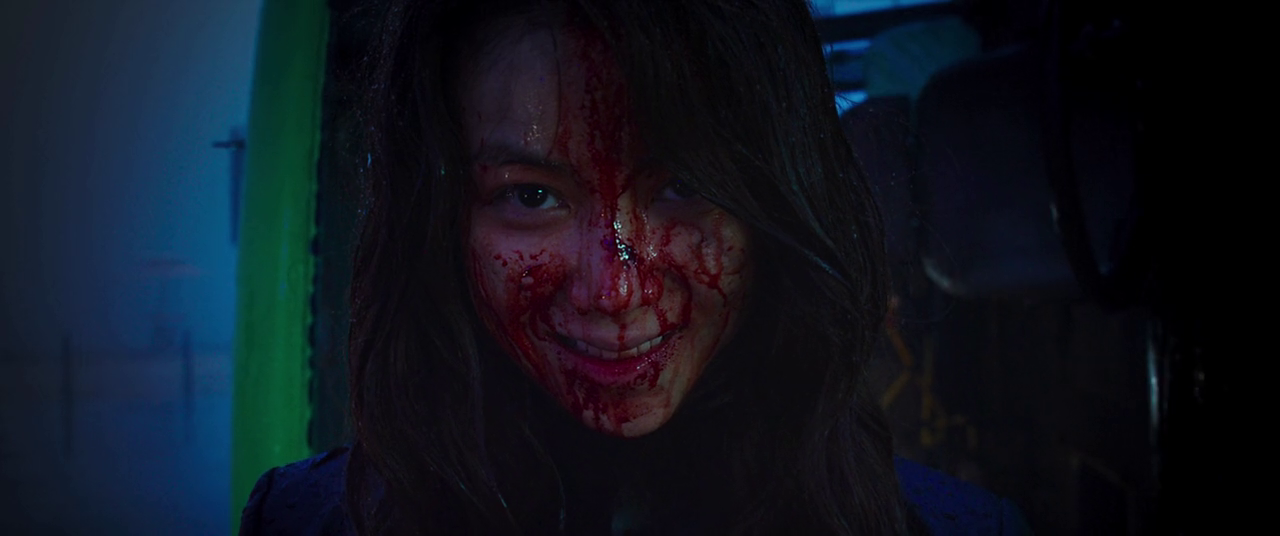
     Nevertheless, The Villainess is an extension of Nikita. What I mean by this is the fact that we get to know everything about Chae Yeon Soo through extensive flashbacks, whereas we know nothing about Nikita (apart from that she was named after a song). Nikita might as well have had exactly the same painful past as Chae Yeon Soo, but it did not haunt her afterwards. The most important bit about the two heroines are their attempts to regain normality. In the case of Nikita, she runs away because she has enough of killing (in fact, her last mission failed because another hitman wanted to solve everything with brute force). In the case of Chae Yeon Soo, she loses her husband and a child simply because she could not leave the past behind. As a result, she becomes an indestructible angel of vengeance (similar to the character played by Meiko Kaji in Lady Snowblood) in the epic finale. After killing the man who ruined her entire life, she turns into an antithesis of herself, she loses her normality (the state that Nikita wants to avoid). Chae Yeon Soo’s malevolent smile at the very end marks her transformation into the villainess…
     All things considered, The Villainess serves not so much as a remake but a companion piece to Nikita, showing what could happen to the archetypal lost woman if she had not run away. Evidently, both movies are about fallen heroines with guns who only wanted to lead a happy life. Actually, I am surprised that we have not been given proper sequels to these films. Perhaps it is best to leave the two heroines as they are.
     I very much recommend watching both movies. I personally like La Femme Nikita a tiny bit better, because it manages to achieve more with its subtlety. I hope that this extensive editorial was not an exhaustive read. I simply wanted to provide food for thought for viewers who also enjoy girls with guns flicks. Please share your thoughts in the comments. My thanks go to Seonsaeng from MyDramaList who kindly read the article and provided his feedback before the publication.
Sources: They Programmed Her to Kill: Black Cat, a Hong Kong remake of Nikita (2002) by Jeanne Deslandes * (Young) Sisters in Arms.Youthification and Femininization in Contemporary Action and Sci-Fi TV Series by Elisa Giomi * THE VILLAINESS Interview: Director Jung Byung-gil on the Stunts and Stars
«Enjoyed this post? Never miss out on future posts by following us»